The Azores in Summer: A Season Overview
Is summer a good time to visit the Azores?
Yes — June to September brings the mildest, driest weather of the year, the best hydrangea colour, and the busiest boat and hiking season. It is not a guaranteed-sunshine climate, so plan for changeable days even in August.
Ask anyone who has already been to the Azores in July or August what surprised them, and weather comes up almost every time — not because it was bad, but because it refused to stay one thing for long. Summer here is the busiest, driest, and most colourful stretch of the year, and it is also still an Atlantic archipelago, not a Mediterranean island. If your dates are already fixed for June through September, this page gives you the season-wide picture — climate, crowds, hydrangeas, and the activities that make the most sense — before you move on to more specific guides on exact months, whale timing, or hydrangea peaks.
What Summer Weather Actually Looks Like
The Azores sit in the middle of the North Atlantic, warmed and steadied by the Gulf Stream, so the gap between winter and summer temperatures is smaller here than on mainland Portugal. Daytime highs in June through September generally run from the low twenties into the mid-twenties Celsius, occasionally touching higher on a still, sunny afternoon in São Miguel or Terceira. That mildness is the good news. The less obvious news is humidity and cloud cover, which stay elevated across the archipelago all year, summer included.
Locals sum it up with a phrase worth repeating before any Azorean trip: “four seasons in one day.” A bright morning can give way to drifting fog on higher ground by midday, a short burst of rain in the early afternoon, then clear skies again by evening — all in the same island, sometimes the same valley. July and August are, on average, the driest and sunniest months of the year across the islands, but “driest” is a relative, statistical claim, not a promise.
Do not build a summer Azores itinerary around the assumption of a dry, Mediterranean-style stretch of guaranteed sunshine; that expectation, more than any single island’s terrain, is the thing that catches first-time visitors off guard. For a fuller month-by-month breakdown of temperatures and rainfall, see our month-by-month weather guide, and for how summer compares with the rest of the year, our best time to visit overview covers the full annual picture.
Fog deserves its own mention because it affects planning more than rain does. Altitude brings cloud in fast, especially on the crater rims of Sete Cidades, the upper slopes of Pico, and the ridge trails of São Jorge. A viewpoint that was clear at nine in the morning can be socked in by eleven. Build flexibility into any day that depends on a specific view or summit, and treat a clear early start as an opportunity rather than a guarantee that holds all day.
Crowds and Prices in the High Season
Summer is, unambiguously, high season across the Azores. Flights from mainland Europe and North America fill up further in advance, car rental rates climb and availability tightens on every island, and popular restaurants — particularly ones serving cozido das Furnas at lunchtime — can be fully booked days ahead in July and August. Whale-watching boats, Pico ascent slots through the Casa da Montanha, and thermal pools like the Poça da Dona Beija all see their heaviest demand of the year in this window.
None of this makes the Azores feel overrun the way some Mediterranean destinations do in August — the archipelago’s total visitor numbers are modest by European standards, and even São Miguel rarely feels crowded outside a handful of specific spots at midday. But it does mean advance planning matters more here in summer than in any other season.
See our guide to booking tours in advance for a sense of realistic lead times, and rent your car as early as you can through our car rental guide — a car is close to essential for exploring any island beyond its main town, since inter-village public transport is limited and each island’s rental market is separate from the others.
| Aspect | Summer (Jun–Sep) | Rest of the year |
|---|---|---|
| Flights & car rental | Highest demand, book early | More availability, often cheaper |
| Whale-watching boats | Busiest, dolphins and sperm whales reliable | Quieter; spring adds migratory great whales |
| Hydrangea bloom | Peak (Jul–Aug) | Sparse outside Jun–Sep |
| Restaurant bookings | Advance reservation recommended | Easier walk-in options |
| Weather pattern | Mildest, driest on average, still changeable | Wetter, cooler, equally variable |
Hydrangeas Without the Guesswork
The Azores’ hedgerow hydrangeas — blue, sometimes pink, lining roadsides and pasture boundaries across nearly every island — are one of the season’s signature images, and summer is when they look their best. Flowers typically begin opening in May and June, reach full bloom through July and August, and start to fade toward the end of summer. An early-June arrival may catch the hedges only starting to colour; a late-September visitor is more likely to see spent, browning blooms than the postcard version.
If your trip sits squarely in July or August, you are in the right window without needing to plan around it further; if your dates fall closer to the edges of summer, our dedicated hydrangea season guide and hydrangea locations guide go into the week-by-week detail this overview does not.
Whales, Dolphins, and What Summer Changes
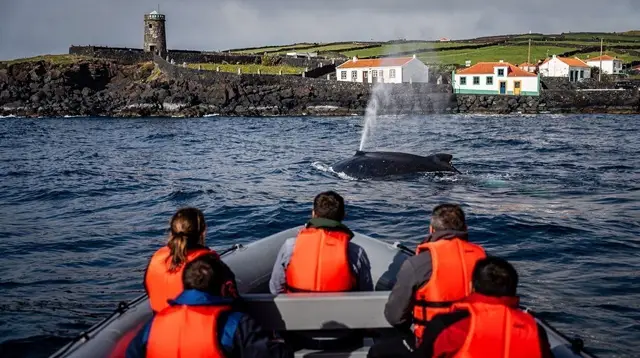
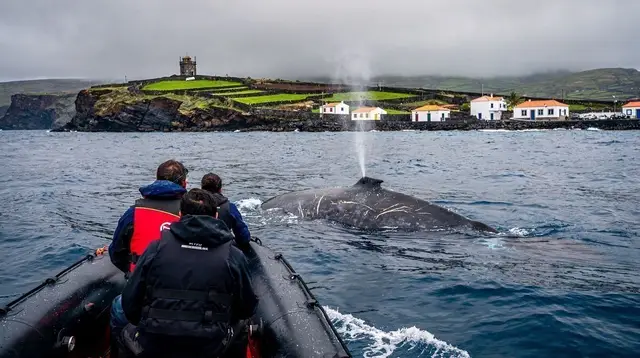
Summer is a strong season for whale watching in the Azores, but it is worth being precise about which animals that applies to. Resident species — sperm whales above all, along with common and bottlenose dolphins — are seen through most of the year, summer included, and remain the backbone of a typical outing.
The large migratory whales, though, including blue and fin whales, pass through mainly in spring rather than summer; expecting a summer trip to guarantee a blue whale sighting is a common and avoidable disappointment. No operator, in any season, can promise a sighting — reputable companies quote high but not perfect success rates, and use land-based lookout spotters, a tradition rooted in Pico’s whaling history, to guide boats toward animals rather than searching blind.
For the detailed seasonal breakdown of which species show up when, our whale season guide is the page to read next. For choosing between boat types and operators, see whale watching in the Azores and the best island for whale watching.
a sunset boat tour along the coast pairs well with a summer evening, when the longer daylight hours stretch the golden light out well past eight o’clock on most islands.
Best Activities for the Summer Months
Long daylight hours, calmer sea states on average than in winter, and the mildest air temperatures of the year make summer the strongest season for a specific set of activities — mostly ones that put you on or in the water, or out on a trail for a full day without racing the sunset.
On the water. Sea conditions are generally at their calmest in summer, which widens the window for coasteering, snorkelling, and boat-based trips. In São Miguel’s Caloura area, a coasteering trip along the Caloura coastline takes advantage of exactly those calmer summer swells, while a broader Azores coasteering outing works well as a first taste of the archipelago’s volcanic coast for visitors based elsewhere on São Miguel.
If you’d rather fish than swim, a half-day fishing trip takes advantage of the same settled summer sea state.
Surfers should note that the swell picture in the Azores runs opposite to what many expect: summer tends to bring smaller, more forgiving waves, which makes it a sensible season for a beginner surf lesson rather than for chasing the biggest swells. Our surfing guide and natural swimming pools guide cover more options for a water-focused summer trip, and best beaches in the Azores rounds up where to swim on each island.
On land. Long, dry-ish days suit full-day hikes and multi-stop road trips better in summer than in the shorter, wetter months. A guided 4WD tour through the Furnas valley covers the thermal pools, the Terra Nostra gardens, and the cozido tradition in a single outing without you needing to plan the logistics yourself, and works especially well on a day when higher-altitude viewpoints elsewhere on the island are fogged in.
If your summer trip includes Pico, a guided island tour of Pico is a practical way to see the UNESCO-listed vineyard landscape, the old whaling port of Lajes do Pico, and the lower slopes of the mountain without arranging transport between stops on your own — useful in a season when rental cars island-wide are in tighter supply. For self-guided walking, our best hikes in the Azores and São Jorge fajã hikes guides suit the long summer daylight well; just keep an eye on ridge-line fog as described above.
Slower options. Not every summer day needs to be active. A visit to the Gorreana tea plantation or a half-day dairy farm tour gives a lower-key look at the agricultural side of the islands, and both work regardless of what the sky is doing that afternoon.
Island by Island: Where Summer Suits Best
Inter-island transport is the one factor that changes meaningfully by season, and it is worth knowing before building a multi-island summer itinerary. The ferry and flight network connecting the core of the archipelago runs at its fullest in summer: the “Triangle” of Pico, Faial, and São Jorge is well served year-round, but the wider central-group network reaching Terceira and Graciosa by ferry operates only from roughly June to September — meaning summer is actually the easier season to island-hop by boat in that group, not a season where it’s harder.
Flores and Corvo connections remain the most weather-sensitive in the archipelago even in the calmer months, so build a buffer day into any itinerary that includes them.
For a base with the widest range of summer activity, São Miguel and its main town Ponta Delgada offer the broadest single-island mix of thermal pools, boat trips, and day-tour options. If your interest leans toward the UNESCO-listed vineyard landscape and the whaling history around Pico, pairing it with Faial via the short Madalena–Horta ferry crossing is a reliable summer combination. Our seven-day, two-island itinerary and Pico–Faial day trip by ferry guide both build around exactly this kind of pairing.
Practical Notes for a Summer Trip
A few practicalities are specific enough to summer that they’re worth flagging directly, rather than leaving to a general packing list.
- Layer for the evening, not just the day. Twenty-three or twenty-four degrees at midday can drop noticeably once the sun goes down, especially near the water or up on higher ground — a light jacket earns its space in a summer bag here more than it would on a Mediterranean island at the same latitude in June.
- Bring a rain layer even in August. The four-seasons-in-a-day pattern does not pause for peak season. A packable rain shell costs little luggage space and saves an otherwise good day.
- Book ahead more than instinct suggests. Flights, rental cars, whale-watching seats, and Pico ascent slots through the Casa da Montanha all tighten in July and August specifically; the general advance-booking guidance in booking Azores tours in advance is worth taking seriously in this window.
- Dark swimwear near iron-rich thermal water. Even though this is a summer activity peak, the practical warning at spots like the Poça da Dona Beija holds all year: the iron content stains light-coloured fabric.
- Check our full checklist. For everything else — from footwear to power adaptors — see the Azores packing list.
Taken together, summer in the Azores rewards travellers who plan ahead on logistics and stay flexible on weather, rather than those expecting a fixed, sunny script. Get the bookings sorted early, keep a rain layer within reach, and the season delivers the best hydrangea colour, the widest activity choice, and the easiest inter-island connections of the year.
Frequently Asked Questions About Visiting the Azores in Summer
Is summer the best time to visit the Azores?
It’s the most popular and generally driest window, with long daylight hours and the widest choice of boat trips and guided hikes. Spring and early autumn are quieter and cheaper, with similar unpredictability, so “best” depends on your priorities more than the calendar.
Does it rain a lot in the Azores in summer?
Less than in winter, but rain and cloud are still possible on any given day. The local saying about four seasons in one day applies year-round, including July and August, so pack for a shower even on a sunny forecast.
Will I see hydrangeas in the Azores in summer?
July and August are the peak bloom months across most islands, after flowers start opening in May and June. Early June arrivals may see fewer open blooms, and by late September the hedges are past their best.
Is summer the best time for whale watching in the Azores?
Summer is reliable for resident species like sperm whales and dolphins, but the great migratory whales such as blue and fin whales pass mostly in spring. No operator can guarantee a sighting on any given outing.
Do I need to book tours and accommodation in advance for summer?
Yes. July and August are the busiest months for flights, car rental, whale-watching boats, and popular restaurants, and availability tightens noticeably compared to the rest of the year. Booking several weeks ahead is the safer approach.
Is it hot in the Azores in summer?
Summer daytime temperatures typically sit in the low-to-mid twenties Celsius, mild by Mediterranean standards and cooled by the Atlantic and the Gulf Stream. Evenings can turn noticeably cooler, especially near the coast or at altitude.
Which islands work best in summer?
São Miguel, Terceira, and the Pico-Faial-São Jorge “Triangle” are the easiest to combine in summer thanks to more frequent inter-island transport. Flores and Corvo remain worthwhile but their connections stay weather-dependent even in the calmer months.
Seasonal experiences on GetYourGuide
Verified deep-linked GetYourGuide tours. Book through these links and we earn a small commission at no cost to you.
GetYourGuide does not provide a product photo for this activity — the image shows the meeting point, photographed by us.