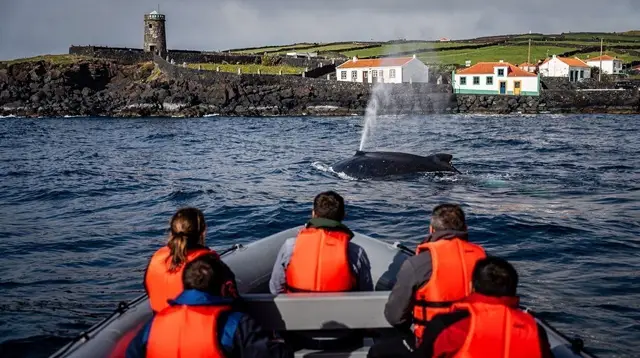
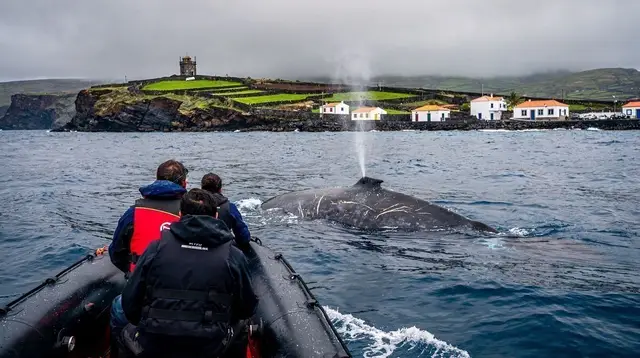
When to See Whales and Dolphins in the Azores: A Month-by-Month Calendar
When is whale watching season in the Azores?
Sperm whales and dolphins are present in Azorean waters most of the year, while the large migratory rorquals — blue, fin, and sei whales — pass through mainly between March and May. No sighting is ever guaranteed on any given trip, whatever the month.
Two Very Different Calendars, One Ocean
Ask ten people when to see whales in the Azores and you will get ten different answers, and most of them will be half right. That is because “whale season” in this archipelago is really two overlapping calendars stitched together. One calendar belongs to animals that live here more or less all year — the sperm whale above all, along with resident pods of common dolphins and bottlenose dolphins. The other belongs to travellers passing through: the great migratory rorquals, chiefly blue, fin, and sei whales, which move through Azorean waters for a few concentrated weeks and then continue north toward colder feeding grounds.
Confusing the two calendars is the single most common mistake in trip planning here. A visitor who books an August week hoping for a blue whale will likely be disappointed, even though August is an excellent month for sperm whales and dolphins. A visitor who assumes “spring means everything is possible” will do better, but should still understand that spring is a migration window with edges, not a fixed date on the calendar.
This guide sets out what is realistically visible, month by month, and why the two calendars do not move together. For the practical side of a boat trip — how it runs, what to bring, and how operators work with the old land-based lookout network — see our separate guide to whale watching in the Azores. For choosing between islands rather than months, see which island is best for whale watching.
The Residents: Sperm Whales, Dolphins, and Why They Stay
Sperm whales are the animal most associated with Azorean waters, and for good reason: the seabed here drops steeply into deep water close to shore, giving sperm whales access to the squid they hunt at depth without a long crossing from the coast. Sightings of sperm whales are reported in nearly every month of the year, which is why biologists and operators describe the population as resident rather than migratory, even though individual animals do move in and out of the area.
Dolphins tell a similar story with some seasonal shading. The common dolphin and the bottlenose dolphin (grand dauphin) are seen across the calendar, often in large, active pods that ride a boat’s bow wave. The Atlantic spotted dolphin is more of a warm-season visitor, more frequently reported from late spring through summer than in winter. None of these species require the visitor to time a trip to a narrow window the way the migratory whales do — this is why a July or September trip can still deliver a strong dolphin encounter even outside the spring migration.
The Migrants: Blue, Fin, and Sei Whales in Spring
The animals that genuinely demand a calendar decision are the large baleen whales — rorquals — passing through on migration. Blue whales, fin whales, and sei whales are not residents of Azorean waters; they use the area as a corridor on a longer journey, generally reported most often from March through May, with April frequently the strongest single month in operator and researcher reports. Outside that window, sightings of these species drop sharply, and by mid-summer they are, for practical purposes, gone from the itinerary.
This is the fact most worth repeating to a reader still choosing dates: summer is not blue whale season in the Azores, whatever a stray listing or an outdated blog post might suggest. Summer is dolphin and sperm-whale season. The spring migration is a distinct, narrower event, and travellers whose primary goal is a rorqual sighting should build their trip around March, April, or May — accepting that even within that window nothing is promised on any single day at sea.
Month by Month
The table below summarises realistic expectations. It reflects patterns reported across recent seasons, not a fixed schedule nature is obliged to follow — treat every row as a probability, not a promise.
| Month | Sperm whales | Dolphins | Large rorquals (blue, fin, sei) | Notes |
|---|---|---|---|---|
| January | Present, fewer trips run | Present | Very rare | Rough seas cut sailing days |
| February | Present, fewer trips run | Present | Rare, migration building | Weather still limits outings |
| March | Present | Present | Migration begins | Early rorqual arrivals possible |
| April | Present | Present | Peak migration | Often cited as the strongest month |
| May | Present | Present, spotted dolphin returning | Migration tapering | Still a strong month for rorquals |
| June | Present | Present, active | Uncommon | Focus shifts to residents |
| July | Present | Present, spotted dolphin common | Very rare | Reliable seas, resident species strong |
| August | Present | Present, spotted dolphin common | Very rare | Peak tourist season, strong resident sightings |
| September | Present | Present | Very rare | Good sea conditions continue |
| October | Present | Present | Rare | Seas beginning to roughen |
| November | Present, fewer trips run | Present | Very rare | Wetter, windier month |
| December | Present, fewer trips run | Present | Very rare | Quietest month for boat trips |
Two things are worth reading out of this table beyond the individual rows. First, sperm whales and dolphins never truly disappear, so a trip built around other priorities — a wedding date, school holidays, cheaper flights — is not automatically a wasted trip for cetacean sightings. Second, the rorqual column has a real shape: near-zero outside March–May, rising sharply into April, and falling away again by June. There is no secret back door into a July blue whale.
Spring in Detail: What Makes March–May Different
Spring’s advantage is not only the presence of migrating rorquals but also a favourable overlap: sperm whales and dolphins are still fully present, so a spring boat trip is effectively stacking two calendars into one outing. A vigia spotting a blow on the horizon in April genuinely does not know in advance whether it belongs to a resident sperm whale or a passing blue whale, and that uncertainty is part of what makes the season exciting for repeat visitors.
The trade-off is sea conditions. Late winter and early spring can still bring the Atlantic’s fast-moving fronts through, and a scheduled morning trip can be postponed for safety with little notice. Anyone planning a spring visit specifically for the migration should build in flexibility — an extra day or two rather than a single non-refundable morning — since a cancelled sailing on the one day allotted for whale watching is a common and entirely avoidable disappointment. This flexibility question is closely tied to weather patterns covered in our month-by-month Azores weather guide and in the seasonal breakdowns for spring and early summer.
Several operators run spring-specific trips out of Pico and São Miguel; one option covering the wider migration window is the Pico Island boat tour that looks for both resident and migratory species, and travellers based near Ponta Delgada can look at the São Miguel whale and dolphin watching outing that runs through the same spring window.
Summer and Early Autumn: The Reliable Season for Residents
From June through September, sea conditions in the Azores are at their calmest and most predictable, and boat operators run the fullest schedules of the year. This is when sperm whale sightings tend to feel most consistent to visitors, not because the whales are more numerous, but because more trips go out and stay out longer in good weather. It is also the strongest window for the Atlantic spotted dolphin, alongside the common and bottlenose dolphins present all year.
If the primary goal is simply “see cetaceans in the Azores” without a specific species requirement, summer is arguably the lowest-risk choice of the whole calendar — good weather, frequent departures, and multiple resident species reliably present. What summer will not deliver, barring an unusual straggler, is a blue, fin, or sei whale; readers weighing that trade-off against summer’s other advantages (long days, warmer water, busier festivals) may find it useful to compare seasons directly in our guide to summer versus winter in the Azores.
A trip that pairs whale watching with a wider look at the ocean and the coastline works well in this window — for instance the islet boat tour with an onboard marine biologist, which folds cetacean spotting into a broader look at Azorean marine life, or a late-afternoon boat trip timed around sunset for travellers who prefer calmer evening seas.
Winter: The Quiet Months
December through February are the months least represented in whale-watching itineraries, and for a straightforward reason: rougher Atlantic seas cut into the number of days boats can safely sail, not into whether sperm whales are present. Sperm whales and dolphins remain around the islands through winter, but fewer confirmed sightings are logged simply because fewer trips run. Anyone visiting in winter for other reasons — off-season prices, fewer crowds, a quieter Ponta Delgada — should treat a whale sighting as a pleasant possibility rather than build the trip around it.
The Vigias: A Whaling-Era Tool Still at Work
Long before whale watching existed as a tourist activity, the Azores ran a whaling industry built around vigias — lookout posts perched on high coastal points, staffed by watchers trained to spot the distinctive blow of a surfacing sperm whale from a long distance. When a vigia spotted a whale, a signal (originally a flag or a rocket, later a radio call) sent whaling boats out from shore toward the animal’s position.
That same infrastructure and skill set did not disappear when Azorean whaling ended; it was repurposed. Today’s vigias are staffed by trained spotters or biologists who use the same elevated vantage points to track whale and dolphin positions and radio them to whale-watching boats, dramatically improving the odds of a fast, well-aimed approach rather than a slow search across open water.
Lajes do Pico, on the island of Pico, is the port most closely tied to this whaling history and remains a natural reference point for operators still working with land-based spotting today. For the fuller history behind this shift from hunting to observation, see our guide to Azorean whaling history; for how a modern trip actually uses this system on the water, see whale watching in the Azores.
Why No Sighting Is Ever Guaranteed
It bears repeating plainly, because it is the detail most often smoothed over in marketing copy: no whale-watching trip in the Azores, at any time of year, guarantees a sighting. Operators frequently cite sighting rates in the high nineties as a season-wide average, and that figure is broadly credible — but it describes a full season of trips across all species, not a promise for one specific outing on one specific morning, and certainly not a guarantee of seeing a particular species like a blue whale on a chosen date.
Sea conditions, cloud cover, the animals’ own unpredictable movements, and simple chance all play a role on any given day. A visitor who books a single morning in April specifically hoping for a blue whale is playing reasonable odds, backed by real seasonal data — but odds all the same, not a certainty. Building in a spare day, keeping expectations grounded in “likely” rather than “guaranteed,” and treating any sighting as a genuine highlight rather than an assumed outcome will make for a far better trip regardless of the month chosen.
Putting a Month on the Calendar
For a reader who has not yet fixed travel dates, the decision usually comes down to one question: is a large migratory whale — blue, fin, or sei — a must-see, or would resident sperm whales and dolphins satisfy the goal on their own?
- If a large rorqual sighting matters most, March through May is the only realistic window, with April the month most often singled out. Build flexibility into the schedule for weather.
- If the goal is simply a strong, reliable cetacean encounter without a specific species requirement, June through September offers the calmest seas, the fullest boat schedules, and consistent sperm whale and dolphin activity.
- If travel dates are fixed by other constraints and fall in winter, sperm whales and dolphins are still present, but expect fewer available sailings and more schedule changes due to weather.
Whichever window fits, a trip out of Pico pairs naturally with a look at the island’s volcanic landscape and vineyards; the full Pico Island tour is a useful way to combine both in one day. Travellers building a longer stay around this theme may also want our dedicated whale-watching trip itinerary, or a broader look at boat tours across the archipelago.
For the practical logistics of choosing an operator and knowing what a trip involves once booked, the companion guide to whale watching in the Azores picks up where this calendar leaves off, and which island to base yourself on covers the geographic side of the same decision. Travellers whose real interest is a supervised swim with dolphins rather than boat-based observation should also see our separate guide to swimming with dolphins in the Azores, since the rules, seasons, and species involved differ from open-water whale watching.
Frequently Asked Questions About Azores Whale Season
Is there a bad month to go whale watching in the Azores?
There is no month with zero chance of a sighting, since sperm whales and dolphins are present for most of the year. Winter (December to February) sees fewer boat trips run, rougher seas, and lower sighting odds, which makes it the weakest month on paper rather than the worst.
What is the best month to see blue whales in the Azores?
Blue whales, along with fin and sei whales, are most often reported between March and May, with April frequently cited as the strongest single month. They are migratory visitors passing through on their way to colder feeding grounds, not residents, so this window narrows or shifts slightly from year to year.
Can I see sperm whales in the Azores in winter?
Sperm whales are considered resident year-round, including in winter, but winter sightings are less consistent because fewer boats operate in rough seas and vigia lookout conditions are harder. A summer or spring trip generally offers more reliable sea conditions for the same species.
Do I need to pick a specific island for a specific month?
Sperm whales and dolphins can be watched from several islands throughout the year, so the month matters more than the island for those species. For the spring migration of large rorquals, no single Azorean island has an exclusive advantage; it is a broader offshore event rather than a coastal one tied to one port.
How reliable are the sighting statistics operators advertise?
Operators commonly advertise sighting rates around 98% across a full season, but that figure covers all species combined and all months together, not a guarantee for any single outing or for a specific species like a blue whale. Weather, sea state, and the animals’ own movements can turn any individual trip into a no-sighting day.
What are the vigias and are they still used today?
Vigias are land-based lookout posts once used by Azorean whalers to spot the blows of sperm whales from shore and direct hunting boats by signal. Today, the same posts are still staffed, now by biologists or trained spotters who radio sighting positions to whale-watching boats, with Pico’s Lajes do Pico as the traditional reference port for this practice.
Is summer really “whale season” in the Azores?
Summer is a strong season for resident sperm whales and for dolphins, including the Atlantic spotted dolphin, which is seen more often in the warmer months. It is not the season for the large migratory rorquals, so calling summer “the” whale season overstates what it actually delivers for blue, fin, and sei whales.
Seasonal experiences on GetYourGuide
Verified deep-linked GetYourGuide tours. Book through these links and we earn a small commission at no cost to you.
GetYourGuide does not provide a product photo for this activity — the image shows the meeting point, photographed by us.