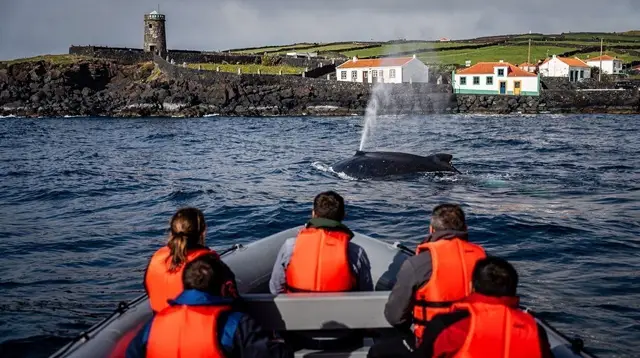
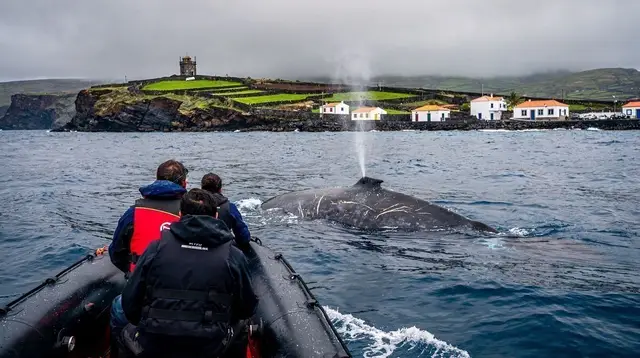
Swimming with Wild Dolphins in the Azores
Can you swim with wild dolphins in the Azores?
Yes. Licensed operators, mainly out of Terceira, run boat trips that let snorkellers slip into open water near resident common dolphins and bottlenose dolphins when conditions and animal behaviour allow. It is never guaranteed and touching or chasing the animals is against the rules on every trip.
Wild Dolphins, Not a Delphinarium
Nothing about this experience happens in a tank. In the Azores, “swimming with dolphins” means putting on a mask and fins, sliding off the side of a small boat in the open Atlantic, and waiting to see whether a pod of wild dolphins chooses to swim past, around, or occasionally right underneath you. There is no trainer, no trick, no glass wall. The animals decide how close they come, and on some days they decide not to come close at all.
That distinction matters because it shapes every part of the trip: the briefing you get before boarding, the way the boat approaches a pod, and the rules that stop guests from ever chasing or touching an animal. If you have swum with captive dolphins elsewhere and expect something similar, recalibrate first. This guide covers only the in-water encounter — for a seat-on-the-boat outing that covers a wider range of species including the great whales, see whale watching in the Azores instead, and for help choosing which island to base yourself on for marine wildlife generally, see the best island for whale watching.
Which Dolphins You’ll Meet in Azorean Waters
Two species make up the large majority of in-water dolphin encounters around the archipelago, and both are resident populations rather than seasonal visitors. That is a meaningful difference from the great whales that pass through the Azores mostly in spring: dolphins here can, in principle, turn up on any day of the year.
| Species | Typical group size | Presence |
|---|---|---|
| Common bottlenose dolphin | Small pods, often under 20 | Resident year-round |
| Short-beaked common dolphin | Larger, more mobile pods, sometimes 50+ | Resident year-round |
Both species are curious and fast, and pods move constantly, which is part of why an encounter is never scripted. A skipper who spots a pod from a distance still has to read its speed and direction before deciding whether an entry is even worth attempting. Slower-moving, resting pods generally make for calmer, more approachable encounters than pods that are actively travelling or feeding.
This page is about getting in the water with these two species specifically. It does not cover snorkelling or diving more broadly — for that, see the snorkelling guide and the diving guide — and it does not cover the resident cachalot (sperm whale) or the migratory rorquals that come through in spring, both of which are watched from the boat, not swum with; that territory belongs to whale watching in the Azores.
How a Snorkel-with-Dolphins Outing Actually Runs
Most trips follow a similar shape, even though exact timing depends on the operator and on how quickly a pod is found.
- Land briefing. Before boarding, guides explain the conduct rules, fit masks, snorkels and fins, and check who is comfortable in open water. This is also when seasickness tablets are worth taking if you are prone to it — there is often a wait at sea before anything happens.
- The search. The boat heads out and the crew scans the surface, sometimes helped by radio contact with other boats or coastal spotters, a tradition with deep roots in the archipelago’s whale-watching heritage. This stage can take anywhere from a few minutes to over an hour.
- The approach. Once a pod is located, the skipper reads its speed and heading and positions the boat well ahead of its path, cutting the engine before anyone enters the water. Dolphins are never chased down from behind — a fast approach only pushes them away.
- The entry. Guests slip in quietly, in small groups, usually at the guide’s signal. From here it is genuinely down to the dolphins: some pods swim close and linger out of curiosity, others glance over and continue on their way within seconds.
- Repeat or return. A trip may attempt several approaches on different pods if time and animal behaviour allow, before heading back to port.
A full outing typically runs two and a half to three and a half hours door to door, counting the briefing and the return to the marina. Operators offering this format include a swimming-with-dolphins trip out of Terceira and a similar dolphin encounter departing from Terceira Island, both built specifically around in-water snorkelling rather than boat-only observation.
The Rules: No Touching, No Chasing, No Guarantees
Every legitimate operator runs the same non-negotiable rules, and they exist because these are wild animals in their own habitat, not performers.
- No touching. Guests are told not to reach for, grab or attempt to pet a dolphin, even one that swims within arm’s reach.
- No chasing. Swimming hard toward a dolphin or a pod is discouraged and usually stopped by the guide — pursuit drives animals away rather than drawing them closer.
- No feeding. Dolphins are never lured with food; doing so alters wild behaviour and is against the conduct standards operators are expected to follow.
- Guide calls the water. If a pod shows signs of stress, changes direction abruptly, or includes very young calves, guides can end the encounter or refuse an entry outright, no discussion.
- Small group entries. Guests typically enter in groups of a handful at a time rather than everyone at once, both for safety and to avoid overwhelming the animals.
The trade-off for following these rules is honesty about outcomes: no operator worth booking will promise you a close encounter, because the promise wouldn’t be true. What they can promise is a well-run search, a safe entry, and a genuine shot at a wild moment that a delphinarium can never offer. If you want the full picture on how to judge one operator against another before booking anything, that comparison lives in how we pick whale-watching operators — this page focuses on the swim itself, not on vetting companies.
Where to Book: Terceira and Beyond
Dedicated dolphin-swimming trips are concentrated on Terceira, where several operators run this format specifically, launching from ports around Angra do Heroísmo and Praia da Vitória. Beyond Terceira, the more common way to get dolphins and snorkelling into the same day is a broader outing that combines coastal snorkelling with a chance of dolphin sightings, rather than a trip purpose-built around swimming with them.
| Trip type | Focus | Where |
|---|---|---|
| Dedicated dolphin swim | In-water encounter is the goal | Terceira |
| Boat tour with swimming | Combines a boat circuit with in-water time | Terceira |
| Guided hike-and-snorkel | Coastal snorkelling, dolphins possible but not the focus | São Miguel |
A boat tour that combines coastline sightseeing with a swimming stop is a good middle option if you want more of the island’s coast worked into the day rather than a trip built purely around one goal.
On São Miguel, a guided hike-and-snorkel outing with a local covers coastal snorkelling and is worth considering if your base is Ponta Delgada and Terceira isn’t on your route — just go in understanding that dolphins are a possibility there, not the trip’s purpose. For general options to get out on the water beyond dolphins specifically, the Azores boat tours guide covers the wider landscape of departures.
Fitness, Gear and Who Should (and Shouldn’t) Get In
You do not need to be a strong swimmer, but you do need to be a calm one. Open Atlantic water is colder and choppier than a pool, currents can pull you a short distance from the boat, and a mask fogging up mid-entry is a poor moment to panic. Most operators ask guests to have at least basic swimming confidence and provide a wetsuit, or at minimum a rash guard, since even in summer the water is cool enough that prolonged snorkelling gets chilly.
Mask, snorkel and fins are supplied on every trip listed here. Bring:
- A swimsuit worn under your clothes to save time changing on a moving boat
- A full change of dry clothes and a towel for the return
- Reef-safe sunscreen, applied before boarding
- Motion-sickness tablets if you are at all prone to seasickness — the search phase can involve real time bobbing on open water
- A dry bag or waterproof phone case if you want photos of the boat, not the swim itself; cameras are not usually handed to guests in the water
Trips are generally not suitable for non-swimmers, very young children, pregnant guests past the point their own doctor advises against strenuous swimming, or anyone with a heart or breathing condition that makes sudden cold-water immersion risky. If in doubt, ask the operator directly before booking rather than finding out at the dock. For the archipelago’s general safety context beyond this specific activity, see Azores travel safety.
Best Time of Year
Because both resident dolphin species are present year-round, there is no single “dolphin season” the way there is a spring peak for the migratory great whales. What actually varies by month is sea state: calmer summer conditions, roughly June through September, make entries easier and cancellations less frequent, while winter’s rougher Atlantic swells push more trips to reschedule or run boat-only.
For the archipelago’s wider weather patterns and what to expect month by month, see best time to visit the Azores and the detailed weather month by month breakdown; for the seasonal picture that does apply to the great whales specifically, see whale season in the Azores.
Because weather can force a late cancellation even outside winter, it is worth building a buffer day into your itinerary rather than scheduling a swim on your last possible morning. General advice on locking in tours ahead of a trip, including how far out to book and what flexibility to look for, is covered in booking Azores tours in advance.
Swimming with Dolphins vs Other Ways to See Marine Life in the Azores
It helps to be clear about what this experience is not, since the Azores offer several distinct ways to encounter marine wildlife and they get lumped together more often than they should.
- Whale watching (boat only) covers a much wider range of species, including the resident cachalot and the seasonal great whales, and keeps everyone aboard the boat throughout. See whale watching in the Azores.
- Swimming with dolphins, covered on this page, narrows the focus to the two resident dolphin species and requires calm-enough conditions and a cooperative pod to actually get in the water.
- General snorkelling, covered in the snorkelling guide, is about coastal reefs, rock pools and marine life close to shore, with dolphins a possible bonus rather than the goal.
- Choosing a boat versus a semi-rigid for observation is a separate decision covered in boat vs RIB for whale watching, relevant to the observation side of things rather than the in-water swim.
If your priority is simply seeing the largest number of species from a stable platform, a standard whale-watching trip will usually deliver more sightings across a single outing. If your priority is a genuine in-water moment with wild dolphins and you’re comfortable with the uncertainty that comes with that, this is the experience built for it.
Frequently Asked Questions About Swimming with Wild Dolphins in the Azores
Can you actually swim with wild dolphins in the Azores?
Yes, on dedicated trips departing mainly from Terceira. A skipper locates a pod, then guides gently slip into the water ahead of the animals’ path so the dolphins can approach on their own terms. There is no pool, no pen and no trained behaviour involved — it is open Atlantic water.
Which dolphin species will I see?
The two species behind most in-water encounters are the common bottlenose dolphin and the short-beaked common dolphin, both present in Azorean waters year-round rather than on a seasonal migration.
Is swimming with dolphins in the Azores guaranteed?
No responsible operator promises it. Dolphins are wild, and whether a pod is found, whether it is in a mood to approach, and whether the sea is calm enough to enter safely all vary by day. Most trips report high success rates but none sell a certainty.
What does a typical dolphin swimming trip involve?
A safety and conduct briefing on land, a boat ride out while the crew and coastal spotters search for pods, several careful, engine-off entries into the water in small groups, and a return to port. A full outing usually runs two and a half to three and a half hours.
Is it safe, and is touching the dolphins allowed?
It is safe when run by an experienced operator and when guests follow the briefing, but it is not risk-free open-water swimming. Touching, feeding, chasing or blocking a dolphin’s path is against the conduct rules on every legitimate trip, and guides will call people out of the water if a pod shows signs of stress.
What should I bring, and can non-swimmers join?
A swimsuit under your clothes, a towel, reef-safe sunscreen, and motion-sickness tablets if you are prone to seasickness. Mask, snorkel and fins are provided. Comfort in open water matters more than being a fast swimmer, and most operators ask for at least basic swimming ability; check with the operator if you are unsure.
How is this different from regular whale watching?
Whale watching keeps everyone on board and covers a wider range of species, including the great whales that only pass through seasonally. Swimming with dolphins is a narrower, in-water experience focused on the resident dolphin species and requires calmer conditions to run at all.
tours.whale-watching
Verified deep-linked GetYourGuide tours. Book through these links and we earn a small commission at no cost to you.
GetYourGuide does not provide a product photo for this activity — the image shows the meeting point, photographed by us.