How We Pick Whale Watching Operators in the Azores
The problem with a simple top pick
Every affiliate site has to answer an uncomfortable question sooner or later: on what basis, exactly, do we tell you to click this link and not that one. For most categories on this site, that’s a matter of taste. For whale watching in the Azores, it isn’t. There are live animals involved, a resident population of sperm whales and dolphins that this archipelago has built part of its identity around, and a real difference between an operator who respects that and one who doesn’t. So a while back I stopped trying to write “the best” whale watching tour as if it were a restaurant review, and wrote down instead the handful of things I actually check before a boat trip earns a place on this site.
I’m laying that method out here because I think a reader deciding whether to trust one of our affiliate links deserves to know what stands behind it, and because it’s more useful to you than a list of superlatives would be. If you’re after the practical side of the experience itself, the species, the season, and how likely you are to see something, that lives over on our whale and dolphin watching guide, and the boat-versus-RIB question has its own comparison. This piece is only about how we choose.
The distance rule I check first
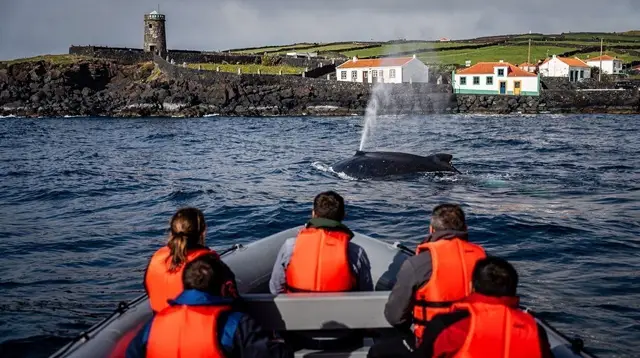
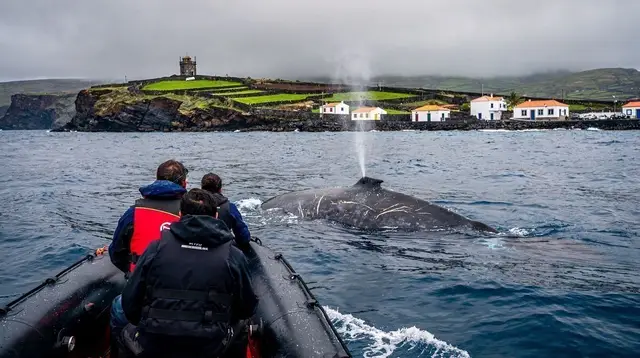
The Azores regulate how close a boat may bring you to a whale or dolphin, how many boats can crowd around the same group at once, and how fast a boat may approach. It’s not a suggestion, it’s the regional code of conduct for cetacean watching, and it exists because these animals are wild, resident, and easily disturbed by repeated close encounters. Before anything else, I look at how an operator talks about this rule on its own site and in its briefings. Does it mention approach distance at all, or does its marketing photography quietly suggest you’ll be close enough to touch a fin. That single tell filters out a surprising number of otherwise polished-looking businesses.
A guide or biologist, not just a skipper
The Azores have a whale watching tradition that predates tourism by more than a century. Whalers once relied on vigias, land-based lookouts scanning the horizon for the telltale blow of a sperm whale, then radioing boats out at sea toward the sighting. That role never disappeared, it changed employer: today biologists and trained guides staff those same lookout points, and radio the tour boats toward animals instead of harpoon boats. Lajes do Pico, on the island of Pico, is still the reference port for that history, and it’s worth reading a little about it if you want the context behind why a guide on board matters here more than it might elsewhere.
For our purposes, a marine biologist or a trained naturalist guide on board is one of the clearest, most checkable signals we have. It’s a person whose job is to read the animals’ behaviour and call off an approach when it’s the right thing to do, not to maximise time near the pod. An operator who invests in that role is, in our experience, also the kind that takes the wider approach code seriously rather than as paperwork.
a São Miguel whale watching outing led by a marine biologistGroup size and what a full boat actually means
Boat capacity is a genuinely useful, if imperfect, proxy. A smaller group is easier for a guide to brief properly, easier to keep quiet and still around a sensitive animal, and easier to manage if the captain needs to hold position rather than push closer. We don’t set a single hard number, since a large rigid-hulled boat and a small traditional one aren’t comparable, but we do favour operators who visibly cap their passenger count below what the boat could technically carry. If you’re weighing a classic boat against a semi-rigid inflatable, that’s a separate decision with its own trade-offs we cover elsewhere, worth reading before you book either way.
a small-group cetacean watching trip out of Ponta DelgadaLicence, history, and a safety record we can actually check
Beyond the animals, there’s the ordinary question of whether a business is who it says it is. We look for a valid regional maritime and tourism licence, a named home port, and enough years of visible operating history that we can cross-reference independent reviews rather than a single glowing testimonial page. We also look, where it’s publicly available, for how an operator handles safety, including how honestly it talks about weather cancellations rather than pushing a trip out in conditions it shouldn’t. An outfit based out of a real, findable harbour like Horta, with years of trips behind it, gives us far more to verify than a name that only exists on a booking page.
Where the sea, not the marketing, decides the outing
None of this guarantees a sighting, and no honest operator will promise you one; the animals decide that part. What these checks are meant to guarantee is something narrower and more useful: that the crew you board with is licensed, briefed, respectful of approach distance, and unlikely to overcrowd a group of dolphins for the sake of a better photo. Some of our recommended departures leave from the Vila Franca do Campo area and combine the outing with the nearby islet, which is a good example of an itinerary built around the animals’ usual range rather than a fixed script.
a whale and dolphin watching trip taking in Vila Franca isletBeing upfront about what this isn’t
I want to be direct about the limits of this method, because the easiest mistake a site like ours can make is implying that every one of the hundreds of listed excursions has been personally ridden by someone on our team. It hasn’t, and any site claiming that about a whole regional catalogue should be read with some scepticism. What we do instead is apply the criteria above consistently, re-check licensing and reviews on a rolling basis, and drop operators when independent feedback turns clearly negative on safety or on how animals are approached. It’s a narrower, more honest claim than “we tested everything,” but it’s the one that’s actually true, and it’s the one I’d want a site to make to me before I clicked a booking link myself.
If you’re still deciding when to go rather than who to book with, our best time to visit guide and our island-by-island breakdown of where sightings are strongest are the better next stops. And if a full day on the water isn’t quite what you’re after, land-based sightings are still possible from lookout points around Nordeste, which is also where some of the old vigia sites still stand.
a full-day excursion around the Nordeste coastlineFor general planning, see our Azores boat tours overview, our notes on booking tours in advance, and our wider piece on sustainable travel in the Azores.
For the tradition this all grew out of, our history of Azorean whaling is worth the read, and if swimming with dolphins is more what you had in mind, that’s covered separately in our swimming with dolphins guide. You can also browse every listed whale watching activity on the site, or compare private tour options if you’d rather not share a boat with strangers at all.
Choosing a whale watching operator in the Azores: FAQs
Do you personally go out on every whale watching boat you recommend?
No, and I want to be honest about that. There are hundreds of departures across the islands every season. What we do is check the operator’s license, look for a guide or biologist on board, and cross-read independent reviews for consistent patterns, rather than claim a crew boarded each one.
What is the legal distance boats must keep from whales and dolphins in the Azores?
Regional regulation sets minimum approach distances, caps how many boats can gather around the same group of animals at once, and limits approach speed. We treat an operator’s visible respect for that code of conduct, not just its marketing photos, as a core selection criterion.
Why does it matter if a marine biologist is on board?
A biologist or trained guide reads animal behaviour, decides when to hold back, and can explain what you’re seeing instead of just pointing. It also tends to correlate with an operator that takes the regulation seriously rather than treating it as a formality.
How big is too big for a whale watching group in the Azores?
There’s no single number we apply everywhere, since boat types vary, but we favour operators who cap passenger numbers below the boat’s maximum rather than sell every seat, since a calmer group makes it easier to follow the guide’s instructions around the animals.
How do you check if an operator is properly licensed?
We look for a valid regional tourism and maritime licence, verifiable years of operation out of a named Azorean port, and a track record we can check against independent reviews and, where available, safety incident history, rather than take a homepage claim at face value.
What if a tour cancels or doesn’t see any whales?
Reputable operators publish a clear rebooking or refund policy for both weather cancellations and no-sighting outings, since even the best crews can’t guarantee an encounter. We treat a vague or absent policy as a warning sign.
Does a higher price mean a better or more responsible operator?
Not reliably. Price often reflects boat type, group size, or route length more than how carefully an operator follows the approach code. We’d rather a reader pick a smaller, guided outing at a moderate price than assume the priciest option is automatically the safest for the animals.
tours.whale-watching
Verified deep-linked GetYourGuide tours. Book through these links and we earn a small commission at no cost to you.
GetYourGuide does not provide a product photo for this activity — the image shows the meeting point, photographed by us.