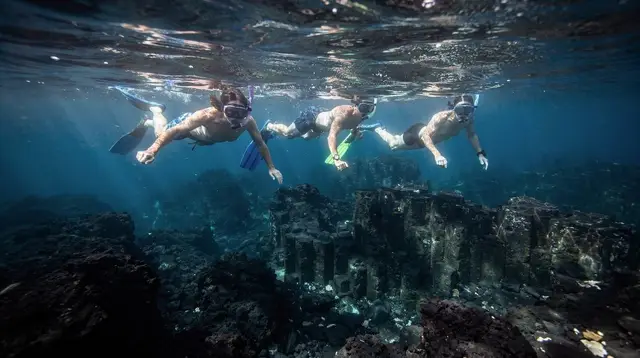
Diving in the Azores
Is diving in the Azores good for beginners, and where should divers base themselves?
The Azores work well for beginner dives close to shore around Faial and Pico, but the archipelago's signature sites are offshore seamounts for experienced divers only. Faial and Pico form the main dive hub thanks to the daily ferry between them, with Santa Maria a strong second base for mobula season and Terceira offering wall and cave-adjacent diving near Angra do Heroísmo.
Nine volcanic islands sitting on a mid-Atlantic ridge give the Azores a kind of diving that has little in common with a tropical reef holiday. There is no coral garden in warm, still water here — instead there are basalt walls, collapsed lava tubes, seamounts rising from deep water, and a species list built around pelagics passing through the open Atlantic rather than fish parked on a shallow reef. This guide covers the archipelago’s diving as a whole: the underwater terrain, the three islands that function as real dive bases, what turns up in the water by season, and the practical numbers — water temperature, exposure protection, fitness — that a certified diver needs before deciding where to fly.
Why Azores Diving Feels Different From a Tropical Trip
The Azores sit on the boundary of three tectonic plates, and every island is the visible tip of a volcano rising from an ocean floor several thousand metres down. That geology carries straight into the diving. Instead of a fringing coral reef, dive sites are built from basalt: vertical walls, arches, swim-throughs formed by old lava flows, and isolated seamounts that break the open water a few kilometres offshore. Because there is no continental shelf slowing things down, deep water starts close to shore, which is exactly why the archipelago attracts pelagic species that tropical reef diving rarely delivers on a normal dive.
The trade-off is temperature and visibility that vary with the weather rather than staying reliably warm and clear. This is Atlantic diving with a volcanic backdrop, not a shallow tropical lagoon, and it rewards divers who come with realistic expectations and the right exposure protection rather than a swimsuit-and-fins mindset.
Choosing a Base: Faial, Pico or Santa Maria
Three islands do almost all of the archipelago’s certified diving. Each has a different personality, and the right one depends on what a trip is actually built around.
| Base | Best for | How to get there | Typical dive style |
|---|---|---|---|
| Faial (Horta) | Central hub, easy access to Pico’s dive sites, boat trips further offshore | Direct flights to Faial, or the Pico–Faial ferry | Boat dives, some shore entries near Horta |
| Pico (Madalena, Lajes do Pico) | Whaling-history dive centres, access to the same central-group waters as Faial | Direct flights to Pico, or the ferry from Faial | Boat dives from Madalena and Lajes do Pico |
| Santa Maria (Vila do Porto) | Mobula ray season, warmer water than the central and western groups | Direct flights to Santa Maria | Boat dives, seasonal pelagic encounters |
Faial and Pico work as a single dive region in practice, since the ferry crossing between Horta and Madalena takes about half an hour and runs several times a day, year-round — one of the few inter-island links in the archipelago reliable enough to plan a trip around without a backup date. A diver can sleep on either island and dive out of both without losing days to logistics, which is not the case for the wider central-group network beyond this pair or for the more fragile western-group crossings to Flores and Corvo.
Santa Maria, the southernmost and geologically oldest island, sits slightly apart from this hub. It is worth a dedicated trip in its own dive season rather than a side excursion from the centre, and its position brings marginally warmer water and a stronger claim on mobula ray sightings in summer.
Faial and Pico: The Central Group’s Dive Hub
Dive centres on both sides of the strait run boats out to the same stretch of water, so the choice between staying in Faial or Pico often comes down to accommodation and flight connections rather than which island has better diving. Horta’s marina is the more geared-up base for visiting divers, with its long tradition as a stopover for Atlantic sailors, while Lajes do Pico carries the older identity of a whaling port — the same harbour that once launched boats after sperm whales now sends out boats to watch and dive around them, at a respectful distance, instead.
Sites around this pair mix volcanic walls close to shore with short boat rides out to islets and shallower seamounts. Visibility is generally better than in summer’s plankton-rich water further south, though it never reaches the tropical extremes some divers expect — 15 to 25 metres is a realistic range depending on conditions. This is also the base most divers use as a step toward the archipelago’s best-known and most demanding site, an isolated seamount reserved for experienced divers and covered on its own in the Princess Alice Bank diving guide rather than here, since it is not a dive to attempt as an introduction to Azores waters.
For a full island-hopping plan that pairs both bases with the rest of the central group, the Pico and Faial in 5 days itinerary lines up diving days against the ferry schedule and the region’s other draws — wine, whale watching and the climb up Montanha do Pico among them.
Santa Maria: Mobula Rays and the Warmest Water in the Archipelago
Santa Maria sits further south and east than the rest of the archipelago, and it shows in the water: slightly warmer temperatures than Faial, Pico or Terceira, and a reputation as the most reliable place in the Azores to encounter mobula rays gathering in numbers through the summer months. Dive boats leave from Vila do Porto, the island’s only town, and the diving here leans toward open-water encounters with schooling rays and the chance of a passing basking shark rather than the wall-and-cave terrain that defines the central group.
It is also the geologically oldest island in the Azores, and its position furthest from the volcanic centre of the archipelago means a gentler underwater landscape in places — sandy patches and lower-relief reef alongside the volcanic structure found everywhere else. A trip built specifically around mobula season treats Santa Maria as the primary base rather than an add-on, since flights and dive-boat schedules here run independently of the Faial–Pico hub.
Terceira: Wall Diving Near a UNESCO Old Town
Terceira offers a different pairing: certified diving alongside one of the archipelago’s cultural highlights, the UNESCO-listed old town of Angra do Heroísmo. Dive sites here run along basalt walls and drop-offs close to the coast, with double-dive boat trips a common way to see two different profiles in a single outing. It suits a diver who wants a shorter, more self-contained trip — city, coastline and diving on one island — rather than the multi-island hopping that a Faial–Pico–Santa Maria itinerary demands.
What Turns Up Underwater, by Season
Marine life in Azorean waters splits fairly cleanly between residents seen close to the reef year-round and seasonal visitors passing through the open Atlantic.
| Species | Season | Notes |
|---|---|---|
| Reef residents (moray eels, groupers, damselfish, barracuda) | Year-round | Seen on most dives around Faial, Pico and Terceira |
| Mobula rays | Roughly June to September | Best odds off Santa Maria and southern Pico |
| Basking sharks | Occasional, spring–summer passage | Not guaranteed on any given trip |
| Volcanic-terrain species (nudibranchs, crustaceans in lava crevices) | Year-round | Concentrated around walls and swim-throughs |
| Pelagics at offshore seamounts | Warmer months, current-dependent | Sites for experienced divers only |
None of this is a promise. Sightings depend on sea conditions, the season and a fair amount of luck, and no dive centre in the Azores can guarantee an encounter with any single species on a given day — the same honesty that applies to the archipelago’s surface wildlife watching, covered separately in the whale watching guide for visitors who want to see cetaceans from a boat rather than underwater with tanks on. Underwater encounters with whales or dolphins are not part of a normal recreational dive here; they are a surface activity in their own right.
Water Temperature and What to Wear
This is the detail that trips up divers arriving with a tropical mindset. The Azores sit in the open Atlantic, warmed a little by the Gulf Stream but never approaching the bathwater conditions of the Caribbean or the Red Sea.
| Month range | Approximate water temperature | Typical exposure protection |
|---|---|---|
| December–March | Mid-teens °C | 7mm wetsuit or drysuit |
| April–June | Mid-to-high teens °C | 6–7mm wetsuit |
| July–September | Low-to-mid twenties °C | 5mm wetsuit, some divers use 7mm |
| October–November | High teens to low twenties °C | 6–7mm wetsuit |
Even at the warmest point of the year, most local dive centres recommend at least a 5mm suit, and many divers doing multiple dives a day or diving deeper sites choose a 7mm suit or a drysuit regardless of the month. Renting gear locally is straightforward at every dive centre on Faial, Pico, Santa Maria and Terceira, but a diver used to tropical exposure protection should plan to hire a proper cold-water suit rather than bring a 3mm shorty — it will not be enough.
Fitness, Experience and What’s Realistic
Because deep water starts close to shore and several signature sites are offshore seamounts exposed to Atlantic swell and current, Azores diving generally asks more of a visitor than a sheltered tropical reef does. Boat crossings can be choppy, entries and exits sometimes happen in surge, and the best-known sites are current-swept by design — that is precisely what draws the pelagic life divers come here to see. A realistic self-assessment before booking: comfortable in open water with limited visibility, confident with buoyancy in current, and physically fit enough for a boat ride and a potentially demanding entry.
That said, sheltered dives close to Horta, Madalena and Vila do Porto suit newly certified divers and even complete beginners on a supervised introductory dive, so the archipelago is not exclusively for advanced divers — it simply keeps its harder sites clearly separated from its easier ones, and any competent dive centre will steer visitors toward the right one for their level.
Getting There and Getting Between Dive Bases
Flights connect Faial, Pico, Terceira and Santa Maria to Ponta Delgada and, seasonally, to the Portuguese mainland — details worth checking against current schedules in the inter-island ferry guide and a wider look at flight options in best time to visit the Azores.
Once on the ground, a rental car covers everything a diver needs beyond the boat itself — dive centres are almost always a short drive from the airport or ferry terminal, and a car matters more for the rest of the trip (Pico’s vineyards, Faial’s Capelinhos volcano, Terceira’s old town) than for the diving alone. The car rental guide covers booking ahead, which matters in peak summer months when both cars and dive-centre slots fill up.
Booking Diving in the Azores
Most visiting divers start with a single guided dive or a short course before committing to a multi-day plan, and booking a slot in advance during July and August is worth doing rather than assuming a walk-in spot will be available.
A first scuba diving experience in the Azores is the standard entry point for anyone without a certification who wants a supervised taste of these waters, while a certified diver can book straight into a guided dive session matched to their level. On Terceira, the Angra do Heroísmo double dive is the local way to see two different wall profiles from a single boat trip in a single morning.
Non-diving days around a dive trip are easy to fill without repeating the same coastline: a guided tour of Pico covers the volcanic landscape and vineyards on the surface, a useful rest-day pairing between dive days that keeps the trip from being entirely water-based.
Snorkelling is a different logistics chain entirely and is covered on its own in the snorkelling in the Azores guide, aimed at visitors without a certification who still want to get in the water. For a wider look at boat-based options beyond diving — whale watching boats, sunset cruises, sailing charters — the Azores boat tours guide rounds those up in one place.
Frequently Asked Questions About Diving in the Azores
Is diving in the Azores suitable for beginners?
Yes, for shore and short boat dives around Horta, Madalena or Vila do Porto, where dive centres run introductory and open-water sessions in sheltered volcanic terrain. The archipelago’s famous offshore seamounts and drop-offs are a different matter — those are reserved for divers with real open-water experience, good buoyancy and comfort in current.
How cold is the water for diving in the Azores?
Sea temperatures run roughly from the mid-teens Celsius in late winter to the low-to-mid twenties in September, the warmest month. Even in summer most dive centres recommend at least a 5mm wetsuit, and a 7mm suit or a drysuit is common for winter diving or longer dives at depth.
Which Azores island is best for diving?
Faial and Pico together form the most practical base, linked by a frequent short ferry and close to sheltered bays as well as offshore reefs. Santa Maria is the pick for mobula ray season, and Terceira suits divers who want to combine diving with the UNESCO old town of Angra do Heroísmo.
Do I need to be a certified diver to dive in the Azores?
You need an open-water certification for most boat dives and any dive below a shallow introductory depth. Non-certified visitors can still get in the water on a supervised discover-diving session in protected bays, but the archipelago’s better sites are built around certified diving, not a beginner tourist experience.
What marine life can you see while diving in the Azores?
Expect volcanic reef life year-round — moray eels, groupers, damselfish and schooling barracuda — plus seasonal visitors: mobula rays gathering off Santa Maria and Pico in summer, occasional passing basking sharks, and the chance of pelagic species around the offshore seamounts. Whales and dolphins are a surface encounter, seen from the boat rather than underwater with divers.
When is the best time to dive in the Azores?
Late June through September gives the calmest seas, the warmest water and the best odds of mobula rays and passing pelagics, which is also when most dive centres run their full schedule. Diving continues outside this window for those prepared for cooler water and rougher crossings, but trip planning gets noticeably harder from November to March.
tours.diving-snorkeling
Verified deep-linked GetYourGuide tours. Book through these links and we earn a small commission at no cost to you.
GetYourGuide does not provide a product photo for this activity — the image shows the meeting point, photographed by us.