Car Rental in the Azores: An Island-by-Island Guide
Can I keep the same rental car when I island-hop in the Azores?
No. Car rental in the Azores is organised island by island — you return your car before every inter-island flight or ferry and pick up a new one on arrival. In July and August, book each leg several weeks ahead, since the fleet on smaller islands is small and sells out.
One Island, One Rental Contract
The single most important thing to understand about car rental in the Azores is that it is never a single, continuous booking. The archipelago is nine separate islands connected by short inter-island flights and, on a handful of central routes, by ferry — and no rental agency’s contract lets a car cross that gap. If your itinerary covers São Miguel, Terceira and Pico, you are not booking one car for the trip. You are booking three, and returning each one before you leave that island.
This shapes almost everything else about planning transport for a multi-island Azores trip: how many separate reservations you juggle, how much lead time you need before the busy summer months, and why the choice between a small local agency and a familiar international chain looks different from one island to the next. This guide walks through how rental works island by island, how to time your bookings around July and August demand, and how to weigh local operators against airport chains.
For the practicalities of actually driving here — narrow roads, hairpin bends, fog on the crater rims — see driving in the Azores; for travellers considering buses instead of a car, see public transport in the Azores; and for the mechanics of the ferries themselves, see inter-island ferries in the Azores.
Why the Azores Rent Car by Car, Island by Island
Each Azorean island runs its own small pool of independent car rental agencies, usually based in or near the main town — Ponta Delgada on São Miguel, Angra do Heroísmo on Terceira, Madalena on Pico, Horta on Faial, Velas on São Jorge, Santa Cruz das Flores on Flores, Vila do Porto on Santa Maria.
There is no archipelago-wide rental network with a fleet that circulates between islands the way it might on a mainland road trip. A car registered and insured to drive on Pico’s roads is not licensed to be driven, or even carried, onto Faial or São Jorge.
That means the ferry option that connects Pico, Faial and São Jorge — the so-called Triangle, the most reliable inter-island link in the archipelago and the one route that runs year-round — is not a way to move your rental car between islands. It is a way to move you and your luggage. The car itself stays behind, handed back to the agency you rented it from before you board.
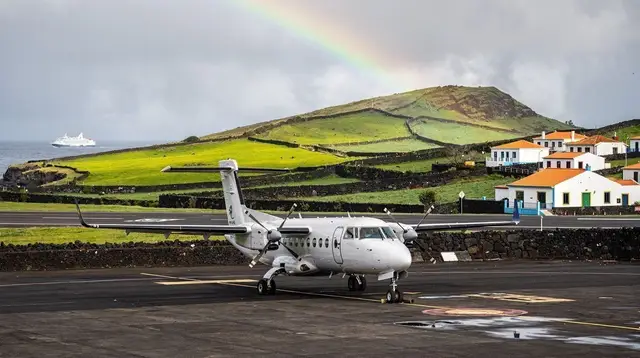
The same logic applies, more strongly, to flights. SATA Air Açores’ inter-island network is how most visitors actually island-hop, and every one of those short hops means returning a car at one airport and, usually, picking up a different one at the next. If your route is a straightforward loop — fly into Ponta Delgada, explore São Miguel, fly to Terceira, explore Terceira, fly home — that is two rental contracts, not one continuous booking with a hand-off in between.
Peak Season: Why July and August Need Weeks of Lead Time
The Azores’ vehicle fleet is small by design — these are compact islands with a limited number of agencies and a limited number of cars, and unlike a mainland destination, no neighbouring region can quietly top up supply when demand spikes. In July and August, when Azorean and mainland Portuguese holidaymakers travel alongside the growing international summer crowd, that fixed supply meets a sharp jump in demand, and cars run out.
The effect is most acute on the smaller islands. Pico, Faial, São Jorge, Terceira, Graciosa, Flores, Corvo and Santa Maria each have a modest handful of agencies with correspondingly modest fleets; a wave of same-week reservations can genuinely empty them. São Miguel, as the largest and most visited island, carries more supply and more agencies, but even there, good rates and larger vehicle categories (people carriers, cars with roof boxes for luggage-heavy families) disappear early.
Practical guidance for peak season:
| When you’re travelling | Recommended lead time |
|---|---|
| July–August (peak season) | 4–8 weeks ahead, per island leg |
| May–June, September (shoulder season) | 2–4 weeks ahead |
| October–April (low season) | 1–2 weeks is usually enough, though local festivals can still tighten supply |
Because each island is its own booking, “book early” really means booking every single leg early — not just the first one. A traveller who reserves São Miguel three months out but leaves Pico and Faial for the week before departure, assuming that a smaller island will somehow have more spare capacity, often finds the opposite is true.
Local Agencies vs. International Chains
On most islands you will choose between two broad categories of rental company.
Local Azorean agencies are independently run, usually with a desk in town or a short shuttle ride from the airport rather than a counter inside the terminal. They tend to be noticeably cheaper than international brands, particularly outside peak season, and staff often know the island’s roads, weather quirks and unpaved shortcuts better than a national call centre would. The trade-off is a smaller, sometimes older fleet, less flexible cancellation terms, and desks that may not be staffed for late-night or very early flights — worth checking before you commit to a red-eye arrival.
International chains operate airport counters on the larger islands (São Miguel and Terceira in particular), with wider opening hours, larger fleets including automatic transmissions and larger vehicle classes, and the reassurance of a familiar loyalty programme or booking platform. The rates are usually higher, and in peak season the premium over a local agency can be substantial — though the gap does narrow in July and August, when local agencies raise prices to match demand rather than staying cheap simply because they are small.
Which one makes sense depends on the island and the itinerary. On a short one- or two-night stop on a smaller island, a local agency picked up a few minutes from the airport is usually the practical, cheaper choice. On São Miguel, where a rental might need to last five to seven days and cover the whole island, comparing both categories properly — insurance excess, mileage limits, fuel policy — before booking pays off more.
If the idea of arranging your own transfer and driving yourself on every island sounds like more coordination than a short stop is worth, it is not the only option. On Terceira, for example, a two-day private tour with transfer included covers the island’s main sights without a rental contract of your own, which can make sense if you are only there for a couple of days between flights.
What to Check Before You Book
Rental terms vary by agency and by island, but a few checks apply everywhere in the Azores:
- Minimum licence-holding period. Most agencies require the driver to have held a full licence for one to three years; confirm this when booking rather than at the counter.
- Deposit and excess. A credit card in the main driver’s name is standard for the deposit; check the excess amount and whether reducing it with additional cover is worth the cost for a short rental.
- Fuel policy. Full-to-full is most common; confirm the nearest fuel station to the drop-off point, since some rural agency locations are a short drive from the pumps.
- Insurance coverage on unpaved or restricted roads. Some agreements exclude damage on unsurfaced tracks or roads marked as off-limits — relevant if your plans include reaching a remote trailhead or a fajã access road on São Jorge.
- Opening hours versus your flight times. A rental desk that closes at 7pm is a problem if your inter-island flight lands at 9pm; ask about after-hours drop-off or key-box arrangements in advance.
None of this replaces reading the specific rental agreement in front of you, but it flags the points that catch first-time visitors most often.
Car Rental by Island: What to Expect
| Island | Rental supply | Booking urgency in July–Aug | Notes |
|---|---|---|---|
| São Miguel | Largest fleet, most agencies, both local and international | High | Airport counters at Ponta Delgada; book automatic transmissions early |
| Terceira | Moderate, local and international options | High | Desks in Angra do Heroísmo and at Lajes airport |
| Pico | Small, mostly local agencies | Very high | Book before travel; useful for reaching the Montanha do Pico trailhead |
| Faial | Small to moderate, local agencies concentrated in Horta | Very high | Pairs naturally with a Pico rental on either side of the ferry |
| São Jorge | Small, local agencies only | Very high | Needed to reach the scattered fajãs beyond Velas |
| Flores | Very small fleet | Very high | Book well ahead; few cars, and demand spikes with cruise and charter arrivals |
| Corvo | Minimal to none | Not applicable for most visitors | Corvo’s village and Caldeirão crater are commonly covered on foot or by taxi in a day |
| Santa Maria | Small, local agencies | High | Fewer visitors overall, but supply is correspondingly limited |
| Graciosa | Very small fleet | Very high | Confirm availability before finalising this leg of your itinerary |
Corvo is the exception worth flagging on its own: it is the smallest inhabited island in the archipelago, walkable in a day, and most visitors arriving on a day trip to Corvo from Flores skip renting a car there entirely.
Building Rental Windows Into a Multi-Island Itinerary
Because every island resets the rental question, the practical approach is to plan car rental leg by leg alongside your flights, rather than as one line item for the whole trip. A traveller following an Azores island-hopping guide across three or four islands should expect three or four separate bookings, each timed to their arrival and departure on that island, not to the trip’s overall start and end date.
This has a knock-on effect on how many days you allocate per island. A rental picked up mid-afternoon and returned before an early flight two days later effectively gives you one full driving day — worth factoring into itineraries like Pico and Faial in 5 days or São Jorge in 3 days, where drop-off deadlines can eat into a short stay more than first-time visitors expect.
For islands you are only passing through briefly, weigh whether a rental car is worth the paperwork against a guided alternative: a guided tour of Pico covers the island’s vineyards and viewpoints in a single day without a rental contract, and a half-day dairy farm tour can fill an afternoon on an island where you have decided a car isn’t worth arranging for such a short stop.
If your itinerary allows some flexibility, it is worth deciding island by island whether a car is genuinely needed. On islands where your main plans are a single hike, a boat excursion, or an evening out — a sunset boat tour, for instance — you may not need a rental at all for that leg, which removes one booking from the list without affecting the rest of the trip.
For readers still deciding how many islands to include and how long to spend on each, how many days in the Azores and which Azores island to visit are useful starting points before locking in flights and, in turn, rental dates. And if the whole idea of multiple separate rentals feels like too much coordination for a first visit, comparing a guided tour against self-driving in the Azores is worth doing before you commit to a fully self-driven itinerary.
The One Mistake to Avoid
The recurring planning error is treating Azores car rental like a mainland road trip, where a single rental follows you from region to region. It does not work that way here. Each island is its own contract, its own pickup, and its own return — plan your bookings, and your lead times, accordingly, and budget the same discipline for a two-night stop on Graciosa as you would for a week on São Miguel.
Frequently Asked Questions About Car Rental in the Azores
Can I take a rental car on the ferry between islands?
In practice, no. Azores rental agencies operate within a single island, and their contracts do not allow the vehicle to leave that island by ferry. Return your car before boarding and arrange a new pickup on arrival.
How far ahead should I book a car for July or August?
Several weeks to a couple of months ahead for the smaller islands (Pico, Faial, Terceira, Graciosa, São Jorge, Flores, Corvo, Santa Maria), where the fleet is limited and sells out early. São Miguel has more supply but still tightens considerably in peak season.
Are local agencies cheaper than international chains?
Often, yes. Local Azorean agencies tend to undercut international chains, sometimes noticeably, though the gap narrows in high season. International brands usually offer larger fleets, airport desks, and English-speaking staff, which can matter more than the price difference on a short stay.
Do I need a car on every island?
Not necessarily. Smaller islands like Corvo can be covered on foot or by taxi in a day, and some travellers prefer a guided tour on islands where they only have a day or two. But for São Miguel, Terceira, Pico, Faial, São Jorge and Flores, a rental car is the practical way to reach trailheads, viewpoints and villages beyond the main town.
What documents do I need to rent a car in the Azores?
A valid driving licence held for the minimum period required by the agency (commonly one to three years), a credit card in the driver’s name for the deposit, and a passport or EU identity card. Non-EU licences printed in a non-Latin alphabet may require an International Driving Permit — check with the agency before travel.
Is it cheaper to book at the airport or online in advance?
Booking online in advance is almost always cheaper and safer than arriving without a reservation, especially in July and August when walk-up availability on the smaller islands can be zero. Airport counters exist mainly for international chains and rarely beat a pre-booked local agency on price.
What happens if my flight between islands is delayed?
Most Azorean agencies are used to SATA Air Açores and Azores Airlines delays and will hold a booking for a few hours, but this is not guaranteed. Note your rental company’s phone number before flying and call as soon as a delay is announced, particularly if you land after the office’s usual hours.
Transfers and transport passes on GetYourGuide
Verified deep-linked GetYourGuide tours. Book through these links and we earn a small commission at no cost to you.
GetYourGuide does not provide a product photo for this activity — the image shows the meeting point, photographed by us.