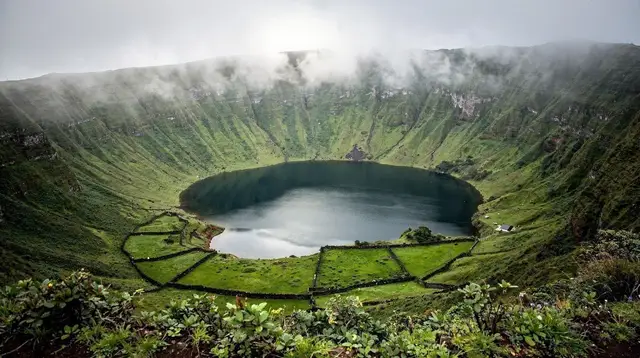
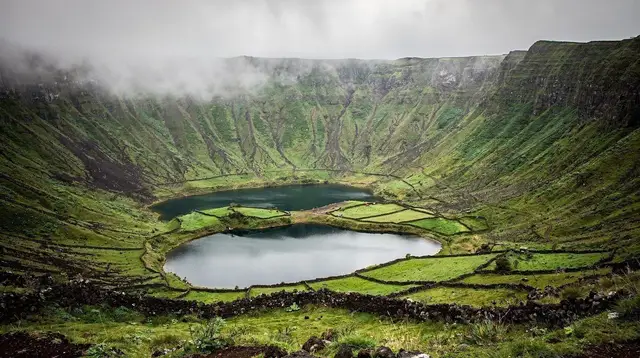
Faial sits in the central group of the Azores, close enough to Pico that the two islands are usually planned as a pair, yet distinct enough to earn its own two or three days. Its identity is built on three things: Horta, the town that has welcomed transatlantic sailors for over a century; a volcanic core centered on the Caldeira; and the raw, still-young landscape of Capelinhos, where an eruption reshaped the island’s western tip in 1957 and 1958. Add the hydrangea hedges that give Faial its nickname, the Blue Island, and you have a compact destination that rewards a short, focused visit more than a rushed day trip.
Why Add Faial to Your Azores Trip
Faial rarely serves as anyone’s only Azorean island. Its role in most itineraries is as the companion to Pico — the two are linked by a ferry crossing short enough to do as a day trip in either direction, which is covered in detail in our Pico–Faial ferry guide. What Faial adds to a Pico-centered trip, or to a wider central-group itinerary that also takes in Terceira or São Jorge, is a genuinely different kind of place: a working harbour town with two centuries of maritime history, set against a volcanic interior that is younger and starker than anywhere else in the archipelago.
Travelers deciding between islands sometimes assume Faial and Pico are interchangeable because they sit so close together. They are not. Pico is defined by its mountain and its wine; Faial is defined by its harbour and its volcanoes. If you are still weighing which islands to prioritize on a first trip, our island-choice guide walks through the trade-offs in more detail.
Horta: An Atlantic Harbour Town
Horta is Faial’s only town of any size and the seat of island life. Its marina has been a mandatory stop for transatlantic sailors since the age of sail, and the tradition of leaving a painted mural on the harbour walls — said to bring good luck to the next crossing — has turned the quay into an open-air record of decades of Atlantic voyages.
This guide keeps its coverage of the town brief by design: the marina, its mural culture and the famous Peter Café Sport, long the sailors’ meeting point, get the full treatment in our dedicated Horta marina guide. What matters here is Horta’s role as Faial’s base: it is where flights and ferries arrive, where most accommodation and restaurants cluster, and where day trips to the Caldeira and Capelinhos begin.
A short tour of the town and its surroundings is a reasonable way to spend a first afternoon on the island.
a half-day tour of Faial’s highlights covers Horta, the coastline and a first look at the volcanic interior without committing a full day.
The Caldeira: Faial’s Volcanic Heart
At the center of the island sits the Caldeira, a roughly 400-metre-deep volcanic crater that anchors Faial’s entire landscape — every road on the island effectively circles around it. The crater rim is walkable and forms one of the best short hikes in the central group, but the trail itself, its access points and the practicalities of the walk are covered separately in our Caldeira do Faial guide rather than here. For the purposes of choosing Faial as a destination, it is enough to know that the Caldeira is the geological reason the island looks the way it does: a ring-shaped highland of pasture and laurel forest wrapped around a deep, often cloud-filled bowl.
A guided car or eco tour is the easiest way to see the crater rim alongside the rest of the island’s interior in a single outing, especially for visitors who would rather not navigate Faial’s fog-prone upland roads themselves.
a guided eco tour through the Caldeira and Faial’s interior pairs the crater viewpoint with stops most self-drive visitors would otherwise miss.
Capelinhos: The Volcano Born in 1957–58
At Faial’s western tip, the Capelinhos volcano is the island’s most dramatic and most recent feature. A submarine eruption began offshore in September 1957 and continued into 1958, eventually building a new lobe of land onto the island and burying a lighthouse and surrounding farmland under ash and lava. The result today is a stark, semi-lunar landscape unlike anywhere else in the Azores — pale ash slopes, a buried lighthouse now serving as an interpretation centre, and a coastline still visibly younger than the rest of the island.
As with Horta and the Caldeira, this guide only sketches Capelinhos in outline; the site’s visitor centre, walking routes and the eruption’s full history are covered in our Capelinhos volcano guide, and the wider volcanic context of the Azores is set out in our guide to the archipelago’s volcanoes and craters.
For visitors without a rental car, or who want Capelinhos folded into a fuller day of sightseeing, a private full-day tour typically combines the volcano with the Caldeira and Horta’s viewpoints.
a private full-day 4WD tour of Faial with a local guide is built around exactly that combination, with the flexibility to linger at Capelinhos.
Why Faial Is Called the Blue Island
Faial’s Portuguese nickname, Ilha Azul, comes from the hydrangeas — hortênsias — that line its roads, field boundaries and pastures across much of the island. The first flowers typically open in May and June, but the display most visitors picture, thick blue hedges running for kilometres along the roadside, belongs to July and August, with the color starting to fade by early autumn.
A trip planned for May or September should expect early buds or a late tail end of the season rather than peak bloom; our Azores hydrangea guide sets out the flowering calendar island by island in more detail. The blue theme extends to the island’s architecture too, where white houses are commonly trimmed in the same blue that colors the hedgerows in summer.
Faial or Pico? A Practical Comparison
Because the two islands sit so close together, the more useful question for most trip planning is not “Faial or Pico” but “how much time on each.” The table below is a rough guide, not a fixed rule.
| Faial | Pico | |
|---|---|---|
| Main draw | Horta’s harbour and marina culture | Montanha do Pico ascent and UNESCO vineyards |
| Landscape | Volcanic crater (Caldeira) plus the 1957–58 Capelinhos site | Portugal’s highest peak, lava-stone wine plots (currais) |
| Typical stay | 2–3 days | 3–4 days |
| Best paired with | Pico (30-minute ferry) | Faial or São Jorge |
| Signature summer feature | Hydrangea hedges (Blue Island) | Currais vineyard landscape, whale-watching base |
Pico’s mountain and vineyard landscape, including the UNESCO-listed currais, are covered in our Pico wine and vineyards guide. In practice, few visitors choose one over the other; the ferry link makes combining both islands the default plan.
Getting to Faial and Around
The Madalena–Horta ferry, run by Atlânticoline, is Faial’s most dependable link to the rest of the archipelago. The crossing takes about 30 minutes and runs year-round, several times a day, as part of what locals call the Triangle — the reliable, all-season ferry network connecting Faial, Pico and São Jorge. Extending inter-island travel further into the central group, to Terceira or Graciosa, only works from June to September, so a trip built around Faial outside those months should lean on the Faial–Pico–São Jorge triangle rather than assume wider connections.
By air, Faial’s airport is served by SATA Air Açores from Ponta Delgada year-round, with direct seasonal flights to mainland Portugal on Azores Airlines — those long-haul links are not guaranteed outside the busier months, so most visitors still route through São Miguel. Once on the island, a rental car is close to essential for reaching the Caldeira and Capelinhos independently, since Faial’s public transport does not run frequently enough to support flexible sightseeing. Fog is common on the crater rim, so allow extra time and drive cautiously on the upland roads regardless of season.
Visitors who would rather not self-drive can cover the island’s main sights with a guided option instead.
a guided car tour around Faial is a straightforward way to see Horta, the Caldeira and Capelinhos without renting a vehicle.
Whale Watching from Faial
Faial shares the central group’s whale-watching waters with Pico, and Horta is a common departure point for boat trips heading into the channel between the two islands. Resident species such as sperm whales and several dolphin species are seen across much of the year, while the larger migratory whales pass through mainly in spring; none of this is ever guaranteed on a single outing. Our whale-watching guide for the Azores covers seasons, species and how operators work in more depth.
For visitors who want a smaller, more specialist trip than a standard whale-watching boat, a marine-biologist-led outing is worth considering.
a private whale and dolphin expedition from Faial or Pico runs in smaller groups than the standard boat tours out of Horta.
When to Visit Faial
June through September is Faial’s most reliable window: hydrangeas are at or near their peak, the Madalena–Horta ferry runs at full frequency, and the wider central-group ferry network to Terceira and Graciosa is also open. Outside those months, expect fewer flowering hedges, more fog on the Caldeira rim, and a Faial–Pico–São Jorge triangle that still runs but with a shorter shoulder-season schedule elsewhere. As on every Azorean island, weather can shift within a single day, so a clear morning at the Caldeira is not a guarantee for the afternoon.
How Many Days for Faial
Two full days cover Horta, the Caldeira rim and Capelinhos at an unhurried pace, with a third day useful for a boat trip, a longer hike, or simply a buffer against fog on the crater. Many visitors combine Faial with a longer stay on Pico using the frequent ferry, an approach mapped out in our 5-day Pico and Faial itinerary. For a broader look at everything the island offers beyond this overview, see our Faial things-to-do hub.
Faial Island FAQ
Is Faial worth visiting in the Azores?
Yes. Faial combines Horta, a historic Atlantic harbour town, with a volcanic interior built around the Caldeira and the Capelinhos volcano. Most visitors treat it as a 2 to 3 day stop paired with neighboring Pico, connected by a short year-round ferry.
How do I get to Faial?
The most reliable route is the Atlânticoline ferry from Madalena on Pico to Horta, a crossing of roughly 30 minutes that runs year-round, several times a day. Faial also has an airport served by SATA Air Açores from Ponta Delgada, with seasonal direct flights to mainland Portugal on Azores Airlines.
How many days do I need on Faial?
Two to three days is enough to cover Horta, the Caldeira and the Capelinhos volcano at a relaxed pace, with time for a boat trip or a hike. Many itineraries fold Faial into a longer Pico stay using the frequent inter-island ferry.
Why is Faial called the Blue Island?
Faial earned the nickname Ilha Azul, the Blue Island, for the hydrangea hedges that line its roads and pastures, in full bloom from around July into August. The name is also read into the blue-trimmed white houses common across the island.
Should I visit Faial or Pico?
They are usually visited together rather than instead of each other, since the ferry crossing takes about half an hour. Faial suits travelers drawn to Horta’s harbour culture and the Capelinhos volcano, while Pico is the pick for the mountain ascent and the UNESCO vineyard landscape.
When is the best time to see hydrangeas on Faial?
Hydrangeas begin flowering in May and June, with the fullest bloom in July and August before they start to fade toward early autumn. Visiting outside that window, in May or September, usually means catching only the first buds or the last of the season.
Is Faial in the Azores the same as the place names on Madeira?
No. Faial is one of four place names that exist in both Portuguese archipelagos without referring to the same location — the others are São Jorge, Calheta and São Vicente. The Faial covered here is a full Azorean island in the central group; the Madeiran Faial is an unrelated locality on a different island chain roughly 850 kilometres away.