Horta Marina and the Peter Café Sport
What is the tradition of painted murals in Horta marina?
Since the 1960s, sailors who cross the Atlantic and dock in Horta have painted a picture on the marina's quay walls, piers and steps — a Faial superstition holds that a boat which leaves without painting one risks bad luck at sea. Thousands of paintings now cover the harbour, repainted and added to every sailing season.
Every visitor to Faial ends up at the same stretch of quay sooner or later, usually without quite planning to. Horta’s marina is not a beach or a viewpoint — it is a working harbour, painted almost floor to ceiling in thousands of small pictures left behind by sailors who passed through on their way across the Atlantic. A short walk along the pier, followed by a drink at the Peter Café Sport and a look at the scrimshaw upstairs, makes one of the easiest and most rewarding half-days on the island, and it needs no car, no booking and very little planning.
Why Sailors Paint the Quay Walls of Horta
Horta occupies a position that has mattered to Atlantic sailors for longer than most visitors realise. Sitting roughly midway between the Caribbean and continental Europe, it is the natural stopover for yachts making the crossing in either direction, and it has filled that role since long-distance recreational sailing became common in the mid-twentieth century. Somewhere in the 1960s, a local tradition took hold: crews arriving in Horta began painting a picture on the marina’s walls, piers and steps before leaving again — the boat’s name, its flag, the date of the crossing, sometimes an elaborate scene that took days to finish.
The custom carries its own superstition. Sailors on Faial say a boat that departs Horta without leaving a painted mark risks bad luck on the next leg of its voyage — engine trouble, foul weather, a broken mast. Whether or not anyone genuinely believes it, the ritual has been repeated by enough crews for enough decades that the harbour is now one continuous, ever-changing gallery. Older paintings are painted over by new arrivals when space runs short, so what you see on any given visit is really a single season’s layer over decades of the same act repeated by strangers who never met each other.
This is worth stating plainly because it is easy to assume a picturesque harbour tradition like this one might exist elsewhere in the archipel. It does not. The painted quay is a Horta phenomenon, tied specifically to the port’s role on the transatlantic sailing route — you will not find anything comparable on the docks of Ponta Delgada, Angra do Heroísmo or Madalena.
Reading the Marina: What to Look For
Walking the length of the marina without any context, the murals can blur into decoration. A few things are worth watching for that turn the walk into something more legible.
| What to look for | What it usually tells you |
|---|---|
| Boat name and national flag | Most common motif — a record that this exact vessel and crew passed through |
| A date | The season and sometimes the exact day of arrival or departure |
| Repainted or overlapping sections | Space in the busiest areas near the pier gets recycled year after year |
| Elaborate multi-day scenes | Usually left by crews who stayed longer in port, waiting on weather or repairs |
| Weathered, faded panels | Older paintings nearer the outer walls, some many years old |
Give the walk twenty to thirty minutes at an easy pace if you are only glancing, or closer to an hour if you enjoy reading the names and dates. The pier area nearest the marina office tends to be the densest and most photographed section, but paintings run along a considerable length of the harbour wall in both directions, so it rewards wandering rather than a single stop for a photo.
Peter Café Sport: A Sailor’s Bar Since 1918
A short walk from the marina, facing the harbour, sits Peter Café Sport — a bar that has been run by the same family since 1918 and has become, almost by accident, one of the best-known addresses in Atlantic sailing. For generations of yacht crews making the crossing, “Peter’s” has functioned as far more than a place to get a drink: it has served as an informal post office for mail and messages left for other sailors, a noticeboard for weather and repair advice, and simply the place everyone eventually walks into after days at sea.
The bar itself keeps a lived-in, slightly cluttered maritime character — burgees and flags left by visiting boats, photographs, charts, and decades of accumulated nautical clutter on the walls. Ordering a drink here (the house gin and tonic has its own small reputation among sailors) and sitting by the window looking out at the marina is, in a real sense, the point of the stop: it is a place to be in rather than a sight to photograph and move on from.
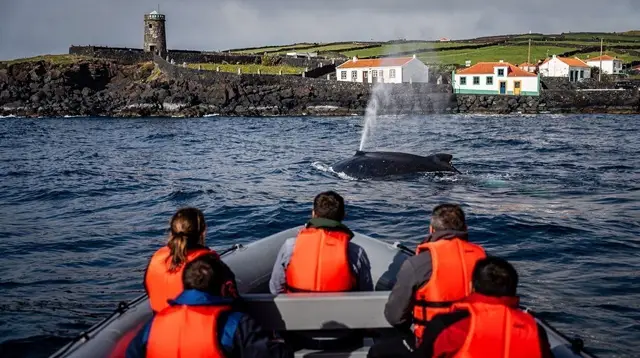
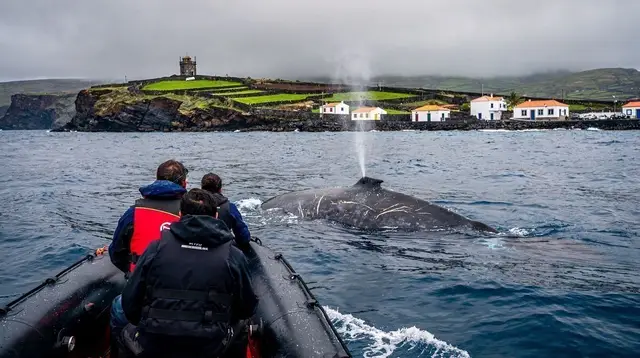
If you are planning a broader look at Faial from the water rather than the quay, the marina is also where boat trips depart, including whale and dolphin watching excursions that head out from the same harbour you have just been walking.
a whale and dolphin watching cruise departing directly from Horta’s marina is a natural way to pair the harbour walk with time on the water, and it leaves from a jetty a few minutes from Peter Café Sport itself.
Upstairs: The Scrimshaw Museum
Above the ground-floor bar, reached by a narrow staircase, Peter Café Sport keeps a small private museum devoted to scrimshaw — the craft of carving and engraving images into sperm whale teeth and bone. Most of the pieces on display were made by Azorean whalers during the decades when open-boat whaling was still practised from Faial and neighbouring Pico, in the long stretches between hunts when there was little else to occupy a crew’s hands.
The collection is compact rather than exhaustive: a handful of display cases, carefully lit, showing ships, whales, portraits and decorative motifs etched with remarkable patience into a material that no longer has any legal trade today. It takes most visitors well under an hour to see properly, and there is a small entry fee for the upper floor, separate from the bar below. It pairs naturally with a stop at the marina walls immediately outside — one is a record of whaling’s material culture, the other a record of the sailors who came after it.
Visitors curious about the wider whaling story behind the objects in the cases — the open boats, the lookout posts, the industry’s slow end across the archipel — will find that covered separately rather than here, since this page stays close to the marina and the café itself.
Planning Your Half-Day in Horta
The marina, the mural walk and Peter Café Sport combine easily into a self-contained half-day, and they slot naturally either side of Faial’s two headline sights, the Caldeira do Faial and the Capelinhos volcano, both of which need a car or a tour to reach.
| Stop | Suggested time | Cost |
|---|---|---|
| Walk the marina murals | 20–45 minutes | Free |
| Drink at Peter Café Sport | 30–60 minutes | Price of a drink |
| Scrimshaw museum upstairs | 20–40 minutes | Small entry fee |
| Total | Roughly 2–3 hours | — |
Because the marina sits right in the centre of Horta, most visitors do it on foot as a standalone stop, then drive or join a tour onward to the Capelinhos volcano or up to the Caldeira do Faial afterward. If you would rather not self-drive for the rest of the island, a guided option covering Faial’s main sights can be built around the same starting point.
a full-day guided tour of Faial departing from Horta typically begins near the marina and works in the Caldeira and Capelinhos alongside smaller stops, which suits visitors who want the harbour on foot and the rest of the island by vehicle on the same day.
For a shorter, walking-paced alternative that stays closer to town and the coastline around it, a guided walking tour of Horta and its trails with a local guide is worth considering if you would rather have context on the murals and the port’s history explained on the spot than read it on a plaque.
Divers and more adventurous swimmers occasionally combine the marina stop with time in the water nearby; Faial’s coastline off Horta is also a departure point for close encounters with sharks under professional supervision.
a supervised shark swimming excursion departing from Horta runs from the same harbour area, for visitors looking to extend their day on the water rather than only along the quay.
Beyond the Marina: Where to Go Next
Horta’s marina works well as an anchor point for the rest of a Faial day. From the harbour it is a short drive to the Caldeira do Faial, the island’s volcanic crater, and a slightly longer one out to the Capelinhos volcano at the island’s western tip, born from an eruption in 1957–1958 — both make sense as a second stop once the marina and café are done. Anyone planning several days on the island rather than a single afternoon should look at a fuller Faial destination guide or the broader Horta destination page for lodging and orientation.
Because Horta is also the main departure point for ferries to Pico, many visitors are here specifically en route to or from the Montanha do Pico or the island’s vineyards; the practicalities of that crossing are covered in a dedicated guide to the Pico–Faial ferry day trip, and a longer combined stay is mapped out in the five-day Pico and Faial itinerary. If you are relying on the ferry network more generally to move around the central group, the inter-island ferries guide is worth reading before you fix a schedule.
Sailors themselves, and the transatlantic tradition that fills the marina with paint every season, sit inside a much longer regional story that this page only touches on. Readers who want the fuller picture of Azorean whaling history, the industry the scrimshaw upstairs at Peter Café Sport belongs to, should turn to the Azores whaling history guide and the related blog piece on the archipel’s last whalers.
Those planning or dreaming about their own Atlantic crossing rather than just watching other people’s boats arrive will find more general context in the sailing and yachting in the Azores guide and the Azores boat tours overview, while whale watchers drawn here by the boats moored at the marina should start with the archipel-wide whale watching guide.
For a broader sense of what else fills a day in the town beyond the harbour, the Faial things-to-do page and the general city sightseeing category list further options nearby.
Frequently Asked Questions About Horta Marina and Peter Café Sport
What is the tradition of painted murals in Horta marina?
Since the 1960s, sailors who cross the Atlantic and dock in Horta have painted a picture on the marina’s quay walls, piers and steps — a Faial superstition holds that a boat which leaves without painting one risks bad luck at sea. Thousands of paintings now cover the harbour, repainted and added to every sailing season.
Why do sailors paint pictures on the ground in Horta?
Horta sits on the classic Atlantic crossing route between the Caribbean or the Azores and mainland Europe, so almost every yacht that makes the passage stops here to reprovision. The custom of leaving a painted mark grew out of that traffic: crews mark their boat’s name, flag and crossing date, and local superstition says skipping the ritual invites misfortune on the next leg.
Is the mural tradition found anywhere else in the Azores?
No. It is specific to Horta’s marina, tied to the port’s long history as the main Atlantic stopover for sailing yachts. You will not find an equivalent painted quay on São Miguel, Terceira, Pico or any other island in the archipel.
What is the Peter Café Sport known for?
Peter Café Sport is a bar on Horta’s waterfront, run by the same family since 1918, that became a legendary meeting point for transatlantic sailors, scientists and whalers. It is as much a maritime institution as a place to eat or drink, and it doubles as an unofficial information point for yacht crews.
What can I see in the scrimshaw museum upstairs?
The upper floor of Peter Café Sport houses a small private museum of scrimshaw — carved and engraved sperm whale teeth and bone, largely made by Azorean whalers in the decades before commercial whaling ended. It is one of the more unusual small museums on Faial and takes well under an hour to see.
How much time do I need for the marina and Peter Café Sport?
Budget two to three hours to walk the quay walls at a relaxed pace, look for boats’ murals from recent seasons, have a drink at Peter Café Sport and visit the scrimshaw museum upstairs. It fits comfortably as a half-day addition alongside the Caldeira do Faial or the Capelinhos volcano.
Is the marina free to visit?
Yes. Walking the quay and looking at the murals costs nothing. The only admission fee in the area is the small entry charge to the scrimshaw museum on the upper floor of Peter Café Sport; the ground-floor bar and marina itself are open to anyone.
When is the best time to see the murals being painted?
Crews paint their murals whenever they dock, which in practice means the marina fills up fastest from late spring through early autumn, when transatlantic sailing traffic peaks. Outside that window the paintings are still visible year-round, just with fewer boats freshly adding to them.
Seasonal experiences on GetYourGuide
Verified deep-linked GetYourGuide tours. Book through these links and we earn a small commission at no cost to you.
GetYourGuide does not provide a product photo for this activity — the image shows the meeting point, photographed by us.