The Crater You Can Drive Straight To
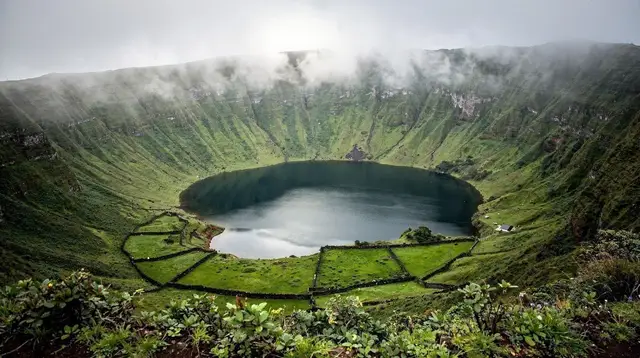
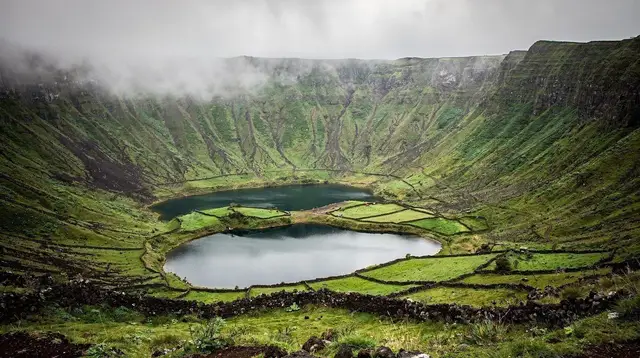
Faial’s defining landmark is not a beach, a marina, or a lava field by the sea. It is the enormous crater that sits at the very centre of the island, a bowl roughly 400 metres deep and about 1.5 kilometres across, ringed by a crest that a paved road can take you to without any hiking at all. That combination — a genuinely dramatic volcanic feature reachable in a rental car within twenty minutes of Horta — is what makes the Caldeira do Faial one of the easiest “big sights” to fit into a single day on the island.
This page covers the crater itself: what it is, how to reach the miradouro, what the rim trail through the Parque Natural do Faial involves, and how much time to actually set aside. It does not cover the Capelinhos volcano and its stark landscape from the 1957-58 eruption, which sits on the opposite side of the island and tells an entirely different story — see the dedicated Capelinhos volcano guide for that. It also does not cover Horta town and its marina, which has its own page. Think of this as the middle stop of a Faial day, between the port town and the western volcano.
What You’re Actually Looking At
The Caldeira do Faial formed when the summit of the island’s central volcano collapsed inward, leaving the wide, roughly circular depression visitors see today. Unlike some of the crater lakes elsewhere in the archipelago, this caldeira holds no permanent lake — it is a dry bowl, its steep inner walls covered in dense vegetation that has recolonised the volcanic slopes over the centuries. Cloud frequently pools inside the crater itself, drifting and clearing within minutes, which is part of what makes it such a rewarding place to photograph: the same viewpoint can look completely different twenty minutes apart.
The crater sits inside the Parque Natural do Faial, the protected area that covers Faial’s volcanic highlands, and the whole feature is part of the broader story told by the Azores Geopark, the UNESCO-recognised network that links volcanic sites across the archipelago. If you want the wider context of how the Caldeira do Faial fits alongside other volcanic craters and lava features on other islands, the guide to Azores volcanoes and craters is a useful companion read before or after your visit.
Getting to the Miradouro by Car
This is the part that makes the Caldeira do Faial so practical for a self-drive itinerary: there is no trailhead approach required to see it. A paved road climbs out of Horta into the island’s interior and ends at a car park right on the crater rim, at the Miradouro da Caldeira. From the car it’s a short, level walk to the railing overlooking the bowl.
Allow around 20 minutes of driving from central Horta, a little longer if you’re coming from the airport or from accommodation further along the coast. The road narrows and winds as it climbs, which is typical of Faial’s interior — take it slowly, especially if driving in the Azores for the first time, since visibility can drop fast if cloud is moving through. If you haven’t arranged car rental in the Azores yet, note that Faial’s car hire is separate from any other island’s, so book locally rather than assuming a mainland or Sao Miguel booking carries over.
Because the drive and the viewpoint together can be done in well under an hour, the Caldeira do Faial slots naturally between two other stops rather than needing to anchor a full day on its own — something worth keeping in mind if you’re mapping out things to do on Faial or comparing it against a longer stop in Horta.
Walking the Rim: The Parque Natural do Faial Trail
For visitors who want more than the roadside view, a marked trail follows the crest of the caldeira through the Parque Natural do Faial. Because the crater is roughly 1.5 kilometres across, a full loop around the rim is a genuine multi-hour undertaking rather than a quick stroll, with continuous ups and downs as the path traces the irregular edge of the crest and repeated views down into the bowl from slightly different angles each time.
Most visitors on a tight schedule instead walk a short section out from the miradouro and back — anywhere from 20 minutes to just over an hour — rather than attempting the complete circuit. If you do want the full loop, treat it the way you would any highland walk in the Azores: check the trail grading guide conventions before you go, and compare it against other options in the best hikes in the Azores guide if you’re deciding how to spend a hiking-focused day on the island.
Faial’s crater rim doesn’t carry the same fame as Sao Jorge’s faja hikes or the trails on Flores, but it rewards anyone willing to walk beyond the car park with a very different perspective on the same crater.
A practical note that applies to the whole of Faial’s highlands: cloud and fog can roll over the summit with little warning, the same “four seasons in a day” pattern that affects the rest of the archipelago. A clear crater view in the morning is genuinely no guarantee for the afternoon, so if photography is the priority, front-load your visit early in the day rather than saving it for later.
Caldeira do Faial vs Caldeira Velha: Don’t Mix These Up
This is the single most important distinction to get right before you visit, because the names are close enough to cause real confusion when planning across islands.
| Caldeira do Faial | Caldeira Velha | |
|---|---|---|
| Island | Faial | Sao Miguel |
| What it is | Dry volcanic crater, summit of the island | Landscaped thermal hot spring |
| Water | None — a dry bowl | Warm bathing pools and a waterfall |
| How you experience it | View from a rim miradouro, optional rim walk | Swim in the pools |
| Access | Free, paved road to the car park | Ticketed site with facilities |
If your itinerary mentions bathing in a crater, that is Caldeira Velha on a different island entirely, not this one — see the Azores hot springs guide if that’s what you’re actually after. The Caldeira do Faial is strictly a look-but-don’t-swim volcanic feature.
Fitting the Caldeira Into a Faial Day
Because it needs so little time, the Caldeira do Faial usually appears as one stop among several rather than the whole plan. A common structure for a self-drive day looks something like this:
| Time | Stop |
|---|---|
| Morning | Horta marina and town centre |
| Mid-morning | Drive up to the Caldeira do Faial miradouro |
| Late morning | Short rim walk, or straight back down |
| Afternoon | Drive to Capelinhos volcano and visitor centre |
| Late afternoon | Return to Horta |
This pairs naturally with a longer stay that also covers Pico via the short ferry crossing — see the Pico and Faial in 5 days itinerary if you’re planning a combined visit to both islands. If your trip is shorter and Faial is just one stop among several islands, check how many days in the Azores you actually need before locking in a schedule that’s too tight for the ferries and flights between islands.
Guided Tours and Alternatives to Driving Yourself
Not every visitor wants to navigate Faial’s winding interior roads alone, and a handful of Faial-based tours build the caldeira into a wider look at the island. A guided eco tour of Faial typically threads through the island’s natural sights, including the highland crater area, with a local guide explaining the volcanic geology as you go — useful if you’d rather listen than navigate. For a more general overview that covers the caldeira alongside other landmarks in a single loop, a guided car tour of Faial takes the driving out of your hands entirely.
Visitors basing themselves in Horta without their own transport sometimes opt for a full-day tour of the island departing from Horta, which bundles the crater visit into a longer day that can also take in Capelinhos and the coastline. None of these are strictly necessary if you’re comfortable driving yourself — the miradouro really is that accessible — but they remove the guesswork around timing and road conditions, particularly if fog is forecast.
Faial’s other headline activity is out on the water rather than up in the crater: the island is one of the archipelago’s main bases for whale and dolphin watching, and pairing a morning at the caldeira with an afternoon whale and dolphin watching cruise from Horta is a common way to combine the island’s volcanic interior with its marine wildlife on the same trip. For the fuller picture of what’s likely to be around and when, the whale watching in the Azores guide explains which species are resident and which only pass through seasonally, so you can set expectations before booking.
When to Go and What to Expect Weather-Wise
There’s no strict closed season for the Caldeira do Faial — the road and the miradouro are open year-round — but visibility is what makes or breaks the visit, and that varies more by weather than by calendar month. Late spring through early autumn (May to September) gives the best overall odds of a clear crater view, and mornings are consistently more reliable than afternoons once cloud has had time to build over the summit.
Outside that window, the crater is still worth a stop if you’re already on Faial and the weather looks cooperative, but don’t build a trip around guaranteed visibility in the wetter months of late autumn and winter. As with the rest of the archipelago, the safest approach is to check conditions on the day rather than planning purely by season — see Azores weather month by month and the general best time to visit the Azores guide for the bigger picture, and pack accordingly using the Azores packing list — a windproof layer earns its place at this altitude even in summer.
Frequently Asked Questions About Visiting the Caldeira do Faial
How long does it take to visit the Caldeira do Faial?
Seeing the crater from the roadside miradouro takes 30 to 45 minutes, including parking and a short walk to the rail. Walking a stretch of the rim trail through the Parque Natural do Faial turns it into a half-day outing, and circling the full rim takes even longer.
Is the Caldeira do Faial the same as Caldeira Velha in Sao Miguel?
No, and this is the single most common mix-up between the two. The Caldeira do Faial is a dry volcanic crater at the summit of Faial, with no water to bathe in. Caldeira Velha, on Sao Miguel, is a landscaped thermal spring with warm pools you can swim in. They share a name but nothing else.
Can you walk down into the crater?
There is no maintained path down into the crater floor for casual visitors. The public route is the miradouro on the rim and the marked trail that follows the crest around it, both of which look down into the crater rather than descending into it.
Is the Caldeira do Faial miradouro accessible by car?
Yes. A paved road climbs from Horta to a car park right at the crater rim, which is why it works well as a stop between other Faial sights even if you only have a spare hour.
What is the best time of day to visit?
Early morning is usually the most reliable, before cloud and fog build up over the summit later in the day. Faial’s interior highlands can fill with mist within an hour, the way weather changes quickly across the whole archipelago.
Is there an entrance fee?
No, the miradouro and the surrounding Parque Natural do Faial are open access with no ticket required. Only organised guided tours or transport you book separately carry a cost.
How long is the crater rim trail?
The marked trail circles the full crest of the caldeira, roughly 1.5 kilometres in diameter, so a complete loop is a multi-hour walk. Many visitors instead walk out and back for 20 to 40 minutes from the miradouro for crater views without committing to the whole circuit.
Can I combine the Caldeira do Faial with the Capelinhos volcano in one day?
Yes, and many self-drive visitors do exactly that, since both sit within a short drive of Horta on the same island. Capelinhos covers a completely different kind of volcanic story, so treat it as a separate stop rather than an extension of the caldeira visit.