Pico and Faial in 5 Days
Why Pico and Faial work as one trip
These two islands sit close enough that a ferry crossing between them takes about twenty minutes, and locals treat the trip the way other places treat a bus ride into town. Pico is the wine island and the mountain island — a stark, volcanic landscape stitched together with black stone walls. Faial is greener, gentler, and built around a working marina that has hosted transatlantic sailors for a century. Five days is enough to see both properly without racing between them, provided the one fixed point on the calendar — the Montanha do Pico ascent — gets booked before anything else.
This itinerary assumes a rental car on each island (car rentals here are separate; nothing carries over island to island), moderate fitness for one full day of hiking, and a mid-range budget that mixes self-catering or guesthouses with a handful of paid excursions.
Before you go: book the mountain first
Access to Montanha do Pico is contingented — a limited number of climbers are allowed on the trail each day, registration happens in advance through the mountain house, and every climber is issued a GPS tracker to return at the end. This is the single detail that can unravel an otherwise well-planned week: showing up on your assigned day to find the ascent full, or discovering that fog has closed the trail with no flexible day left to reschedule.
Book the mountain slot as soon as your flights are confirmed, then build the rest of this itinerary around it — not the other way around. We cover the reservation process and time slots separately; treat that step as homework to finish before day one below even starts.
Day 1: Arrival in Madalena and Pico’s wine country
Fly or ferry into Madalena, Pico’s main town, and use the arrival afternoon to get oriented rather than rushing into the highlands. Madalena’s waterfront faces Faial directly across the channel — on a clear afternoon you can see Horta from the harbor wall, which is a useful preview of tomorrow’s geography.
Once you’ve settled into a guesthouse, drive the short stretch toward Criação Velha, the best-preserved section of the UNESCO-listed Pico vineyard landscape. The currais here — small rectangular plots walled in with dry volcanic stone — were laid out from the 15th century onward to shield vines from salt wind, and the pattern of black walls against green vine leaves is unlike any other wine country in Europe. An hour of walking the paths between the plots, plus a stop at a local adega for a tasting, is a gentle way to shake off travel fatigue before the more demanding days ahead.
For dinner, stay in Madalena and get an early night — day two starts before sunrise.
Day 2: The Montanha do Pico ascent
This is the physically demanding day of the trip, and it deserves the whole day with no other plans layered on top. Report to the Casa da Montanha at your booked time; staff check you in, issue the GPS unit, and brief you on trail conditions before you set off.
The climb to 2,351 meters — the highest point in Portugal — takes most parties four to six hours round trip, longer if you continue past the crater rim to the Piquinho, the small final cone at the true summit. The terrain is loose volcanic rock the whole way, with no shade and frequently shifting weather; cloud can close in within minutes even on a clear morning. A certified guide is strongly recommended, especially for the exposed scramble up the Piquinho itself, and is close to essential if you’re aiming for a sunrise or overnight ascent rather than a daytime one.
Come back down to Madalena in the afternoon with legs that have earned a slow dinner and an early bed. If cloud or wind forces a cancellation on your booked day, this is also why building in Pico time before the ferry crossing matters — a spare day here can absorb a weather reschedule that a same-day itinerary can’t.
Day 3: Lajes do Pico, whaling history and whales
Drive south to Lajes do Pico, the island’s historic whaling port and still the reference point for whale watching in the archipelago today. The old vigias — clifftop lookout posts once used to spot the surfacing blows of sperm whales — are still staffed, now by marine biologists who radio directions to the boats below rather than to harpoon crews.
Sperm whales are resident here and reported most months of the year, alongside common and bottlenose dolphins; the great migratory rorquals pass mainly in spring, so don’t expect a summer whale-watching trip to mean the same thing a spring one does. Boats leave several times daily in season, and a whale watching trip out of Lajes do Pico is the natural way to spend the morning, ideally with the vigia system still doing the spotting work rather than a boat searching blind. No operator can guarantee a sighting, whatever the success-rate numbers on their booth window say — treat it as a very likely outcome, not a certainty.
In the afternoon, visit the Whaling Museum in Lajes area to see the flensing yards and factory buildings that put the morning’s boat trip in historical context, or if you’d rather stay on the water, a Pico whaling-heritage boat tour covers similar ground from the sea. For travelers who’d rather have someone else handle logistics for the whole day, a guided day tour around Pico can combine Lajes, the vineyards and a viewpoint stop into one outing. Overnight again in Madalena; the ferry to Faial leaves from there tomorrow.
Day 4: Ferry to Faial and Horta
Catch the Atlânticoline ferry from Madalena to Horta — a crossing of roughly twenty minutes that runs multiple times a day, year-round, making it the most dependable inter-island link in the whole archipelago. Cars can cross too, though many travelers prefer to leave their Pico rental behind and pick up a fresh one on arrival in Faial, since rentals here are booked island by island.
Spend the rest of the morning in Horta itself. The marina is the heart of the town: generations of transatlantic sailors have painted murals on the harbor walls before setting off again, a superstition-turned-tradition that now covers hundreds of meters of pavement and seawall. Stop into Peter Cafe Sport, the yachties’ bar that’s been serving this crowd since 1918, for a coffee or a gin and to look at the scrimshaw collection upstairs.
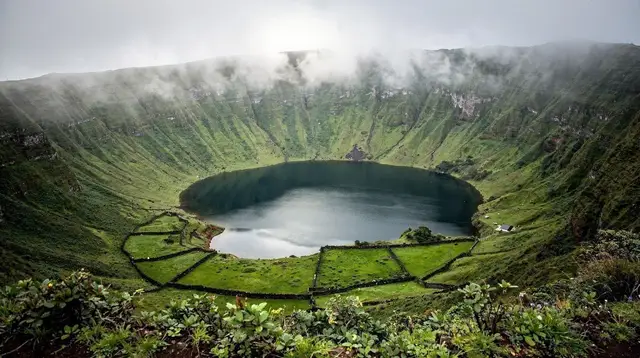
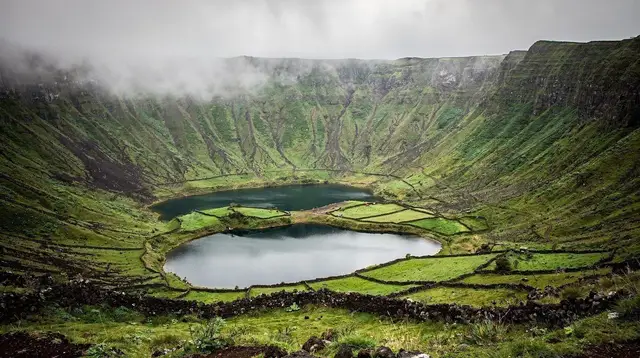
In the afternoon, drive out to the Capelinhos volcano site on the island’s western tip. This isn’t a historic ruin — the volcano erupted from the sea here in 1957–58, burying a lighthouse in ash and adding new land to the island in real time. The visitor center is built partly underground into the old ash field, and the walk out across the grey, lunar terrain to the buried lighthouse is one of the more striking short walks in the Azores. Round out the day at the Caldeira do Faial, the volcanic crater near the island’s center, if there’s daylight left, or save it for tomorrow morning.
Day 5: Faial’s crater, one more sea outing, and departure
Use the morning for whichever half of yesterday’s plan didn’t fit — the Caldeira do Faial crater rim, with its short walking trail and views down into the vegetated bowl, is worth the detour if you missed it.
If your flight or ferry timing allows, close out the trip with one more marine outing before leaving Faial: a whale and dolphin watching cruise from Horta covers similar waters to yesterday’s Pico trip but from the Faial side of the channel, or a half-day tour of Faial is a lower-key way to see the rest of the island — coastal viewpoints and villages you haven’t had time for — before heading to the airport.
Depending on the season, direct flights connect Horta back to Lisbon or to Ponta Delgada for onward travel; confirm which applies to your dates, since the Pico–Faial direct link to the mainland isn’t guaranteed year-round.
Where to base yourself
| Nights | Base | Why |
|---|---|---|
| 1–3 | Madalena, Pico | Closest town to the mountain house and the vineyard region |
| 4–5 | Horta, Faial | Walking distance to the marina, ferry terminal and Peter Cafe Sport |
Budget snapshot for this route
| Item | Approximate cost |
|---|---|
| Montanha do Pico ascent (crater rim) | 15 EUR, plus a refundable GPS deposit or waiver fee |
| Whale watching boat trip | Mid-range per person, varies by operator and season |
| Ferry, Madalena–Horta (foot passenger) | Low cost, several sailings daily |
| Car rental, per island | Booked separately for Pico and for Faial |
Treat all figures as the order of magnitude to plan around rather than a locked-in price — operators and the mountain house adjust rates from season to season.
Frequently asked questions about the Pico and Faial itinerary
Can I do Pico and Faial in fewer than 5 days?
You can compress it to 3–4 days by dropping either the wine country walk or one of the two whale-watching outings, but the Montanha do Pico ascent and its weather-dependent scheduling are the reason most visitors build in a spare day rather than cutting the trip shorter.
Do I need to book the Pico ascent before arriving?
Yes. Registration and a GPS-tracker checkout are required at the Casa da Montanha, spots are limited each day, and turning up without a reservation on a day you assumed was free is the most common way this itinerary goes wrong.
How does the ferry between Madalena and Horta work?
Atlânticoline runs the Madalena–Horta crossing year-round, several times a day, in about twenty minutes; it’s the most reliable inter-island link in the Azores, unlike routes to the wider central or western island groups, which are far more seasonal.
Will I definitely see whales on this trip?
No sighting is guaranteed on any single outing, though operators report high success rates across a season. Sperm whales and dolphins are resident near Pico and Faial for much of the year; the large migratory whales pass mainly in spring, so a summer trip is really a dolphin-and-sperm-whale trip, not a rorqual season.
Do I need one rental car or two for this itinerary?
Two, generally — car rentals on Pico and on Faial are separate arrangements, since no single company covers both islands, and the ferry crossing is usually done as a foot passenger with a fresh pickup on the other side.
What’s the hardest part of this itinerary physically?
The Montanha do Pico ascent, by a wide margin — four to six hours on loose volcanic terrain with no shade, more if you continue to the Piquinho summit cone. Everything else in this itinerary is moderate walking at most.
Is Capelinhos worth the detour on Faial?
Yes — it’s one of the few places in the world where you can walk across land that didn’t exist before a 1950s eruption, with a lighthouse still half-buried in ash as the visible marker of how much new ground the volcano added.
Registration and a GPS-tracker checkout are required at the Casa da Montanha, spots are limited each day, and turning up without a reservation on a day you assumed was free is the most common way this itinerary goes wrong.”
- question: “How does the ferry between Madalena and Horta work?” answer: “Atlânticoline runs the Madalena–Horta crossing year-round, several times a day, in about twenty minutes; it’s the most reliable inter-island link in the Azores, unlike routes to the wider central or western island groups, which are far more seasonal.”
- question: “Will I definitely see whales on this trip?” answer: “No sighting is guaranteed on any single outing, though operators report high success rates across a season.
Sperm whales and dolphins are resident near Pico and Faial for much of the year; the large migratory whales pass mainly in spring, so a summer trip is really a dolphin-and-sperm-whale trip, not a rorqual season.”
- question: “Do I need one rental car or two for this itinerary?” answer: “Two, generally — car rentals on Pico and on Faial are separate arrangements, since no single company covers both islands, and the ferry crossing is usually done as a foot passenger with a fresh pickup on the other side.”
- question: “What’s the hardest part of this itinerary physically?” answer: “The Montanha do Pico ascent, by a wide margin — four to six hours on loose volcanic terrain with no shade, more if you continue to the Piquinho summit cone.
Everything else in this itinerary is moderate walking at most.”
- question: “Is Capelinhos worth the detour on Faial?” answer: “Yes — it’s one of the few places in the world where you can walk across land that didn’t exist before a 1950s eruption, with a lighthouse still half-buried in ash as the visible marker of how much new ground the volcano added.”
tours.5 days
Verified deep-linked GetYourGuide tours. Book through these links and we earn a small commission at no cost to you.
GetYourGuide does not provide a product photo for this activity — the image shows the meeting point, photographed by us.