Pico Wine and the UNESCO Vineyard Landscape: A Tasting Guide
Where do you taste wine in Pico's UNESCO vineyard landscape?
Most tastings cluster around Madalena and Criação Velha, on Pico's western coast, where the Wine Museum (Museu do Vinho) anchors the protected currais landscape. Small producers and cooperative cellars nearby pour Verdelho and other volcanic-soil wines, often paired with a walk through the stone-walled plots themselves.
A vineyard landscape unlike any other in Europe
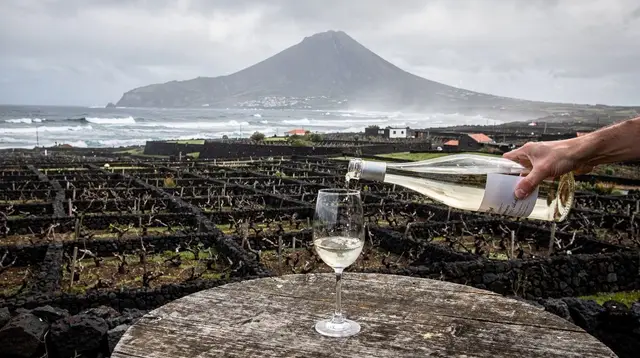
Before you drive out to Madalena or Criação Velha expecting rolling green rows of vines, reset the image. The Pico vineyard landscape has no slopes, no terraces, and almost no soil. What it has instead is black volcanic rock, cut into thousands of small rectangular plots, each fenced in by low walls of dry-stacked lava stone.
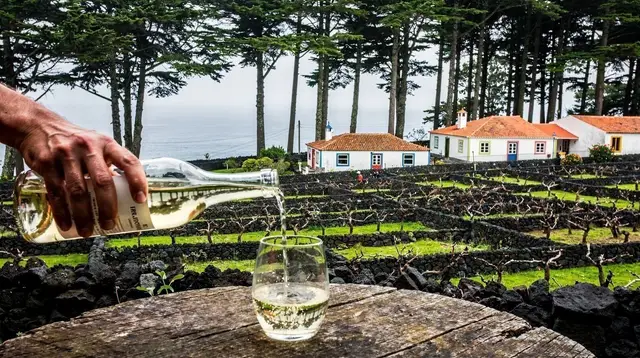
These walls are the whole point: they break the Atlantic wind and salt spray so the vines inside can survive at all, growing flat against the rock rather than climbing a trellis on a hillside. Locally these plots are called currais, the same word used elsewhere in Portuguese for a livestock pen, and the comparison is not accidental — the vines are corralled in for protection, just as animals would be.
UNESCO inscribed the Pico Island Vineyard Culture on the World Heritage list in 2004, recognising roughly 987 hectares of this stone-walled landscape as an outstanding example of how settlers adapted European winemaking to a genuinely hostile volcanic environment. The vines here go back to the 15th century, planted by early Azorean settlers who had almost no usable topsoil to work with and instead built a system entirely out of what the island gave them: broken basalt.
This guide covers the wine landscape and tasting circuit specifically — the currais themselves, the UNESCO site, and where in the Madalena and Criação Velha area to actually taste what grows there. For wine production across the wider Azores, see the Azores wine guide; for a narrative walk through the currais rather than a planning guide, see our blog account of walking Pico’s vineyards.
What a curral actually is, and why it looks nothing like the Douro
It is worth being precise here, because the mental image most travellers bring — sunlit hillside rows, a valley view over a river — is exactly wrong for Pico.
A curral is a small rectangular enclosure, typically 4 to 8 metres wide, walled on all sides with dry-stacked volcanic stone (no mortar, just fitted basalt fragments). Inside, vines grow low, often trained flat along the ground or on short supports, hugging the rock. There is no drainage engineering, no slope-following terracing, no soil depth in the way a mainland vineyard would count it. The wall’s job is not to hold back earth on a hillside; it is to blunt the wind and the salt-laden Atlantic air so the vine survives, and to retain what little heat the black rock absorbs during the day.
The result, seen from above, is a landscape that looks almost architectural: thousands of small stone-bordered cells laid edge to edge across the lava field near the coast, more like a giant mosaic than a farm. Walking through them at ground level feels different again — narrow paths between waist-high walls, black rock underfoot, the sea usually visible or audible close by.
The best-preserved concentrations of currais are around Criação Velha and Santa Luzia, both a short drive from Madalena on Pico’s western tip. This is the core of the UNESCO-protected zone, and it is also where the tasting circuit is densest.
The UNESCO designation, in plain terms
The World Heritage listing (whc.unesco.org, reference 1117) dates to 2004 and covers the Landscape of the Pico Island Vineyard Culture — the protected zone of currais, the access paths and walls that connect them, the small wine-related buildings scattered through the fields (former storage huts, a handful of windmills), and the settlement pattern that grew up around this specific form of agriculture.
It is a working landscape, not a museum piece: producers still farm inside currais that fall within the protected boundary, and grape harvest still happens on foot, plot by plot, because no machinery fits between the walls. That combination of active use and heritage protection is part of what makes a visit here different from touring a vineyard built for tourism — much of what you see is simply how wine is still made on Pico, not a reconstruction of how it used to be.
Where to taste: the Madalena and Criação Velha circuit
Almost everything relevant to a Pico wine visit sits within a few kilometres of Madalena, the small port town on the island’s west coast, and stretches out along the coast road toward Criação Velha and São Roque do Pico.
The Wine Museum (Museu do Vinho), in Madalena, is the natural starting point. It sits inside the former convent buildings and adjoining wine-production structures, and its permanent exhibition covers the history of Pico wine from the first plantings through the 19th-century Verdelho export trade to imperial Russia, the phylloxera and oidium outbreaks that later devastated production, and the landscape’s eventual UNESCO recognition. A small working curral is preserved on the museum grounds, useful for orienting yourself before walking the wider fields.
From the museum, several small producers and a regional cooperative operate tasting rooms within easy driving distance, generally pouring Verdelho — the historic signature white grape of Pico — alongside Arinto dos Açores and other varieties suited to volcanic soil. Tasting flights typically run through two or three whites and sometimes a fortified style. Because production volumes here are genuinely small (this is not an industrial wine region), opening hours at individual cellars can be irregular outside peak tour bookings, which is the practical argument for joining a scheduled tasting rather than turning up unannounced.
A short table of what the main formats look like in practice:
| Format | What’s included | Typical length |
|---|---|---|
| Museum visit only | Wine Museum exhibits, preserved curral on-site | 45–60 minutes |
| Guided currais walk + tasting | Walk through Criação Velha/Santa Luzia plots, one cellar tasting | 2–3 hours |
| All-inclusive vineyard and wine tour | Museum, currais walk, multiple tastings, often transport included | Half day |
| Combined Pico highlights tour | Vineyards plus other western Pico stops (Lajes do Pico, coastline) | Full day |
For travellers who want the walk and the tasting handled as one booking rather than assembled cellar by cellar, an all-inclusive UNESCO vineyard and wine tour covers the museum, a walk through the currais, and tastings in one outing. A lighter version focused purely on the tasting side is a wine and vineyards tour built around tasting rather than a full day of sightseeing.
Walking the currais independently versus joining a tour
Several stretches of the protected landscape near Criação Velha and Santa Luzia have marked paths and boardwalks that are open to independent walking, free of charge, at any time of day. If your main interest is photographing the stone-wall pattern or simply understanding the scale of the site, an independent walk covers that well, and it costs nothing beyond getting yourself there — a rental car is the practical way to do it, since Pico has no dense public transport network (see driving in the Azores and car rental in the Azores if you’re arranging that from elsewhere).
What an independent walk does not give you is access to working cellars, most of which don’t take walk-in visitors, and it leaves the grape varieties, the wall-building technique, and the history of the 19th-century export trade unexplained unless you’ve read up beforehand. A guided option such as a UNESCO vineyard landscape and wine heritage tour is built specifically to close that gap, pairing the walk with a guide who explains what you’re looking at and arranging cellar access that isn’t otherwise open to passers-by.
Fitting a wine visit into a wider day on Pico
Because the vineyard landscape sits on Pico’s west coast, it pairs naturally with other things-to-do in that part of the island rather than standing alone as a full-day plan for most visitors. Travellers based in Madalena can combine a morning museum-and-tasting visit with an afternoon toward Lajes do Pico, the island’s old whaling port, or toward the Montanha do Pico trailhead area if the peak ascent is also on the itinerary (that climb needs its own planning — see our Montanha do Pico climbing guide, since it requires registration and a quota system, not a walk-up).
For a broader single-outing option that covers vineyards alongside other Pico landmarks in one booking, a general Pico island tour or a highlights-focused Essence of Pico tour both typically route through the Madalena wine area as one stop among several, useful if wine tasting is a strong interest rather than the sole reason for your day.
Travellers arriving from Faial via the short Madalena–Horta ferry crossing — the most reliable inter-island link in the archipelago, running year-round several times a day — can realistically combine the crossing with a wine-focused afternoon on the same day; see the Pico–Faial day trip by ferry for how that timing works, and inter-island ferries in the Azores for the wider network.
If you’re staying multiple nights and want vineyards folded into a longer western-islands plan, the Pico and Faial in 5 days itinerary blocks out a full day for the wine landscape alongside the other western Pico sights.
The currais also sit inside the broader Azores Geopark network, a UNESCO Global Geopark designation covering volcanic sites across the archipelago; if the geological side of the story interests you as much as the wine, the Azores Geopark guide puts Pico’s vineyard landscape in that wider context.
What to pair it with, and what not to expect
A tasting flight of Verdelho pairs naturally with Azorean food more broadly — if you’re building out a food-focused day on the islands rather than a wine-only one, our Azorean food guide and the São Jorge cheese guide cover the other signature products worth seeking out, cheese in particular being a common pairing with Pico whites in local tasting menus.
Set expectations correctly before you go: this is a small-scale, low-volume wine region recovering a historic reputation, not a mass-tourism wine trail with dozens of open-door tasting rooms lining a road. Expect a handful of serious producers, a strong museum anchor, and a landscape that rewards slow walking more than a checklist approach. Good footwear matters — the ground between currais is uneven volcanic rock, not a groomed path, and there is little shade, so sun protection is worth carrying even on a cloudy-looking Azorean day given how quickly the weather here can shift.
Frequently asked questions about wine and the currais in Pico
What exactly is a curral in the Pico vineyard landscape?
A curral is a small rectangular plot, usually 4 to 8 metres wide, enclosed by low walls of dry-stacked volcanic stone. The walls block wind and salt spray so vines can survive at ground level, right on the lava rock, with no soil layer to speak of.
Why is the Pico vineyard landscape a UNESCO World Heritage Site?
UNESCO inscribed the landscape in 2004 for its roughly 987 hectares of currais built by Azorean settlers from the 15th century onward, an exceptional example of adapting European viticulture to a harsh volcanic Atlantic environment.
Where is the best place to taste wine near the currais?
The Madalena and Criação Velha area is the main hub: it holds the highest concentration of currais, the regional Wine Museum, and several small cellars where you can taste right after walking the stone-walled plots.
Can you just walk into the currais landscape without a guide?
Yes, several stretches near Criação Velha and Santa Luzia have open paths and boardwalks you can walk independently, but a guided tour adds context on the walls, the grape varieties, and access to cellars that don’t otherwise open to passers-by.
What wine is Pico known for?
Verdelho is the signature white grape, historically prized enough to be shipped to the courts of imperial Russia in the 19th century before phylloxera and oidium devastated the vineyards; today’s producers also work with Arinto dos Açores and other varieties suited to the volcanic soil.
Is the Pico vineyard landscape the same as a typical vineyard region like the Douro?
No. There are no terraced hillside rows here. The currais sit flat, at ground level, boxed in by stone walls for protection rather than arranged for drainage or slope drainage the way terraced regions are.
How long does a wine visit in Pico take?
A focused visit, museum plus one or two tastings and a walk through the currais, takes half a day. Most half- and full-day tours bundle it with other western Pico stops such as Lajes do Pico or the whaling history sites.
tours.wine-tasting
Verified deep-linked GetYourGuide tours. Book through these links and we earn a small commission at no cost to you.
GetYourGuide does not provide a product photo for this activity — the image shows the meeting point, photographed by us.