The Silence Between the Lava Walls
The First Wall I Touched
I did not expect the stone to be warm. It was late afternoon on Pico, the light already turning that flat gold it gets before the fog decides whether to come back, and I had put my hand on a wall without thinking about it — the way you touch a doorframe walking into a room you know well. The stone was rough, porous, unmistakably volcanic, and it had been holding heat from a sun that, an hour earlier, I hadn’t even noticed was strong enough to leave a trace.
That’s the thing nobody tells you about the currais: you don’t see the landscape first. You feel the wall.
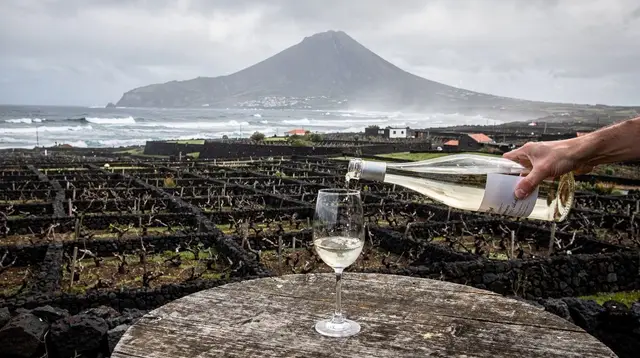
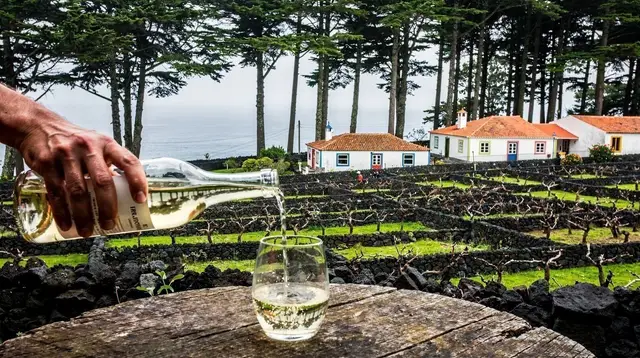
I’d driven out from Madalena with no plan beyond walking until I got tired, then walking a little more. The road narrows near the coast, and at some point the fields on either side stop being fields in any way I recognized — no hedges, no fences, just this endless low grid of black stone, waist-high, running in every direction like something drawn by a child who’d been given a ruler and told not to stop. Between the walls, vines. Not rows of vines climbing trellises the way I’d pictured a vineyard, but vines lying almost flat, hugging the ground, tucked into little rectangular pens no bigger than a small room.
I parked where the tarmac gave up and became gravel, and I walked.
Learning to Read the Grid
At first the currais just look repetitive — pen after pen after pen, a pattern that resists being photographed because no single frame captures what the whole is doing. But if you walk slowly enough, and I mean slower than feels natural, you start to notice that no two pens are quite the same size. Some are barely large enough for a handful of vines. Others stretch longer, following some fault line in the old lava flow that someone, centuries ago, decided was worth working around rather than through.
That’s when it hit me that this entire landscape is an argument with wind. Every wall exists because the Atlantic here doesn’t ask permission. Stand in an open stretch near the coast and the gusts come sideways, carrying salt you can taste on your lips within minutes. Duck into one of the currais, crouch even a little, and the air goes still almost immediately — the same trick a low garden wall performs, except multiplied across a whole hillside, and built from stone that someone split and stacked by hand out of a lava field that must have looked, to whoever started this project sometime in the 15th century, almost impossible to farm at all.
I found myself thinking about that person more than once. Whoever cleared the first curral here wasn’t decorating a coastline — the coastline wasn’t for looking at yet in the sense we mean it now. They were solving a problem: how do you grow anything at all on a shelf of cooled lava, a few kilometers from open ocean, with wind that flattens whatever it doesn’t shred? The answer, walked out over generations, was this grid. It’s still being maintained today, wall by wall, near São Roque do Pico and further along toward Lajes do Pico, which only made the whole thing feel less like a monument and more like a conversation still going on.
The walls thickest and most photographed cluster around Criação Velha, where the core of the UNESCO-listed landscape sits closest to the road — but the grid doesn’t stop or start there in any way you can feel on foot. It just keeps going, curral after curral, until the lava field runs out and the land turns to something else.
The Mountain, Always There
You cannot walk this landscape without the mountain watching you do it. Montanha do Pico sits behind everything here, and depending on the hour it’s either sharp-edged against a clean sky or dissolved almost entirely into cloud, so that you catch yourself checking on it the way you’d check on weather — which, in a sense, is exactly what you’re doing. I lost an embarrassing amount of time just standing at the edge of one curral, vines at my knees, watching the summit come and go behind fast-moving cloud while the ocean did something completely different fifty meters in the other direction, flat and silver and entirely unbothered.
There’s a particular quality of light in the hour before sunset out here, low enough that every wall throws a shadow twice its own height, and the whole grid suddenly reads as three-dimensional in a way it doesn’t at midday. The black stone stops looking uniform and starts showing all its variation — some pieces smooth where the lava cooled evenly, others jagged and vesicular, full of the little holes gas leaves behind when it’s trying to escape rock. I found a low section of wall, sat on it, and just watched the color shift for longer than I’d admit to anyone waiting on me for dinner.
Climb high enough on a clear day — and climbing Montanha do Pico is its own separate undertaking, regulated and not something to improvise — and the currais below flatten into exactly the kind of pattern I’d been trying and failing to photograph from ground level: a grid of black lines on green, running all the way to a coast that, from up there, looks impossibly thin.
What Stayed With Me
I won’t pretend I understood the winemaking side of any of this — how the grapes grown flat inside these pens end up in a glass, what the vintners actually do with the fruit that survives out here. That’s a different kind of visit, with a different kind of attention, and it deserves its own telling rather than a paragraph tacked onto a walk. What I can tell you is what the landscape does to your sense of scale.
From a distance, near Pico or from a boat offshore, the currais read as texture, almost like a woven fabric laid over the coast. Up close, walking between them, they become architecture — small, human-scaled, deliberate, repeated at a scale that starts to feel less like farmland and more like a monastery cloister with the roof removed.
I’ve since read enough to know this is one of the reasons the whole landscape carries UNESCO recognition, and I understand the reasoning in the way you understand a fact — but the reasoning isn’t what I remember walking back to the car in the dark. What I remember is the wind stopping the moment I stepped into a curral, and starting again the moment I stepped out.
I remember thinking that Lajes do Pico, further down the coast, watched whales from the land for generations before anyone hunted them from boats, and that this same patience — reading the land, working with what it gave you rather than against it — seems to run through the stone walls too. Later that evening, from a boat that had gone out to look for exactly those animals, I watched the coastline recede and picked out the pale grid of the currais from the water, and it looked, from there, almost like handwriting.
Faial sits close enough across the channel that on a clear evening you can see it from the Pico shoreline, and more than one visitor doing this walk ends up adding a day in Horta almost as an afterthought — the two islands pair naturally enough that some itineraries treat them as one trip rather than two, splitting a five-day Pico and Faial itinerary roughly down the middle. I never fully decided whether I preferred Pico’s stone grid or Faial’s marina — probably because they’re not really answering the same question.
If your trip allows for it, do this walk twice: once in full sun, once as the light drops. It is a different landscape both times, and neither version explains the other.
When to Go and How to Get There
There’s no single best month for this stretch of coast, but the general best-time guide for the Azores applies here as much as anywhere on Pico — expect wind regardless of season. Getting to the currais on your own schedule means having a car; driving in the Azores is straightforward on Pico specifically, with the coastal road running close enough to the vineyard grid that you can pull over wherever a wall catches your eye.
Questions Readers Ask About Walking Pico’s Currais
What exactly are the currais?
Currais are small rectangular plots enclosed by low walls of unmortared volcanic stone, built to shelter grapevines from wind and salt spray along Pico’s coast. Most are only a few meters across, and the surrounding grid stretches across large sections of the island’s western and southern shoreline.
How old is this landscape?
The practice of walling in vines this way dates back to around the 15th century, when early settlers began working the cooled lava fields near the coast. Many of the walls walked today have been rebuilt and maintained many times over, but the layout follows patterns set centuries ago.
Is walking through the currais physically difficult?
Not particularly — the ground is uneven and rocky underfoot, and there’s no shade, but there are no serious climbs involved in simply wandering the grid near the coast. Sturdy shoes and a windbreaker matter more than fitness.
Do I need to know anything about wine to enjoy the walk?
Not at all. The walk is about the landscape itself — the stone, the wind, the light, the mountain in the background — rather than about the grapes or the wine they eventually become. That side of the story belongs to a different kind of visit entirely.
Is the landscape different depending on the time of day?
Very much so. Midday light flattens the grid into a repeating pattern, while late afternoon light throws long shadows from every wall and brings out the texture of the stone. The mountain behind the landscape also shifts constantly between visible and cloud-covered.
Can I combine this walk with anything else nearby on Pico?
Many visitors pair a walk through the currais with time along the coast near Lajes do Pico, historically tied to the island’s whaling and whale-watching traditions, or with an evening boat trip once the light has gone.
watching for whale spouts from a shoreside lookout with a Pico guide after an afternoon among the vines turned out to be the right way to end that particular day — one kind of patience following another. For those traveling as a small group, a private whale and dolphin expedition between Pico and Faial stretches that same instinct for reading the water out onto the boat itself, and a more classic cetacean watching boat trip is an easy way to close a day that began among the lava walls.
For the practical side of visiting the vineyards — what to look for, what the wine tastes like, how the landscape is organized for visitors — that belongs in its own guide to Pico’s UNESCO vineyards rather than in this walk, and the wider Azores wine guide covers the other islands making wine under similar conditions. For now, I’d just say: give yourself more time among the currais than you think you need, and let the mountain decide when the light is done for the day.
tours.wine-tasting
Verified deep-linked GetYourGuide tours. Book through these links and we earn a small commission at no cost to you.
GetYourGuide does not provide a product photo for this activity — the image shows the meeting point, photographed by us.