Pico vs Faial: How to Split Your Time Between the Two
Should I visit Pico or Faial, or both?
Visit both — they are opposite halves of the same trip, not competing choices. Pico is volcanic and agricultural (the mountain, the UNESCO wine landscape), Faial is maritime and portuary (Horta marina, Peter Cafe Sport). A 30-minute ferry links Madalena and Horta year-round, so most visitors base in one and day-trip to the other, or split a short stay roughly in half.
Two Islands, One Ferry, Opposite Personalities
Pico and Faial sit close enough that a ferry crosses between them in about half an hour, and most itineraries for the Azores’ central group put both on the same list without much thought. That proximity creates a common assumption: that Pico and Faial are essentially variations on the same island, worth visiting together mostly because it is convenient. They are not variations on anything.
Pico is a working volcano turned wine country, built around a mountain and a UNESCO-listed patchwork of lava-stone vineyards. Faial is a port island, shaped for three centuries by transatlantic sailors, whalers, and the marina at Horta that still fills every summer with yachts crossing the Atlantic. The question worth answering before you book is not which island to choose over the other, but how to divide your nights between two places that do genuinely different things well.
This guide is about that split — how much time each island earns, what you would miss by rushing either one, and how to sequence a stay so the volcano and the vineyards on one side, and the marina and the harbour town on the other, both get a fair share of your itinerary. It does not cover the logistics of a same-day ferry crossing between the two, which has its own guide, and it does not attempt to replace the dedicated pages on each island’s full range of things to do.
It also assumes you have already decided the central group deserves a place on your itinerary in the first place. If that decision is still open, our guide to choosing which Azores island to visit and our piece on how many days the Azores as a whole deserve cover the broader planning questions this page leaves to one side.
At a Glance
| Pico | Faial | |
|---|---|---|
| Defining feature | Montanha do Pico, 2,351 m, Portugal’s highest point | Marina at Horta, Atlantic sailing crossroads |
| Landscape identity | Volcanic cone, lava-stone wine currais | Sheltered harbour, Caldeira crater, Capelinhos coast |
| UNESCO status | Pico Island Vineyard Culture (2004) | — |
| Main town | Madalena, and the port of Lajes do Pico | Horta |
| Signature activity | Climbing the mountain, wine tasting among the currais | Walking the marina murals, a drink at Peter Cafe Sport |
| Whale-watching departures | Lajes do Pico, historic vigia tradition | Horta, most common visitor departure point |
| Getting around | Car close to essential | Horta itself is walkable; car needed beyond it |
| Best paired with | Faial, São Jorge (the “Triangle”) | Pico, São Jorge (the “Triangle”) |
What Pico Is Actually For
Pico’s identity starts with its shape. The island is essentially one long volcanic ridge rising to a single, unmistakable cone that dominates every view across the channel from Faial and São Jorge. That cone, the Montanha do Pico, is Portugal’s highest point at 2,351 metres, and climbing it is the island’s headline activity for travellers who plan around it.
It is not, however, an open trail — ascents start from the Casa da Montanha, require registration and a quota, and end with the return of a GPS tracker handed out at the base. If the mountain is on your list, our climbing guide covers what the climb actually involves, and a five-day Pico and Faial itinerary shows how to build a full stay around it.
Below the mountain, Pico’s other defining feature is entirely different in character: a landscape of small, rectangular plots called currais, walled off from Atlantic wind and salt spray by low black stone enclosures built from the island’s own lava rock. This is the Pico Island Vineyard Culture, inscribed by UNESCO in 2004, and its best-preserved sections sit around Criação Velha and Santa Luzia, not far from Madalena.
Wine has been made here since the fifteenth century, and tasting it inside the currais themselves is one of the few Azorean experiences that could not happen anywhere else in the archipelago. Our guide to Pico’s wine and UNESCO vineyards goes deeper into the vineyard landscape and how to visit it properly, and a guided tasting is worth booking rather than improvising — a wine-focused tour through Pico’s UNESCO vineyards covers the currais and the tasting in one outing.
Pico also carries the older, harder history of the Azores’ whaling era. Lajes do Pico was one of the archipelago’s principal whaling ports, and the tradition of the vigia — a lookout stationed on high ground scanning the sea for a cachalot’s spout — began here and continues today in a very different form, now guiding whale-watching boats rather than whaling ships. Visitors who want that history alongside the modern activity can combine both: a whaling-history-themed boat tour departing Lajes do Pico puts the island’s maritime past in context before or after time on the water looking for the same animals the old whalers once hunted.
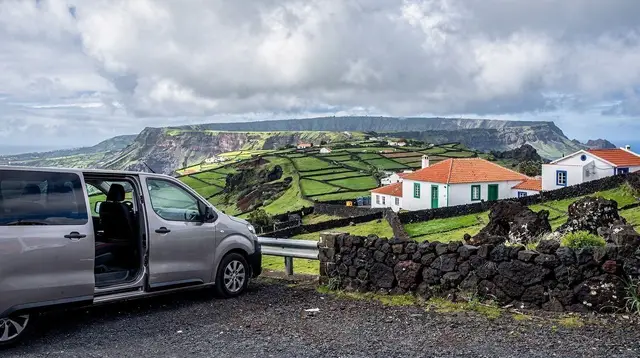
Practically, Pico asks for a car and a slower rhythm. Distances between Madalena, the vineyard area, and São Roque do Pico on the north coast are short, but the villages and the currais reward wandering rather than a checklist pace. /things-to-do/pico/ and Madalena are useful starting points for laying out a base.
What Faial Is Actually For
Faial reads almost like a mirror image of Pico: where Pico is inward and agricultural, Faial is outward and maritime. Its centre of gravity is Horta, a working port town built around a marina that has functioned for decades as one of the key stopover points for yachts crossing the Atlantic between Europe and the Caribbean or the Americas.
Sailors traditionally paint a mural on the marina’s quayside before departing, on the belief — taken seriously enough that almost everyone still follows it — that skipping the tradition brings bad luck on the crossing ahead. The result is a harbour wall covered in thousands of individually painted names, dates, and boat crests, a kind of open-air record of who has passed through. Our guide to Horta’s marina and Peter Cafe Sport covers the marina and the walking route through it in full.
Just off the marina sits Peter Cafe Sport, a bar that has served sailors, scientists, and whalers since 1918 and doubles as an informal clearing house of Atlantic sailing information — weather, routes, repairs — passed along at the counter for generations. It is a stop worth building time around rather than squeezing in.
Faial’s other landmark could not be more different in tone: the Capelinhos volcano, born from a submarine eruption in 1957–58 that buried a lighthouse in ash and added new land to the island’s western tip. The site today is a stark, grey, almost lunar landscape, paired with an interpretation centre built partly underground beneath the old lighthouse. It is one of the more visually striking single stops in the whole archipelago, and unlike the Montanha do Pico ascent, it requires no registration or quota — just a visit. Above Horta, the Caldeira do Faial, the island’s own volcanic crater, adds a short, rewarding walk with views back down over the town and across to Pico’s cone.
Faial rewards travellers who like to walk more than drive. Horta itself is compact and walkable, and the marina, the town centre, and Peter Cafe Sport sit within easy reach of each other. A car becomes useful only once you head out to Capelinhos or the Caldeira. /things-to-do/faial/ and Horta lay out the fuller range of what the island offers beyond these highlights, and Capelinhos and Caldeira do Faial cover those two sites specifically.
How to Split Your Nights
There is no single correct ratio, but a few patterns work reliably for travellers arriving with the central group already decided:
- Five or six nights across both islands: two to three nights each, based in Madalena or nearby on Pico and in Horta on Faial. This is enough time to climb or at least attempt the mountain, spend a slow half-day among the currais, and still give Horta’s marina and Capelinhos proper attention rather than a rushed afternoon.
- A shorter three- or four-night stay: base on whichever island’s headline draw matters more to you, and cross for a single day to see the other. A traveller prioritising the mountain and the vineyards bases on Pico and day-trips into Horta; a traveller prioritising the marina and sailing culture does the reverse.
- Pico first, then Faial, tends to work slightly better than the other order for travellers doing the mountain climb, since an early attempt gives a weather backup day before moving on — Pico’s upper slopes are prone to sudden cloud, and a second morning in reserve is worth having before committing to the crossing.
Whichever split you choose, avoid the temptation to treat either island as a half-day stop squeezed around the other. Pico’s vineyards and Faial’s marina both ask for unhurried time to actually land; neither is built for a drive-through visit.
Since almost every plan above needs a rental car on at least one of the two islands, sort that out before arriving rather than after: our guide to car rental in the Azores and our notes on driving conditions cover booking ahead and what the roads on islands like Pico are actually like.
Getting Between Them
The short version: a ferry runs between Madalena on Pico and Horta on Faial, takes about thirty minutes, and operates multiple times a day, year-round — the single most reliable inter-island connection in the Azores, alongside the equally consistent link to São Jorge that together locals call the Triangle. That reliability is precisely what makes splitting time between Pico and Faial so straightforward compared with reaching the western or eastern groups.
For the full mechanics of planning a same-day round trip, timetables, and what to do if you want to see both islands without changing hotels, see our Pico–Faial day-trip guide and our guide to inter-island ferries — this guide is deliberately about how to allocate your nights, not about the crossing itself.
Many visitors extend the pairing into a full “Triangle” itinerary by adding São Jorge, reachable by the same ferry network and known above all for its fajãs — see our guide to São Jorge’s fajã hikes for what that island adds. A ten-day, three-island itinerary is one way to fit all three into a single trip without shortchanging any of them.
Activities That Work on Either Side of the Channel
A handful of experiences are genuinely shared between the two islands rather than exclusive to one, which makes them useful anchors regardless of how you split your stay. Whale and dolphin watching is the clearest example: boats operate from both Lajes do Pico and Horta into the same channel, and sightings depend far more on the day’s conditions and the season than on the departure port.
A private outing such as the private whale and dolphin expedition departing from either Pico or Faial can be booked from whichever island you happen to be based on, and a shore-based guided whale lookout session is a lower-key alternative for a morning when a boat trip does not fit the schedule.
For travellers who want a taste of both islands’ landscapes without renting separately on each, a combined buggy tour covering terrain on both Pico and Faial is one of the few activities built explicitly around the pairing rather than around one island alone. Our whale-watching guide and our piece on Azores whaling history cover the wider context for both activities.
The Practical Verdict
Treat Pico and Faial as two chapters of the same central-group stay rather than as alternatives. Pico gives you the volcano, the quota-limited climb, and a UNESCO wine landscape unlike anything else in the archipelago. Faial gives you a working Atlantic harbour, its painted marina wall, a bar with a hundred years of sailing history behind its counter, and a volcanic coastline barely seventy years old.
Skipping either one to spend extra time on the other is less a matter of missing attractions and more a matter of missing an entire register of what the Azores are — agricultural and volcanic on one hand, maritime and portuary on the other. A car on Pico, comfortable shoes in Horta, and a ferry crossing in between is really all the planning this pairing needs.
Pico and Faial: Frequently Asked Questions
Is Pico or Faial better for a first visit to the Azores?
Neither replaces the other. If your central-group time is short, base on the island whose main draw matters more to you — the Montanha do Pico ascent and the wine landscape on Pico, or the sailing and marina culture of Horta on Faial — and cross for a day to see the rest.
How many nights should I spend on each island?
For a five- or six-night stay in the central group, two to three nights per island works well. Pico rewards a slower pace around Madalena and the vineyards of Criação Velha and Santa Luzia; Faial’s Horta can be seen more compactly, with a half-day left over for Capelinhos.
Is Faial just a stopover on the way to Pico?
No. Horta’s marina, its painted quaysides, and the Capelinhos volcano site are destinations in their own right, not a waiting room before the ferry to Pico.
Do Pico and Faial share the same kind of scenery?
Not really. Pico is dominated by its volcanic cone and the stone-walled currais of its wine landscape; Faial’s identity is built around its sheltered harbour, the Caldeira crater above Horta, and the stark, ash-grey Capelinhos coastline.
Which island has better whale watching, Pico or Faial?
Both operate boats into the same channel between the two islands, and sightings depend more on the day and the season than on which port you leave from. Pico’s port of Lajes do Pico carries the older whaling and vigia tradition; Horta on Faial is simply the more common departure point for visitors already staying there.
Can I see Pico and Faial without renting a car on both islands?
It is possible for Horta itself, which is walkable, but a car is close to essential on Pico to reach the vineyards, the Casa da Montanha, and villages like São Roque do Pico. Most visitors rent separately on each island rather than trying to share one vehicle across the ferry.
Is the ferry between Pico and Faial reliable?
The Madalena–Horta crossing is the most dependable inter-island link in the Azores, running year-round, multiple times a day. It is part of what locals call the Triangle with São Jorge, the one route in the archipelago not routinely disrupted by season.
Popular Azores experiences on GetYourGuide
Verified deep-linked GetYourGuide tours. Book through these links and we earn a small commission at no cost to you.
GetYourGuide does not provide a product photo for this activity — the image shows the meeting point, photographed by us.