10 Days in the Azores: São Miguel, Pico and Faial
Why three islands in ten days works
This is a flight-plus-ferry route for a traveller with ten real days and a moderate pace: five days based on São Miguel, then a short inter-island flight to Pico for three days, then the frequent Madalena–Horta ferry across to Faial for the final two. It is built around one flight in, one short inter-island flight, one short ferry crossing, and one flight home — not a chain of daily island-hops. If ten days feels tight for your travel style, the fourteen-day version covers a fourth island at a gentler pace, and if you only have a week, the two-island itinerary drops Faial and stays on São Miguel and Pico.
A quick note on the middle leg, because it is the most common planning mistake on this route: Pico and Faial are connected by ferry, not by plane. The short, scenic Atlânticoline crossing between Madalena and Horta runs several times a day, year-round, in about 30 minutes. The inter-island flights on this trip are reserved for the longer hop to and from São Miguel — flying between Pico and Faial would mean skipping the best short crossing in the archipelago. For the full mechanics of that crossing — timetables, where to buy tickets, what to do with a rental car — see our dedicated Pico–Faial ferry guide.
| Leg | Mode | Approx. time |
|---|---|---|
| Home → Ponta Delgada, São Miguel | Flight | Varies by origin |
| Ponta Delgada → Pico | Inter-island flight (SATA Air Açores) | About 45 minutes |
| Madalena (Pico) → Horta (Faial) | Ferry (Atlânticoline) | About 30 minutes |
| Horta → Ponta Delgada → home | Flight(s) | Varies; onward leg often seasonal |
Remember the clock as you land: the Azores run on UTC-1, one hour behind mainland Portugal, which matters for anyone connecting through Lisbon.
Day 1: Arrival in Ponta Delgada, São Miguel
Land in Ponta Delgada, collect a rental car — see our car rental guide for what to expect island by island — and spend the afternoon easing in with a walk through the historic centre: the black-and-white basalt paving, the city gates, the marina. Keep expectations light for day one; jet lag and a new time zone are real. If there is energy left, an early evening slot with the Azores Whaling Heritage Tour is a good, low-effort introduction to the archipelago’s whaling history before the more active days ahead.
Day 2: Sete Cidades crater lakes
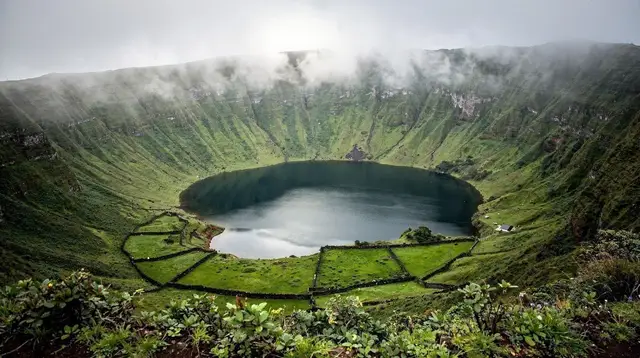
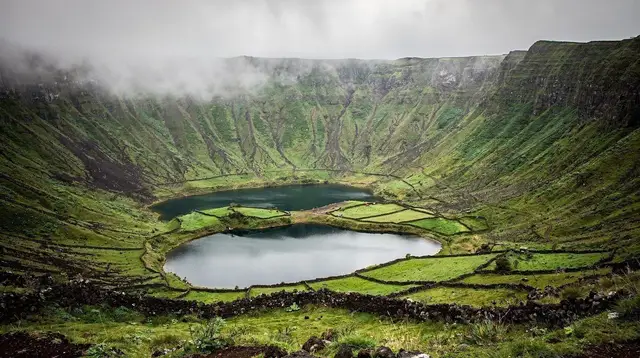
A full day at Sete Cidades, the twin volcanic lakes framed by a single crater rim — one lake often reads blue, the other green, depending on light and angle. Walk a section of the rim trail if the weather cooperates, or drive the viewpoints if cloud is low; at altitude, fog can roll in fast on São Miguel, so build in flexibility rather than a fixed itinerary for this day.
Day 3: Furnas — hot springs and cozido
Drive to Furnas for a day built around the valley’s geothermal activity. Soak at Terra Nostra Park’s iron-rich thermal pool or at Poça da Dona Beija — pack a dark swimsuit and a towel you do not mind staining, since the iron-rich water discolours light fabric. For lunch, book a cozido das Furnas 24 to 48 hours ahead: it is cooked for six to seven hours in the volcanic soil and served only at midday, never as a walk-in order.
Day 4: Lagoa do Fogo and the east
Head to Lagoa do Fogo, the crater lake sitting inside a nature reserve with no road down to the water — reaching the shoreline means a hike, while the roadside viewpoint is enough for most visitors on a moderate-pace trip. In the afternoon, swing by the Gorreana tea plantation, Europe’s oldest working tea estate, for a walk through the fields and a free tasting.
Day 5: Free morning, flight to Pico
Use the morning as a buffer — Furnas and Sete Cidades both reward a second look, or simply pack and return the São Miguel rental car ahead of the afternoon flight. Take the short SATA Air Açores hop from Ponta Delgada to Pico; flights on this route run daily but are worth booking early in high season. Arrive in Madalena, pick up a Pico rental car, and settle in for the evening.
Day 6: Wine country and Montanha do Pico views
Spend the morning in the UNESCO-listed vineyard landscape around Madalena, walking among the currais — the small lava-stone-walled plots that have sheltered vines here since the 15th century. For context on the wine itself, our Pico wine and UNESCO vineyards guide is worth reading the night before.
In the afternoon, drive up toward Montanha do Pico for the view from below — the summit climb itself is a full day (see Day 7) and requires advance registration, so today is for orientation, not the ascent. A guided outing such as Pico: Day Tour Get to Know Pico Island with a Local Guide covers both the vineyards and the mountain approach without you needing to plan the logistics yourself.
Day 7: Lajes do Pico and whale-watching heritage
Drive to Lajes do Pico, the island’s historic whaling port and the traditional base for the vigias — clifftop lookout posts once used to spot sperm whale blows, still staffed today by guides who radio sightings to boats. Book a morning outing with Whale Lookout Tour with Guide for a realistic shot at the archipelago’s resident sperm whales and dolphins — no operator can promise a sighting, but the vigia method genuinely improves the odds.
Spend the rest of the day around the port town, where whaling-era buildings and small museums fill in the history behind the morning’s outing. For a fuller sense of the species and seasons involved, see our whale-watching in the Azores guide.
Day 8: Ferry to Faial, afternoon in Horta
Return the Pico rental car in Madalena and take the Atlânticoline ferry across to Horta — about half an hour, with cars carried on the same crossing if you are renting separately on Faial rather than bringing one over. Pick up a Faial rental car on arrival and spend the afternoon at Horta’s marina, tracing the painted murals left by generations of transatlantic sailors and stopping at the Peter Café Sport, the port’s storied sailors’ bar. Our Horta marina and Peter Café Sport guide is a good companion for the walk.
Day 9: Capelinhos and the Caldeira do Faial
A full day on Faial itself: the Capelinhos volcano, born from an undersea eruption in 1957-1958, whose lighthouse still stands half-buried in ash-grey pumice, and the Caldeira do Faial, the island’s own central crater, ringed by a rim walk when weather allows. A Faial Island: Guided Car Tour is a practical way to cover both sites plus the island’s quieter viewpoints in a single day without second-guessing the drive yourself, especially given how quickly fog can settle over Faial’s high ground.
Day 10: Horta by boat, then home
Close the trip on the water rather than the road: a Horta: Whale and Dolphin Watching Cruise gives one last chance at sperm whales, common dolphins or bottlenose dolphins from Faial’s own departure point.
Return the rental car in Horta in time for the flight back to Ponta Delgada and onward home — a direct Horta–Lisbon flight exists in some seasons but is not year-round, so check your specific dates before assuming it as the return leg. For the wider set of inter- island flight patterns behind this trip, see our SATA inter-island flights guide and the companion inter-island ferries guide.
Practical notes for this route
| Item | Note |
|---|---|
| Car rentals | Three separate bookings — São Miguel, Pico, Faial — not one continuous rental |
| Time zone | Azores run UTC-1, one hour behind mainland Portugal |
| Ferry vs flight | Pico–Faial is a ferry crossing; only the São Miguel legs are flights |
| Montanha do Pico | Registration, daily quota and a GPS tracker are required — plan Day 6 as approach only |
| Cozido das Furnas | Book 24–48 hours ahead (48–72 in July–August); lunch service only |
This ten-day frame assumes a moderate pace and a mid-range budget; for a sense of how the daily spend breaks down across accommodation, car hire, meals and activities, see our Azores daily budget guide. If you are still weighing whether three islands in ten days is the right call versus staying on one island longer, our which Azores island to visit and how many days in the Azores guides are the right next stop before you book flights.
FAQs about the São Miguel–Pico–Faial ten-day route
Do I need to fly between Pico and Faial?
No. Pico and Faial are linked by a short, frequent Atlânticoline ferry between Madalena and Horta, roughly 30 minutes and running year-round several times a day. The two short flights on this route are Ponta Delgada to Pico at the start of island number two, and Horta back to Ponta Delgada at the end.
How long is the ferry between Pico and Faial?
The Madalena to Horta crossing takes about half an hour and operates all year, unlike the wider central-group ferry network, which is largely a June-to-September service. It is the single most reliable inter-island link in the archipelago.
Is ten days too rushed for São Miguel, Pico and Faial?
Ten days is a comfortable, moderate pace for this combination: roughly five days on São Miguel, three on Pico and two on Faial, with a short flight and one ferry crossing rather than a packed hop-by-hop schedule. It leaves room for weather delays, which are common in the Azores.
Do I need a rental car on all three islands?
Yes, practically speaking. Each island’s car hire is booked separately, and public transport between villages is limited, so this itinerary assumes a car on São Miguel, a car on Pico, and a car on Faial rather than one continuous rental.
What is the best time of year for this route?
Late spring through summer works well: hydrangeas are building toward full bloom from June, whale and dolphin sightings are strong, and July-August are statistically the driest months, though rain at some point most days should still be expected.
Can I see whales on both São Miguel and Pico?
Yes. Resident species such as sperm whales, common dolphins and bottlenose dolphins are seen from boats out of both islands for much of the year, while the great migratory rorquals pass mostly in spring. No operator can guarantee a sighting on a single outing.
Should I book the Montanha do Pico climb in advance?
Yes. The ascent requires registration with the Casa da Montanha, daily climber numbers are capped, and every hiker is issued a GPS tracker that must be returned at the end, so this is not a walk-up trail.
Is ten days enough to see the hydrangeas in bloom?
It depends on the month. Hydrangeas typically start flowering in May-June and reach full bloom in July-August, so a trip timed for mid-summer sees them at their best, while a late-May or September visit may catch only the beginning or the tail end.
tours.10 days
Verified deep-linked GetYourGuide tours. Book through these links and we earn a small commission at no cost to you.
GetYourGuide does not provide a product photo for this activity — the image shows the meeting point, photographed by us.