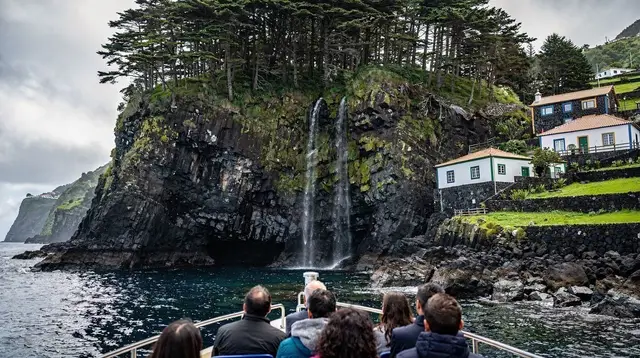
Pico to Faial as a Day Trip: The Ferry Reality
Can you do Pico to Faial as a day trip by ferry?
Yes — the Madalena-Horta crossing takes about 30 minutes and runs several times a day, every day of the year, so a same-day round trip is realistic in settled weather. Outside the summer months, Atlantic swell can thin out or cancel sailings with little warning, so build in a buffer rather than trusting a fixed timetable.
The Short Crossing That Makes Island-Hopping Easy
Of all the inter-island links in the Azores, none is easier to use casually than the one between Pico and Faial. Atlânticoline runs the Madalena-Horta ferry across the strait that separates the two islands, and the crossing itself takes only about 30 minutes — closer to a harbor shuttle than an open-ocean voyage. Together with São Jorge, Pico and Faial form what locals call the “Triangle,” the one cluster of islands in the archipelago where boats connect year-round rather than only in the warmer months.
That short crossing time is what makes a genuine day trip possible. You are not committing to an overnight stay just to see Horta’s marina from Pico, or to walk the black lava flats of Capelinhos from a base in Madalena. In practice, though, “possible” and “guaranteed” are different claims, and this guide is about the difference: how often the ferry actually runs, how much time you really get on the other island once you subtract the walk to and from the terminal, and — the part most itineraries skip — why the sea, not the printed timetable, has the final say outside summer.
If you want the wider picture of how ferries connect all nine islands, that belongs in inter-island transport planning rather than here. This page stays narrowly on one question: should you build a Pico-Faial (or Faial-Pico) day trip into your stay, and how do you make it work without losing a day to a cancelled sailing.
How the Madalena-Horta Ferry Actually Works
The route is simple to describe: small passenger ferries shuttle between the terminal at Madalena, on Pico’s northwest coast, and the marina town of Horta, on Faial. Atlânticoline (atlanticoline.pt) operates the service, and because the Triangle route runs all year, it is structurally different from the Terceira-Graciosa or the wider central-group network, which only operates from June to September.
A few practical points worth knowing before you plan around it:
- Crossing time: about 30 minutes, dock to dock.
- Frequency: several sailings a day, with more departures in the summer high season and a reduced schedule the rest of the year.
- Who it’s built for: foot passengers. This is not a car ferry route in the way some longer Azorean crossings are; travelers doing a day trip should plan to walk from each terminal into town, or arrange a taxi or pre-booked transfer.
- Where to check exact times: always the operator’s current timetable, not a fixed schedule copied from an old itinerary — departures shift by season and by weather.
Because both Madalena and Horta are compact harbor towns, the ferry terminal sits close to the center in each case. That matters for a day trip: you lose very little time getting from the dock to the first thing you actually came to see, whether that’s a glass of Pico wine or a walk along Horta’s breakwater.
Typical Pico-Faial Day: What the Hours Look Like
| Time (approximate) | Activity |
|---|---|
| 8:00–9:00 | Early ferry from your base island |
| 9:00–15:00/16:00 | Time on the other island |
| 15:00–17:00 | Return ferry (earlier in low season) |
| Evening | Back at your base for dinner |
Treat these as illustrative blocks, not a booked schedule — the actual departure times shift with the season, and you should confirm them close to your travel date rather than relying on a table like this one.
Basing Yourself on Pico: A Day Trip to Faial
If your accommodation is in or near Madalena, São Roque do Pico, or Lajes do Pico, a day trip to Faial centers naturally on Horta. The marina here is one of the most storied stops in transatlantic sailing — generations of yacht crews have left painted murals on the harbor walls, a tradition still added to today, and the Peter Cafe Sport remains the social anchor of the waterfront, part bar, part scrimshaw museum, part informal maritime archive. For the fuller story of the mural tradition and the cafe’s place in transatlantic sailing, see the Horta marina guide.
Beyond the marina, the standout half-day excursion from Horta is the Capelinhos volcano site on Faial’s western tip, born from a submarine eruption in 1957-1958 that buried a lighthouse in ash and reshaped the coastline. The visitor center there does a good job of explaining what happened without requiring hours of your day. If you have more time and prefer altitude to lava fields, the Caldeira do Faial crater rim offers a shorter alternative to a full-day hike elsewhere in the archipelago.
A realistic version of this day:
- Early ferry from Madalena to Horta.
- Walk the marina murals and grab a coffee or an early lunch near Peter Cafe Sport.
- Taxi or rental car out to Capelinhos (it’s a drive, not a walk, from central Horta).
- Back to Horta for a late-afternoon return crossing to Pico.
For visitors who would rather not coordinate taxis and timing themselves, a private guided option that bundles the crossing with transport on the other side removes most of the friction — worth considering if your Portuguese is limited or your schedule is tight. A private tour with ferry pickup included is built around exactly this kind of cross-island day, meeting you at the terminal rather than leaving you to work out local transport cold.
Travelers who want to fold in some open water rather than only land-based sights on Faial sometimes extend the day into a whale-watching trip departing from the Faial side — worth checking against whale watching in the Azores before you commit, since availability depends on season and on which port the boats sail from that day.
Basing Yourself on Faial: A Day Trip to Pico
The reverse direction works just as well. From Horta, the ferry drops you in Madalena, and from there Pico’s two headline draws are within reach, though not both comfortably in one day if you want to do either justice.
The first is the UNESCO-listed vineyard landscape around Criação Velha and Santa Luzia, where centuries-old currais — small plots walled in black volcanic stone to block wind and salt spray — checkerboard the coastal lava fields. It’s a landscape that rewards slow walking more than a rushed drive-through, and a wine tasting fits naturally into a few unhurried hours.
The second is Montanha do Pico itself, the highest point in Portugal at 2,351 meters. This is not a spontaneous add-on to a ferry day trip: the ascent requires advance registration through the Casa da Montanha, a GPS tracker issued at the start and returned at the end, and a multi-hour climb that leaves little room for also catching an evening ferry back. If the summit is your goal, that deserves its own dedicated stay on Pico rather than a slice of a day trip from Faial — see the full climbing logistics separately rather than trying to compress them here.
For a Faial-based day trip, the vineyards and the historic whaling port of Lajes do Pico — where the old shore-based whale lookouts, the vigias, once guided boats out to spotted cachalots, a history covered in full in the Azores’ whaling history — make a more realistic pairing than an attempt at the mountain. A half-day wine tour covers the ground efficiently:
a guided wine tour through Pico’s volcanic vineyards typically includes tastings and an explanation of the curral system, which is easy to admire from a car window but far more interesting once someone explains why the stone walls are shaped the way they are.
Travelers who’d rather cover more ground in less time, including a loop past both the vineyards and the coastline near Madalena, sometimes prefer a buggy tour that covers highlights on both Pico and Faial — useful context if you’re weighing a single ferry day trip against a tour that already bundles both islands into its route.
Seasonal Reliability: Don’t Plan Around a Fixed Timetable
Here is the point that matters most, and the one most easily glossed over: the Pico-Faial ferry being the most reliable inter-island crossing in the archipelago does not make it immune to the Atlantic. The Triangle route runs all year, but “runs all year” is not the same claim as “never disrupted.” Swell generated by Atlantic fronts can force operators to reduce the number of sailings on a given day, or cancel a crossing outright, and this happens more often from autumn through spring than during the calmer summer months.
Practically, this means:
- Summer (roughly June–September): the schedule is at its densest, with the most departures per day, and cancellations are comparatively rare. This is the safest season for a same-day round trip with no slack in your plans.
- Shoulder seasons and winter: fewer sailings per day, and a real chance that sea conditions push a departure to a different time or take it off the board entirely. A day trip is still often possible, but it should not be the only thing standing between you and a flight, an onward ferry, or a non-refundable dinner reservation.
The islands famously go through “four seasons in one day” as fronts move through quickly — it’s a local saying, not an exaggeration — and a still, sunny morning is no guarantee about what the strait looks like by mid-afternoon. If your visit falls outside summer, check the operator’s timetable the evening before and again the morning of your crossing, and have a same-day backup sailing in mind rather than assuming the one you booked is fixed in stone.
This is also where a guided or private option earns its keep on a tight schedule: an operator running a private whale and dolphin expedition based out of Pico or Faial tends to track sea conditions closely as a matter of course, which indirectly gives you a second, well-informed read on whether it’s a good day to be crossing the strait at all — useful information even if you’re not booking their tour specifically.
What to Actually Do With Your Hours There
Once the ferry logistics are settled, the real planning question is what to fill a six-to-eight-hour window with, since that’s roughly what a day trip in either direction leaves you once travel time is subtracted.
If your day is on Faial (coming from Pico):
- Walk the painted murals along the Horta marina breakwater.
- Stop at Peter Cafe Sport for lunch or a drink with a maritime pedigree few bars anywhere can match.
- Drive or taxi out to the Capelinhos volcano visitor center.
- If time allows, a short loop up toward the Caldeira do Faial crater rim.
If your day is on Pico (coming from Faial):
- A wine tasting through the Criação Velha or Santa Luzia currais.
- A stop in Madalena itself before heading further along the coast.
- A visit to Lajes do Pico for its whaling history, if you’re not stretching the day too thin.
- Skip the Montanha do Pico summit attempt entirely unless this is a multi-day Pico stay, not a ferry day trip.
For travelers who’d rather see a curated slice of the island without self-driving on unfamiliar roads, both a guided tour of Pico’s key sights and independent car rental are reasonable choices — the tour trades flexibility for someone else handling the timing pressure of catching a return ferry, which matters more on a compressed day-trip schedule than it would on a multi-day stay. If you’d rather be behind the wheel, see car rental in the Azores for what to expect island by island; each island’s rental fleet is separate, so a car booked on Faial does not travel with you across the strait.
Booking the Ferry and Practical Tips
A few things that make the logistics smoother:
- Book or check tickets ahead in high season. Summer sailings can fill, particularly midday departures that overlap with day-trippers going both directions at once.
- Confirm the return time before you commit to activities. Nothing sours a day trip faster than discovering the last ferry back leaves earlier than you assumed.
- Pack for both islands’ weather, not just one. Microclimates differ enough between Pico and Faial that what’s clear on one side of the strait can be overcast on the other — see Azores weather month by month for a broader sense of what to expect by season.
- Don’t schedule a flight for the same evening as your ferry day trip outside summer. If the return crossing gets pushed or cancelled, you want slack, not a connection at risk.
- A car is optional but useful on the far side. Both Capelinhos on Faial and the Pico vineyards are a drive from their respective ferry terminals; walking is possible into each town center but not out to the sights themselves.
If a full Pico-Faial day trip ends up feeling like too much coordination for your trip’s pace, it’s worth comparing it against simply splitting your stay across Pico and Faial over five days instead, which removes the same-day return pressure entirely and lets weather delays become a minor inconvenience rather than a plan-breaker. And if you’re still deciding whether to split time between the two islands at all, or focus on just one, which Azores island to visit covers that broader tradeoff before you get into ferry timetables.
Frequently Asked Questions About the Pico-Faial Ferry Day Trip
How long is the ferry crossing between Pico and Faial?
About 30 minutes between Madalena, on Pico, and Horta, on Faial. It is the shortest inter-island crossing in the Azores and the only one that runs multiple times a day, all year.
Is the Pico-Faial ferry reliable all year, or only in summer?
It is the most dependable inter-island link in the archipelago, but not immune to weather. Swell from Atlantic fronts can reduce the number of daily sailings or cancel a crossing outright, especially from autumn through spring, so treat winter and shoulder-season plans with a built-in margin.
Can I take a car on the ferry between Pico and Faial?
The Madalena-Horta service is built for foot passengers and is the practical choice for a day trip. If you want a car on the other island for the day, it is generally simpler and cheaper to rent locally on arrival than to ship a vehicle across for a few hours.
How many hours would I realistically have on the other island?
With an early morning crossing and a late-afternoon or early-evening return, expect somewhere in the range of six to eight usable hours on the ground, once you account for walking from the ferry terminal into town and back.
Is it better to base myself on Pico or on Faial for this day trip?
Either works, since the crossing takes the same 30 minutes in both directions. Pico suits travelers prioritizing the Montanha do Pico ascent and the UNESCO-listed vineyards; Faial suits those centering their stay on Horta’s marina and the Capelinhos volcano. For a fuller side-by-side comparison, see Pico vs Faial.
What should I do if my return ferry gets cancelled?
Have a same-day backup sailing in mind and know that the last crossing of the day is the one that matters most — if conditions are marginal, operators sometimes run it earlier or consolidate departures. Book accommodation for that night as a contingency during the shoulder seasons, and never schedule a flight departure for the same evening as a Pico-Faial day trip outside summer.
Does the ferry run late enough for a full day on the other island?
In peak summer, multiple daily departures allow an early crossing over and a late one back, giving a fuller day. Outside summer, the schedule thins, so check the current timetable before locking in dinner reservations or a tour that runs into the evening.
Transfers and transport passes on GetYourGuide
Verified deep-linked GetYourGuide tours. Book through these links and we earn a small commission at no cost to you.
GetYourGuide does not provide a product photo for this activity — the image shows the meeting point, photographed by us.