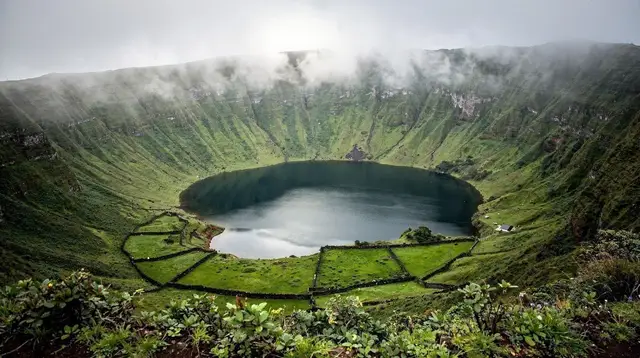
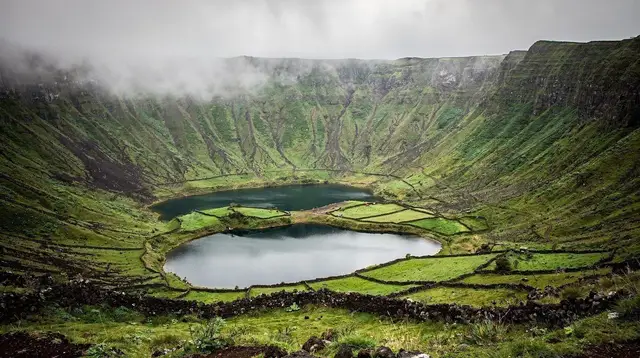
A Ridge Island Shaped by Lava
São Jorge does not look like the other Azores islands on a map. Where São Miguel sprawls and Pico rises to a single cone, São Jorge is a long, narrow ridge, barely 8 km wide at its broadest point but stretching some 55 km from tip to tip, running roughly east to west between Pico and Faial in the archipelago’s central group. A spine of high pasture and forest runs the length of the island, dropping in places to sheer cliffs of 300 m or more that plunge straight into the Atlantic.
That cliff line is broken, every few kilometers, by a fajã: a flat shelf of land at sea level, created either by an old lava flow that reached the coast or by a landslide that carried a chunk of the upper ridge down to the water. There are around forty of these platforms scattered around the island’s edge, each one a small, isolated pocket of flat ground where a handful of houses, a patch of vineyard or a fishing cove might sit, hemmed in by cliff on one side and ocean on the other.
This guide keeps to the island as a whole; the fajãs themselves, and the hikes that drop down to them, have their own dedicated coverage in the São Jorge fajã hiking guide, and if the concept itself is unfamiliar, our explainer on what a fajã actually is is a good starting point before you arrive.
The island’s two main towns sit at opposite ends of the ridge: Velas in the west, the administrative capital with the airport and main ferry terminal, and Calheta in the east, smaller and quieter. Both are covered as destinations in their own right elsewhere on this site; here they matter mainly as the two gateways you will use to come and go.
An Island Built on Cattle and Cheese
Where São Miguel’s economy leans on pineapples and tea, and Pico’s on wine, São Jorge’s identity is dairy. Cattle graze the high pastures that run along the ridge and spill down toward some of the fajãs, and the milk they produce goes almost entirely into one product: São Jorge cheese, a firm, cured cow’s-milk cheese that carries a Protected Designation of Origin and is exported across mainland Portugal. Small cheese-making cooperatives are scattered through the island’s parishes, and several now open their doors to visitors for tastings and short tours, including a half-day option you can book directly.
a half-day cheese tour that visits a working dairy and pairs a tasting with the island’s landscapeThis is only the briefest introduction; the cheese itself, how it is made and where to taste the different ages, has a full write-up in the São Jorge cheese guide. What matters for an overview of the island is simply that the cattle economy explains the landscape you’ll drive through: rolling green pasture along the ridge, dry-stone walls, and a rural, working-farm character that is more understated than the postcard drama of Pico’s vineyards or São Miguel’s crater lakes.
Getting to São Jorge
There are two ways onto the island, and which one makes sense depends heavily on the season.
| Route | Mode | Approx. duration | Frequency |
|---|---|---|---|
| Ponta Delgada (São Miguel) to Velas | SATA Air Açores flight | About 35 minutes | Several times weekly, more in summer |
| Horta (Faial) to Velas | Atlânticoline ferry, via Pico | Roughly 1-2 hours depending on stops | Daily, June-September only |
| Madalena (Pico) to Velas | Atlânticoline ferry | Around 1 hour | Daily, June-September only |
Flights connect through Ponta Delgada Airport year-round on SATA Air Açores; there is no direct service from mainland Portugal, so anyone flying in from Lisbon connects through São Miguel. For a full rundown of how the inter-island network fits together, see our guides to inter-island flights on SATA and inter-island ferries in the Azores.
The ferry option is the one most travelers who are already island-hopping actually use, sailing out of Horta or Madalena as part of what locals call the Triangle, the cluster of routes linking Pico, Faial and São Jorge. It is important to be precise about when this runs: the Triangle operates daily from June to September, and thins out considerably, sometimes to a handful of weekly sailings, in the rest of the year. Outside that window, always check current timetables before building a schedule around a same-day crossing, since sea conditions in the wider central-group network beyond the Triangle can also cause cancellations.
Getting Around and Where to Base Yourself
São Jorge has one road that essentially runs the ridge’s length, with side roads dropping down toward the coast and, in places, all the way to a fajã. Public transport between villages is limited, so a rental car is close to essential if you want to see more than the area immediately around Velas or Calheta; note that Azores car rentals are booked island by island, with no shared network across the archipelago, a point covered in our car rental guide.
Driving here comes with the same cautions that apply across the Azores’ central and western islands: roads along the ridge are narrow, cliff-edge in places, and prone to sudden fog that can cut visibility with little warning, especially at higher elevation. Free-roaming or transhumant cattle are a genuine hazard on pasture roads, not just a scenic detail. Our general driving in the Azores guide covers these points in more depth and is worth reading before you pick up the keys.
Most visitors base themselves in or near Velas, since it has the airport, the main ferry terminal, and the widest choice of guesthouses and small hotels, using it as a hub for day drives along the ridge and down to individual fajãs.
Weather on a Cloud-Catching Ridge
São Jorge’s spine catches the moisture-laden Atlantic air moving across the central group, and the result is an island that tends to run cloudier and wetter at altitude than the coastal lowlands of neighboring Faial or Pico. The Azores’ well-worn saying about experiencing four seasons in a single day applies here as much as anywhere in the archipelago: a clear ridge-top view in the morning can be gone under fog an hour later, and a sunny fajã can sit directly below a cloud-capped plateau.
July and August are the statistically driest months and, combined with the Triangle ferry running at full frequency, make the strongest case for a summer visit. November through February bring the heaviest rain. None of this rules out a visit in other months, but it does mean packing a layer for wind and damp regardless of when you go, and treating any single day’s forecast with some skepticism.
Things to Do on São Jorge
Beyond the fajã hikes and cheese tastings covered elsewhere on this site, São Jorge offers a handful of activities worth knowing about even on a short visit.
Boat-based whale and dolphin watching departs from the island’s harbors much as it does from Pico and Faial, taking advantage of the same rich waters of the central group.
a whale and dolphin watching trip with an onboard marine biologist departing from São JorgeFor a shorter, more coastal outing, snorkeling boat trips run along the island’s cliff-lined shore.
a two-hour boat ride with snorkeling stops along the São Jorge coastlineTravelers who want to see more of the ridge without driving it themselves, or who are short on time, can join a guided jeep circuit that covers the island’s high points and a lunch stop.
a full-day jeep tour of São Jorge with lunch includedFor sunrise chasers, a guided tour up to Pico da Esperança, the island’s highest point on the central ridge, times the walk to catch first light over the surrounding ocean and, cloud cover permitting, a view across to Pico’s cone.
a guided sunrise tour to Pico da Esperança on São Jorge’s ridge
Multi-day hikers with camping gear can also combine several fajãs into an overnight route; that option, and the detailed trail-by-trail breakdown of the island’s best-known paths, belongs in the dedicated São Jorge fajã hiking guide rather than here.
Pairing São Jorge with Pico and Faial
For most travelers, the real planning question isn’t “should I visit São Jorge” but “how does São Jorge fit alongside Pico and Faial.” The three islands sit close enough together, and are connected closely enough by the summer Triangle ferry, that they are commonly treated as a single loop rather than three separate decisions.
| Island | Known for | Best paired with |
|---|---|---|
| São Jorge | Fajãs, ridge scenery, cheese | Pico, Faial |
| Pico | Mountain ascent, UNESCO vineyards | Faial, São Jorge |
| Faial | Horta marina, Capelinhos volcano | Pico, São Jorge |
A common pattern is to fly into Horta on Faial, ferry across to Pico for the vineyards and the mountain, then continue to São Jorge before flying back out through Ponta Delgada, or to reverse that order. Our Pico-Faial day trip by ferry guide and dedicated São Jorge in 3 days itinerary both work through the logistics in more detail, and the Pico and Faial in 5 days itinerary is a natural companion if you’re extending the loop westward. For the broader question of sequencing several islands in one trip, see our Azores island-hopping guide.
How Many Days Do You Need
Two to three days covers São Jorge comfortably for most visitors: enough time to drive the ridge, walk down into one or two fajãs, take a boat trip or cheese tasting, and still leave room for the weather to disrupt a plan without wrecking the whole visit. A single overnight is workable if São Jorge is one stop among several on a tight multi-island loop, but it leaves very little slack if fog or a canceled ferry sailing costs you half a day, which is a real possibility on this route.
Not to Be Confused With São Jorge, Madeira
One naming trap catches first-time researchers more than any other: São Jorge is also the name of a parish on Madeira, an entirely different Portuguese archipelago several hundred kilometers to the south, closer to Morocco than to continental Portugal. The two share nothing beyond a name. Madeira’s São Jorge sits within a network of levadas, the irrigation-channel footpaths that are Madeira’s signature hiking infrastructure; the Azores’ São Jorge has no levadas at all; its paths are trilhos, waymarked trails that follow the ridge and drop to the fajãs, and its volcanic landscape, climate pattern and tourist season all differ from Madeira’s.
If your research turns up levada walks, thermal terraces, or a warmer, drier climate description attached to “São Jorge,” you have almost certainly found Madeira’s parish rather than this island; our Azores versus Madeira comparison lays out the wider set of differences between the two archipelagos if the mix-up has you second-guessing other parts of your research too.
Practical Notes Before You Go
São Jorge runs on the same Azores time zone as the rest of the archipelago, UTC-1, which is one hour behind mainland Portugal and Lisbon; this matters most when timing a connecting flight through Ponta Delgada. As part of Portugal’s autonomous region, São Jorge is in the EU, the Schengen area and the euro zone, so currency, entry rules and mobile roaming follow the same terms as the rest of the Azores and mainland Europe. For a broader roundup of things to do around the island by category rather than by activity type, the São Jorge activities hub collects them in one place.
Common Questions About Visiting São Jorge
How do I get to São Jorge from Ponta Delgada or Lisbon?
There is no direct flight from Lisbon. Most visitors fly into Ponta Delgada on São Miguel and connect on a short SATA Air Açores inter-island flight, or reach São Jorge by ferry from Pico or Faial when the seasonal network is running.
Can I visit São Jorge as a day trip from Pico or Faial?
Yes, within the Triangle. The Atlânticoline ferry network linking Pico, Faial and São Jorge runs from June to September, making a day trip realistic in that window, though outside those months the schedule thins out and can be affected by sea conditions.
Is São Jorge the same as São Jorge in Madeira?
No. This São Jorge is one of the nine Azores islands, in the mid-Atlantic and a different archipelago entirely from Madeira, which lies further south near Morocco. The two share only a name; they do not share geology, hiking terminology, or a tourist season.
How many days do I need on São Jorge?
Two to three days is enough to get a feel for the island’s ridge, a couple of fajãs and its villages without rushing, and it fits comfortably into a longer loop that also covers Pico and Faial.
What is São Jorge’s weather like?
Like the rest of the Azores, São Jorge has an oceanic climate with high humidity and cloud cover year-round, and conditions can change several times in a single day. July and August are statistically the driest months, without being guaranteed dry.
Do I need a rental car on São Jorge?
A car makes the island far easier to explore, since public transport between villages is limited and each Azores island requires its own separate rental. Roads along the ridge are narrow and can be foggy, so plan for slower driving than the distances suggest.
Is São Jorge worth visiting if I only have a few days in the Azores?
It depends on the itinerary. São Jorge rewards travelers who are already planning to island-hop through Pico and Faial; if your entire trip is limited to three or four days in total, São Miguel alone will fill that time more efficiently.