Inter-Island Flights in the Azores: The SATA Network
How do inter-island flights work in the Azores?
SATA Air Açores operates a hub-and-spoke network centred on Ponta Delgada, São Miguel, connecting all nine islands. Routes to Terceira, Pico and Faial run several times daily in high season, while Santa Maria, Graciosa and especially Flores and Corvo see far fewer flights, so those legs need booking well ahead.
A Hub Built Around Ponta Delgada
Nine volcanic islands, spread across roughly 600 km of open Atlantic, cannot be stitched together by road. For anyone building a multi-island itinerary in the Azores, the practical question quickly becomes: fly, or take the ferry — and on which legs. This guide covers the flying half of that decision: how the SATA Air Açores network is structured, how booking and frequency actually work island by island, and where the comparison with ferries tips one way or the other. For the ferry network itself, see inter-island ferries in the Azores; for the flight into the archipelago from the mainland or from Europe, see flights to the Azores explained.
The inter-island network is, in effect, a hub-and-spoke system centred on Ponta Delgada on São Miguel. Almost every inter-island itinerary that touches more than two islands routes back through Ponta Delgada at some point, because direct flights between two “spoke” islands that are not São Miguel are rare. Flying from, say, Flores to Terceira without stopping in Ponta Delgada is generally not an option — plan around the hub, not against it. This guide does not cover the airport itself in detail (layout, transfers, lounges); that lives in the separate Ponta Delgada airport guide.
It is worth being precise about who flies what, because the names overlap and confuse first-time visitors. SATA Air Açores operates the scheduled inter-island network described in this guide. Azores Airlines (the rebranded former SATA International) is a different operation within the same group, flying long-haul routes to mainland Portugal, other European cities and North America. Booking, check-in and baggage rules differ slightly between the two, so always confirm which carrier’s site an itinerary search is actually using.
How the Route Map Breaks Down
The nine islands fall into three groups, and flight frequency drops sharply as you move from the eastern group toward the western group. Treating “inter-island flights” as one uniform product is the mistake to avoid here — a Ponta Delgada-Terceira hop and a Ponta Delgada-Corvo hop are barely comparable in terms of how many seats exist, how often the aircraft flies, and how much slack a traveller should build in.
| Group | Islands | Typical flight frequency from Ponta Delgada |
|---|---|---|
| Eastern | São Miguel (hub), Santa Maria | Several flights daily to Santa Maria in high season, fewer off-season |
| Central | Terceira, Pico, Faial, São Jorge, Graciosa | Terceira, Pico and Faial: multiple daily flights in peak months; São Jorge and Graciosa: noticeably thinner |
| Western | Flores, Corvo | A handful of weekly flights outside summer, tightest capacity in the whole network |
The routes with the strongest, most reliable traffic are Ponta Delgada-Terceira, Ponta Delgada-Pico, and Ponta Delgada-Horta (Faial); these three are reinforced with extra frequencies through the summer season, when demand from both visitors and returning residents peaks. Ponta Delgada-Flores also gets a seasonal boost, but it never reaches the density of the central-group routes — it remains, by the nature of the western group’s isolation, one of the network’s most fragile links.
São Jorge and Graciosa sit awkwardly in between the well-served central routes and the thin western ones. São Jorge’s flights connect through Ponta Delgada rather than directly from the other central islands, which matters for anyone planning to see the island’s fajãs — the coastal platforms covered in the São Jorge fajãs hikes guide — or to taste the island’s protected cheese without building in an extra travel day.
Graciosa, the smallest island in the central group, has an even thinner schedule; its Furna do Enxofre lava cave and windmill-dotted landscape are worth the detour, but the island itself is not a place to visit on a whim between two other stops — it needs to be planned around its own limited flights, in the same way as Flores or Corvo.
Do not mistake “several flights a day” on the busiest legs for the kind of low-cost-airline flexibility found on the mainland. These are small turboprop aircraft with limited seats, not a shuttle service you can show up for and expect a same-day alternative if you miss a flight. On Ponta Delgada-Terceira, missing a flight in peak season might mean a few hours’ wait; on Ponta Delgada-Corvo it can mean the next day, or later.
Booking: What Actually Matters
Booking an inter-island SATA flight works like booking any scheduled airline ticket — through the SATA Air Açores website or app, with a route, a date and a fare class. The mechanics are ordinary; what is not ordinary is how quickly certain routes sell out relative to the number of seats available.
A few practical points worth building into an itinerary:
- Book the thin routes first. If an itinerary includes Flores, Corvo, Santa Maria or Graciosa, secure those flights before anything else. These are the legs where a handful of sold seats can mean waiting days for the next available departure, particularly outside July and August.
- Watch festival dates. Flights around Angra do Heroísmo’s religious festivals, and around the Divino Espírito Santo celebrations that ripple across several islands through the spring and summer, fill up well in advance — both with visitors and with Azoreans travelling to see family.
- Build in a buffer day. Because Azores weather can turn from clear sky to low cloud within hours — the local saying about four seasons in a single day applies as much to flying conditions as to sightseeing plans — an itinerary with zero slack between an inter-island flight and, say, a flight home from Ponta Delgada is a risk worth avoiding.
- Check which carrier operates the mainland connection. A trip that needs to reach Lisbon from Pico or Faial should not assume a same-season direct flight exists; those direct links run only in the warmer months, and are not a year-round fallback.
- Confirm baggage allowances separately. SATA Air Açores’ inter-island fares carry their own baggage rules, distinct from Azores Airlines’ long-haul allowances, so a single checked bag booked on the transatlantic leg does not automatically carry over to the inter-island hop.
For visitors arriving into Ponta Delgada and needing a transfer straight from the terminal before an onward inter-island flight or a first night on São Miguel, a pre-booked airport transfer in Ponta Delgada removes one variable from an already tightly timed connecting day.
What Flying Between the Islands Actually Feels Like
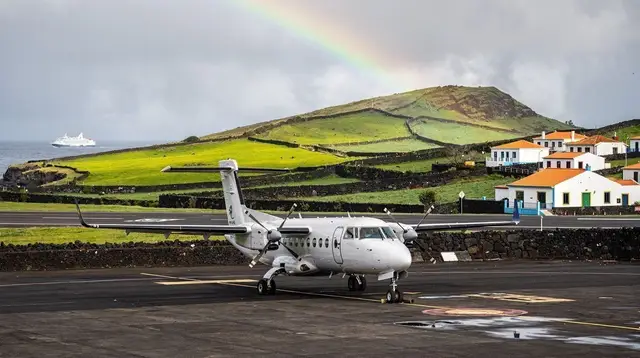
Inter-island flights run on small turboprop aircraft, not the narrow-body jets used on the long-haul routes into Ponta Delgada. Check-in at the smaller island airports is correspondingly simple — there is no equivalent of a major hub’s security queues or multiple terminals, and boarding tends to happen close to departure time rather than the long dwell periods common on international flights. That simplicity cuts both ways: a smaller aircraft and a smaller airport also mean less slack when something goes wrong, which is part of why the buffer-day advice above matters more here than it would on a mainland shuttle route.
Cabin baggage allowances on these turboprops are tighter than on a transatlantic flight, and hold space is limited, so bulky hiking or diving gear — relevant for anyone packing for hikes in the Azores or a diving trip on one of the outer islands — is worth checking against the airline’s specific allowance rather than assuming transatlantic rules apply. The upside of the small aircraft is the view: low cruising altitudes over open Atlantic water mean the approach into islands like Pico or Faial often gives a clear look at the volcanic landscape below well before landing.
Flying vs the Ferry: Where Each One Wins
This is the decision most multi-island itineraries actually turn on, leg by leg, rather than as one blanket choice. The full comparison of ferry routes, schedules and seasonality lives in the inter-island ferries guide; the summary relevant here is where flying clearly beats the boat, and where it does not.
Ferries tend to win on the short central-group hops that Atlânticoline runs year-round — above all Madalena (Pico) to Horta (Faial), a crossing of around 30 minutes, several times a day, in every season. Together with São Jorge, this trio forms what locals call the “Triangle,” the one part of the inter-island network where a boat is both faster door-to-door and more frequent than arranging a flight. A day trip built around this crossing is covered separately in the Pico-Faial ferry day trip guide.
Flights tend to win in three situations: covering longer distances where a ferry simply does not run a direct route; reaching the western group (Flores, Corvo) outside the roughly June-to-September window when the wider ferry network operates; and reaching Santa Maria or Graciosa, both of which have comparatively thin maritime links. It is worth repeating the caution already flagged in the ferry guide from the flying side too: no inter-island link in this archipelago should be assumed reliable in every season without checking which one it is. The central “Triangle” is the dependable exception, not the rule for the whole network.
A traveller island-hopping through the central group with a rental car waiting on each island — a separate topic covered in the car rental guide — often ends up mixing both: a ferry for the Pico-Faial-São Jorge triangle, and a flight to bridge back to Terceira or onward to Santa Maria.
Building an Itinerary Around the Network
Two practical approaches to building a multi-island trip:
Fly the long legs, ferry the short ones. Land in Ponta Delgada, spend time on São Miguel, fly to Terceira, then fly on to Pico or Faial, and from there use the year-round ferry to shuttle between Pico, Faial and São Jorge before flying back to Ponta Delgada for the return leg. This keeps flight bookings to the busiest, most reliable routes and lets the ferry do the fine-grained hopping within the central group. A worked example of this style of trip is laid out in the Azores island-hopping guide.
Treat the western group and outer islands as a dedicated leg. Flores and Corvo, and to a lesser extent Santa Maria and Graciosa, reward being built into an itinerary as their own short chapter rather than squeezed between busier stops, precisely because their flight (and ferry) capacity is the tightest in the archipelago. A same-day hop between the two westernmost islands is covered in the Corvo day trip from Flores guide; it depends on weather and on a very limited number of daily connections, so it is not something to schedule on the last morning before an international flight home.
Anyone still deciding which islands to prioritise before working out how to link them by air or sea should start with which Azores island to visit, which lays out the trade-offs between the more accessible islands and the more remote ones this guide has been describing in terms of flight frequency.
How much of a multi-island itinerary should ride on flights versus ferries also depends on how many days are available. A shorter trip that still wants to combine São Miguel with one central-group island benefits from keeping flights to a single there-and-back hop rather than chaining several thin routes together; the trade-offs for different combinations are laid out in the how many days in the Azores guide.
A longer trip, such as the ten-day, three-island itinerary, has more room to absorb a weather delay on one leg without derailing the rest, which is one more reason island-hopping itineraries tend to reward extra time over a tightly packed schedule. Budgeting for inter-island flights alongside accommodation and tours is covered in the daily budget guide.
Once on Terceira, a common way to use an inter-island flight efficiently is to pair it with a guided day exploring the island rather than self-driving cold off a short flight — a full-day tour of Terceira or, for a shorter stopover, a two-day private tour with transfer included both start from arrivals and take the logistics off the traveller’s hands.
On Pico, arriving by air rather than ferry still leaves a full day free for a guided tour of Pico Island covering the volcano, the vineyards and the old whaling port. Santa Maria, one of the harder islands to reach by air with any frequency, rewards travellers who do make the trip with quieter diving conditions on a double dive off Santa Maria.
Weather, Delays and Realistic Expectations
The Azores’ Atlantic climate is not just a sightseeing footnote — it directly affects the inter-island flight network. Fog forms readily around the hillier runways, and the same fast-moving fronts that can turn a clear morning into an afternoon downpour also ground or delay short regional flights, more often on the smaller western-group and Graciosa routes than on the well-served Ponta Delgada-Terceira corridor. This is not a reason to avoid flying between islands; it is a reason to avoid scheduling an inter-island flight for the same day as an international departure, and to keep at least one spare day in a longer itinerary if the plan depends on reaching Flores, Corvo, Santa Maria or Graciosa on a specific date.
None of this makes SATA’s network fragile in absolute terms — for the vast majority of visitors moving between São Miguel, Terceira, Pico and Faial, flights run predictably enough to plan around confidently. The caution applies specifically to the outer islands, where lower frequency means a single weather delay has a much bigger knock-on effect on the rest of a trip.
Checking the live status of a specific route the morning of travel costs nothing and can save a day of scrambling — treating a same-day inter-island connection as flexible by default, rather than assuming it will run exactly on schedule, is the single habit that separates itineraries that survive a weather day from ones that unravel.
Transfers and transport passes on GetYourGuide
Verified deep-linked GetYourGuide tours. Book through these links and we earn a small commission at no cost to you.
GetYourGuide does not provide a product photo for this activity — the image shows the meeting point, photographed by us.