The smallest inhabited island in the Azores
Graciosa is easy to miss on a map of the Azores, and that is more or less the point. It is the smallest of the five islands that make up the central group, tucked north of Terceira, and it carries none of the infrastructure that comes with a big cruise-port town or a long GetYourGuide catalogue. What it offers instead is quiet: a scatter of whitewashed villages, wind-milled hills, vineyards planted in pockets of dark volcanic soil, and one genuinely extraordinary underground feature, the Furna do Enxofre, that draws in visitors willing to make the extra effort to get here.
This page is a first look at the island as a whole — its geography, its character, its rhythm — rather than a step-by-step visit to the cave itself. For the practical walkthrough of the Furna do Enxofre, its opening hours and what the descent involves, see the dedicated Furna do Enxofre guide and the Furna do Enxofre destination page.
If you already know you want two full days here and are past the “should I go” question, the Graciosa in 2 days itinerary lays out a schedule. What follows is the orientation you need before either of those: what Graciosa is, why it looks the way it does, and — this matters more here than on any other island in the archipelago — what you can and cannot book online before you arrive.
Why Graciosa is called the white island
Locally, Graciosa is often called “a ilha branca,” the white island, and the nickname is not marketing. Many of the older houses in its two main settlements, Santa Cruz da Graciosa and Praia, are built and finished in a pale render that stands out against the surrounding green, and the island’s volcanic soils and rock in places run lighter and paler than the dark basalt that dominates most of the archipelago.
Combined with the low, rolling terrain — Graciosa has none of the dramatic peaks of Pico or São Jorge — the overall impression is softer and brighter than the rest of the central group. It is a small island you can drive across in under an hour, which makes it easy to underestimate on paper and genuinely memorable once you are standing in it.
The Caldeira da Graciosa and the Furna do Enxofre
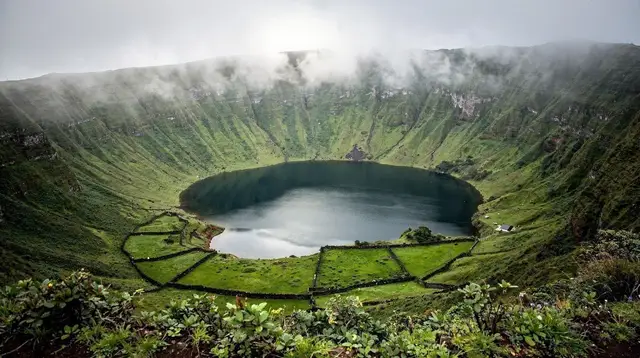
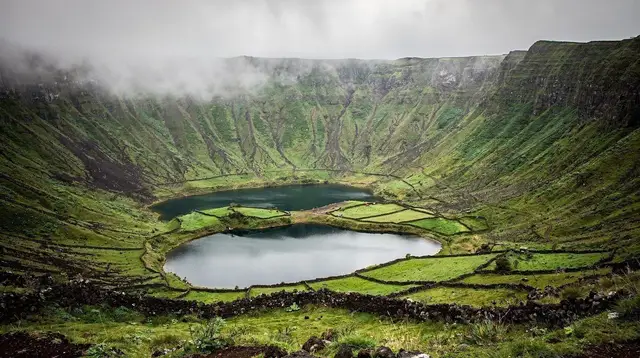
Geologically, Graciosa is built around a single volcanic complex: the Caldeira da Graciosa, a broad crater in the island’s interior that dominates its skyline from almost every angle. Inside that caldeira sits the island’s headline feature, the Furna do Enxofre — the largest volcanic cave in Europe, holding an underground lake and active sulfur fumaroles beneath a domed lava ceiling. It is the reason serious geology and geopark visitors put Graciosa on their list at all, and it is treated as a priority geosite within the wider Geoparc Açores network, a UNESCO Global Geopark that covers the whole archipelago (see the Azores Geopark guide for how that designation works across the nine islands).
We are deliberately not walking through the descent, the stairs, or the practicalities of visiting the Furna do Enxofre on this page — that belongs to the Furna do Enxofre guide. What matters here is the shape it gives the island: Graciosa is essentially built around this one crater, and almost every itinerary on the island orbits it in some way, whether that means the cave itself, the crater rim roads above it, or the agricultural land inside the wider caldeira basin.
Santa Cruz da Graciosa and its windmills
Santa Cruz da Graciosa, the island’s main town, is a small, low-rise settlement on the northern coast, built around a working harbor and a scatter of churches and civic buildings in the same pale stone and whitewash that gives the island its nickname. Above and around the town, a scatter of traditional white windmills with red or wooden caps still dot the hillsides — working reminders of an agricultural economy that has changed only slowly here. They are one of the most photographed details on the island, precisely because there is so little else competing for the frame: no tour buses, no queue of visitors, just wind, stone, and grazing land running down to the Atlantic.
Praia, on the island’s eastern side, is the other settlement worth knowing by name — smaller again than Santa Cruz, with its own quieter waterfront. Between the two, minor roads wind through vineyard plots, pasture, and the low ridge of hills that ring the central caldeira.
A UNESCO biosphere reserve, twice over
Graciosa was designated a UNESCO Biosphere Reserve in 2007, a recognition that runs alongside — and should not be confused with — the UNESCO World Heritage listings held elsewhere in the archipelago, such as Angra do Heroísmo’s historic center on Terceira or the Pico vineyard landscape.
A biosphere reserve is a different kind of classification: it recognizes an ongoing balance between conservation and the way people actually live on the land, rather than protecting a single historic site or monument. Corvo, the smallest and most remote of the nine Azorean islands, holds the same biosphere status, and Flores carries it too — a small cluster of quiet, low-traffic islands that share this designation without sharing a World Heritage listing.
In practice, that status shows up on Graciosa as a working landscape rather than a museum piece: grazing land, small vineyard plots, and a caldeira interior that is farmed as much as it is admired.
Wine, cheese and the rhythm of daily life
Graciosa has its own small wine tradition, grown in volcanic soil in the same broad family of Azorean viticulture that produces the UNESCO-listed vineyard landscape on neighboring Pico — though on a much smaller and more local scale, without Pico’s currais or its formal heritage listing. Dairy farming is the island’s other backbone, and while São Jorge, one island over, is the name most associated with Azorean cheese (see the São Jorge cheese guide), Graciosa’s own pastures feed into the same regional dairy culture.
None of this is set up for visitors in the way a wine-tasting circuit or a cheese-tour itinerary would be on a larger island. What you find instead are small producers, local markets, and a handful of restaurants around Santa Cruz da Graciosa serving straightforward Azorean cooking — fresh fish, local cheese, and whatever the day’s catch or harvest happens to be. It is a good place to eat slowly and not expect a curated food-tour experience.
Getting to Graciosa: flights and the seasonal ferry
Graciosa’s isolation is real, and it shapes almost every practical decision about visiting. SATA Air Açores flies into Graciosa, typically routed via Terceira, and this is the most reliable year-round option. The alternative is the ferry network run by Atlânticoline, but here the timing matters: the wider inter-island ferry network that reaches Graciosa and the rest of the central group beyond the reliable Pico–Faial–São Jorge “Triangle” only operates from June to September (see the inter-island ferries guide for how the full network breaks down by season). Outside that window, flying is effectively the only practical way in and out.
This seasonal gap is worth planning around rather than discovering at the ferry terminal. If your trip falls outside June–September, build your Graciosa visit around flight availability from Terceira and don’t assume a boat option will be there as a backup. A rental car is close to essential once you land — Graciosa has limited public transport between its villages, and the windmill-dotted hillsides and caldeira rim roads are best explored at your own pace (see the car rental in the Azores guide).
Best time to visit Graciosa
June through September is the practical sweet spot for Graciosa, for one overriding reason: it is the only window when the seasonal ferry network connects the island to the rest of the central group, which opens up combining Graciosa with Terceira, Pico, Faial, or São Jorge without relying entirely on flights. It also lines up with the Azores’ driest and mildest stretch of weather more broadly (see best time to visit the Azores and Azores weather month by month), though as everywhere in the archipelago, the local saying about “four seasons in one day” still applies — pack for a sudden shift from sun to rain regardless of the month.
Outside that window, Graciosa is still visitable and, arguably, even quieter — but plan around flights rather than ferries, and expect fewer restaurant and accommodation options to be open.
Why you can’t book a Graciosa excursion online — and what to do instead
This is the detail that trips up more visitors than anything else on this page: as of September 2026, Graciosa has no bookable activities listed on GetYourGuide or Viator. Every other inhabited island in the Azores — São Miguel, Terceira, Pico, Faial, São Jorge, Flores, Corvo, and Santa Maria — has at least some catalogue of tours, whale-watching trips, or guided excursions available to reserve online. Graciosa does not, and that is not a gap in this guide; it reflects the actual state of the booking platforms.
What that means practically is that a Graciosa visit is built around independent exploration — walking or driving to the Caldeira da Graciosa and the Furna do Enxofre, wandering Santa Cruz da Graciosa and its windmills, and eating at local restaurants — rather than a schedule of pre-booked activities. If having at least one or two bookable excursions in your Azores itinerary matters to you, the practical move is to pair Graciosa with a neighboring island where the catalogue is active, and build your reservable activities there.
Pairing Graciosa with the rest of the central group
Because Graciosa sits within the central group, alongside Terceira, Pico, Faial, and São Jorge, most visitors treat it as an add-on to a longer central-islands itinerary rather than a standalone destination — see which Azores island to visit if you are still deciding how to split your time, or Azores in 10 days: three islands for a longer multi-island framework.
A common pattern is to base yourself on Terceira or Pico, use the June–September ferry window (or a short flight) to add one or two nights on Graciosa, and book your bigger excursions on the island where you are spending the rest of your trip.
On Terceira, that might mean adding a boat trip to swim alongside wild dolphins off the coast before or after your Graciosa days. On Pico, the obvious anchor activity is whale watching: a half-day boat trip out from the old whaling port of Lajes do Pico in search of sperm whales, or a broader guided tour around Pico’s vineyards, villages and volcanic landscapes for travelers who want the island’s highlights covered in a single day.
If cetaceans are the priority of your whole trip rather than just one island, a general whale and dolphin watching excursion booked on whichever central-group island you’re based on is worth building your schedule around, since sightings and seasons vary by month rather than by island.
None of these tours operate on Graciosa itself — they are ways to fill out the rest of a central-group trip that includes Graciosa as its quiet, unbookable chapter.
Cycling, walking and photography on a quiet island
Graciosa’s small scale and gentle terrain are part of why it suits slow travel so well: it is realistic to see much of the island by bike in a day or two, without the steep, sustained climbs that define São Jorge or Pico (see the cycling and e-bikes in the Azores guide for how bike rental works across the archipelago). The same open, low-rise landscape — windmills along the ridgelines, whitewashed villages, vineyard plots running down toward the coast — also makes Graciosa a rewarding stop for photographers who prefer working without a crowd (see the Azores photography spots guide for other locations worth planning a shoot around across the nine islands).
Planning at a glance
| Question | Short answer |
|---|---|
| How long do I need? | 1 full day minimum; 2 days if you want an unhurried pace |
| Best way in? | SATA flight via Terceira year-round; seasonal ferry June–September |
| Do I need a rental car? | Yes — public transport between villages is limited |
| Can I book tours online? | Not for Graciosa itself; book on Terceira or Pico instead |
| Best season? | June to September, for ferry access and drier weather |
| What’s the headline sight? | The Furna do Enxofre, inside the Caldeira da Graciosa |
Frequently asked questions about visiting Graciosa
Is Graciosa worth visiting if I only have one Azores trip?
It depends on your priorities. Graciosa rewards travelers who already want a quiet, low-key island and are curious about the Furna do Enxofre specifically. First-time visitors with limited time are usually better served concentrating on São Miguel and one or two central-group islands with fuller infrastructure, then adding Graciosa on a return trip.
Why is there no GetYourGuide or Viator catalogue for Graciosa?
As of September 2026, neither platform lists bookable activities for Graciosa, unlike the Azores’ eight other inhabited islands. This appears to reflect the island’s small size and low visitor volume rather than a lack of things to see — but it does mean you should not plan around finding a tour to book here.
How do I get to Graciosa?
SATA Air Açores flies to Graciosa, typically via Terceira, year-round. The Atlânticoline ferry network also reaches Graciosa, but only as part of the wider central-group service that runs from June to September; outside that window, flying is the reliable option.
Do I need a rental car on Graciosa?
Yes, in practice. Public transport between Santa Cruz da Graciosa, Praia, and the rest of the island is limited, and a car makes it far easier to reach the Caldeira da Graciosa, the Furna do Enxofre, and the windmill-dotted hillsides at your own pace.
What is the Furna do Enxofre?
It’s the largest volcanic cave in Europe, sitting inside the Caldeira da Graciosa, with an underground lake and active sulfur fumaroles. This page covers it only in outline — for the full visit guide, opening details, and what to expect underground, see the Furna do Enxofre guide.
When is the best time to visit Graciosa?
June through September, mainly because that’s the only window when the seasonal inter-island ferry connects Graciosa to the rest of the central group. It also tends to bring drier, milder weather than the winter months, though sudden weather changes are normal anywhere in the Azores.
Can I combine Graciosa with Terceira or Pico in one trip?
Yes, and most visitors do exactly that. Graciosa works best as an add-on to a longer central-group itinerary based on Terceira or Pico, using the seasonal ferry or a short flight to fit in a day or two, while booking any tours or excursions on the island where you’re spending the bulk of your trip.
Is Graciosa the same kind of island as São Jorge or Pico?
No — it’s noticeably smaller and flatter than either, without São Jorge’s dramatic fajãs or Pico’s towering volcano. Graciosa’s character comes from its caldeira, its windmills, and its unusually quiet pace, even by Azorean standards.