Down a Staircase Into an Active Volcano
Most visitors to the Azores never set foot on Graciosa. It has the fewest flights, no dependable ferry from the eastern or western island groups, and not a single bookable tour on the major platforms. That absence of infrastructure is also, in a strange way, the point: what waits at the bottom of the Caldeira da Graciosa is one of the least crowded volcanic sites anywhere in the Azores, and arguably one of the most striking.
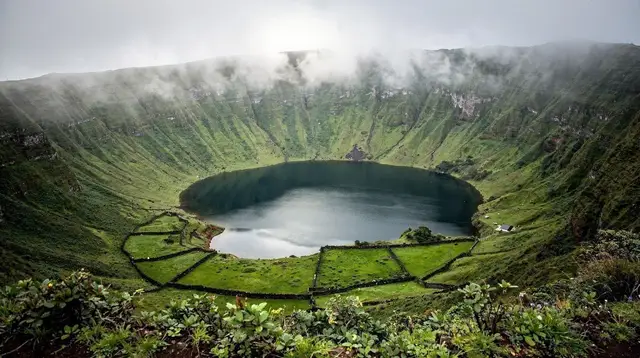
The Furna do Enxofre is a crater within a crater. The outer landform is the Caldeira da Graciosa itself, a broad volcanic depression that dominates the island’s interior. Inside it, a separate, deeper opening drops into a cavernous chamber that has been shaped and reshaped by past eruptions, collapse, and centuries of sulfur venting. A built staircase, cut into the rock and reinforced with a handrail, takes visitors down roughly a hundred steps to a solid walkway suspended over the chamber floor. From there, in half-light, you look out over a still underground lake, blackened lava walls, and drifting steam rising from active fumaroles.
There is no ticket booth staffed by a tour operator, no scheduled departure time, and — this is worth stating plainly — no guided excursion, shuttle, or paid activity for Furna do Enxofre or for Graciosa more broadly listed on GetYourGuide or Viator as of September 2026. Anyone visiting does so independently, on their own schedule, usually with a rented car parked near the crater rim.
What the Chamber Actually Looks Like
Descriptions of Furna do Enxofre tend to converge on the same three elements: the lake, the fumaroles, and the scale. The underground lake sits at the chamber’s lowest point, dark and mineral-stained, fed by rainwater that percolates down through the volcanic rock above. Around and above it, active fumaroles continue to vent warm, sulfur-scented steam — a visible, audible reminder that the volcanic system underneath Graciosa is dormant, not dead. The lava walls themselves carry the folded, ropy textures typical of Azorean volcanic rock, catching whatever light filters down from the opening above.
The chamber is frequently described as one of the largest known volcanic cave chambers in Europe, a claim tied to its sheer interior volume rather than to any single dramatic feature. It rewards a slow visit: walk to the far end of the platform, let your eyes adjust, and the scale of the space becomes clearer than it does from photographs, which struggle to capture the depth of the drop or the size of the room.
Because the site sits underground and away from direct sun, temperatures stay noticeably cooler and more humid than the surface above. Bring a light layer even in summer, and expect the steps and the walkway surface to be damp — sensible, non-slip footwear matters more here than at almost any other stop in the Azores.
The Caldeira da Graciosa Above
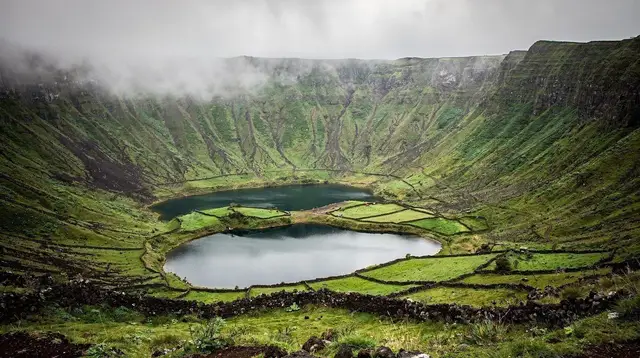
The Furna do Enxofre cannot really be separated from the landscape that contains it. The Caldeira da Graciosa is the island’s dominant volcanic feature, a wide green bowl visible from much of Graciosa’s interior road network. Farmland and pasture now cover much of its outer slopes, a quiet contrast to the sulfurous chamber hidden beneath. A short walk or drive around the caldeira rim gives context to the whole site before or after the descent, and on a clear day offers wide views across the island toward the Atlantic.
This layered structure — a visitable volcanic chamber nested inside a larger caldeira, itself part of an island that formed through the same tectonic and volcanic forces shaping the rest of the archipelago — is characteristic of the Azores generally. Readers curious about how sites like this compare across islands, including the better-known Algar do Carvão on Terceira, will find that broader picture in our guide to the archipelago’s volcanoes and craters and in the dedicated Algar do Carvão guide; this page focuses specifically on what Furna do Enxofre itself involves.
A UNESCO Biosphere Reserve Site
Graciosa was designated a UNESCO Biosphere Reserve in 2007, a classification tied to sustainable management of its natural environment rather than to any single monument. Furna do Enxofre sits among the reserve’s most cited geological features, and the wider island falls within the Geoparc Açores network, a UNESCO Global Geopark grouping that treats volcanic sites across the archipelago as a connected geological story rather than as isolated curiosities. Readers wanting the fuller picture of how that geopark status works across the nine islands can find it in our Geoparc Açores guide.
It is worth being precise about terminology here: a biosphere reserve designation is a UNESCO environmental-management classification, distinct from UNESCO World Heritage status, which recognizes places like Angra do Heroísmo on Terceira or the Pico wine landscape for their historical or cultural value. Graciosa carries the biosphere designation, not a World Heritage listing.
Getting to Graciosa
This is the part of the trip that filters out most visitors, and it deserves an honest answer rather than a glossed-over one. Graciosa has its own small airport served by SATA Air Açores, typically connected through Terceira or Ponta Delgada rather than by direct long-haul flight. Seat availability on these inter-island hops can be limited, particularly outside the summer months, so it is worth booking well ahead if Graciosa is on the itinerary. Our guide to inter-island flights on SATA Air Açores covers how these routes generally work.
Ferry access is the more fragile option. The reliable, year-round maritime link in the Azores is the short Pico–Faial crossing, and the wider central-group ferry network that occasionally includes Graciosa only operates from June to September, weather permitting. Outside that window, or even within it during unsettled weather, a scheduled sailing to Graciosa is not something to build a tight itinerary around. Our inter-island ferry guide explains which connections are dependable in which season, and which are not.
Once on the island, a rental car is close to essential. Graciosa is small, but its public transport is minimal, and the road to the Caldeira da Graciosa and the Furna do Enxofre car park is best covered independently. See our car rental guide for how island-by-island rental works across the archipelago — each island is booked separately, Graciosa included.
When to Go
June through September is the pragmatic answer, not because the cave itself changes dramatically with the seasons — it is underground, and its temperature stays fairly stable year-round — but because that window offers the most reliable flights and the best odds that any seasonal ferry option is running. Outside those months, a visit to Graciosa becomes more of a standalone commitment: check flight schedules carefully, build in flexibility, and do not assume a same-day return is guaranteed if weather disrupts a single daily flight.
The Azores as a whole follow the local saying about four seasons in one day, and Graciosa is no exception. A clear morning at the crater rim can turn to drizzle within the hour. Pack a light rain layer regardless of the forecast, and see our month-by-month weather guide and best time to visit overview for how this plays out across the year.
What to Bring and What to Expect
| Item | Why it matters |
|---|---|
| Non-slip, closed shoes | Steps and the walkway surface are frequently damp |
| Light jacket or fleece | The chamber is noticeably cooler than the surface, even in summer |
| Small flashlight or phone light | Lighting inside the chamber can be dim in places |
| Cash in small euro denominations | Any on-site fee is typically modest and locally handled, not card-based |
| Flexible flight or ferry buffer | Graciosa’s transport links are the most fragile of any island covered on this site |
There is no restaurant or facilities cluster at the crater itself. Santa Cruz da Graciosa, the island’s small main town roughly ten to fifteen minutes away by car, is the practical base for meals, fuel, and any last-minute supplies before or after the visit. Its white windmills are a well-known local landmark and a reasonable stop to pair with the crater on the same half-day loop.
Combining Graciosa With the Rest of the Trip
Because Graciosa has no bookable tours of its own, most travelers treat it as a deliberate detour layered onto a longer central-group itinerary rather than as a stand-alone base. A common pattern is to fly in from Terceira, spend a half or full day around the Caldeira da Graciosa and Furna do Enxofre, and fly back out to continue island-hopping elsewhere. Our two-day Graciosa itinerary lays out how to use a short stay efficiently, and our broader piece on which Azores island to visit can help decide how much of a trip Graciosa deserves relative to the more heavily visited islands.
Terceira itself, as the usual gateway, has its own bookable activities worth folding into the same leg of the trip. Travelers pairing a day of dolphin encounters in Terceira’s coastal waters with a Graciosa side-trip sometimes book something like a swim with dolphins off Terceira on the days flanking the Graciosa crossing, since nothing comparable exists on Graciosa itself.
Others extend the central-group leg toward Pico, where whale-watching and whaling-history tours run consistently in season — a historic whaling boat excursion from Pico or a more general cetacean-watching trip in the central group gives the trip a bookable anchor point that Graciosa cannot offer on its own.
None of this changes the core fact about Furna do Enxofre: it is visited independently, on foot, without a booking. What can be booked is everything around it — the flights, the surrounding islands’ tours, the accommodation in Santa Cruz da Graciosa or on Terceira — and planning those pieces early matters more here than for almost any other stop in the archipelago.
Nearby and Related Reading
For travelers weighing whether Graciosa fits their trip at all, our guide to common mistakes in the Azores covers the broader trap of underestimating inter-island logistics, and getting to the Azores lays out the mainland connections that precede any inter-island hop.
Photographers should also see our Azores photography spots guide, which touches on how low-light underground settings like this one differ from the archipelago’s better-known coastal viewpoints. Those who want the single-sentence tour of all nine islands, Graciosa included, will find it in our piece on the nine islands in one sentence each.
Frequently Asked Questions About the Furna do Enxofre
What is the Furna do Enxofre?
It is a volcanic crater on Graciosa, entered by a staircase that leads down to a walkway inside a large underground chamber holding a lake, sulfurous fumaroles, and lava rock formations. It is regularly described as one of the largest known volcanic cave chambers in Europe.
Can you book a guided tour of Furna do Enxofre online?
No bookable guided tour, shuttle, or paid excursion to Furna do Enxofre or elsewhere on Graciosa currently appears on the major booking platforms. Visitors reach the site independently, usually by rental car, and walk down on their own.
Is Furna do Enxofre difficult to visit?
The site itself is not physically demanding: a staircase of roughly 100 steps descends to a solid walkway with a handrail. The harder part is logistical, since Graciosa’s flights and any seasonal ferries are limited and weather-dependent.
Does the cave smell like sulfur?
Yes. Active fumaroles vent warm, sulfur-scented steam inside the chamber, which is part of the experience rather than a sign of danger, though it is noticeable and can be uncomfortable for sensitive airways.
How long does a visit take?
Most visitors spend 45 minutes to 90 minutes at the site itself, including the descent, time on the walkway, and the climb back up. Many combine it with a wider half-day loop of the Caldeira da Graciosa and Santa Cruz da Graciosa.
Is Furna do Enxofre the same as Algar do Carvão?
No. Algar do Carvão is a separate volcanic chimney on Terceira with its own staircase and its own underground lake. Furna do Enxofre is on Graciosa and has its own distinct geology, though both are Azorean volcanic cave sites.
When is the best time to visit?
June through September gives the most reliable flight schedules to and from Graciosa and the best odds of dry, walkable conditions. Outside those months, transport links to the island become noticeably less frequent.
Why is Graciosa rated a lower priority than other Azores islands on this site?
The rating reflects how few visitors reach Graciosa, not the quality of what is there. Limited flights, no year-round ferry from most islands, and a near-total absence of bookable tours make it a harder island to reach, so it sits lower in our tiering by practicality rather than by interest.