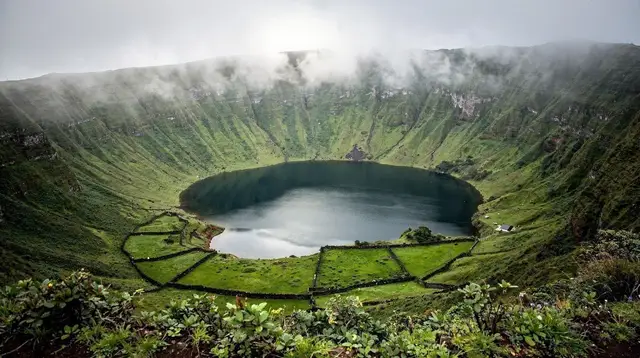
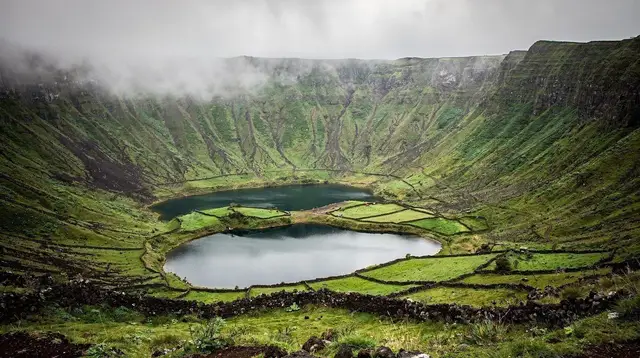
Algar do Carvão: Terceira's Volcanic Chimney You Walk Into
What is the Algar do Carvão and how long does a visit take?
The Algar do Carvão is a volcanic chimney on Terceira that visitors descend by a built staircase to a natural chamber lined with rare silica stalactites. A self-guided visit takes about 30 to 45 minutes, and it pairs easily with a half-day that also covers Angra do Heroísmo.
A chimney, not a cave: what makes it different
Most of the volcanic hollows visitors picture in the Azores are lava tubes: long, roughly horizontal tunnels left behind when the outer skin of a lava flow cooled and hardened while the molten rock inside kept draining away. The Algar do Carvão is something else. It is an algar, a volcanic chimney, formed above a magma conduit where the roof of an underground cavity gave way and opened a near-vertical shaft to the surface.
On Terceira, it is the best-known example of this kind of feature, and one of the priority geosites of the wider Geoparc Açores network. If you want the general picture of how lava tubes, chimneys, and other volcanic hollows form across the nine islands, that comparison belongs on the Azores lava caves guide; this page stays with the one site, the practical details of visiting it, and the half-day it fits into around Angra do Heroísmo.
The shaft itself runs roughly 90 metres from the surface down to the floor of the chamber below, and a built staircase follows the inside of it in a series of landings rather than one straight run. Near the bottom, the passage opens into a wide underground room where mineral-rich water dripping through the rock has, over a very long time, deposited silica in shapes that look startlingly like the stalactites and stalagmites of a limestone cave, even though the underlying rock here is basalt rather than limestone. That silica formation is the single detail most repeat visitors remember, and the reason the site draws geology-minded travellers who would otherwise skip a cave visit.
Descending into the chimney: the staircase and the chamber
The visit follows a fixed route: a ticket booth and small interpretation area at the surface, then the staircase down into the shaft. The upper section of the descent runs close to bare rock walls that narrow and widen as the shaft twists slightly on its way down, and the light from the surface fades within the first few landings. Lower down, the passage opens out and the staircase levels onto a platform at the edge of the main chamber, where the ceiling recedes and the silica formations become visible hanging from the rock above and rising, in places, from the chamber floor.
There is a small pool of standing water at the lowest point, fed by rainwater draining through the volcanic rock above, and the acoustics of the chamber change noticeably once a group stops talking and the sound of dripping water becomes the loudest thing in the space. A full loop, in and back out, at an unhurried pace with time to read the panels and let your eyes adjust, runs about 30 to 45 minutes for most visitors; add extra time if you are travelling with children who want to look closely at each formation on the way down.
Temperature, humidity, and what to bring
Whatever the weather is doing on the surface on Terceira, the chamber inside the Algar do Carvão holds a cool, damp microclimate that changes very little across the seasons. Expect noticeably lower temperatures than outside, high humidity, and a persistent dampness on the rock surfaces and the staircase itself. A light jacket or fleece is worth carrying even on a warm summer day, since the drop in temperature on the way down catches most first-time visitors off guard. Closed shoes with reasonable grip matter more here than at almost any other stop on Terceira, since the stairs are frequently wet from condensation and dripping water rather than from rain tracked in from outside.
Camera equipment fogs up quickly moving from the warm surface air into the cool chamber, so give a lens a minute to adjust before shooting, and expect low-light conditions throughout — a phone camera will generally need its low-light or night mode, and a proper camera benefits from a wider aperture or a higher ISO rather than a flash, which tends to wash out the silica detail rather than reveal it.
Lighting and safety on the stairs
The site has fixed lighting installed along the staircase and inside the chamber, enough to see the steps and the main formations, but it is deliberately soft in places to protect the silica deposits and to preserve the atmosphere of the site, so do not expect the even, bright lighting of an indoor attraction. A small torch or a phone flashlight is a reasonable backup for anyone uneasy in dim spaces, though most visitors manage comfortably with the installed lighting alone.
The staircase itself is the main safety consideration. Handrails run along the route, and the steps are well maintained, but the combination of damp stone, low light, and a steady stream of visitors moving in both directions means it pays to keep one hand on the rail, take the steps at your own pace rather than the group’s, and pause on landings to let faster visitors pass rather than trying to overtake on the stairs. This is not a site to rush, and it is not a site to attempt in flip-flops or worn-out shoe soles. As noted above, the fixed staircase with no lift or ramp also means the Algar do Carvão is not accessible for wheelchair users or for anyone who cannot manage a long flight of stairs; there is no alternative route to the chamber.
Opening hours and planning your visit
| Detail | What to expect |
|---|---|
| Shaft depth | Roughly 90 m from surface to chamber floor |
| Visit duration | About 30–45 minutes for the full loop |
| Temperature | Cool and damp year-round, regardless of surface weather |
| Access | Fixed staircase only; not wheelchair accessible |
| Photography | Low light throughout; flash generally discouraged |
| Best paired with | A half-day also covering Angra do Heroísmo |
Opening hours shift with the season and the site is typically closed on some public holidays, so check the current schedule before driving out rather than assuming year-round identical hours. Arriving earlier in the day tends to mean smaller groups on the staircase and more time to linger in the chamber without queuing on the landings behind other visitors.
Getting there from Angra do Heroísmo
The Algar do Carvão sits inland on Terceira, a short drive from Angra do Heroísmo, and reaching it comfortably on your own schedule really does call for a rental car — public transport between Terceira’s villages is limited, and this is one of the sites where driving yourself pays off, as covered in more detail in the general car rental in the Azores guide. The roads inland climb gently through pasture before reaching the signposted entrance and parking area, and the drive itself is straightforward compared with some of Terceira’s coastal routes.
If you would rather not navigate and park yourself, or you want context on the geology from someone who can point out what the silica formations actually are as you descend, a small-group tour that includes the descent into the chimney with a guide covers the transport and the explanation in one booking, and tends to suit visitors without a rental car based in Angra do Heroísmo for the day.
Don’t confuse it: Algar do Carvão vs Gruta do Carvão
The name is the trap here. The Algar do Carvão, on Terceira, is the vertical volcanic chimney this page covers. The Gruta do Carvão is a horizontal lava tube running underneath the city of Ponta Delgada, on São Miguel — a different island, a different geological feature, and a site reached on foot through an urban visitor centre rather than by a rural staircase into open ground. Beyond the shared word “carvão” in both names, the two have almost nothing in common, and mixing them up when planning an itinerary means showing up on the wrong island entirely.
| Algar do Carvão | Gruta do Carvão | |
|---|---|---|
| Island | Terceira | São Miguel |
| Feature type | Vertical volcanic chimney | Horizontal lava tube |
| Setting | Rural, inland, staircase descent | Urban, under Ponta Delgada |
| Notable for | Silica stalactite formations | Length and preservation as a lava tube |
For the wider picture of how lava tubes, chimneys, and other volcanic hollows differ across the archipelago, the Azores lava caves guide is the place to start before narrowing down to any one site, including Algar do Carvão or its Terceira neighbour, Algar do Carvão — the destination page for practical location details such as parking and the nearest towns.
Pairing it with a half-day in Angra do Heroísmo
Most visitors staying in or near Angra do Heroísmo treat the Algar do Carvão as the anchor for a single half-day out, rather than a full day on its own — the visit itself is relatively short, and the drive back into town leaves time for Angra do Heroísmo’s UNESCO-listed streets in the same morning or afternoon. A common order is an early start out to the Algar do Carvão before the midday visitor numbers build up, then back into Angra for lunch and a walk through the historic centre, with Monte Brasil as an easy add-on if there is time left.
Travellers who want the walking side of Angra guided rather than self-directed can book a guided walking tour through Angra do Heroísmo’s UNESCO-listed centre to fill the second half of the same day, or arrange a certified local guide for the full day if you would rather have one person handle both the chimney and the town without switching between separate bookings.
For a longer stay on the island, the Terceira in 3 days itinerary slots the Algar do Carvão into a fuller schedule alongside Biscoitos and the island’s other sights, and the day trips from Angra do Heroísmo guide lists further combinations if you have more than one free morning on Terceira.
Guided or self-guided?
Visiting on your own is straightforward: buy a ticket at the entrance, follow the staircase down at your own pace, and read the panels along the way for the basic geological context. A guide adds value mainly in explaining how the silica formations differ from limestone stalactites, why the chimney formed where it did relative to Terceira’s other volcanic features, and how the site fits into the island’s broader history documented at places like Algar do Carvão and the visitor centre exhibits there.
If a small-group format with that context appeals more than a self-guided walk down and back, the guided cave tour mentioned above is the option built specifically around this site rather than a general island tour that only stops here in passing.
Whichever way you visit, pack for the temperature drop, wear shoes that grip wet stone, take the staircase at a pace that suits you rather than the group ahead, and leave enough time afterwards to enjoy Angra do Heroísmo above ground — the contrast between the cool, quiet chamber below Terceira and the sunlit streets of its old port city is, for a lot of visitors, half the point of the day.
Algar do Carvão FAQ: what to know before you go
What is the Algar do Carvão exactly?
It is a volcanic chimney (algar) on Terceira, formed when a lava tube’s roof collapsed and left a vertical shaft open to the surface. A staircase descends into the shaft to a wide underground chamber, where silica has formed stalactite-like drip formations that are unusual for a volcanic site rather than a limestone cave.
How do I get to the Algar do Carvão on Terceira?
The site sits inland on Terceira, a short drive from Angra do Heroísmo, and is easiest to reach by rental car since there is no dense public transport network linking villages on the island. Signposted parking is available at the entrance.
Is the Algar do Carvão the same as the Gruta do Carvão in Ponta Delgada?
No, and the similar names cause real confusion. The Algar do Carvão is a vertical volcanic chimney on Terceira; the Gruta do Carvão is a horizontal lava tube under the city of Ponta Delgada on São Miguel, a different island and a different kind of volcanic feature entirely.
What should I wear inside the Algar do Carvão?
A light jacket or fleece, since the chamber stays cool and damp year-round regardless of the weather outside, plus closed, non-slip shoes for the staircase, which is often wet.
Is the Algar do Carvão accessible for visitors with reduced mobility or young children?
The only way down is a fixed staircase with no lift or ramp, so it is not accessible for wheelchair users or anyone unable to manage stairs. Young children can usually manage the descent with supervision, but the steps are steep in places and best avoided with a stroller or in the arms of an adult on uneven footing.
What are the opening hours and how long should I plan for the visit?
Hours vary by season and the site closes on some public holidays, so it is worth checking the current schedule before driving out. Budget 30 to 45 minutes underground, plus time to park and read the interpretation panels at the entrance.
Can I combine the Algar do Carvão with Angra do Heroísmo in one morning?
Yes, this is the standard pairing for visitors based in Angra do Heroísmo. The drive between the two is short, and a half-day easily covers both the descent into the chimney and a walk through Angra’s UNESCO-listed streets.
tours.caves-lava-tubes
Verified deep-linked GetYourGuide tours. Book through these links and we earn a small commission at no cost to you.
GetYourGuide does not provide a product photo for this activity — the image shows the meeting point, photographed by us.