Lava Caves and Tunnels of the Azores
Where can you visit lava caves and tunnels in the Azores?
Terceira has the archipelago's densest network of lava tube entrances, several bookable as guided tours, and Pico offers a guided walk through lava tunnels combined with crater lagoons. São Miguel's Gruta do Carvão, under Ponta Delgada, and Terceira's Algar do Carvão are each striking enough to warrant their own dedicated guide. Graciosa's Furna do Enxofre looks similar on a map but is a different kind of cavity entirely, and has no bookable tour.
How an Island Grows Empty Rooms
Every lava cave in the Azores starts the same way. A flow of molten rock moves downhill, and the outer skin of that flow, exposed to air, cools and hardens into a crust within minutes. Underneath, insulated by that same crust, lava keeps moving as a liquid river. When the eruption feeding it eventually slows or stops, the still-molten interior drains away and continues downhill, leaving behind a hollow tunnel of solidified rock — a lava tube. Some are barely wide enough to crouch through; others run for hundreds of metres with chambers tall enough to stand upright in.
This isn’t a one-island curiosity. The Azores sit directly on the junction of three tectonic plates, and every one of the nine islands is volcanic in origin, so the raw material for lava tubes exists across the archipelago, not only where a single famous cave happens to be signposted. The same geology that built Pico’s summit and São Miguel’s hot springs also carved tunnels underground on more than one island. For the bigger picture of how that geology shaped the whole archipelago, see Azores volcanoes and craters; for how the islands’ geosites fit into a formally recognised network, see the Azores Geopark guide.
This page is a map of that underground landscape, not a deep dive into any single cave. Two of the Azores’ best-known individual sites, Algar do Carvão on Terceira and the Gruta do Carvão under Ponta Delgada, each have their own dedicated, practical guide with opening hours and access details. What follows here is the wider picture: which islands have lava caves worth building into an itinerary, which volcanic cavities only look like lava tubes, and how to decide where to spend your limited time underground.
Not Every Azorean Cave Is a Lava Tube
Before island-hopping toward “the caves,” it helps to know that the Azores actually offer four distinct kinds of underground or semi-underground feature, and they are not interchangeable.
| Type | How it forms | Where to find it | Bookable online? |
|---|---|---|---|
| Lava tube | Crust hardens over a flowing lava stream; molten interior later drains out | Terceira’s cave network; Pico’s lava tunnels; Gruta do Carvão, São Miguel | Yes, on Terceira and Pico |
| Collapsed volcanic chimney | A vertical conduit that once fed an eruption, later partly collapsed | Algar do Carvão, Terceira | Yes |
| Magma-chamber cavity | Collapse of an emptied magma chamber, often with fumaroles | Furna do Enxofre, Graciosa | No bookable tour as of 2026-09-08 |
| Sea cave | Wave erosion cutting into volcanic cliff rock at the coast | Vila Franca do Campo islet, São Miguel | Yes, usually by kayak |
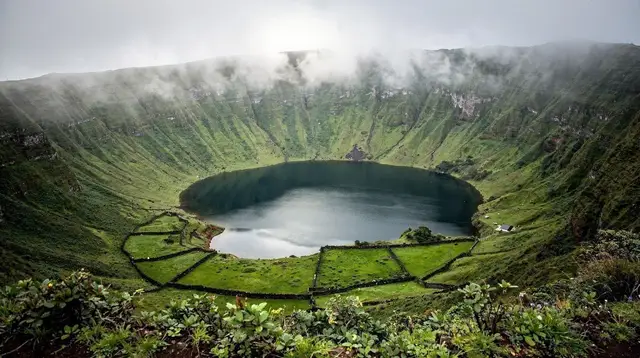
The one to get right is the Furna do Enxofre, on the small central-group island of Graciosa. It sits inside the Caldeira da Graciosa, it is volcanic, and it is genuinely one of the largest volcanic cavities in Europe, complete with an underground lake and sulphur fumaroles — but it did not form the way a lava tube does. It is the product of a magma chamber that emptied and then collapsed, not a tunnel drained by a flow of lava.
Lumping it in with Terceira’s or Pico’s lava tubes is the single most common mix-up when writing about Azorean caves, and it matters practically too: Graciosa is also the one island in this guide with no activity bookable online, so a visit takes more planning than a click. The Furna do Enxofre guide covers it in full, including how to get there.
Terceira: The Island With the Most Caves to Choose From
If a single island in the Azores deserves the label “cave island,” it’s Terceira. Its volcanic interior, much of it now quiet pastureland, is riddled with lava tube entrances, and several are strung together into organised routes rather than visited one at a time. A typical outing takes in a handful of tube entrances across a half-day, descending into passages where lava once ran freely before the surface hardened above it.
a three-hour guided caves tour departing from Terceira is the straightforward way to see several of these entrances in one outing, with a guide managing lighting, footing, and the low sections that require ducking.
For a slower, more complete day, some operators fold the caves into a wider loop of the island’s volcanic route, adding a stop at the lava-planted vineyards of Biscoitos — Terceira’s other famous piece of volcanic ground, where vines are grown inside small stone-walled plots called currais rather than open rows. a private tour of Terceira’s caves and lava route with a wine stop is built around exactly that combination.
Terceira’s single most dramatic underground feature, the vertical volcanic chimney of Algar do Carvão, is deliberately left out of this comparison — it has earned a page of its own, covered in the Algar do Carvão guide, with the practical detail (depth, lighting, opening days) that a landmark like that deserves. If Terceira is your base, a short stay built around Terceira in 3 days has enough time for both a cave tour and Algar do Carvão without feeling rushed.
Pico: Lava Tunnels Beneath the Vineyards and the Volcano
Pico is best known above ground — for the 2,351 m summit of the Montanha do Pico, the country’s highest point, and for the UNESCO-listed wine landscape of stone-walled currais at Criação Velha and Santa Luzia. Its underground side is less advertised but genuinely worth building into a visit: a network of lava tunnels running through the island’s interior, usually paired on a guided outing with a stop at one of Pico’s crater lagoons.
a guided tour combining Pico’s crater lagoons with its lava tunnels is the way most visitors see this side of the island — it isn’t a stand-alone attraction with fixed opening hours the way Algar do Carvão is, so a guided outing is the practical route in. If your Pico time is limited and split with a ferry across to Faial, the underground stop fits well into an itinerary built around Pico and Faial in 5 days, slotted in on a day when the summit trail is fogged in and a surface hike isn’t the better option anyway.
São Miguel: A Cave Under the Capital, and Sea Caves on the Coast
São Miguel hosts two very different kinds of “cave” experience, and they shouldn’t be confused with each other. The first is the Gruta do Carvão, a lava tube running beneath the streets of Ponta Delgada itself — an unusual case of a genuine volcanic feature sitting inside a capital city rather than out in the countryside. It’s compact enough to see in under an hour and has its own practical guide at Gruta do Carvão, Ponta Delgada.
The second is nothing like a lava tube at all: sea caves cut into the volcanic cliffs around the small islet off Vila Franca do Campo, on São Miguel’s south coast. These formed the ordinary way sea caves do everywhere — waves working relentlessly at a weaker seam in the rock — and they’re explored from the water rather than on foot. a guided kayak tour of the coast and islet caves at Vila Franca do Campo is the way to see them, and it makes a useful contrast if you’ve just come from an underground lava tube walk: same word, “cave,” genuinely different landscape.
Graciosa: A Volcanic Cave That Isn’t a Lava Tube
Graciosa deserves its own short section precisely because it’s the island most likely to get filed under the wrong heading. Its Furna do Enxofre, inside the Caldeira da Graciosa, is one of the largest volcanic cavities in Europe, complete with an underground lake and active sulphur fumaroles, and the island itself carries UNESCO biosphere reserve status.
But as covered above, it’s a magma-chamber collapse, not a lava tube, and — worth repeating because it changes how you’d plan a visit — Graciosa has no activity bookable online as of 2026-09-08. Getting there means combining ferry or flight connections from the central group with an independently arranged local guide, which makes it a poor fit for a short trip and a genuinely rewarding detour on a longer one. The full detail is in the Furna do Enxofre guide.
Comparing the Azores’ Cave Sites at a Glance
| Site | Island | Type | Typical visit | Bookable tour |
|---|---|---|---|---|
| Lava tube network | Terceira | Lava tube | Half-day, several entrances | Yes |
| Algar do Carvão | Terceira | Collapsed chimney | 30-45 minutes | Yes (see its own guide) |
| Lava tunnels and lagoons | Pico | Lava tube | Half-day, guided | Yes |
| Gruta do Carvão | São Miguel | Lava tube | Under an hour | Yes (see its own guide) |
| Vila Franca do Campo islet caves | São Miguel | Sea cave | 2-3 hours, kayak | Yes |
| Furna do Enxofre | Graciosa | Magma-chamber cavity | Half-day including travel | No |
Which Caves to Visit, By Itinerary
If your trip is a single-island stop on São Miguel, the Gruta do Carvão is the low-effort option since it sits inside Ponta Delgada, and pairing it with a Vila Franca do Campo kayak day covers both cave types São Miguel has to offer — a route that fits comfortably into São Miguel in 3 days without crowding out Sete Cidades or Furnas.
If Terceira is your focus, build around a half-day caves tour plus a separate visit to Algar do Carvão; the two together barely dent a three-day stay.
On a Pico and Faial loop, the lava tunnels and lagoons tour is worth reserving for a day when weather on the summit trail looks unreliable — Pico’s peak is frequently in cloud, and an underground outing doesn’t care about visibility the way a summit attempt does.
On a longer, multi-island trip that reaches the central and western groups, Graciosa’s Furna do Enxofre is worth the extra planning specifically because it’s so different from everything else on this list — no other site in this guide involves fumaroles and an underground lake. It won’t fit a quick hop, but on a two-week loop it’s a genuine highlight rather than a detour for its own sake. For working out how the islands fit together at that scale, see which Azores island to visit.
Practical Tips for Visiting Azorean Lava Caves
A few things hold true across every lava cave on this list, regardless of island. Underground temperatures stay noticeably cooler than the surface year-round, so bring a light layer even if it’s warm outside — this is one of the few Azorean activities genuinely unaffected by the archipelago’s famous “four seasons in a day” surface weather. Footing is uneven and often damp on solidified lava rock, so closed shoes with real grip aren’t optional.
Ceilings drop low in places, so expect some ducking, and if you’re prone to claustrophobia, ask an operator about a given route’s tightest section before booking rather than after you’re inside it. Most of the sites above are only accessible with a guide, either because that’s the only access offered or because navigating uneven, unlit lava rock without local knowledge is a genuinely bad idea — this isn’t a place to save money by going it alone.
Common Questions About the Azores’ Lava Caves and Tunnels
What is a lava tube and how does it form in the Azores?
A lava tube forms when the surface of a flowing lava stream cools and hardens into a crust while hotter lava keeps moving underneath. Once the eruption feeding it stops, the molten interior drains away downhill, leaving a hollow tunnel in solidified rock. The Azores sit on a junction of three tectonic plates, so this kind of fresh volcanic plumbing is common across several islands, not just one.
Which Azores island has the most lava caves to visit?
Terceira. Its interior pastureland hides an unusually dense cluster of lava tube entrances, several of which are combined into a single guided tour, and the island is also home to Algar do Carvão, its best-known single volcanic cavity, covered in its own guide.
Is the Furna do Enxofre on Graciosa a lava tube?
No. It formed from the collapse of a magma chamber rather than the drainage of a lava tube, and it is marked by an underground lake and sulphur fumaroles rather than the smooth tunnel walls of a lava tube. It sits inside the Caldeira da Graciosa and is covered in its own guide.
Can you visit Algar do Carvão and Gruta do Carvão on the same trip?
Only if your trip covers both Terceira and São Miguel, since the two sites sit on different islands roughly an hour apart by air. Algar do Carvão is a former volcanic chimney on Terceira; Gruta do Carvão is a lava tube running beneath the city of Ponta Delgada on São Miguel.
Do you need a guide to visit the Azores’ lava caves?
For most sites, yes, either because access is only offered as part of an organised tour or because the terrain underground is uneven, dark, and easy to misjudge without local knowledge. A handful of surface-level entrances can be viewed without a guide, but going inside generally means booking ahead.
What should I wear inside an Azorean lava cave?
Closed, sturdy shoes with good grip are non-negotiable, since lava rock floors are uneven and often damp. Bring a light layer even in summer, as underground temperatures stay noticeably cooler than the surface, and expect to duck under low sections on some routes.
Are the Vila Franca do Campo caves the same as lava tubes?
No. The caves around the Vila Franca do Campo islet, off São Miguel’s south coast, are sea caves carved by wave erosion into volcanic cliff rock, usually explored by kayak, rather than tunnels left behind by flowing lava.
Can I book a Graciosa cave tour online?
As of 2026-09-08, no. Graciosa has no bookable activity listed on GetYourGuide, including for the Furna do Enxofre, so visiting means arranging a local guide independently or joining a tour that departs from elsewhere in the central group.
tours.caves-lava-tubes
Verified deep-linked GetYourGuide tours. Book through these links and we earn a small commission at no cost to you.
GetYourGuide does not provide a product photo for this activity — the image shows the meeting point, photographed by us.