Furna do Enxofre: Graciosa's Volcanic Cave and Lake
What is the Furna do Enxofre on Graciosa?
The Furna do Enxofre is a collapsed volcanic caldera on Graciosa, descended by a stone staircase and a tunnel to an underground lake ringed by sulfur fumaroles. It anchors the island's UNESCO biosphere reserve status, but it is not a hot spring and nobody swims in it — and as of September 2026, Graciosa has no excursion here bookable online on GetYourGuide.
On the smallest inhabited island of the central group, a road cuts across a wide grassy plateau and ends at a car park with no obvious sign of what lies beneath it. A stone staircase drops into the ground, curls through a short tunnel, and opens onto an underground lake wrapped in sulfur fumes. This is the Furna do Enxofre, and it is the single reason most travelers put Graciosa on an Azores itinerary at all.
Inside the Caldeira: What Graciosa’s Sulfur Cave Actually Looks Like
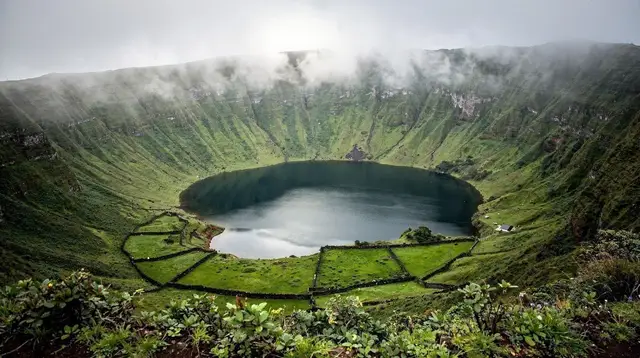
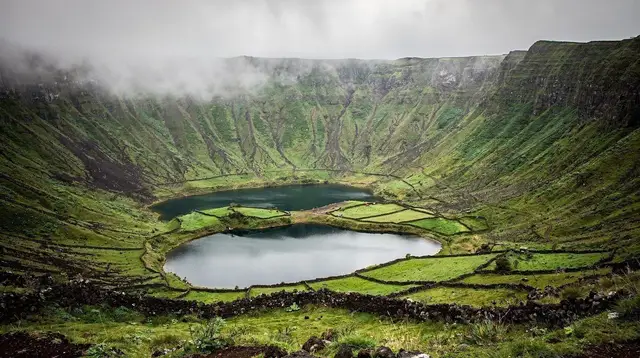
The Furna do Enxofre — the name translates roughly to “sulfur cave” — is not a lava tube in the way the lava caves of neighboring islands are. It is a collapsed volcanic caldeira: a chamber that formed when a magma reservoir emptied and the ground above it caved in, leaving a huge underground void. The chamber sits inside the wider Caldeira da Graciosa, the broad volcanic crater that dominates the island’s interior and gives Graciosa its low, table-top silhouette from the sea.
Access today is engineered rather than improvised: a concrete and stone staircase, several dozen steps, drops through a man-made tunnel cut into the caldeira wall. The tunnel itself takes a minute or two to walk, cool and dim, before it opens onto the floor of the chamber. What greets you is a genuinely large interior space — visitors consistently describe it as one of the biggest volcanic voids they have stood inside anywhere in Europe — dominated by a still, dark lake. Around its edges, fumaroles vent sulfur gas continuously, which is where both the smell and the name come from. Walkways and railings keep visitors on a fixed path around the platform above the water; this is a site built for looking, not for swimming or wading.
Lighting inside is minimal and deliberately low-key, chosen to preserve the cave’s natural atmosphere rather than turn it into a lit attraction. That means photographs without a tripod or a fast lens tend to come out dark and grainy — worth knowing if the visit is partly for photography. The air is noticeably more humid and several degrees cooler than outside, and carries a persistent rotten-egg edge from the sulfur that some visitors barely notice and others find quite strong within a few minutes.
Not a Hot Spring: Why Nobody Swims Here
It is an easy mix-up, and one worth correcting before you plan around it: the Furna do Enxofre has the two ingredients — sulfur and an underground lake — that usually signal a thermal bathing spot elsewhere in the Azores. It isn’t one. Unlike the thermal pools covered in our broader Azores hot springs guide, which are largely concentrated around Furnas on São Miguel, the lake inside the Furna do Enxofre is not a bathing facility. There are no changing rooms, no managed water temperature, and no expectation that visitors enter the water. The experience here is entirely about descending into the chamber and viewing the lake and fumaroles from the walkway, not soaking in anything.
If a warm soak is what you are after, that is a São Miguel itinerary, not a Graciosa one — the two islands serve very different purposes on an Azores trip, and conflating them is one of the most common planning mistakes for first-time visitors piecing together an island-hopping route.
Furna do Enxofre vs Algar do Carvão: Two Chambers, Two Different Moods
The Furna do Enxofre invites an obvious comparison with the Algar do Carvão on Terceira, and the comparison is fair as far as the basic mechanics go: both are volcanic chambers reached by a descending staircase, both sit inside a wider caldeira landscape, and both count among the archipelago’s showcase examples of its volcanic geology. Beyond that, the two sites diverge.
| Furna do Enxofre (Graciosa) | Algar do Carvão (Terceira) | |
|---|---|---|
| Formation | Collapsed volcanic caldeira | Ancient volcanic chimney |
| Interior character | Sulfur fumaroles, dark mineral tones | Stalactites, stalagmites, clear lake |
| Water | Sulfur lake, not for bathing or wading | Small, clear lake at the base |
| Bookable tours | None on GetYourGuide as of Sept 2026 | Independently visitable, no comparable gap |
| UNESCO status | Graciosa biosphere reserve geosite | Not itself a UNESCO listing |
Travelers who have done both tend to describe the Algar do Carvão as the more visually dramatic of the two, thanks to its mineral formations and clearer water, while the Furna do Enxofre feels more raw and elemental — a genuinely active-smelling volcanic environment rather than a polished show cave. Neither replaces the other on an itinerary; if your route touches both Terceira and Graciosa, seeing both back to back is one of the better ways to appreciate how differently two structurally similar features can turn out.
A Centerpiece of Graciosa’s UNESCO Biosphere Reserve
Graciosa was designated a UNESCO biosphere reserve in 2007, a status shared with Corvo and tied to the island’s environmental management rather than to any single monument — worth distinguishing from the separate UNESCO World Heritage listings held elsewhere in the archipelago, such as the historic center of Angra do Heroísmo or the wine landscape of Pico. Within that reserve, the Caldeira da Graciosa and the Furna do Enxofre are treated as priority geosites, and the island falls under the umbrella of the wider Azores Geopark, a UNESCO Global Geoparks network member.
That framing matters for how the site is managed: the staircase, tunnel, and walkway were built to let visitors experience the chamber while limiting disturbance to the fumarole system and the lake itself. It also explains why the site feels understated rather than commercialized — there is no visitor center with gift shop energy at the entrance, just a car park, the descent, and the cave. For an island of roughly 4,300 people that receives a fraction of the visitor numbers of São Miguel or Terceira, the Furna do Enxofre is treated less as an attraction to be maximized and more as a natural feature to be preserved.
Getting to Graciosa: Flights, Ferries, and Realistic Timing
Graciosa’s remoteness is part of what keeps the Furna do Enxofre off most first-time Azores itineraries, and it is worth planning around honestly rather than optimistically.
By air, SATA Air Açores operates inter-island flights connecting Graciosa to Terceira and, with a stop, to São Miguel — see our guide to inter-island flights on SATA for how these routes typically connect. Flights are short, generally well under an hour in the air, but frequency is lower than on the busier São Miguel–Terceira corridor, so it pays to book with some flexibility around your dates.
By sea, Atlânticoline’s wider central-group ferry network, which includes Graciosa alongside Terceira, Pico, Faial, and São Jorge, only operates from June to September — full detail in our inter-island ferries guide. Outside that window, there is no scheduled ferry service to the island, which is a very different situation from the Pico–Faial “Triangle” crossing that runs year-round. If your trip falls outside summer, flying is effectively the only option for reaching Graciosa.
Once on the island, a rental car is close to essential: the Furna do Enxofre sits inland from Santa Cruz da Graciosa, and public transport between the island’s small settlements is limited. Most visitors plan Graciosa as a single dense day or a short overnight — our Graciosa in 2 days itinerary lays out a realistic pace that includes the cave alongside the island’s windmills and coastline.
Practical Details for the Visit
| Detail | What to expect |
|---|---|
| Access | Stone staircase and short tunnel, moderate number of steps |
| Time needed | Roughly 45 minutes to an hour on site |
| Footwear | Closed, non-slip shoes — floor can be damp |
| Clothing | A light layer; the interior is cooler and more humid than outside |
| Water contact | None expected — viewing platform only, not a bathing site |
| Photography | Low ambient light; a fast lens or higher ISO setting helps |
| Booking | No advance ticketing system tied to GetYourGuide as of Sept 2026 |
| Best paired with | Caldeira da Graciosa rim views, Santa Cruz da Graciosa windmills |
Because the site is not run as a ticketed, time-slotted attraction the way some larger Azores sites are, most visitors simply drive up, park, and descend, with only modest queuing even during the island’s short summer visitor peak.
Pairing Graciosa With the Rest of the Central Group
Because Graciosa carries no bookable excursions of its own, most travelers treat it as one leg of a wider central-group route built around islands where guided experiences are easier to arrange in advance. If your itinerary continues on to Faial afterward, a guided car tour that circles the island’s coastline and the Capelinhos volcano site or an eco-focused guided tour covering Faial’s caldeira and countryside are both straightforward to book ahead of arrival.
Travelers timing a trip around Terceira’s São João festivities can also look at a guided walking tour through Angra do Heroísmo during the São João celebrations, which pairs naturally with the historic center’s UNESCO status.
More generally, arranging a certified local guide for the hiking or heritage days elsewhere on your route is a useful way to fill in the gap left by Graciosa’s thin tour catalogue — book the guided pieces of your trip on islands where that infrastructure exists, and treat the Furna do Enxofre itself as an independent, self-driven stop.
For structuring the wider trip, see our Terceira in 3 days and Pico and Faial in 5 days itineraries, or the broader question of which Azores island to visit if Graciosa is one option among several on a first trip.
Other Volcanic Sites to Compare It Against
If the Furna do Enxofre is your entry point into the Azores’ volcanic side, it is worth seeing where it sits relative to the archipelago’s other showcase features, covered in our Azores volcanoes and craters guide. The Algar do Carvão on Terceira remains the closest direct comparison in form. Beyond the two chambers, the broader category of the archipelago’s lava caves covers a different kind of feature entirely — true lava tubes formed by flowing molten rock rather than a collapsed magma chamber — and is worth a look if the geology itself, rather than any single site, is what draws you in.
Furna do Enxofre Questions: What to Know Before You Descend
What exactly is the Furna do Enxofre?
It is a large collapsed volcanic chamber, or caldeira, on the island of Graciosa in the Azores. A stone staircase and a short tunnel lead down from the surface into the chamber, which holds an underground lake surrounded by sulfur fumaroles. It is considered one of the largest volcanic caves of its kind in Europe.
Can you swim in the Furna do Enxofre?
No. Despite the sulfur smell and the underground lake, this is not a thermal bathing site. The water and air inside carry sulfur fumes, and access is limited to the walkway and viewing areas around the lake, not the water itself. Visitors who want a soak should look at São Miguel’s thermal pools instead.
Is the Furna do Enxofre the same as the Algar do Carvão on Terceira?
No, though the two are often mentioned together. Both are volcanic chambers you descend by staircase, but their interiors differ sharply: the Algar do Carvão on Terceira is known for its stalactites, stalagmites, and a small clear lake at the bottom, while the Furna do Enxofre on Graciosa is a sulfur environment with fumaroles and a darker, more mineral atmosphere.
How do you get to Graciosa to visit the Furna do Enxofre?
Graciosa is reached by a short SATA Air Açores flight from Terceira or São Miguel, or by ferry, which on the wider central-group network (including Graciosa) only runs from June to September. There is no year-round ferry link to Graciosa, so flights are the more reliable option outside summer.
How long does a visit to the Furna do Enxofre take?
Budget around 45 minutes to an hour at the site itself, including the descent, time at the lake platform, and the climb back up. Add travel time from wherever you are staying on Graciosa, since the cave sits inland from the island’s small towns.
What should I bring or wear for the visit?
Wear closed, non-slip shoes, since the staircase and tunnel floor can be damp and uneven, and bring a light layer, as the underground air is cooler and more humid than the surface. A light jacket also helps with the sulfur smell, which some visitors find stronger than expected.
Can I book a guided tour to the Furna do Enxofre online?
Not as a standalone GetYourGuide listing as of September 2026 — Graciosa has no bookable activities in the catalogue at all. Most visitors see the cave independently by rental car, or as part of a locally arranged island tour organized once they arrive, rather than through an online booking made in advance.
tours.caves-lava-tubes
Verified deep-linked GetYourGuide tours. Book through these links and we earn a small commission at no cost to you.
GetYourGuide does not provide a product photo for this activity — the image shows the meeting point, photographed by us.