The island most Azores trips start with
Of the nine islands that make up the Azores, São Miguel is the largest, the most populated, and the only one with a major international airport — which is why, for most travelers, it’s also the first island they set foot on.
Landing at Ponta Delgada puts you within a day’s drive of a startlingly compact set of landscapes: a volcanic crater holding two lakes of different colors, a steaming valley where lunch is cooked underground, a jet-black crater lake reached by cloud forest trails, and tea fields that don’t exist anywhere else in Europe. No other Azorean island offers this particular combination in one place, and that concentration — more than sheer size — is what makes São Miguel the default entry point to the archipelago.
It helps to be precise about what that means. São Miguel is not “the Azores in miniature.” The other eight islands each carry landscapes and traditions São Miguel doesn’t have: the summit climb and UNESCO vineyards of Pico, the fajãs of São Jorge, the whaling-era marina of Faial, the walled city of Angra do Heroísmo on Terceira. What São Miguel offers is scale and variety within a single, easily driveable island — reason enough to anchor a trip here, but not a substitute for seeing what’s unique elsewhere in the chain.
Sete Cidades: one crater, two lakes, and a village in between
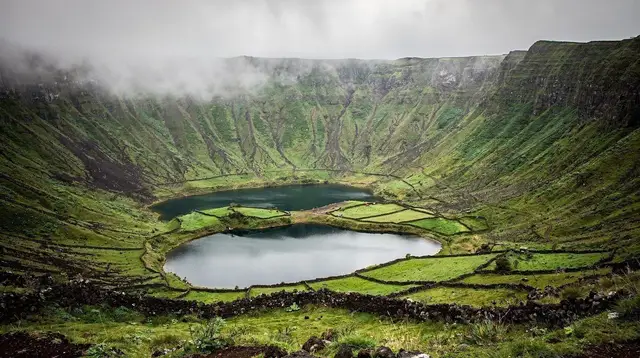
The single image most associated with the Azores — a huge volcanic caldera cradling a blue lake on one side and a green lake on the other, with a small village strung along the shoreline between them — belongs to Sete Cidades, on São Miguel’s western tip. The crater itself is roughly 5 km across, formed by collapse after a series of eruptions, and its rim offers a string of miradouros (viewpoints) that are the most photographed spots in the whole archipelago. Vista do Rei is the best known, but it’s one of several angles on the same caldera, each showing the lakes at a slightly different distance and light.
Sete Cidades rewards more than a single viewpoint stop: the crater floor itself, with its farmland, small chapel and lakeside paths, is worth descending into on a full day out rather than photographing from above and moving on. A guided full-day van tour combining Sete Cidades and Lagoa do Fogo is a practical way to cover both without driving the island’s narrower roads yourself, especially useful given the fog that regularly settles over the crater rim with little warning.
Furnas: a valley that cooks its own dinner
On the opposite side of the island, the Furnas valley runs on geothermal heat rather than views. Fumaroles vent steam and sulphur straight out of the ground around the Lagoa das Furnas, and locals have used that heat for centuries to cook cozido das Furnas — a stew of meats and vegetables buried in the volcanic soil for six to seven hours and dug up, whole, at lunchtime. It’s one of the more distinctive food traditions anywhere in Portugal, and one worth booking ahead for: restaurants typically need 24 to 48 hours’ notice (longer in July and August), since the pots go into the ground before dawn.
The same geology feeds Furnas’s thermal pools. Terra Nostra Park centers on a large iron-rich pool at around 40°C set inside a historic botanical garden, and Poça da Dona Beija offers a more intimate series of outdoor thermal pools open into the evening. Both draw on the same mineral-rich, faintly orange water — worth knowing before you pack a pale swimsuit or towel, since the iron content stains light fabrics a lasting rust color. Furnas alone can fill a full day, and it’s one of the clearest examples of why São Miguel’s sights don’t generalize to the rest of the Azores: nowhere else in the archipelago has this exact combination of buried-lunch tradition and geothermal bathing.
Other thermal pools worth knowing about
Furnas isn’t the island’s only geothermal stop. For a fuller picture of where to soak on São Miguel — from the Terra Nostra Park pool to Poça da Dona Beija and other spots scattered around the island — a dedicated Azores hot springs guide rounds up the options, with separate write-ups on the Terra Nostra thermal pool and Poça da Dona Beija itself.
Lagoa do Fogo: the crater lake you have to earn
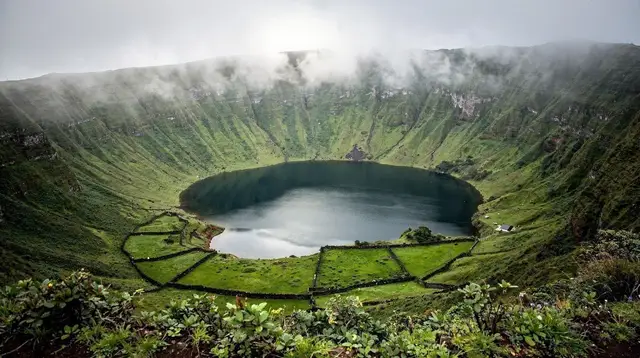
Between Sete Cidades and Furnas sits Lagoa do Fogo, a near-perfectly circular crater lake ringed by protected reserve land and often wrapped in low cloud. Unlike Sete Cidades, there’s no village or road down to the water — access is by trail, and the lake’s dark, wind-rippled surface has a starker, more remote feel than the postcard lakes further west. It’s a strong contrast to visit on the same trip: one accessible and photogenic, the other quieter and more physical to reach.
Hiking down to the shoreline and back is a half-day undertaking best done with good boots and a weather buffer, since the reserve sits high enough to catch cloud even when the coast is clear. A guided full-day hike to Lagoa do Fogo takes care of routing and timing, which matters here more than at most Azorean viewpoints — fog can close in and drop visibility with little warning.
Gorreana: the only tea grown in Europe
A short drive along the north coast near Ribeira Grande sits Gorreana, Europe’s oldest and, along with a smaller neighboring estate, only working tea plantation. It has been growing and processing tea on São Miguel’s volcanic soil since the 1880s, using original machinery still in service today, and the visit is free — walk through the fields, watch the processing floor, and taste the black and green tea in the on-site shop. It’s a low-key stop compared with the craters and thermal valleys, but it’s a genuinely singular one: there is no equivalent plantation anywhere else in the Azores, or in Europe.
Food and drink beyond cozido
Cozido das Furnas and Gorreana tea are São Miguel’s two most distinctive food traditions, but they’re part of a wider island food culture — from fresh seafood in Ponta Delgada to the island’s own cheeses and wines from elsewhere in the archipelago. Our Azorean food guide covers what to look for on menus across São Miguel and the rest of the islands.
Ponta Delgada: airport, capital, and a base worth a day of its own
Most itineraries treat Ponta Delgada purely as an arrival and departure point, but the city built around the island’s black-and-white basalt architecture, its 18th-century Portas da Cidade gate, and its working marina deserves at least a half-day on foot. It’s also the most practical base for exploring the rest of São Miguel, since day trips to Sete Cidades, Furnas and Lagoa do Fogo all radiate out from roughly the same central hub.
Ponta Delgada is also where São Miguel’s whale-watching heritage is most visible, and the island remains one of the most consistent places in the Azores to see cetaceans — resident sperm whales, common and bottlenose dolphins are recorded most months, while the great migratory whales pass mainly in spring.
Boats depart along this coast for whale and dolphin watching trips out to Vila Franca Islet, a flooded crater just offshore, and land-based lookout posts called vigias — once used by whalers to spot sperm whale blows — still guide today’s boats by radio, a tradition explained in more depth on a dedicated São Miguel whaling-heritage tour. For visitors who want the geography covered efficiently by road, jeep excursions around the island are a common alternative to self-driving the narrower interior routes.
Whale watching beyond Vila Franca Islet
São Miguel’s waters are one of the more reliable places in the archipelago to see cetaceans, and it’s worth understanding why before booking a trip. Our whale watching in the Azores guide explains the seasonal patterns behind those sightings, while a separate guide compares which island gives you the best odds if São Miguel is one stop on a longer, multi-island trip.
Quieter corners: Caloura and Vila Franca do Campo
Away from the headline sights, small coastal settlements like Caloura and the town of Vila Franca do Campo — separate from the offshore islet of the same name — offer a slower-paced side of São Miguel for travelers with a day or two to spare beyond the main circuit.
Getting around São Miguel
São Miguel is large enough, and its sights spread out enough, that transport shapes how much of the island you can realistically see. Public buses connect the main towns but run on limited schedules, which makes a rental car the default choice for independent travelers who want to set their own pace between Sete Cidades, Furnas and the quieter east around Nordeste. Roads are generally good but narrow and winding in the interior, with fog a real hazard at altitude — the crater rims at Sete Cidades and Lagoa do Fogo are exactly where visibility can drop fastest.
Travelers who’d rather not navigate those roads themselves have several organized alternatives, from van tours that combine multiple sights in a day to smaller-group jeep tours, and even a jeep tour covering the island’s main highlights for a more off-road-flavored day. Around Ponta Delgada itself, short buggy outings are a popular way to explore the coastline near the capital without committing to a full-day excursion.
For the practicalities of getting to the island in the first place, see our guide to flights to the Azores; once you land, our car rental in the Azores guide covers what to expect from local agencies at Ponta Delgada’s airport.
Hiking on São Miguel
Beyond the crater-rim viewpoints, São Miguel has a solid network of waymarked trails, from short walks around Sete Cidades to longer routes through the island’s forest reserves. A dedicated guide to São Miguel’s hiking trails breaks down the main options, and sits alongside our wider roundup of the best hikes in the Azores for travelers comparing islands before they commit to boots and a trailhead.
Weather and when to go
São Miguel’s climate is mild and green year-round, tempered by the Gulf Stream, but it’s rarely dry for long. Humidity and cloud cover are constants, and the island shares the Azores-wide pattern locals sum up as “four seasons in one day” — a clear morning at the coast can turn to rain on the crater rim by midday and back to sun an hour later. July and August are the statistically driest months and line up with the fullest hydrangea bloom along the island’s roadsides and crater rims, which typically starts in May or June and fades by early autumn. November through February bring the wettest, cloudiest stretch, though the island’s core sights — the thermal pools especially — are just as enjoyable, if not more atmospheric, in cooler weather.
How long to stay: sample itineraries
If three to five days feels like an estimate rather than a plan, our 3-day São Miguel itinerary and 7-day São Miguel itinerary lay out day-by-day routes covering the sights described above, useful whether São Miguel is the whole trip or the first leg of a longer one.
Where São Miguel fits in a wider Azores trip
For travelers deciding how to split their time across the archipelago, São Miguel is rarely the whole trip — it’s usually the anchor. A short visit of three days covers Sete Cidades, Furnas and Ponta Delgada; five to seven days adds Lagoa do Fogo, Gorreana and the less-visited east coast without feeling rushed.
From here, flights and ferries connect onward to the rest of the archipelago, though it’s worth knowing that reliable, year-round inter-island transport is really only guaranteed within the central “Triangle” of Pico, Faial and São Jorge — connections to Terceira, Graciosa or the far-flung western islands of Flores and Corvo are seasonal or weather-dependent, and shouldn’t be assumed when planning a multi-island itinerary that starts here.
Because São Miguel offers so much within a single island, it’s tempting to treat its sights as a preview of the whole Azores. They’re not — Furnas’s cozido, Sete Cidades’ twin lakes and the Gorreana plantation are specific to this one island, and the other eight each have their own landscapes worth planning for separately. Used as an introduction rather than a summary, though, São Miguel does exactly what most first-time visitors need: it shows, in a few days, why the Azores are worth returning to.
FAQ: Planning a trip to São Miguel
Is São Miguel the best island to visit in the Azores?
It’s the best single-island choice for a first trip, because it’s the only Azorean island with a major international airport and it concentrates the archipelago’s headline sights — crater lakes, thermal springs, a working tea plantation — in one place. Other islands, like Pico or Terceira, offer experiences São Miguel doesn’t have, such as the Pico summit climb or UNESCO-listed Angra do Heroísmo.
How many days do you need on São Miguel?
Three days covers the essentials — Sete Cidades, Furnas and Ponta Delgada — but five days lets you add Lagoa do Fogo, the Gorreana tea plantation and the quieter east coast around Nordeste without rushing. See our dedicated 3-day and 5-day itineraries for a route.
Are the sights on São Miguel typical of the whole Azores?
No. Furnas, Sete Cidades and the Gorreana tea plantation exist only on São Miguel, not on the other eight islands. Each Azorean island has its own distinct landscape and identity — Pico has its volcano and vineyards, São Jorge its fajãs, Faial its marina — so São Miguel is a strong introduction, not a stand-in for the whole archipelago.
Do you need a car to see São Miguel?
Yes, effectively. Public transport between villages is limited, and the island’s main draws — Sete Cidades, Furnas, Lagoa do Fogo — are spread across a large, hilly island best covered by rental car, jeep tour or organized van excursion.
What is the weather like on São Miguel?
Mild year-round thanks to the Gulf Stream, but humid and cloudy often, with fast-changing conditions — locals describe “four seasons in one day.” There’s no dry season on the scale of the Canary Islands or Madeira; July and August are statistically the driest months without being rain-free.
When do the hydrangeas bloom on São Miguel?
First flowers usually appear in May and June, with full bloom in July and August and some fading by early autumn. Visitors in spring or late September may see only the beginning or end of the season rather than the classic hedgerows in full color.
Can you fly directly to São Miguel from outside Portugal?
Yes. Ponta Delgada’s airport has seasonal and year-round direct connections from several European cities and North America, in addition to year-round flights from Lisbon, which makes São Miguel the natural arrival point for most Azores trips.