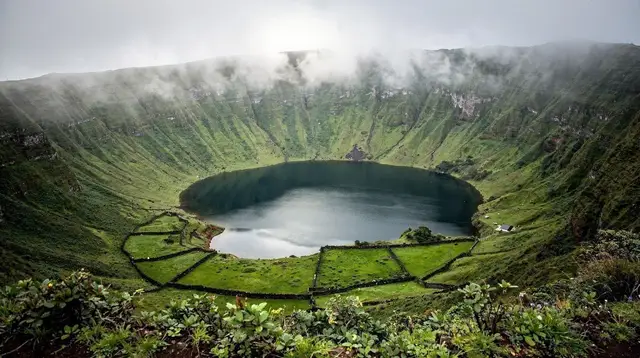
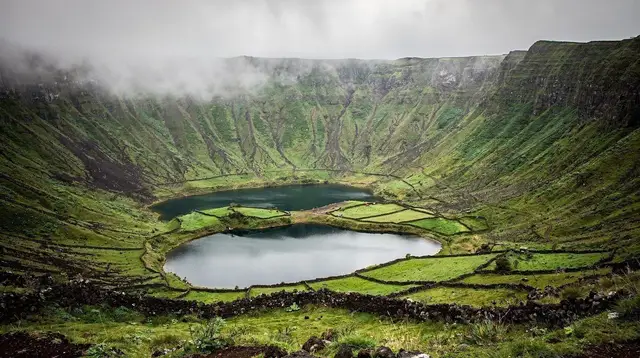
Sete Cidades is the single most photographed sight on São Miguel, and also one of the easiest to get slightly wrong on a first visit — because the postcard image of two perfectly colored lakes only exists under the right sky, and the crater holds more than just a viewpoint stop. This page is about orienting a first visit: the road in, the village at the bottom, the two lakes, and the handful of miradouros that make the crater rim worth slowing down for.
A Crater With a Village Inside It
Sete Cidades occupies the western tip of São Miguel, formed by a large volcanic caldera roughly 5 km across. What sets it apart from most crater lakes elsewhere is that a working village — also called Sete Cidades — sits right at the bottom, on the strip of land between the two lakes. There’s a parish church, small cafés, a scattering of houses, and grazing fields, all inside what is technically the mouth of a dormant volcano. Coming from the rim road, the first sight of green fields and rooftops sitting inside the crater bowl is often more striking to first-time visitors than the lakes themselves.
The caldera is reachable by a single main road that loops around and down into it, connecting to the rest of São Miguel near Mosteiros and back toward Ponta Delgada. Most visitors arrive from the island capital, either self-driving or on an organized tour, and treat Sete Cidades as a half-day or full-day loop rather than a stop on the way to somewhere else.
Getting There from Ponta Delgada
By car, the drive from Ponta Delgada to Sete Cidades takes about 25 to 35 minutes, covering close to 20 km across the interior of the island. The route climbs out of the capital, passes through farmland and pasture, and eventually reaches the crater rim before descending into the caldera itself. It’s a straightforward drive by São Miguel standards, though the final stretch down into the crater has the same tight curves typical of Azorean roads built into volcanic terrain, so it isn’t a road to rush.
Self-driving is by far the most flexible way to see Sete Cidades, since it lets you choose your own order of viewpoints and stop wherever the light looks good. For visitors without a rental car, a guided tour from Ponta Delgada is the practical alternative, and several operators run dedicated Sete Cidades routes that combine the main viewpoints with time in the village.
A fast option for a tight schedule is the 1h30 express run out to Sete Cidades, aimed at travelers who want the highlights without committing a full day. For a slower pace with local commentary, the guided Sete Cidades tour with a local host spends more time at each stop.
If you’re mapping out a longer stay on the island rather than a single excursion, it helps to see where this crater sits relative to everything else — see our overview of São Miguel and the day-by-day breakdown in São Miguel in 3 days.
Lagoa Azul and Lagoa Verde: The Twin Lakes Explained
The two lakes inside the caldera are Lagoa Azul (“blue lake”) and Lagoa Verde (“green lake”), separated by a narrow land bridge that the main road crosses. Local legend explains the color split with a story about a blue-eyed shepherd and a green-eyed princess forbidden to marry, whose tears are said to have formed the two lakes in their respective colors — a nice story to know before you look down from the rim, even if the real explanation is optical rather than romantic.
In practice, the color difference between the two lakes comes down to depth, mineral content, and how light reflects off each surface, and it is most visible from height — from a rim viewpoint looking down, rather than at water level. Seen from the shore, both lakes often look like fairly ordinary, calm freshwater lakes in shades of grey-green. It’s only from above, in direct sun, that the contrast opens up into something closer to the postcard image.
This is the detail worth setting expectations around before the trip: the blue-and-green contrast depends entirely on daylight conditions, and it is not guaranteed. São Miguel is a humid island with frequent cloud cover, and on an overcast day the two lakes can look nearly identical, both a flat grey-green rather than showing any real color split. If your visit lands on a cloudy morning, it doesn’t mean you’ve missed anything broken — it means the light simply isn’t cooperating, and it’s worth building in a second stop later in the day, or even a return visit, if the view matters enough to you.
For a closer, lake-level walk around the water rather than the rim overlooks covered here, our dedicated crater walking notes are in the Sete Cidades crater guide, and broader trail options across the island are covered in São Miguel hiking trails — this page focuses on orienting the viewpoints and the village rather than route-by-route walking directions.
Inside the Village of Sete Cidades
Down at the bottom of the caldera, the village itself is small and unhurried: a central church with a distinctive twin-towered facade, a few cafés and small restaurants, grazing cattle in the surrounding fields, and views back up toward the crater rim from ground level. It’s worth budgeting at least 20 to 30 minutes here even on a tight schedule, both to get a sense of what daily life looks like inside a volcanic caldera and to see the lakes from the opposite perspective to the rim viewpoints.
The village also makes a natural lunch stop if you’re spending a full day in the area, before heading back up to the rim for afternoon viewpoints or continuing the loop road toward Mosteiros on the coast.
Vista do Rei: The View Everyone Photographs
Vista do Rei (“the King’s view”) is the best-known viewpoint over Sete Cidades, positioned on the crater rim with both lakes framed in a single sweeping view. It’s the image most visitors have seen before ever landing on São Miguel, and it’s the reason many day-tour itineraries build in a dedicated stop here. Behind the main lookout sits the abandoned shell of the Monte Palace Hotel, closed since the 1980s and now partly overtaken by vegetation — not open to the public, but visible from the viewpoint and a curiosity in its own right.
Vista do Rei gets busy, particularly around midday when tour buses and rental cars converge at the same time, so arriving earlier or later in the visitor window tends to mean a calmer stop. As with the lakes themselves, the payoff at Vista do Rei is entirely weather-dependent: on a clear day it delivers the full postcard view, and in fog or heavy cloud there may be little to see beyond a grey wall of mist.
Miradouro da Grota do Inferno and Other Viewpoints
A short distance from Vista do Rei, the Miradouro da Grota do Inferno offers a different angle on the caldera, generally with fewer visitors and a slightly more elevated perspective over the crater bowl and its patchwork of fields. It’s a good second or third stop for travelers who want more than one look at the lakes, or who found Vista do Rei too crowded to enjoy properly.
Several smaller pull-offs and lookout points line the rim road as it circles the caldera, and part of the appeal of self-driving Sete Cidades is stopping wherever a gap in the trees opens up a new angle. Photographers in particular tend to build in time for more than one viewpoint, since the light and cloud cover can shift meaningfully within the same morning — see Azores photography spots for more on timing shots around this kind of fast-changing weather.
Key Viewpoints at a Glance
| Viewpoint | What it shows | Best for |
|---|---|---|
| Vista do Rei | Both lakes framed together, plus the abandoned Monte Palace Hotel | The classic photograph, first-time visitors |
| Miradouro da Grota do Inferno | A quieter, elevated angle over the crater bowl | Fewer crowds, a second perspective |
| Village viewpoints (lake level) | Lakes and rim seen from inside the caldera | Slower pace, a different sense of scale |
When the Lake Contrast Actually Happens — and When It Doesn’t
It’s worth repeating this plainly, because it’s the single most common source of disappointment for first-time visitors: the sharp blue-and-green split between Lagoa Azul and Lagoa Verde shows up on clear days with strong direct light, generally better around late morning into early afternoon once the sun is higher. On cloudy or foggy days — which happen often on this side of São Miguel given the island’s year-round humidity — both lakes can look flat and similarly colored, with none of the contrast visible in photographs online.
There is no way to guarantee which kind of day you’ll get from a forecast checked days in advance, since São Miguel’s weather can shift within a single morning. If seeing the classic contrast matters to your trip, it helps to keep Sete Cidades flexible in your itinerary — a stop you can push to a clearer day rather than a fixed slot on day one — and to check conditions the morning of your visit rather than relying on a forecast from earlier in the week.
How Much Time to Give Sete Cidades
For most first-time visitors, a half day is enough to cover the main rim viewpoints and a short stop in the village, especially if arriving by a scheduled tour with a fixed route. Travelers who want to linger at more than one viewpoint, walk around at lake level, and have an unhurried lunch in the village should plan for closer to a full day.
Suggested Visit Lengths
| Time available | What you can realistically cover |
|---|---|
| 1.5–2 hours | Vista do Rei plus a quick pass through the village by car |
| Half day (3–4 hours) | Vista do Rei, Grota do Inferno, and a proper stop in the village |
| Full day | Both main viewpoints, extended village time, and flexibility to wait out cloud |
If Sete Cidades is one stop among several on a longer São Miguel loop, our São Miguel in one day itinerary shows how it can fit alongside other highlights without overloading the schedule.
Booking a Tour vs Driving Yourself
Self-driving suits travelers who want full control over timing — useful given how weather-dependent the lake views are — and who are comfortable with the narrow, curving roads typical of the Azores. It also makes it easy to combine Sete Cidades with other stops on the western side of the island in the same day.
A guided tour is the better choice for visitors without a rental car, or those who’d rather have local commentary on the legend of the lakes and the abandoned hotel than navigate the loop road themselves. For a small-group experience with a set route, the half-day Sete Cidades tour covers the main viewpoints and the village in a single organized outing.
Travelers who prefer a more private, flexible pace, including the option to linger longer at a favorite viewpoint, might look instead at a private jeep 4x4 tour that can be tailored around Sete Cidades. For visitors combining Sete Cidades with the nearby coastal village of Fenais da Luz on the same outing, a guided trip covering both is also available.
Where Sete Cidades Fits in a São Miguel Itinerary
Because it sits at the western tip of the island, Sete Cidades is usually treated as either its own dedicated half-day or full-day trip, or as the anchor stop of a western São Miguel loop that also touches the coast near Mosteiros. It is not close to Lagoa do Fogo, which lies well to the east near the island’s interior highlands — the two are often confused by name alone, but they are separate crater lakes reached by different roads, and treating them as a single stop tends to make for a rushed day at both.
For a broader sense of how Sete Cidades compares to other volcanic landscapes across the archipelago, see Azores volcanoes and craters. And if you’re weighing whether to focus a first trip entirely on São Miguel or split time across islands, the São Miguel in 3 days itinerary places Sete Cidades early, on the logic that it benefits from being visited before you know whether later days will bring clearer skies.
Practical Tips for Visiting Sete Cidades
- Check the sky before you commit to a specific viewpoint window. Given how weather-dependent the lake contrast is, a flexible morning beats a fixed appointment with Vista do Rei.
- Arrive earlier or later than midday if you want Vista do Rei without the peak crowd of tour buses and rental cars.
- Bring a layer. The crater rim sits at higher elevation than the coast and catches more wind and mist than the roads leading up to it.
- Budget time for the village, not just the rim. The lake-level perspective is a genuinely different experience from the overlook photos.
- Don’t try to combine Sete Cidades and Lagoa do Fogo as a quick double stop — they’re on opposite sides of the island’s interior, and rushing both tends to shortchange each.
For general planning around when to schedule outdoor sights like this one across a trip, see our best-time-to-visit tool, and for more on the island’s swimmable and scenic water spots beyond Sete Cidades, Azores natural swimming pools rounds out the picture.
Frequently Asked Questions About Visiting Sete Cidades
How long does it take to drive from Ponta Delgada to Sete Cidades?
Around 25 to 35 minutes by car, covering roughly 20 km across the western half of São Miguel. The road climbs steadily before dropping into the caldera, so allow a little extra time to stop at viewpoints along the way.
Do the Sete Cidades lakes really look blue and green, or is that edited in photos?
The color contrast between Lagoa Azul and Lagoa Verde is real, but it depends on direct sunlight hitting the water at the right angle. On an overcast day, which is common on this humid island, both lakes can look a similar grey-green rather than showing the postcard blue-and-green split.
Is there an entrance fee to visit the Sete Cidades crater?
No ticket is needed to see the crater, the lakes, or the village itself, since Sete Cidades is open countryside and a public settlement rather than a paid attraction. Any cost comes from parking, a guided tour, or activities you book separately, such as a boat trip on the lake.
What is Vista do Rei and is it worth the stop?
Vista do Rei is a roadside viewpoint on the crater rim, one of the most photographed spots on São Miguel because it frames both lakes together in a single view. It’s worth the short stop on a clear day, though the view is essentially wasted in thick fog or heavy cloud.
Can I visit Sete Cidades without a car?
It’s possible with a guided tour or an organized day trip from Ponta Delgada, since public transport into the caldera is limited and not built around tourist schedules. A rental car or a booked tour gives far more flexibility to stop at multiple viewpoints.
How much time should I set aside for Sete Cidades?
A half day is enough to see the main viewpoints and take a short walk around the village and lake edge. A full day suits travelers who want to combine the rim viewpoints, time down in the caldera, and a slower lunch stop without rushing.
Is Sete Cidades the same as Lagoa do Fogo?
No, they are two separate crater lakes on different parts of São Miguel. Sete Cidades sits in the far west of the island around a village, while Lagoa do Fogo is a separate, higher-altitude crater lake further east with no village at its shore.
What’s the best time of day to see the twin lakes at their most colorful?
Late morning to early afternoon on a clear day tends to give the strongest light for the blue-and-green contrast, since the sun needs to be reasonably high to light both lake surfaces. Early morning fog is common in the caldera, so arriving too early can mean waiting for it to lift.