Best Photography Spots in the Azores
Where are the best photography spots in the Azores?
The classic shots are the Sete Cidades miradouros and Ponta da Ferraria on São Miguel, the fajãs of São Jorge, the Capelinhos volcano on Faial, and the Montanha do Pico silhouette from Faial's coast. Golden hour and misty mornings matter more than any single viewpoint — the same miradouro can look flat at noon and extraordinary an hour after sunrise.
The Azores photograph unusually well for how little marketing the islands do. There is no single postcard shot that sums up the archipelago, because the nine islands don’t look like each other: São Miguel gives you crater lakes and thermal steam, São Jorge gives you cliffs dropping onto flat green shelves, Pico gives you a volcanic cone rising straight out of vineyards planted in black lava rock. Building a photography-led trip here means accepting that upfront and planning around light and weather rather than around a single bucket-list frame.
Building a photography itinerary across three island groups
The islands split into an eastern group (São Miguel and Santa Maria), a central group (Terceira, Graciosa, São Jorge, Pico and Faial), and a western group (Flores and Corvo). Inter-island transport shapes what’s realistic in a given trip: the ferry “Triangle” linking Pico, Faial and São Jorge runs year-round, several times a day, and is the most dependable way to combine three very different landscapes in a single week.
The wider central-group network, including Terceira and Graciosa, only runs June to September, and the western-group flights and ferries to Flores and Corvo are the most weather-sensitive links in the archipelago. If your shot list spans more than one group, check inter-island ferries and flight schedules before you fix dates, not after.
Most photographers get more out of two or three islands shot properly than five islands rushed. If you’re undecided, which island to visit and the Azores photography itinerary both work through the trade-offs in more detail than this page can.
São Miguel: Sete Cidades, Ponta da Ferraria and the volcanic vantage points
Sete Cidades is the image most people associate with the Azores before they’ve ever been: twin crater lakes, one tinted green and one blue, seen from a rim of miradouros above the village. It’s a genuinely spectacular composition when it delivers — and the honest caveat is that it doesn’t always deliver. São Miguel’s interior is prone to cloud and fog rolling in off the Atlantic, and the classic dual-lake view from Vista do Rei or Miradouro da Boca do Inferno can be reduced to grey nothing for a morning, a full day, or several days running.
Arriving early, before the valley’s own moisture builds through the day, improves your odds noticeably, but it isn’t a guarantee. If Sete Cidades matters enough to your trip, give it more than one attempt and read our crater guide for the specific viewpoints that hold up best in partial cloud, plus a dawn account in Sete Cidades at dawn.
Ponta da Ferraria, at the western tip of the island, offers a completely different subject: black volcanic rock meeting the open Atlantic, with a natural seawater pool warmed by geothermal vents right where the waves break. It rewards late-afternoon light, when the low sun rakes across the wet rock and throws long shadows off the lava formations — a strong complement to a Sete Cidades sunrise earlier the same trip.
Elsewhere on São Miguel, the Lagoa do Fogo crater lake sits higher and clearer of the coastal fog band than Sete Cidades on many days, and the Furnas valley adds steam vents and thermal colour rather than open-water panoramas — a useful backup when the western craters are socked in.
Terceira: Angra do Heroísmo’s UNESCO townscape
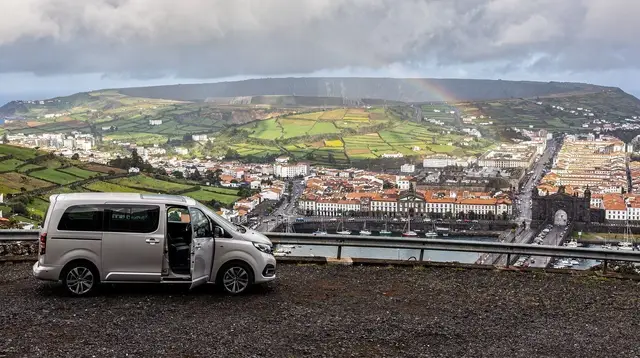
Where São Miguel is mostly landscape, Terceira gives photographers an urban and architectural subject instead. Angra do Heroísmo, the island’s capital, has been inscribed as a UNESCO World Heritage site since 1983 for its role as a major staging port on the Atlantic trade routes of the Age of Discovery. Pastel-fronted townhouses climb from the harbour toward Monte Brasil, and the old fort and marina both work well as foreground for the volcanic cone of Monte Brasil behind them.
Late afternoon light along the waterfront, with the sun low over the Atlantic, is the strongest window; our Angra UNESCO guide maps the specific streets and viewpoints. Terceira also has volcanic subjects of its own — the Algar do Carvão lava chimney interior, lit artificially and demanding a tripod, and the lava-planted vineyards of Biscoitos on the north coast.
Pico and Faial: the mountain, the caldeira and the marina murals
The single most photographed silhouette in the Azores may not be taken on the island it belongs to. The Montanha do Pico, at 2,351 metres the highest point in Portugal, is often shot from across the channel in Faial, where the cone rises cleanly above the water with none of the foreground clutter you get standing at its base. Sunrise and sunset both work here depending on cloud cover on the peak itself — Pico frequently wears a cap of cloud that can hide the summit for hours at a stretch, so patience, or a second attempt on a different day, pays off more than any specific hour.
On Faial itself, Horta marina is worth slow, deliberate shooting rather than a single frame: decades of murals painted by visiting sailors cover the harbour walls, a maritime tradition tied to the belief that an unpainted departure brings bad luck. The Caldeira do Faial, the island’s own volcanic crater, gives a green, cloud-forest-lined bowl best shot at midday when direct light reaches the crater floor rather than leaving it in shadow.
And Capelinhos, the volcano born from a submarine eruption in 1957-1958, is the starkest subject on the island: an ash-grey, semi-lunar headland with an abandoned lighthouse half-buried in volcanic material. Flat, overcast light suits Capelinhos better than most Azores locations — it reads as bleak and dramatic rather than washed out. Our Capelinhos guide covers access and the interpretation centre built into the old lighthouse.
Anyone climbing Pico itself for a summit sunrise should treat it as a managed activity, not a casual hike: registration through the Casa da Montanha is mandatory, daily numbers are capped, and every climber is issued a GPS tracker to return at the end. Our overnight camping on Pico guide has the current registration and timing details for a summit shoot.
Faial’s stretch of coast is also where several photo-session tours are actually run, since the marina, the caldeira rim and the western headlands all give reliable backdrops without depending on a single fragile weather window. If you’d rather be photographed than photographing, a professional photo session on Faial for couples and families uses exactly these locations, and the same operators also run a custom-planned proposal photography session if you’re building a specific moment around one of these viewpoints.
São Jorge: the fajãs, from clifftop to sea level
São Jorge is built almost entirely of near-vertical cliffs, and it’s the fajãs — around forty flat coastal shelves formed by old lava flows or landslides — that make it one of the most rewarding islands in the archipelago for photography. Fajã dos Vimes and the Fajã da Caldeira de Santo Cristo, with its clam lagoon, both give a genuinely unusual composition: a flat green plain wedged between sheer cliff and open ocean, often only reachable on foot or by a narrow switchback road.
Shoot them from above, at the clifftop miradouros along the island’s spine, for scale, and again from sea level for the texture of the lava rock and the lagoon itself. Morning light tends to catch the cliff faces better than afternoon on this island’s south coast; our São Jorge fajãs hiking guide breaks down which trails reach which viewpoints and how long each descent takes.
Flores, Corvo and Graciosa: the far edges of Europe
Flores is arguably the single most photogenic island in the archipelago and the least visited, largely because its ferry and flight links are the most fragile in the Azores — sensitive to swell and wind, and capable of being suspended for days outside summer. Its interior is dense with waterfalls, crater lakes and green cliffs, and the payoff for photographers who make it there is real: fewer people at every viewpoint, and light that isn’t competing with anyone else’s tripod.
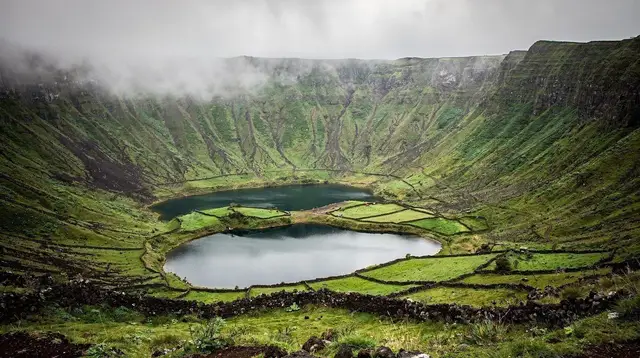
Corvo, the smallest inhabited island in the Azores, adds one more subject entirely: the Caldeirão, a single vast crater that occupies most of the island, seen from its rim road. Both Flores and Corvo carry UNESCO biosphere reserve status, a designation about environmental management rather than heritage architecture, distinct from the UNESCO World Heritage listing at Angra do Heroísmo or the Pico vineyard landscape.
Graciosa, in the central group, is easy to overlook but has one of the most unusual interiors to shoot underground: the Furna do Enxofre, the largest known volcanic cave in Europe, with a subterranean lake and active sulphur fumaroles reached by a metal staircase down into the crater. Above ground, the island’s white windmills near Santa Cruz da Graciosa give a simpler, calmer subject in a landscape that otherwise reads as flat and pastoral compared with its neighbours. Note that Graciosa has no bookable activities on GetYourGuide as of this review — everything here is independent exploration.
Because the far-flung islands and Graciosa depend so heavily on fragile transport links, build slack into any itinerary that includes them rather than a same-day return.
Chasing light: sunrise, sunset and the hours in between
| Location | Strongest light | Notes |
|---|---|---|
| Sete Cidades miradouros | Sunrise | Fog risk rises through the day |
| Ponta da Ferraria | Late afternoon | Low sun on wet black rock |
| Angra do Heroísmo waterfront | Late afternoon / sunset | Sun sets over open Atlantic |
| Montanha do Pico (shot from Faial) | Sunrise or sunset | Depends on whether the summit is cloud-free |
| Capelinhos | Any time, overcast preferred | Flat light suits the ash-grey landscape |
| São Jorge fajãs | Morning | Cliff faces lit before midday haze builds |
| Flores waterfalls and lakes | Midday to afternoon | Foliage needs direct light to read as green |
| Furna do Enxofre (Graciosa) | Any time — no natural light reaches the floor | Tripod essential |
The Azores sit on a proverb worth taking literally for planning purposes: locals describe “four seasons in one day,” as fast-moving Atlantic weather fronts push clear skies, cloud and rain through in the space of a few hours. That’s a reason to shoot opportunistically rather than around a fixed schedule — if a miradouro clears unexpectedly at 2pm, go, rather than waiting for a “better” evening slot that may never arrive. It also means a location that disappointed you in the morning is worth a second look later the same day.
Sunset itself has an extra layer of interest on the western islands. Flores and Corvo, at certain times of year, sit near the westernmost point of continental Europe’s longitude, which is the premise behind boat trips built specifically around watching the sun go down over open water — a sunset tour billed as the last sunset of Europe runs from the western group for exactly this. Elsewhere in the archipelago, a general sunset boat tour gets you off the cliffs and onto the water for a sea-level angle on the coastline that no miradouro can match, and it doubles as a decent chance at dolphins if a pod happens to be nearby.
If hortensias — the blue and pink hydrangea hedges that line so many Azores roads in postcards — are part of your shot list, note that this guide deliberately doesn’t cover their bloom window. Flowering typically starts in May or June and peaks in July and August, fading toward the end of summer; see hydrangea season in the Azores for the month-by-month detail, and our broader best time to visit guide for how that interacts with everything else on this page.
Drone rules in the Azores: what to check before you fly
A drone genuinely changes what’s possible at several of these locations — the fajãs of São Jorge, the crater rim of Corvo, and the Pico-from-Faial silhouette all read differently from above than from any ground-level miradouro. That said, the Azores are not a free-for-all for drone operators, and treating it as one risks a fine or a confiscated aircraft.
Portugal, and by extension the Azores, follows EU drone regulation, which means registration is required for most drones above a low weight threshold, and operator and remote pilot registration is generally required regardless of weight if the drone carries a camera. On top of the EU baseline, the Azores apply local no-fly restrictions around airports on every inhabited island, around some protected natural areas and UNESCO or biosphere reserve sites, and near sensitive infrastructure.
These restricted zones aren’t identical from island to island, and they change; register with the relevant Portuguese aviation authority and check current airspace restrictions for each specific island on your itinerary before you travel, rather than assuming a rule that applied on one island applies everywhere in the archipelago.
Practically, that means: don’t assume you can fly at Sete Cidades, Capelinhos or a São Jorge fajã just because you saw a drone photo of it online — check the current restriction for that specific site, carry your registration proof, and have a non-drone backup plan (a longer lens, a higher miradouro) for anywhere flight isn’t allowed.
Combining photography with other activities
A photography-led trip doesn’t have to be photography-only. A guided tour of Pico island covers several of the volcanic and vineyard viewpoints in one day for anyone who’d rather not self-drive the island’s narrower roads, and a picnic with photos and brunch on São Miguel is a low-effort way to get a posed set of images at one of the island’s scenic spots without dedicating a full session to it.
Questions Photographers Ask About the Azores
What is the best time of day to photograph Sete Cidades?
Early morning, ideally within the first two hours after sunrise, before the valley cloud builds and before tour buses arrive at the main miradouros. Light is softer and the lakes are more likely to be visible than later in the day.
Will I actually see the two lakes from the Sete Cidades miradouro?
Not always. São Miguel’s interior fills with cloud and fog on a large share of days, sometimes for several days in a row, and the classic view of both lakes side by side can simply not be there. Build a buffer day into your itinerary if that shot matters to you, and have a backup plan for the visit.
Can I fly a drone in the Azores?
Recreational drone flight is legal under Portuguese and EU drone rules, but the Azores add local restrictions: no-fly zones around airports and protected natural areas, registration requirements for most drones, and specific bans in some UNESCO and biosphere reserve sites. Check the current rules for each island before you travel, since restricted zones vary by location.
Which island has the best sunset photography?
Faial and Flores both have a strong claim, since both sit on the western edge of the archipelago and, at certain times of year, of continental Europe’s longitude. Faial’s marina and Capelinhos headland both face open west-facing horizons; Flores adds crater lakes and waterfalls as foreground interest.
What is a fajã and why do photographers go to São Jorge for them?
A fajã is a flat coastal shelf formed by an old lava flow or a landslide, sitting between towering cliffs and the Atlantic. São Jorge has around forty of them, and the combination of vertical cliff, flat green shelf and ocean gives compositions that don’t exist elsewhere in the islands.
Is the Capelinhos volcano site good for photography in overcast weather?
Yes, arguably better than in full sun. Capelinhos is a stark, ash-grey landscape born from a 1957-1958 eruption, and flat or moody light suits its lunar character more than harsh midday sun does.
Do I need to book a professional photographer, or can I shoot the islands myself?
Most of this guide is built around independent photography with your own camera or phone. A booked photo session makes sense mainly for portraits, couples or family photos where you want to be in the frame yourselves rather than behind the camera.
What camera gear should I pack for Azores photography?
A wide-angle lens covers most of the miradouros and fajãs; a mid-range zoom helps with Montanha do Pico from a distance and with whale-watching boat shots. Pack a rain cover or dry bag regardless of season, and a polarising filter for the crater lakes and coastal pools.
tours.photography
Verified deep-linked GetYourGuide tours. Book through these links and we earn a small commission at no cost to you.
GetYourGuide does not provide a product photo for this activity — the image shows the meeting point, photographed by us.