The 6-Day Azores Photography Itinerary: Sete Cidades to Pico
This route is built around light, not mileage. Six days, three islands, and a deliberate decision to let the western Azores add a second landscape register to the trip rather than staying inside São Miguel the whole time. If you only have a weekend, the crater lakes and calderas of Sete Cidades alone can fill it — see how many days in the Azores makes sense for other paces. This itinerary assumes six full days, a rental car on every island, and a willingness to treat one afternoon as an unavoidable travel day.
Why Sete Cidades, Lagoa do Fogo, Flores and Pico Together
Each stop on this route photographs differently. Sete Cidades gives you the archipelago’s signature composition — twin crater lakes, one blue-green and one blue, seen together from a rim. Lagoa do Fogo trades that postcard symmetry for raw volcanic slopes and a black sand shoreline that few day-trippers reach on foot.
Flores and its village of Fajã Grande swap volcanic drama for water: cliff-face waterfalls, crater lakes, and a green so saturated it looks graded even straight out of camera. Pico closes the loop with something none of the others have — a 2,351 m volcanic cone framed by centuries-old lava-stone vineyards.
None of these islands is a quick add-on to another. Getting from São Miguel to Flores means booking an inter-island flight through SATA Air Açores, not treating it as a short hop — Flores belongs to the western group, the most geographically isolated of the three, and its connections are the least flexible in the archipelago. Build the itinerary around that fact rather than fighting it.
Day 1: Arrival and Ponta Delgada
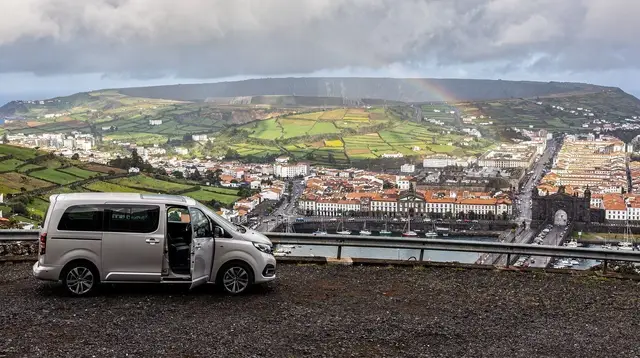
Land at Ponta Delgada and use the first afternoon to reset rather than shoot hard. Pick up your rental car — see car rental in the Azores for what to expect at the counter — and walk the historic waterfront around the Portas da Cidade gate while you adjust to the light and the time zone. Remember that the Azores run on UTC-1, an hour behind mainland Portugal, which matters if you are timing sunrise shoots against a phone still set to Lisbon.
Save your first real session for late afternoon: the marina and the black-and-white cobbled streets of central Ponta Delgada take on a warm, even light in the last two hours before sunset, and it is a low-pressure way to test your gear before the harder locations start tomorrow. An early dinner and an early night pay off directly, because tomorrow starts before sunrise.
Day 2: Sete Cidades at Dawn and Through the Day
Leave Ponta Delgada in the dark to reach the Sete Cidades viewpoints before first light. The crater can fill with cloud with almost no warning, so treat any clear dawn as the shoot, not a rehearsal for a better one later. Vista do Rei and the rim trails around it give the classic twin-lake composition; working the crater floor itself, closer to the village and the lakeshore, gives a different, more intimate frame.
If you would rather not navigate the access roads and viewpoint timing alone, the Half Day Sete Cidades Tour covers the crater’s main viewpoints with a local guide, which frees you to focus on composition instead of route-finding. For background on what you are shooting and why the crater looks the way it does, the Sete Cidades crater guide is worth reading the night before. Spend the rest of the day working the crater at a slower pace — midday light is flat here, so use it for scouting compositions rather than shooting, and come back down for a second look as the sun drops.
Day 3: Lagoa do Fogo and São Miguel’s Interior
Lagoa do Fogo sits in São Miguel’s mountainous interior and photographs best in the hours around sunset, when raking light picks out the black volcanic sand along the shoreline and the steep green slopes above it. Unlike Sete Cidades, there is no village at lake level — most viewpoints are along the access road and require a short walk, so budget time accordingly and check the Lagoa do Fogo guide for current trail conditions before you go, since weather closes sections of this road with no notice.
A guided option that pairs both crater sites in one outing is the Full Day Sete Cidades Lagoa do Fogo tour, useful if your first dawn at Sete Cidades was clouded out and you want a second attempt built into the same day as Lagoa do Fogo. Use the fog and drizzle pockets that appear here on the four-seasons-in-a-day pattern for atmospheric, moody frames rather than fighting for clear skies — some of the best crater shots in the archipelago come from partial cloud, not blue sky. Return to Ponta Delgada in the evening and pack for an early flight.
Day 4: São Miguel to Flores — the Long Travel Day
This is the day to accept as a transit day rather than resent as lost shooting time. The flight from São Miguel to Flores routes through a connection, not a direct hop, and delays on this western leg are more common than on the archipelago’s central routes — build in slack rather than scheduling a shoot for the moment you land. Check the best time to visit the Azores notes on seasonal flight reliability before locking in dates, since the western group’s connections are the most weather-sensitive in the archipelago.
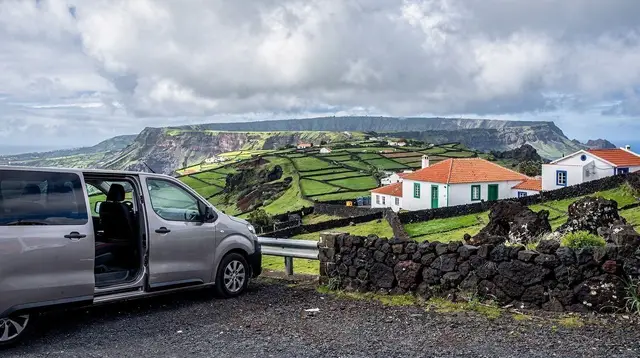
Once you land on Flores and collect your second rental car, drive straight to Fajã Grande on the island’s western tip. If the flight and drive leave you any daylight, even an hour of overcast late-afternoon light on the village’s waterfalls is worth the walk — Flores’ green is dense enough that flat light still produces usable frames, unlike the crater lakes back on São Miguel. Settle in for two nights here.
Day 5: Flores — Waterfalls and Crater Lakes
This is the itinerary’s other anchor day, and Flores rewards a full one. Photographing here means working two different registers: cliff-face waterfalls dropping almost to the Atlantic near Fajã Grande, and a chain of crater lakes inland with a completely different, cooler palette. A guide who knows which waterfalls are running depends heavily on recent rainfall, and the Flores Island: Full Day Tour with Local Guide is worth booking for exactly that reason — access points shift, and local knowledge saves a wasted drive to a trail that is dry or washed out.
Spend the morning on the waterfall trails around Fajã Grande, where a tripod earns its weight for slow-shutter water work, then move inland in the afternoon for the crater lakes while the light softens. The Flores hiking trails guide covers trail conditions in more depth than a single day allows you to discover firsthand. Flores is also one of two UNESCO biosphere reserves in this itinerary’s path, alongside Pico’s vineyard landscape — worth knowing if you like context behind what you are framing, though that classification says nothing about photogenic quality on its own; it is a management designation, not a scenic rating.
Day 6: On to Pico — Vineyards, Currais and the Volcano
The final leg routes you back through a connection toward Pico, closing the loop that started on São Miguel. Land with enough daylight left to reach Pico’s lava-stone vineyard landscape at Criação Velha before sunset — this UNESCO-listed patchwork of small, walled currais is one of the few places in the Azores where a genuinely different kind of texture, stone rather than water or crater rim, dominates the frame, with the 2,351 m Montanha do Pico rising directly behind it on a clear evening.
If you have any energy left, the Pico: Day Tour Get to Know Pico Island with a Local Guide is a practical way to be positioned at the right vineyard viewpoint at the right time without spending your last evening scouting roads on unfamiliar ground.
The Pico wine and UNESCO vineyards guide has more on shooting the currais specifically, including which stretches near Santa Luzia catch the volcano in the background versus which face the Atlantic instead. Do not expect the summit itself to be free of cloud on demand — see the climbing Mount Pico guide if you are tempted to add the ascent on a future trip, since it is a permitted, quota-limited climb rather than an open trail.
Practical Notes for a Photography-Focused Trip
A few things apply across all three islands. Weather turns fast enough here that the local saying about four seasons in one day is closer to a scheduling instruction than folklore — build flexibility into every outdoor session rather than fixed shoot times. Fog is common at altitude on São Miguel and Pico in particular, and it can erase a view in minutes, so treat any clear window as the shot, not a warm-up.
| Stop | Best light window | Main subject |
|---|---|---|
| Sete Cidades | Dawn | Twin crater lakes |
| Lagoa do Fogo | Late afternoon | Volcanic slopes, black sand |
| Fajã Grande, Flores | Morning and late afternoon | Waterfalls, crater lakes |
| Pico vineyards | Sunset | Currais, Montanha do Pico |
A rental car is close to mandatory on each island — viewpoints are spread out and there is no shared inter-island rental network, so you will pick up and drop off separately on São Miguel, Flores and Pico. If you want a longer, slower version of the São Miguel half of this trip, the São Miguel in 5 days itinerary covers it without the flight to the western group, and the Flores and Corvo in 4 days itinerary is the route to follow if you would rather give the western islands the extra day this trip trades away for Pico.
FAQ: Planning a 6-Day Azores Photography Itinerary
Is six days enough for an Azores photography trip covering three islands?
Yes, but only if you accept one long travel day in the middle. Two full days on São Miguel, two on Flores and a final evening on Pico gives you dawn or dusk light at every stop without cramming shoots between flights.
Can I fly directly from São Miguel to Flores?
Not as a simple hop. Flores sits in the western group, geographically separate from São Miguel, and SATA Air Açores routes this leg through a connection rather than a direct point-to-point flight. Book it as its own segment and build in a buffer.
Do I need a car for this itinerary?
Yes, on every island. Sete Cidades, Lagoa do Fogo, Fajã Grande and the Pico vineyards are all reached by narrow roads with no useful bus service between viewpoints, so a rental car on each island is close to mandatory for a photography schedule built around specific light.
What is the best time of day to photograph Sete Cidades and Lagoa do Fogo?
Early morning for Sete Cidades, when the twin lakes are calmest and cloud has not yet filled the crater, and late afternoon for Lagoa do Fogo, when low sun rakes across the black sand shoreline. Both spots can vanish into fog within an hour, so treat any clear window as a shoot, not a plan for later.
Why include Pico instead of ending the trip on Flores?
Pico adds a completely different frame: a 2,351 m volcanic cone rising directly behind stone-walled vineyards, which nothing on São Miguel or Flores replicates. It also lets the trip close on the Atlantic’s most recognisable Azorean silhouette rather than repeating waterfall shots.
How much walking does this itinerary involve?
Moderate amounts. Most viewpoints are short walks from parking at Sete Cidades and Lagoa do Fogo, while Fajã Grande’s waterfall trails and the Pico vineyard paths involve uneven volcanic stone underfoot, useful to know when carrying a tripod and multiple lenses.
What should I pack specifically for Azores landscape photography?
A sturdy tripod for waterfall and dawn shots, a circular polariser for the crater lakes, waterproof covers for camera and bag, and layers for sudden weather changes — the local saying about four seasons in one day is a packing instruction, not a joke.
Trip-planning essentials on GetYourGuide
Verified deep-linked GetYourGuide tours. Book through these links and we earn a small commission at no cost to you.
GetYourGuide does not provide a product photo for this activity — the image shows the meeting point, photographed by us.