Fly west from Ponta Delgada for just over an hour and the archipelago runs out of islands. Flores is the last one, and one of the westernmost points of Europe, closer in longitude to parts of North America than to Lisbon. It is a small, steep, intensely green island where every valley seems to end in a waterfall, and where the pace of a visit is set less by an itinerary than by the weather rolling in off the open Atlantic.
Where Flores Sits in the Azores
Flores and its tiny neighbor Corvo form the archipelago’s western group, cut off from the central and eastern islands by open ocean and, in practical terms, by the archipelago’s least reliable transport links.
If you are weighing whether to add Flores to a wider Azores trip, that isolation is the first thing to plan around, not an afterthought — see our notes on inter-island flights with SATA and on inter-island ferries in the Azores before you commit to dates. This page covers Flores on its own terms: its waterfalls, its crater lakes, and its role as the launching point for a side trip to Corvo, which we cover separately in its own destination guide.
Geologically, Flores is younger and wetter than the eastern islands, shaped by heavy rainfall cutting deep, U-shaped valleys into volcanic rock. That combination — steep slopes, soft rock, high rainfall — is exactly why the island has so many waterfalls: water simply has nowhere gentle to go on its way to the sea.
Fajã Grande and the West Coast
Fajã Grande is a small village of black-and-white houses on the island’s western coast, and for most visitors it is the natural base for exploring Flores. It sits close to several of the island’s best-known cascades and near the westernmost point of the inhabited Azores, a stretch of coastline that several local operators build entire itineraries around. Fajã Grande’s harbor also has calm, naturally sheltered pools where the lava rock breaks the Atlantic swell, making it one of the more approachable places on the island for a swim outside the height of summer.
From the village, short trails follow the coast and climb into the hills behind it, linking a string of cascades that fall almost directly from farmland into the sea. Because these routes are short, well-marked in parts, and close together, Fajã Grande makes an efficient half-day base even for travelers who are not committing to a full day of hiking. For anyone who does want the fuller trail network — the longer coastal and highland routes elsewhere on the island — that detail belongs in our dedicated guide to hiking trails on Flores rather than here.
a full-day guided tour that strings together Fajã Grande, the island’s main waterfalls and its crater lakes with a local driver-guide is the simplest way to see the highlights in one day without self-navigating narrow, winding roads.
Waterfalls: Poço da Ribeira do Ferreiro and Beyond
The single most photographed spot on Flores is the Poço da Ribeira do Ferreiro, a natural amphitheater above Fajã Grande where a cluster of waterfalls drops in parallel down a wall of green, moss-covered rock into a series of pools. It is reached by a short, well-used trail from the road above the village, and it is the image most visitors carry away from Flores — several thin falls side by side, framed by hydrangea hedges in high summer.
Flores has dozens of named and unnamed waterfalls beyond this single spot, scattered across the island’s ravines and coastal cliffs, particularly around the villages on the western and northern coasts. Most are only reachable on foot, and the island’s official hiking network — including longer routes that connect several falls in a single outing — is worth planning properly rather than improvising; again, that trail-by-trail detail lives in our separate hiking guide for Flores and our broader guide to the best hikes in the Azores.
For a different vantage point, several boat operators run trips along the coastline to see the taller cliffside waterfalls and sea caves from the water — a perspective the walking trails cannot fully offer, since many of the falls drop straight into the ocean. a boat excursion along the coast to the sea caves and cliffside waterfalls covers ground a land-based visit simply cannot reach.
Rocha dos Bordões and the Basalt Columns
A short drive inland from Fajã Grande, the Rocha dos Bordões is one of the most striking rock formations in the Azores: a cliff face of tall, hexagonal basalt columns standing close together like a giant, weathered pipe organ. It formed as thick lava cooled slowly and cracked into these regular columns, a process similar to the one behind Giant’s Causeway-type formations elsewhere in the world, but on Flores it rises directly out of pastureland, with grazing cattle often visible at its base. A roadside viewpoint gives an easy, no-hiking way to see it; a short path lets you get closer to the base of the columns.
It is one of the few sights on Flores that rewards even a brief stop without committing to a hike, which makes it a natural addition to a half-day driving loop that also takes in the crater lakes above Lajedo.
Crater Lakes: Lagoa Funda and Lagoa Comprida
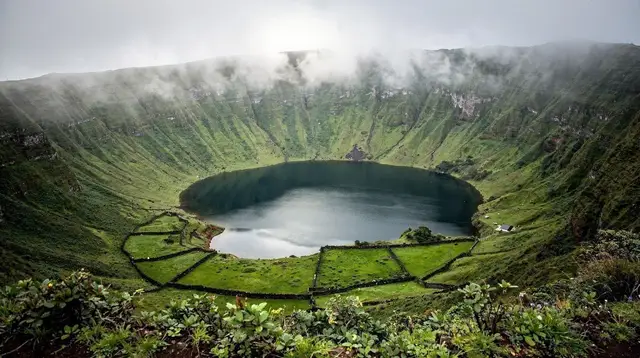
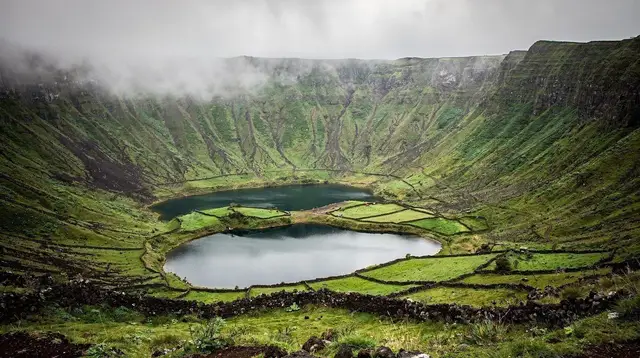
Above the village of Lajedo, a cluster of volcanic crater lakes sits in a high, open landscape that feels distinct from the greener, more enclosed valleys near Fajã Grande. Lagoa Funda and Lagoa Comprida are the two most visited, connected by a road that runs along a ridge between them with viewpoints over both at once. In good weather the water reflects the surrounding hills in a way that makes this one of the most photographed spots on the island after the waterfalls themselves; in poor weather, low cloud can swallow the ridge entirely within minutes, which is worth knowing before you plan a sunset visit around them.
The plateau around the lakes is also one of the better places on Flores to see hortensias — hydrangea hedges — in bloom during the summer months, echoing the flowering hedgerows found across the wider archipelago; see our guide to hydrangeas in the Azores for the seasonal window to expect them.
a boat tour out toward the westernmost point of the inhabited Azores pairs naturally with a day that also covers the crater lakes and Rocha dos Bordões, since all three sit within a short drive of each other on the island’s western half.
A UNESCO Biosphere Reserve
Flores carries UNESCO Biosphere Reserve status, recognizing the island’s landscape and the way its communities have managed it, alongside similar designations held by its western-group neighbor Corvo and by Graciosa in the central group. This is a designation about environmental management, not a World Heritage listing for a single monument, and it sits within the wider Azores Geopark network that spans the whole archipelago. In practical terms for a visitor, it reinforces something already obvious on the ground: trails are marked and maintained, but development is deliberately light, and much of the island’s interior remains pasture, wetland and native vegetation rather than resort infrastructure.
Best Time to Visit Flores
Flores follows the same general Azores pattern — no dry season, a temperate ocean climate softened by the Gulf Stream, and a real chance of “four seasons in one day,” where sun, cloud and a passing shower can all turn up within a few hours. What sets Flores apart is how much its remoteness amplifies the practical consequences of that weather, since flights and any onward ferry connections toward Corvo are more easily disrupted here than almost anywhere else in the archipelago.
June through September is the most reliable window: waterfalls are still fed by year-round rainfall even in the drier summer months, hydrangeas are in bloom on the crater-lake plateau, and outbound connections back toward São Miguel are least likely to be interrupted for days at a time. Shoulder months can still work well for hikers who prioritize quiet trails over guaranteed sunshine, provided the itinerary has slack built into it.
Getting to Flores — and Why Flexibility Matters
Flores is reached almost exclusively by air, with SATA Air Açores operating the inter-island route from Ponta Delgada; direct seasonal links to other islands exist but are not year-round, and there is no dependable direct ferry linking Flores to the central or eastern groups the way the Pico–Faial “Triangle” ferry runs. The short hop across to Corvo — a very different story, and often done as a boat crossing rather than a flight — is covered in full in our day trip to Corvo from Flores guide.
The honest planning takeaway is this: Flores and Corvo sit at the fragile end of the Azores’ transport network. Connections here are the most weather-sensitive and the most seasonal in the entire archipelago, and they should never be treated as being as dependable as, say, the central-group Triangle. If your schedule has a hard return flight from Lisbon or another international connection booked tightly after a Flores visit, build in at least one buffer day, and read our fuller breakdown of inter-island ferries in the Azores before finalizing dates.
A rental car is close to essential once you land — public transport between villages is minimal, and the waterfalls, crater lakes and Rocha dos Bordões are spread across an island with narrow, cliffside roads that reward slow, cautious driving, including a real chance of fog at higher elevations and livestock crossing rural roads.
Flores, or Flores-and-Corvo? Planning Your Days
Because getting to the western group at all takes deliberate planning, most visitors treat Flores and Corvo as a paired decision rather than separate trips. A common, workable shape is three to four days based in or around Fajã Grande for Flores itself, with a single day carved out — weather permitting — for the short crossing to Corvo. Our Flores and Corvo in 4 days itinerary lays out one version of that structure, and if you are building a longer multi-island trip, our 14-day island-hopping itinerary shows where a western-group leg like this typically slots in relative to São Miguel, Terceira or Pico.
If you are still deciding whether Flores belongs on your route at all, our broader guide to which Azores island to visit and our direct comparison of Flores versus São Jorge both weigh the trade-off between Flores’ waterfalls and remoteness against islands with easier, more frequent connections. For travelers who specifically want the quietest possible corner of the archipelago, Flores is a strong contender — a case we make at more length in the quietest island in the Azores — but that quiet comes paired with the transport trade-offs above, not despite them.
For travelers who want the island’s landscapes covered from land, sea, canyon and saddle in a single, structured day rather than piecing it together, a private full-day tour focused specifically on the island’s waterfalls removes the guesswork of sequencing Fajã Grande, Ribeira do Ferreiro and the crater-lake plateau on your own. See our things to do on Flores hub and our general note on how many days you need in the Azores for how a Flores stop fits your total trip length.
Flores at a Glance
| Highlight | What it is | Best suited to |
|---|---|---|
| Fajã Grande | Coastal village and natural base | First stop, short coastal walks, sea pools |
| Poço da Ribeira do Ferreiro | Cluster of parallel waterfalls in a green amphitheater | Photography, an easy signature walk |
| Rocha dos Bordões | Hexagonal basalt column cliff | A quick, no-hike roadside stop |
| Lagoa Funda & Lagoa Comprida | Volcanic crater lakes on a high plateau | Scenic driving loop, hydrangea season |
| Corvo (separate island) | Smallest inhabited Azorean island, a short crossing away | A single add-on day, weather permitting |
Frequently Asked Questions about Visiting Flores
Is Flores worth visiting if I only have a short Azores trip?
Flores rewards travelers who value waterfalls, quiet landscapes and dramatic coastal scenery, but its remote position means reaching it and leaving it reliably takes planning. On a short, single-island Azores trip, most travelers get a fuller and easier experience on São Miguel or Terceira; Flores is best added when your schedule can absorb some transport uncertainty.
How many days should I spend on Flores?
Three to four days is a comfortable minimum: enough time for Fajã Grande and its nearby waterfalls, the Rocha dos Bordões, and the crater lakes above Lajedo, with at least one buffer day built in for weather. Add a further day if you plan to cross to Corvo as well.
Can I visit Flores as a day trip from another Azores island?
It is possible on paper via a same-day flight from São Miguel, but it leaves very little margin for delay and no realistic time to see the island properly. Flores works far better as a multi-day stop in its own right than as a rushed day trip.
Is Flores connected to Corvo by ferry or by plane?
The short hop to Corvo is typically made by boat rather than a scheduled inter-island flight, and like every western-group connection it is weather-dependent and can be cancelled with little notice. Plan it as a flexible add-on day rather than a fixed commitment, and see our dedicated day-trip guide for the current picture.
When do the waterfalls at Flores look their best?
The waterfalls are fed by rain year-round, so they rarely run dry, but the surrounding hydrangea hedges near Poço da Ribeira do Ferreiro and the crater lakes are at their fullest in July and August. Photographers chasing soft light and fewer other visitors often prefer the shoulder months of June or September instead.
Do I need a rental car to see Flores properly?
Yes, in practice. Public transport between villages is minimal, and the island’s main sights — the waterfalls near Fajã Grande, the Rocha dos Bordões, and the crater-lake plateau above Lajedo — are spread out across narrow, cliffside roads. A rental car, driven cautiously in possible fog and around free-roaming livestock, is close to essential.
Is Flores in the same time zone as the rest of the Azores?
Yes. Flores keeps the same UTC-1 time zone as every other island in the archipelago, one hour behind mainland Portugal. The complication for Flores is not the clock but the connections — flights and boat links to and from the western group are the most seasonal and weather-sensitive in the Azores, so build slack into any itinerary that depends on a tight arrival or departure.