The Azores in 14 Days: Six Islands, No Rushed Mornings
Fourteen days is the number that lets the Azores stop feeling like a checklist. Anything shorter forces you to pick a group — oriental, central or occidental — and skip the rest. Fourteen days lets you do all three, provided the connections between them are planned before you book a single flight, not improvised once you land.
This itinerary moves through six islands — São Miguel, Terceira, Pico, Faial, São Jorge and Flores — using SATA Air Açores flights between groups and Atlânticoline ferries inside the reliable Pico–Faial–São Jorge “Triangle.” It is a moderate-difficulty, mid-range-budget route: comfortable walking, no technical hiking required, a rental car booked separately on each island, and enough slack near the end to absorb a weather delay without losing a day of the trip.
If you have fewer than two weeks, the shorter seven-day or ten-day versions of this trip cover two or three islands instead of six.
Why this route and not a shorter one
Two islands can be seen in a week. Six cannot — not because the islands themselves take longer to walk, but because the gaps between them do. Flights between islands run on SATA’s timetable, not on demand, and the ferry network that links the central group is seasonal outside the Pico–Faial–São Jorge triangle. A trip built to cover six islands in ten days ends up spending three of them on transfers with no cushion, so a single cancelled ferry to the western group collapses the whole back half of the plan. Fourteen days adds the two spare days that make that risk manageable rather than fatal.
Day 1: Arrive in Ponta Delgada, São Miguel
Land at Ponta Delgada, collect your rental car, and use the afternoon gently: a walk through the old town’s basalt-and-limestone streets and the city gates, then an early dinner. São Miguel is the biggest island in the group and the easiest place to adjust to island pace before the itinerary gets busier. Remember that the Azores run on UTC-1, one hour behind mainland Lisbon — a detail that catches out travellers connecting through the capital.
Day 2: Sete Cidades and the west
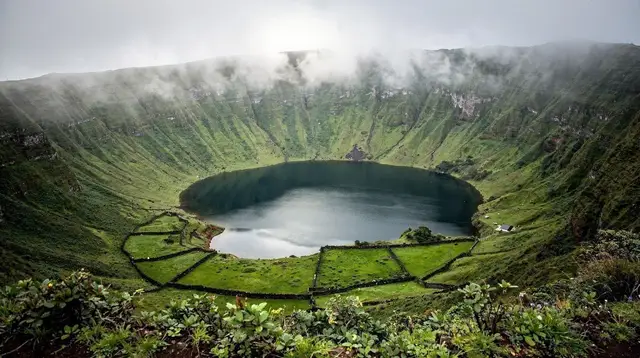
Drive to Sete Cidades for the twin crater lakes — one traditionally described as blue, the other green, seen together from the Vista do Rei viewpoint. Continue along the west coast in the afternoon, with time for a short coastal walk if the cloud lifts. This is also a fair introduction to the Azorean proverb about four seasons in one day: pack a layer regardless of the morning forecast.
Day 3: Furnas valley
A full day around Furnas: the Terra Nostra botanical garden and its warm, iron-rich pool, the Poça da Dona Beija thermal pools (bring a dark swimsuit and a towel you don’t mind staining — the iron-rich water leaves a lasting orange tint), and a lunch of cozido das Furnas, the stew cooked for hours in the volcanic ground nearby. Book the restaurant a day or two ahead, since the pots go into the ground before dawn and come up only in time for lunch.
Day 4: East coast and a first whale watching trip
Head toward Lagoa do Fogo in the morning, then out to the eastern tip of the island around Nordeste and Povoação for the greenest, least-visited scenery on São Miguel. In the late afternoon, join a boat out of Ponta Delgada for the São Miguel whaling heritage and whale watching tour, which pairs the island’s whaling history with a real chance of sperm whales or common dolphins — sightings are frequent but never guaranteed, whatever a brochure promises.
Day 5: Fly to Terceira
Return the São Miguel car and fly SATA to Terceira, the central group’s other major island. Spend the afternoon in Angra do Heroísmo, the UNESCO-listed old town that was once a key stopover port between Europe, Africa and the Americas. Pick up a second rental car here — none of the islands share a fleet, so this is booked separately from São Miguel’s.
Day 6: Terceira’s volcanic interior
Descend into the Algar do Carvão, a hollow volcanic chimney you climb down into rather than a cave you enter sideways, then drive out to Biscoitos to see vines grown directly in fields of solidified lava. In the afternoon, book the Terceira dolphin swimming excursion — a different kind of encounter from São Miguel’s whale trip, and one worth doing on this island specifically since Terceira’s waters see resident common and bottlenose dolphins close to shore.
Day 7: Fly to Faial
Fly SATA from Terceira to Faial, landing at Horta. Spend the afternoon at the marina, covered end to end in murals left by passing sailors, and stop at Peter Café Sport, the yacht crews’ traditional meeting point since the Atlantic crossing era.
Day 8: Capelinhos and the Caldeira
Drive out to Capelinhos, the volcano born from an underwater eruption in 1957–58 — its visitor centre sits half-buried in the ash it produced. In the afternoon, take the guided half-day tour of Faial up to the Caldeira do Faial, the island’s own volcanic crater, before returning the car in Horta ahead of tomorrow’s ferry.
Day 9: Ferry to Pico
Cross by Atlânticoline ferry from Horta to Madalena — about thirty minutes, and the most dependable inter-island crossing in the archipelago, running year-round several times a day. Collect a rental car on Pico and settle into Madalena for the evening.
Day 10: Wine, whales and the volcano’s lower slopes
Morning at the UNESCO-listed vineyard landscape around Criação Velha, where black stone walls called currais break the wind around individual vines planted straight into lava. In the afternoon, head to Lajes do Pico, the old whaling port, for the whale watching trip with an onboard biologist — a route that still uses the same shore-based vigia lookouts once used to spot sperm whale blows for the whaling boats.
If you want to add the Montanha do Pico ascent itself, it needs a separate reservation at the Casa da Montanha and adds a full extra day; this itinerary keeps to the lower slopes to stay on schedule.
Day 11: Ferry to São Jorge
A short additional Atlânticoline crossing takes you from Pico into the year-round Triangle network and on to Velas, on São Jorge. This is the one ferry leg of the trip you can book with real confidence — it’s the same reliable route, not the seasonal one.
Day 12: The fajãs
São Jorge is built around its fajãs, the coastal shelves formed by old lava flows and landslides. Spend the day on the island’s east side, ideally with the full-day hike that takes in one or two of the more dramatic fajãs and their clam lagoons, then close with a plate of the island’s own protected-origin cheese in Velas.
Day 13: Fly to Flores — and build in slack
Fly from São Jorge (via a connecting hop) to Flores, in the western group. This is the leg to treat with the most respect: island-hopping guides sometimes imply the western crossings are as dependable as the central Triangle ferries, and they are not — flights and ferries out to Flores and Corvo are the most weather-sensitive links in the whole archipelago. Building your Flores days at the very end of a 14-day trip, rather than in the middle, means a delay here costs you buffer time rather than the rest of the itinerary.
Day 14: Flores before departure
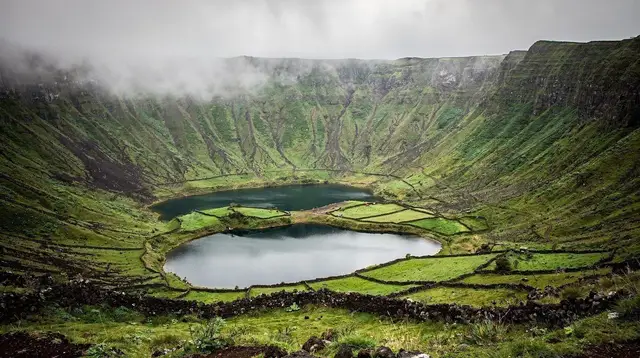
A full day among Flores’s crater lakes and waterfalls — Lagoa Funda, Lagoa Comprida, and the cascades near Faja Grande if the weather holds. If your outbound connection is early, shift this day’s driving to the morning and keep the afternoon free as insurance against the same crossing fragility that got you here. If Flores or Corvo is the part of the trip you’d rather not compress, the standalone four-day Flores and Corvo itinerary shows how to give the western group more room on its own.
Budget and pace notes
| Leg | Transport | Typical cost (one way) |
|---|---|---|
| São Miguel → Terceira | SATA flight | Varies by season and booking window |
| Terceira → Faial | SATA flight | Varies by season and booking window |
| Faial → Pico | Atlânticoline ferry | Low cost, ~30 minutes |
| Pico → São Jorge | Atlânticoline ferry | Low cost, within the Triangle network |
| São Jorge → Flores | SATA flight (via connection) | Varies by season and booking window |
Book inter-island flights as early as your dates allow — SATA capacity between the outer islands is limited even in shoulder season — and treat the ferry legs as flexible only within the Triangle. A rental car on each island, rather than one car carried by ferry, keeps the budget mid-range and the logistics simple.
Questions about a 14-day Azores itinerary
Do I need to rent a car on every island?
Yes. Car rental is arranged separately per island — there is no single fleet that follows you across ferries or flights — and public transport between villages is limited enough that a car is close to essential for seeing any island beyond its main town.
What happens if the Flores flight or ferry is cancelled?
Treat it as a real possibility, not an edge case: western-group connections are the most weather-sensitive in the archipelago. Scheduling Flores at the end of the trip, as this itinerary does, means a delay eats into slack time rather than displacing the islands still to come.
Could I do these six islands in fewer than 14 days?
Only by cutting a group entirely. Ten days covers three islands comfortably; stretching the same three flights and two ferries over six islands in ten days removes the buffer that protects the trip from a single missed connection.
Is this itinerary suitable for a family with children?
The pace is moderate and most stops involve short walks rather than technical terrain, but six islands and five transfers is a lot of packing and unpacking for young children. A shorter, single- or two-island version is usually a better fit for a family trip.
Do I need to book the whale watching trips in advance?
Yes, especially in July and August. Boats operate on daily quotas and popular afternoon departures on São Miguel and Pico sell out days ahead in peak season.
Should I climb Montanha do Pico on this itinerary?
Only if you’re willing to add a day. The ascent requires a separate booking with the Casa da Montanha, a GPS tracker issued at the start, and enough time to descend safely — it doesn’t fit comfortably into the single day this itinerary allots to Pico’s lower slopes and vineyards.
Is 14 days too long if I only care about hiking?
Not necessarily, but a hiking-focused version of this trip would swap some of the town and thermal-pool time for more trail days on São Jorge and Flores — worth considering if hiking, not sightseeing, is the priority.
What’s the single biggest planning mistake for a trip like this?
Booking the western-group flight or ferry to Flores in the middle of the trip instead of near the end. Any disruption there then threatens every island still to come, rather than just the final days.
Related reading
- How to plan Azores island hopping
- Inter-island ferries in the Azores
- SATA inter-island flights explained
- Climbing Mount Pico
- São Jorge’s fajã hikes
tours.14 days
Verified deep-linked GetYourGuide tours. Book through these links and we earn a small commission at no cost to you.
GetYourGuide does not provide a product photo for this activity — the image shows the meeting point, photographed by us.