Corvo is the smallest inhabited island in the Azores, and it makes almost no attempt to be anything else. Around 400 people live here, every single one of them in the same place, and the island’s dominant feature — a wide volcanic crater called the Caldeirão — takes up so much of the land that there was never much room for a second village to begin with. Corvo also carries a genuine geographic distinction: it is the westernmost point of continental Europe, a fact that draws a certain kind of traveller across a stretch of open Atlantic just to stand at the edge of it.
This page is about the island itself — what Vila do Corvo looks like, what the Caldeirão actually is, why birders treat this speck of rock as sacred ground, and what a few hours here can realistically offer. It is deliberately not about how you get here. The crossing from Flores, by boat or light aircraft, is one of the most weather-dependent legs in the whole archipelago, and it deserves its own careful treatment rather than a rushed paragraph — that logistics-heavy detail lives in our dedicated day trip to Corvo from Flores guide, and anyone actually planning the trip should read that one before this one.
One island, one village, one crater
Vila do Corvo sits on a narrow shelf of flatter land at the island’s southern edge, tucked below the Caldeirão’s outer slopes and facing the sea toward Flores. It is a small, dense cluster of houses, a church, a harbour used by the boats and fishing vessels that connect Corvo to the outside world, and a handful of guesthouses and small eateries serving the trickle of visitors who make it across. There is nowhere else to look for a “town centre” on Corvo — this is the entire settled footprint of the island, and everyone who lives on Corvo lives within a short walk of everyone else.
That scale changes how a visit feels compared with a stop on São Miguel or Terceira. There is no choice of neighbourhoods, no competing restaurant scenes, no traffic to speak of. A walk from one end of Vila do Corvo to the other takes minutes. What fills the rest of a visit is the land around it: the road that climbs toward the crater rim, and the crater itself, which is really the reason most people make the effort to come at all.
The Caldeirão: a crater that swallows the island
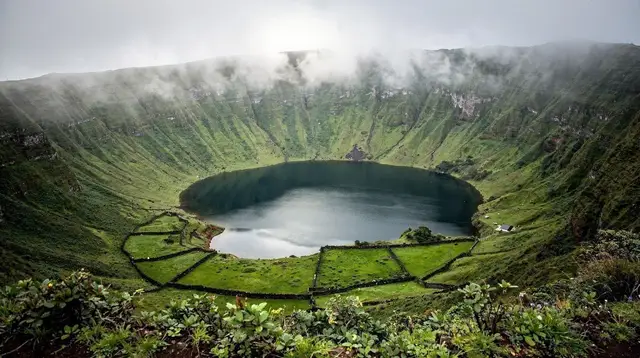
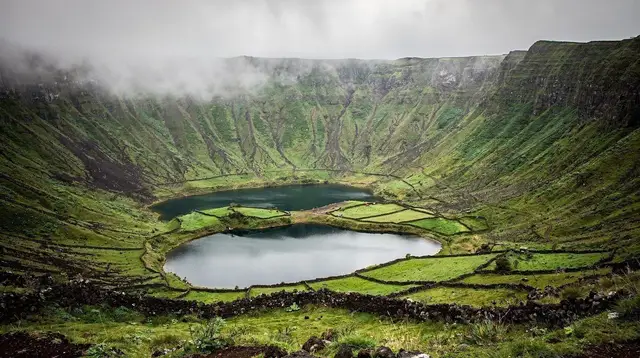
Almost the entire land area of Corvo is occupied by the Caldeirão, the volcanic crater left behind after the collapse of the island’s original cone. A rough access road switchbacks up from Vila do Corvo toward the rim, and from the top the ground simply falls away into a huge bowl, with wetland and shallow water pooling on the crater floor far below. Small islets rise out of that low ground, giving the crater interior a scattered, miniature quality that has made it something of a local curiosity: seen from above, the pattern of islets in the Caldeirão has long struck visitors and islanders alike as an odd, compressed echo of the wider Azorean archipelago itself, nine points of higher ground surrounded by water, at a fraction of the scale.
Walking the rim, or dropping partway down toward the crater floor on the rougher paths that branch off the main track, is the closest thing Corvo has to a signature activity. There is no ticket booth, no visitor centre, no set opening hours — just weather, wind, and whatever cloud is sitting on the crater that day.
That last point matters more here than almost anywhere else in the archipelago: Corvo is small and exposed, and low cloud or heavy wind can close the rim view down to almost nothing with very little warning. A traveller who reaches the crater on a clear day is seeing one of the more striking landscapes in the Azores; a traveller who reaches it in fog is seeing grey air a few metres in front of them, and there is no way to guarantee in advance which one it will be.
Because the crater sits within a wider protected landscape, Corvo carries UNESCO Biosphere Reserve status, a designation it shares with neighbouring Graciosa rather than the separate UNESCO World Heritage listings held by places like Angra do Heroísmo or the Pico vineyard landscape. It is a recognition of how the island is managed as a living ecosystem, not a monument, and it lines up with how little built infrastructure there is anywhere outside the village. Readers curious about how this fits into the archipelago’s wider conservation network can see the fuller picture in our Azores Geopark guide.
The westernmost point of Europe
At Corvo’s northwestern tip, past the crater and away from the village, the land simply runs out at the Atlantic. This point, Ponta do Marco, is recognised as the westernmost point of continental Europe — not a marketing flourish invented for tourism, but a real geographic distinction tied to Corvo’s position at the far edge of the Azores’ western group, alongside Flores. Reaching it on foot from Vila do Corvo is a longer undertaking than the crater rim walk and is realistically only worth attempting with a local guide or as part of an organised full-day itinerary, given how few hours a typical crossing actually leaves on the island.
What the point itself offers is less a dramatic monument and more a feeling: open Atlantic in every direction to the west, no next island, no next headland, just water toward the horizon. For travellers who care about geographic superlatives, or who simply want a clear, physical sense of how far this stretch of Portugal sits from the rest of Europe, it is a genuinely rare thing to stand at.
Why birdwatchers treat Corvo as a pilgrimage
Corvo’s outsized reputation in birding circles has almost nothing to do with the birds that live here permanently and everything to do with the ones that end up here by accident. The island sits at an extreme western edge of the Azores, directly in the path of Atlantic weather systems, and every autumn a steady trickle of North American bird species — blown off course during their normal migration and carried far out over open ocean — makes landfall here rather than anywhere else in Europe. For a certain community of birders, the chance of spotting a genuinely rare transatlantic vagrant has made Corvo a recognised destination in its own right, well out of proportion to the island’s size or population.
Casual visitors do not need any of this context to enjoy a walk around the crater or the coastline, but it is worth knowing why a small number of travellers arrive on Corvo carrying binoculars and very specific expectations. Anyone planning a trip built specifically around this is better served by our dedicated birdwatching in the Azores guide, which goes into season and species detail this page does not attempt to cover.
What Corvo does not have — and why that is the point for some travellers
It is worth being direct about what a day on Corvo will not include. There is no second village, no real restaurant choice, no bank machine a visitor should count on, and no guaranteed connectivity once away from the centre of Vila do Corvo. Cash carried over from Flores is the safer plan. There is no scheduled airport serving regular commercial jets, only the small aircraft link and the boat crossing, both covered in full in the dedicated logistics guide rather than here.
For some travellers, this short list of absences is a reason to skip Corvo entirely in favour of more time on Flores itself, walking to waterfalls around Fajã Grande or exploring the crater lakes there. For others, it is precisely the appeal: an island too small and too remote to have been shaped around tourism at all, where a visit still feels like an event rather than a transaction. Neither reaction is wrong — it depends on what kind of day a traveller is looking for, and our which Azores island to visit guide can help weigh that choice against the rest of the archipelago.
Planning a realistic day on Corvo
The single most important planning principle for Corvo is flexibility. Both the boat and the light aircraft that connect it to Flores are genuinely weather-dependent, not just occasionally delayed, and cancellations are common enough that a Corvo day trip should never be the fixed centrepiece of a tight Azores itinerary. Travellers with only one or two days on Flores and a flight to catch elsewhere in the archipelago should treat a Corvo crossing as a bonus if conditions allow, not a guarantee to build a schedule around. Full detail on how the crossing itself works, typical schedules, and how to book it is in our Flores to Corvo day trip guide.
| What a typical day trip includes | What it usually does not include |
|---|---|
| Crossing from Flores by boat or light aircraft | A guaranteed departure — weather can cancel it |
| A walk or drive up to the Caldeirão crater rim | Enough time for the full westernmost-point walk without a guide |
| Time in Vila do Corvo, the island’s only village | A restaurant choice beyond a small handful of options |
| A local guide familiar with the crater paths | Reliable card payment or ATM access |
A number of operators run the crossing as a packaged sightseeing day rather than leaving travellers to arrange the boat and a guide separately once they land, which removes a layer of uncertainty on an island with so little visitor infrastructure of its own. The Boat Trip to Corvo and Island Sightseeing Tour covers the crossing itself along with guided time on the island, while the Boat Rides to Corvo Island option focuses on the crossing for travellers who prefer to explore Vila do Corvo and the crater rim independently once they arrive.
Travellers who would rather stay on Flores and treat Corvo as optional, weather permitting, can instead book a Flores Island: Full Day Tour with Local Guide and revisit the Corvo question separately once conditions on the day are clearer.
None of this replaces checking the crossing status close to the date rather than weeks in advance. The safest approach for most travellers is to keep at least one spare day in a Flores itinerary specifically so a cancelled crossing on one morning does not simply erase the chance to see Corvo at all — a small amount of scheduling slack is worth far more here than anywhere else in the archipelago.
Best time to try for Corvo
Sea and air conditions around Corvo are calmest, and crossings most reliable, from June to September, which is why that window is the practical best time to plan a visit rather than any particular seasonal scenery on the island itself. Outside those months, particularly in winter, the frequency of cancelled crossings rises sharply, and travellers chasing Corvo specifically for its birdwatching reputation should note that the best vagrant-species window, autumn, sits right at the edge of the more reliable sailing season — another reason to build flexibility into the plan rather than a single fixed date.
General seasonal planning for the wider archipelago, including how Corvo’s access fits into it, is covered in our best time to visit the Azores and Azores weather month by month guides.
For travellers building a longer stay around the western islands rather than a single rushed day, an itinerary that treats Flores and Corvo together, with slack built in from the start, tends to produce a far less frustrating experience than trying to slot Corvo into the tail end of a packed multi-island route. Comparisons with the far larger, far more developed islands further east, such as our Azores versus Madeira piece, are useful context for understanding just how different Corvo’s pace and infrastructure really are from a typical Atlantic island holiday.
Corvo, one honest sentence
Corvo will not fill a week, it will not always let you reach it on the day you planned, and it offers almost none of the comfort or choice found elsewhere in the Azores — and for the travellers it is right for, that is exactly the point. A handful of hours on a crater rim at the edge of Europe, with a village of 400 people below and open Atlantic on three sides, is not a trip most people forget quickly.
Frequently asked questions about visiting Corvo
How many people live on Corvo?
Around 400 people, and every one of them lives in the same place: Vila do Corvo, the island’s only village, on the flat coastal shelf below the crater. There is no second settlement to visit.
Is Corvo really the westernmost point of Europe?
Yes, in the sense that matters for continental Europe: Corvo’s Ponta do Marco, at its northwestern tip, is the westernmost point of Portugal and of the wider European continental landmass, excluding fully separate overseas territories further out in the Atlantic. It is a genuine geographic superlative, not a marketing line.
Can I visit Corvo on a day trip from Flores?
That is how almost everyone visits. A day trip covers the crossing, a few hours on the island around Vila do Corvo and the Caldeirão viewpoints, and the return crossing the same day. Full logistics, schedules and booking advice for that crossing are covered separately in our Flores-to-Corvo day trip guide.
Is the crossing to Corvo reliable?
No, and that is the single most important thing to know before planning around it. Both the boat and the light aircraft that serve Corvo are among the most weather-dependent links in the entire archipelago, and cancellations are common, especially outside summer. Build at least one buffer day into a Flores stay if reaching Corvo matters to you.
What is the Caldeirão on Corvo?
The Caldeirão is the volcanic crater that occupies almost the whole island. Its rim is reachable by a rough road and short walking paths, and the crater floor holds wetland and small lake features overlooked from above. It is the main reason hikers and photographers make the trip to Corvo at all.
Why is Corvo famous with birdwatchers?
Corvo’s isolated position at the far western edge of the Azores puts it directly in the path of rare vagrant birds blown off their normal migration routes between North America and Europe, particularly in autumn. It has built a genuine international reputation among birders for exactly this reason, well beyond its size.
Is there an ATM or much infrastructure on Corvo?
Services on Corvo are minimal by design and by necessity: a small number of guesthouses and eateries, a couple of shops, and no guarantee of banking infrastructure a visitor could rely on. Carry cash from Flores and do not expect Corvo to function like a larger Azorean island.
Do I need a guide to visit Corvo?
It is not legally required, but on an island this small, with a single village and unmarked crater paths, a local guide or an organised sightseeing tour makes far better use of the few hours a day trip allows than arriving and improvising.