Corvo, Graciosa, or Flores: Which Azores Island Is Actually the Quietest?
When “Quiet” Becomes a Competition
I have now been to every inhabited island in the Azores, and I still argue with myself about this ranking more than almost anything else in the archipelago. Once you have crossed São Miguel and Terceira off your list — too many rental cars, too many day-trip buses idling outside Sete Cidades — you are left with a genuinely hard question: which of the remaining islands is the quiet one, and which is merely small?
I want to make a case, argue against it, and then tell you where I actually landed. The three contenders are Corvo, Graciosa, and Flores. Pico, Faial, and São Jorge are calmer than the big two, but they still have marinas, ferries running on a real schedule, and enough visitors that a slow month in Horta still feels social compared to a slow month on Corvo.
The Case for Corvo
Corvo has about 400 people and one village. There is no airport — you fly or ferry to Flores, then take a short, weather-dependent boat crossing, and some weeks that crossing simply does not run. The entire island is built around a single volcanic crater, the Caldeirão, and the walk around its rim is the closest thing Corvo has to a headline attraction. There is no queue for it. There is often no one else on it.
What tips Corvo into first place for me is not the population number by itself — it is what that number does to the island’s rhythm. Shops close for reasons that have nothing to do with tourist demand. The one road loops the coast and then stops. If you want a soundtrack for a place with almost no engineered noise, this is it. I read through what a fajã actually is before my first Azores trip and assumed Corvo would feel like an extension of that landscape; it does not, quite — it is starker, rounder, more like standing inside a bowl.
The Case for Flores
Flores is the prettiest argument against Corvo, and I mean that as praise for Flores rather than a knock on Corvo. The waterfalls, the crater lakes, the green that gives the island its name — none of it is secret, and a growing number of hikers know it. Trails around Faja Grande and the crater lakes near Santa Cruz das Flores get genuinely busy in July and August, in a way Corvo never does.
But “busy” on Flores still means a handful of cars at a trailhead, not a coach park. And Flores has an advantage Corvo cannot match: it is a base from which you can actually plan things, including the crossing to Corvo itself, covered in detail in the guide to a day trip to Corvo from Flores.
If you want quiet without giving up comfortable guesthouses, decent restaurants, and a reasonably reliable flight schedule, Flores is the more livable choice, and it is the island I would send a first-time visitor to if Corvo’s ferry gods were not cooperating that week. The island’s own hiking trails guide is worth reading before you go, because trail conditions and cloud cover change fast here.
Graciosa Is a Different Kind of Quiet
Graciosa does not belong in the same bracket as Corvo and Flores, and that is exactly the point I want to make about it. It is the smallest island in the central group, a UNESCO biosphere reserve, and — this is the detail that changes how you should plan a visit — it has no bookable activities online at all. Not a reduced catalogue, not a single boat tour: nothing. Whatever you do on Graciosa, from descending into the Furna do Enxofre to circling the white windmills near Santa Cruz da Graciosa, you arrange locally or you drive to yourself.
That makes Graciosa quiet in a structural sense rather than an atmospheric one. It is not that crowds avoid it; it is that the island was never built for the kind of organised tourism that shows up as a listing on a booking site. I would not call it the “winner” of this comparison, because winning implies it is competing on the same terms as Corvo and Flores. It is playing a different game — one for people happy to show up with a rental car, a paper map, and no fixed itinerary. If that is you, read the inter-island ferries guide closely before committing, because Graciosa’s connections to the rest of the central group thin out sharply outside summer.
How I’d Actually Choose
| Island | Population | Bookable online? | Getting there | Best for |
|---|---|---|---|---|
| Corvo | ~400 | Very limited | Flores, then boat (weather-dependent) | Absolute solitude, one crater walk |
| Flores | ~3,300 | Some hiking and boat trips | Small airport, seasonal Lisbon link | Waterfalls, crater lakes, easier logistics |
| Graciosa | ~4,300 | None on GetYourGuide | Flights or ferries, thin off-season | Self-drive exploring, no set-piece tours |
If someone forces me to name one island as “the quietest in the Azores,” I say Corvo, because it wins on the numbers that define quiet — fewest people, fewest roads, fewest reasons for anyone else to be there. But my honest travel advice is different from my honest ranking: build your trip around Flores, treat Corvo as a day you might lose to weather, and treat Graciosa as a detour for people who already own a decent set of hiking boots and don’t need an app to enjoy themselves.
None of this is really about São Miguel and Terceira, but they are the reason the question exists at all. After a week of Sete Cidades viewpoints filling up by 9am and Furnas restaurants booked solid for cozido, the appeal of an island with 400 people and one road is not scenery — it’s relief. If you want a broader sense of how these smaller islands fit into a longer trip, the Azores island-hopping guide lays out realistic routes, and the Flores and Corvo in 4 days itinerary is the one I would actually follow if I were doing this again.
A Practical Note Before You Fly Out
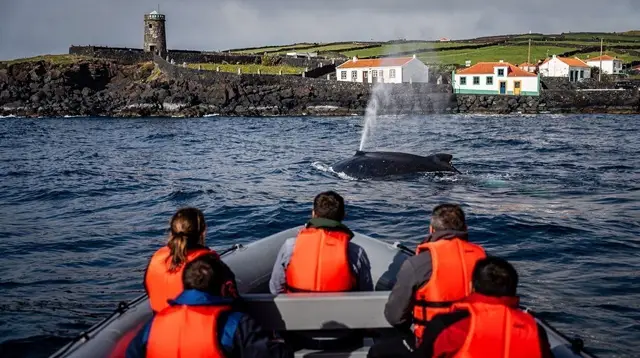
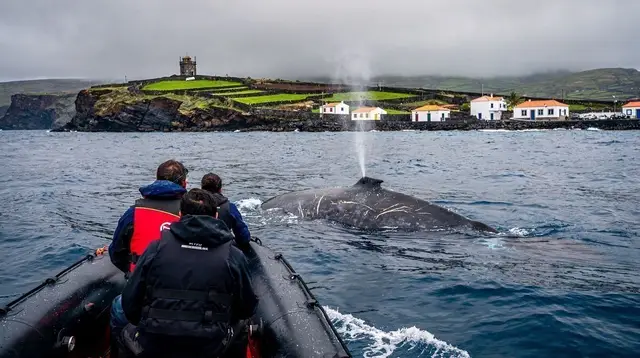
If you are routing through São Miguel or Faial before heading west, it is worth locking in one big-ticket activity on the busier islands first, since Corvo, Graciosa, and Flores genuinely will not offer it. On São Miguel, that usually means whale watching — I booked the São Miguel whale and dolphin watching tour on my last trip and it filled the gap nicely before three days of near-silence on Corvo.
From Pico, the whale lookout tour with a guide pairs well with the historical detail in the whaling history guide, and if your route passes through Horta, the guided Faial island tour is a reasonable way to see the island in the same day you catch a flight onward to Flores.
Corvo vs Graciosa vs Flores: The Questions I Get Asked
Is Corvo really the quietest island in the Azores?
By population and infrastructure, yes — Corvo has around 400 residents and a single village, Vila Nova do Corvo, wrapped around the Caldeirão crater. Nothing else in the archipelago comes close on that specific metric.
Can I book tours on Graciosa online?
No. As of my last check, Graciosa has no activities listed on GetYourGuide at all. Everything you do there — the Furna do Enxofre, the windmills, the coastline — you arrange in person or drive to yourself.
Is Flores quieter than Corvo?
Flores is quieter than São Miguel or Terceira, but not quieter than Corvo. It has more residents, more guesthouses, and a small but real stream of hikers chasing its waterfalls and crater lakes, especially in summer.
How do I get to Corvo or Flores?
Flores has a small airport with limited connections from Ponta Delgada and a seasonal Lisbon link. Corvo has no airport at all — you fly or ferry to Flores first, then cross the strait, and that crossing can be cancelled for days by weather.
Do I need a car on Graciosa?
Practically, yes. Graciosa rewards drivers far more than walkers, since its two headline sites — the Furna do Enxofre and the Santa Cruz da Graciosa windmills — sit a fair drive apart with thin public transport between them.
Which quiet island should a first-timer pick?
If you only have one extra day, Flores gives you the most scenery per hour. If you want the story to tell afterwards, Corvo delivers it, but only with a flexible schedule that can absorb a cancelled crossing.
Seasonal experiences on GetYourGuide
Verified deep-linked GetYourGuide tours. Book through these links and we earn a small commission at no cost to you.
GetYourGuide does not provide a product photo for this activity — the image shows the meeting point, photographed by us.