The Last Whalers of the Azores
A Cliff, a Coffee, and an Old Habit
I was standing on a headland on the north coast of Pico with a coffee going cold in my hand when I noticed the man next to me was not looking at the view. He was looking at the water — specifically, at one patch of water, the way you’d watch a door you expect someone to walk through. He wasn’t a tourist. He told me, without much ceremony, that his grandfather used to stand in more or less that exact spot, for more or less the exact same reason, except that when his grandfather saw what he was looking for, boats would launch with harpoons instead of cameras.
That conversation is the reason I wanted to write this, and it’s why I’m not going to give you a full timeline of Azorean whaling here — Azores whaling history already does that properly, year by year. What I want to talk about instead is the feeling of standing on that cliff and realising the past hadn’t been demolished and replaced. It had just changed what it was watching for.
Islands Built Around One Animal
It’s easy, on a first trip, to experience Pico, Faial and São Jorge as postcards — vineyards, a marina, green fajãs — without registering how recently these same islands ran on an entirely different economy. Shore-based whaling here wasn’t a medieval footnote; it ran into the early 1980s, decades after most of the whaling world had stopped.
Small factory buildings and open-boat crews worked out of harbours that are now better known for ferries and dive boats. I’m not going to walk through the whole industrial side of it, because it’s not really the point of this piece, and the detail is already covered elsewhere. What struck me, talking to people on Pico and in Horta, was how ordinary the transition felt to them. Nobody described a clean break. They described a slow handover.
The Vigia Never Really Stopped Working
The word that kept coming up was vigia — the lookout, and by extension the lookout post itself, usually a small structure wedged into a cliff with a clear line over the water. A vigia’s whole skill was reading the sea from far above it: knowing what a whale’s blow looks like at two kilometres, telling a cachalot from a shadow, judging which way a pod was likely to move before it moved. That’s a genuinely difficult, patient skill, built over a working lifetime, not something you can teach in an afternoon.
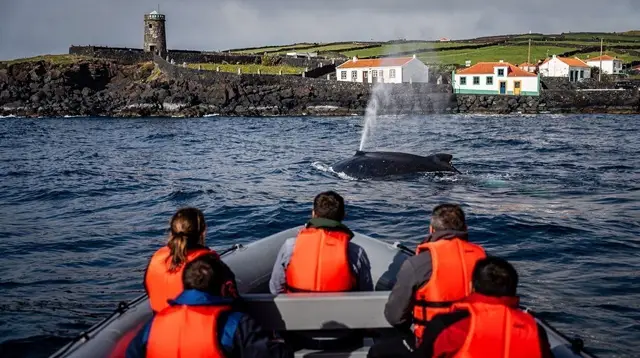
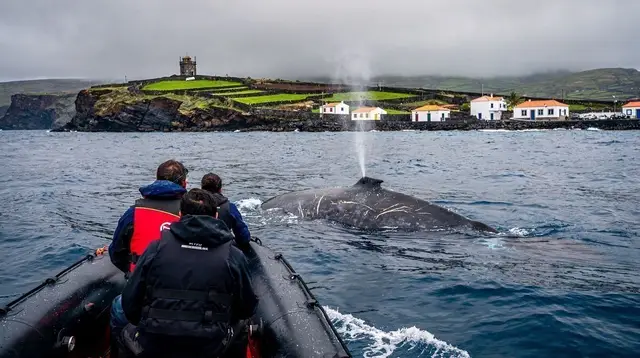
When the harpoon boats stopped going out, that skill didn’t have anywhere obvious to go — except it did. Several of today’s whale-watching operators either grew out of former whaling families directly, or trained under people who had spent years reading these same waters for a very different purpose. The lookout points didn’t close. They were repurposed, sometimes literally the same building, now radioing coordinates to RIBs full of visitors with cameras instead of a fleet with harpoons. I find that detail more moving than almost anything else in Azorean history: the exact same human skill, aimed at the exact same animal, for the opposite reason.
If you’re choosing where to base a trip specifically to see this side of the islands, which island is best for whale-watching is a more useful, practical read than anything I’ll offer here — this is a piece about how it feels, not where to book.
What the Boats Carry Now
Wandering around a place like Horta’s marina, you get a second, quieter version of this same handover. Sailors’ murals on the seawall, decades of names and dates, sit not far from buildings that once had entirely different jobs. Whalebone carving — scrimshaw — is still made and sold as an Azorean craft, which is its own strange inheritance: an art form born directly out of hunting, kept alive today as decoration and memory rather than trophy. I don’t think that’s something to be squeamish about. It’s closer to how a fishing community keeps its knots and its songs long after the boats change.
A Question I Keep Coming Back To
I asked the man on the cliff in Pico whether it felt odd that his family had gone from killing cachalots to, in his son’s generation, driving tourists out to watch and protect them. He shrugged in a way that suggested the question was more mine than his. To him, both jobs were the same job at the core: know the sea, know the animal, be there when it surfaces. The reason changed. The attention didn’t.
I’ve thought about that a lot since. It would be tidy to tell this as a redemption story — hunters becoming protectors — but that framing flattens something more interesting, which is continuity. The Azores didn’t erase their whaling past to build whale-watching; they built whale-watching on top of it, using the same eyes, the same cliffs, often the same last names. If you go out on a whale and dolphin watching trip from São Miguil or Pico, there’s a fair chance the spotting system guiding your boat traces back, however indirectly, to a vigia post that once served a very different fleet.
a whaling heritage tour that walks through this history on São Miguel gave me more of that continuity than any museum panel could — hearing it from someone whose own family lived both halves of it.
Later in the trip, an afternoon out spotting whales and dolphins made the connection concrete: the guide radioing in sightings was using language and hand signals that, he told us cheerfully, his uncle had used for the opposite purpose thirty years earlier. For a longer day on the water with someone who can talk you through both the marine biology and the history, a private seafari with a marine biologist is worth the extra cost.
Where I’d Point You Instead
I planned my own days around this loosely, without trying to turn it into a checklist. A slow morning on Pico, a wander through São Roque do Pico where one of the old stations stood, an afternoon in Horta, and one evening back on a headland with nothing to do but watch the water the way the man I met was watching it. If you want the practical version of an Azores trip built partly around this theme, our Azores whale-watching itinerary lays out a route without losing the slower, more personal side of it.
I don’t think the Azores ever really stopped being a whale-watching archipelago. They just changed, within living memory, what watching was for.
Questions I Still Get About This History
When did whaling actually end in the Azores?
Shore-based sperm whale hunting continued into the early 1980s, well after most whaling nations had stopped, with the last stations on Pico, Faial and São Jorge closing within a few years of each other.
Were there really whaling factories on the islands?
Yes. Small processing stations and lookout posts operated on Pico, Faial and São Jorge, built around the same coastal geography that later made these islands natural bases for whale-watching.
What is a vigia?
A vigia is a cliffside lookout post, once manned by a spotter who scanned the ocean for the blow of a cachalot and radioed the harpoon boats. Many of the same posts are still used today, now by whale-watching operators.
Do former whalers or their families work in whale-watching now?
In several cases, yes — spotting skills and knowledge of where cachalots surface have been passed down within families and small crews, from whaling boats to today’s observation boats.
Is it strange that a whale-hunting culture now protects whales?
It can feel that way at first, but the two activities share the same starting point: reading the ocean and knowing where the whales are, which is the real inheritance passed from one generation to the next.
Can I still see traces of the whaling era on Pico or Faial?
Old lookout points, quiet harbourside buildings and the general shape of towns like Horta still carry that history, though this piece is a personal reflection rather than a visiting guide to any one site.
tours.whale-watching
Verified deep-linked GetYourGuide tours. Book through these links and we earn a small commission at no cost to you.
GetYourGuide does not provide a product photo for this activity — the image shows the meeting point, photographed by us.