Flores vs São Jorge: Which Azores Island Should You Add?
Should I choose Flores or São Jorge for my Azores trip?
Choose Flores if you want waterfalls, crater lakes and a remote, slow-paced island and can accept limited flights and ferries. Choose São Jorge if you want dramatic fajã landscapes, cheese and hiking with easy, frequent ferry links to Pico and Faial.
Two Green Islands, One Hard Choice
Both islands look green from a plane window, both get rained on more often than the brochures admit, and both are usually described with the same word: unspoiled. That similarity is exactly why travellers planning the Azores get stuck comparing them. But Flores and São Jorge are built on completely different geography, sit in different island groups, and answer to different logistics. Treating them as interchangeable “green hiking island” options is the mistake to avoid here — the terrain, the access, and the trip they each reward are genuinely different.
Flores belongs to the western group, together with Corvo, and its landscape is defined by water: waterfalls tumbling off cliff faces, crater lakes filling old volcanic calderas, and a coastline carved into deep, fertile valleys. São Jorge belongs to the central group, alongside Pico, Faial and Graciosa, and its landscape is defined by a knife-edge ridge: a long, narrow spine of land dropping steeply on both sides into coastal shelves called fajãs. If you can only add one of these two islands to an already packed Azores route, this page is built to help you decide which — without pretending the decision is close for every traveller.
Getting There: The Real Constraint
For most people the deciding factor is not scenery at all, it is logistics, and here the two islands are not close.
São Jorge sits inside the most reliable transport pocket in the entire archipelago. Atlânticoline ferries connect Velas and Calheta with Pico and Faial several times a day, all year round — this is the so-called “Triangle,” the one part of the inter-island network that keeps running through winter without the seasonal gaps that affect the rest of the central and western groups. SATA Air Açores also flies into São Jorge regularly from Ponta Delgada and Terceira. In practice, if your ferry or flight to São Jorge is delayed by a morning, you usually still make your next connection the same day.
Flores has none of that redundancy. It is reached mainly by SATA Air Açores flights from Ponta Delgada or Terceira, with a limited number of seats and, in poorer weather, cancellations that can stack up rather than being absorbed within a day.
There is a maritime connection onward to Corvo, but it is short-hop and weather-dependent rather than a wider ferry network — Flores and Corvo are, functionally, an isolated pairing rather than islands you thread into a longer overland-and-ferry chain. None of this makes Flores unreachable; thousands of visitors get there every year. It does mean you should build in slack, especially at the start or end of a trip, and avoid scheduling a same-day onward flight from the mainland immediately after leaving Flores.
If your itinerary already includes Pico or Faial, adding São Jorge costs you very little extra planning — it is a short ferry ride, sometimes done as a day trip rather than an overnight stay. If your itinerary does not already touch the western group, adding Flores is a bigger commitment: a dedicated flight, several nights, and a buffer day at the end in case the weather does not cooperate.
What Flores Looks Like on the Ground
Flores earns its name — “flowers” — from the way its slopes turn dense and green, but the real draw is water. The island is a sequence of cliffs, valleys and calderas where rain has had thousands of years to carve dramatic drops. Near Fajã Grande, on the western edge of the island, several named waterfalls drop almost directly into or near the sea, and the village itself has the feel of an end-of-the-road settlement, which geographically it more or less is.
Inland, the twin lakes area around Poço da Ribeira do Ferreiro is usually the single most photographed spot on the island: a cluster of small waterfalls threading down a green amphitheatre into a chain of pools. A short walk away, Rocha dos Bordões is a striking wall of tall, near-vertical basalt columns, more geological curiosity than lake or fall, and a good example of how varied Flores’ volcanic scenery is over a small area. Around Santa Cruz das Flores, the island’s main town, the pace is unhurried: a handful of guesthouses, a small harbour, and a sense that the island’s real attractions are outside town rather than in it.
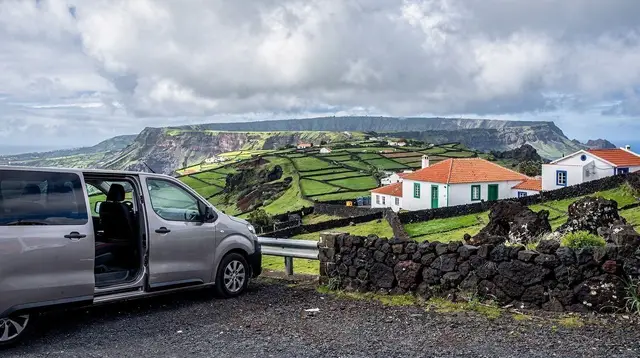
Flores rewards travellers who like driving or riding between viewpoints and short walks more than long treks, though committed hikers will find full-day trail options too — those routes are covered in detail on our dedicated Flores hiking trails guide rather than here. For a first visit, most people cover the highlights by vehicle: a van tour that loops the waterfalls and lakes in a single day, a scenic car route timed for the best light, or a quad bike outing for those who want to set their own pace along the coastal roads.
a full-day van tour around Flores’ waterfalls and crater lakes is the most efficient way to see the island’s scattered highlights without renting a car yourself, and it pairs well with a boat trip to Flores’ sea caves with snorkelling stops along the coast if you want to see the island from the water as well as the road.
What São Jorge Looks Like on the Ground
São Jorge is a different kind of green. The island is long and narrow, built around a high central ridge that runs almost its entire length, with land dropping away sharply on both the north and south coasts. That drop is what created the island’s defining feature: the fajãs, flat coastal shelves formed by old lava flows or landslides, now scattered with a scatter of houses, small farms, or in a few cases a single restaurant and nothing else. There are around forty of them along the coastline, ranging from tiny to inhabited villages.
Two fajãs get named again and again for good reason. Fajã da Caldeira de Santo Cristo has a shallow tidal lagoon known for clams (ameijoas), a handful of simple guesthouses, and a genuine sense of remoteness even though it is walkable in a few hours. Fajã dos Vimes, easier to reach, mixes lush gardens with small-scale coffee and fruit growing, an unusual sight this far into the Atlantic. Reaching most fajãs means a descent on foot or a longer drive around — this is the terrain covered in full in our São Jorge fajãs hikes guide.
Away from the coast, the island’s high pastures are the source of its other main claim to fame: queijo de São Jorge, a protected, raw-milk cheese matured for months into a firm, sharp table cheese. Around Velas and inland toward Calheta, dairy farms and small producers make tasting the cheese one of the easiest, most reliable things to do on the island regardless of the weather that day.
a half-day São Jorge cheese tour that visits a working dairy and tasting room is a good low-effort introduction to the island’s food culture, while a guided fajã hiking and camping trip down to the coast suits travellers who want to spend a night at sea level rather than up on the ridge. For those short on time, a four-hour panoramic tour covering the island’s viewpoints and villages is a realistic way to see most of São Jorge’s character in a single half-day between ferries.
Activities and Bookable Tours Compared
The bookable tour catalogues for both islands are small and focused rather than sprawling, which mirrors how compact each island actually is. On Flores, tours cluster around getting to the scattered waterfalls and lakes efficiently — by van, quad bike, scenic car, or boat — since the island’s attractions are spread wide across rough coastal roads. On São Jorge, tours cluster around the two things that define the island: cheese and dairy culture on the plateau, and fajã access on foot or by boat, since the terrain that makes the island beautiful is also what makes independent exploring slower.
Neither island has anything close to the volume of activities you would find on São Miguel or Terceira, and that is by design of the terrain rather than a gap in the market — small, remote islands simply support fewer operators. If your Azores trip is built around packing in many bookable activities per day, neither Flores nor São Jorge will feel as busy as the bigger islands, and that is worth knowing before you arrive rather than after.
Flores vs São Jorge at a Glance
| Flores | São Jorge | |
|---|---|---|
| Island group | Western | Central |
| Signature landscape | Waterfalls and crater lakes | Ridge line and coastal fajãs |
| Getting there | Flights from Ponta Delgada/Terceira; limited seats | Ferries from Pico/Faial year-round, plus flights |
| Reliability of access | Lower — weather-sensitive flights | Higher — the central “Triangle” ferry route |
| Best paired with | Corvo | Pico and Faial |
| Signature food | Local produce, no single icon dish | Queijo de São Jorge cheese |
| Typical activity style | Van/quad/car touring between sights | Hiking down to fajãs, boat trips, cheese tastings |
| Good for a short 2-3 day add-on | Only with flexible dates | Yes, more predictably |
Which Island Fits Your Trip
If your Azores route already runs through Pico and Faial, São Jorge is close to a free addition: a short ferry hop, ideally an overnight stay so you have time to walk down to at least one fajã rather than only seeing the ridge road, and it slots into a route built around the central group without adding real risk to your schedule. It also suits travellers who want a tangible food theme to their day — cheese tastings and a working dairy are easy to build a half-day around, whatever the weather is doing.
If your Azores route already includes, or can be extended to include, Corvo, then Flores becomes the natural pairing, and its waterfalls and crater lakes are a genuinely different kind of scenery from anything you will see on the central or eastern islands. It suits travellers who prioritise a small number of striking, photogenic stops over a packed schedule, and who are comfortable building slack into their flight dates rather than treating every connection as guaranteed.
What does not work well is treating either island as a rushed afternoon stop squeezed between other commitments. São Jorge tolerates a short visit better because its ferries are frequent and dependable, but even there, a same-day return from Pico leaves barely enough time to reach one fajã and back. Flores tolerates a short visit far less well: with flights that can be limited or delayed, a one-night stay leaves little room for the weather, or the return flight, to go wrong.
Combining Both, or Choosing One
Because Flores sits in the western group and São Jorge sits in the central group, there is no direct, convenient way to link them within a single Azores trip — you would effectively be running two separate mini-trips joined by a flight back through Ponta Delgada or Terceira. For most itineraries, that is not worth the extra flying time and cost, and it is why most travel planning for the Azores treats this as a choice rather than a checklist.
If your overall Azores trip already runs seven to ten days across two or three islands, better use of that time is usually to pick the pairing that matches your existing route — São Jorge with Pico and Faial, or Flores with Corvo — rather than trying to force both into one loop.
If you are still undecided on your whole route rather than just this one comparison, our broader which Azores island to visit guide and island hopping guide cover how Flores and São Jorge each fit into a wider multi-island plan, and our dedicated itinerary pages for three days on São Jorge and four days across Flores and Corvo go deeper into day-by-day planning than this comparison is meant to.
Flores vs São Jorge: Your Questions Answered
Is Flores or São Jorge easier to reach?
São Jorge is easier. It sits inside the central island group and is linked by frequent, year-round ferries to Pico and Faial, plus regular SATA Air Açores flights. Flores is in the western group, served mainly by air from Ponta Delgada or Terceira, with limited seats and a maritime link to Corvo that is sensitive to weather.
Which island has better waterfalls, Flores or São Jorge?
Flores is the waterfall island. Sites such as Fajã Grande, Poço da Ribeira do Ferreiro and Rocha dos Bordões give it one of the highest concentrations of cascades and crater lakes in the Azores. São Jorge has striking coastal cliffs and fajãs but far fewer waterfalls.
Can I visit Flores and São Jorge on the same trip?
It is possible but demanding, because they sit at opposite ends of the archipelago and are not directly connected. Most itineraries pick one or the other and pair it with a neighbouring island: São Jorge with Pico and Faial, or Flores with Corvo.
Is São Jorge good for hiking compared to Flores?
Both islands reward hikers, but the terrain differs. São Jorge’s classic routes drop from a high, narrow ridge down to coastal fajãs and back up. Flores’ trails link waterfalls and crater lakes across gentler, rolling terrain. Neither is harder overall; they are simply different styles of walking.
Which island is better for a short 2 to 3 day trip?
São Jorge suits a short add-on trip better, because its ferry and flight connections are more predictable, so you lose less time to logistics. A short trip to Flores works best with flexible dates, since flights can be limited and weather can affect the return journey.
Does São Jorge have more bookable tours than Flores?
Both islands have a modest, focused range of bookable activities rather than a large catalogue. São Jorge’s tours lean toward cheese tastings, fajã hiking and camping, and boat or diving trips along the coast. Flores’ tours lean toward van, quad and scenic car routes to its waterfalls and lakes, plus a caves and snorkelling outing.
Are Flores and São Jorge both good for hydrangeas?
Both islands turn green and floral in summer, but neither is the archipelago’s signature hydrangea postcard the way parts of São Miguel are. On both islands, the best hydrangea colour runs from June to August; outside that window, expect green hedgerows rather than full bloom.
Popular Azores experiences on GetYourGuide
Verified deep-linked GetYourGuide tours. Book through these links and we earn a small commission at no cost to you.
GetYourGuide does not provide a product photo for this activity — the image shows the meeting point, photographed by us.