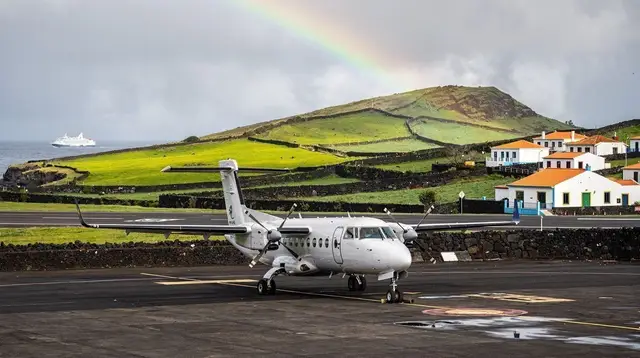
Getting to the Azores: Flights, Airports and First Steps
How do you get to the Azores?
You fly. The Azores are a Portuguese archipelago roughly 1,500 km out in the Atlantic, so there is no ferry or bridge from the mainland. Most visitors land at João Paulo II Airport in Ponta Delgada, on São Miguel, reached with direct flights from mainland Portugal, several other European cities, and a handful of North American gateways.
Why Flying Is the Only Way In
There is no bridge, tunnel, or scheduled passenger ferry connecting mainland Europe to the Azores, and there never has been. The archipelago sits roughly 1,500 km west of Lisbon, out in open Atlantic water, on its own volcanic ridge where three tectonic plates meet. For a visitor planning a first trip, that single geographic fact settles the whole question of how to arrive: you fly, full stop. Everything else in this guide — which airport, which route, which season — sits underneath that one starting point.
It is worth separating this question cleanly from two others that trip up first-time planners. Getting to the Azores from abroad is a completely different logistics problem from getting between the nine islands once you have landed. SATA Air Açores and the Atlânticoline ferry network, which you will read about elsewhere on this site, only operate within the archipelago — neither one flies or sails to Lisbon, Porto, Boston, or anywhere else off the islands.
If you are still at the stage of booking your first flight, you can safely ignore inter-island schedules for now; they only matter once you are already standing on Azorean soil. For the mechanics of moving between islands after you arrive, see our guides to inter-island flights on SATA Air Açores and inter-island ferries.
The Main Gateway: Ponta Delgada, São Miguel
Nearly every international itinerary into the Azores lands at João Paulo II Airport (airport code PDL), on the outskirts of Ponta Delgada, the capital of São Miguel and the largest of the nine islands. This is the only airport in the archipelago with substantial direct international connections, which is why São Miguel functions as the de facto front door to the Azores, whatever your final destination island turns out to be.
That single fact has a practical consequence worth planning around from day one: if your real goal is Pico, Terceira, Faial, or one of the smaller islands, your itinerary will still begin with an international flight into Ponta Delgada, followed by a separate onward flight or ferry to reach your target island.
Very few visitors fly directly onto any island other than São Miguel from outside Portugal. We cover the terminal itself, its facilities, and how to move through it efficiently in a dedicated piece — see the Ponta Delgada airport guide — but for now, the takeaway is simple: book your international flight to PDL, and treat the rest of the archipelago as a second leg of the trip.
Flying From Mainland Europe
Mainland Portugal has the densest and most frequent service into the Azores, unsurprisingly, since the islands are Portuguese territory. Lisbon and Porto both run regular flights to Ponta Delgada year-round, and Lisbon in particular sees enough frequency that it functions as a reliable fallback connection point even outside peak season.
Beyond Portugal, a number of other mainland European cities operate direct or seasonal routes into Ponta Delgada, with frequency generally increasing through the spring and summer months and thinning out in winter. If your home city does not have a direct option, connecting through Lisbon is almost always the most straightforward route, simply because of how much traffic already flows between the two capitals.
One detail specific to this itinerary is easy to overlook when you are staring at a connection time in an app: the Azores run on UTC-1, a full hour behind mainland Portugal and the rest of continental Europe. A layover in Lisbon that looks comfortable on paper can feel tighter than expected once you remember your onward boarding pass will show local Azorean time, not Lisbon time — and the reverse applies on the way home. It rarely causes a missed flight, but it is worth double-checking rather than assuming, especially on a tight same-day connection.
Flying From North America
A handful of North American cities have seasonal direct service into Ponta Delgada, which is one of the reasons the Azores have become a increasingly popular stopover-style destination for transatlantic travelers, distinct from the more established mainland Portugal routes. These routes are not year-round in most cases, so availability and frequency shift with the season, generally strongest through the warmer months and reduced or absent in winter.
If a direct seasonal option does not line up with your travel dates, connecting through Lisbon (or occasionally another major European hub) is the reliable fallback, in the same way it is for European travelers without a direct route. Because North American capacity into the Azores is comparatively limited next to the mainland European market, this is the route where booking well ahead of your travel dates makes the most difference — a fare or a seat that is easy to find six months out can disappear or jump in price much closer to summer.
A Rough Sense of Flight Time
None of the numbers below are meant as a substitute for checking a live booking search, since schedules, routings, and carriers change from season to season — but as a general planning reference, the hop from mainland Portugal to the Azores is a short one compared with the transatlantic leg from North America.
| Route type | Typical journey | Frequency |
|---|---|---|
| Lisbon or Porto → Ponta Delgada | A short hop, well under half a transatlantic flight | Year-round, frequent |
| Other mainland European cities → Ponta Delgada | Direct or seasonal, otherwise via Lisbon | Seasonal, strongest in spring/summer |
| North American gateways → Ponta Delgada | A single transatlantic hop | Seasonal, limited frequency |
| Connecting via Lisbon (any origin) | Two legs, mind the UTC-1 time change | Available year-round |
For the specific airlines, exact routes, and how they change through the year, our companion guide on flights to the Azores goes into the detail that sits outside the scope of this page.
Booking Strategy: What Actually Matters
A few practical habits make the difference between a smooth first booking and a stressful one, particularly because Azores capacity is smaller and less flexible than a typical mainland European or North American route:
- Book seasonal and North American routes earlier than you would for a mainland city. Limited frequency means fewer empty seats to fall back on if your first-choice dates sell out.
- Treat a Lisbon connection as completely normal, not a compromise. With frequent Lisbon-Ponta Delgada service, connecting through the capital is often the easiest and most flexible way in, especially outside the direct-route season.
- Build in a buffer on tight connections. Between the UTC-1 time difference and the usual unpredictability of European short-haul schedules, a generous layover reduces stress far more than it costs in travel time.
- Decide your target island before you book, not after. Since almost everyone arrives through São Miguel regardless of final destination, your Ponta Delgada arrival date effectively sets the start date for any onward inter-island flight or ferry you will need to arrange separately.
- Check the Azores’ own peak season alongside the flight calendar. July and August combine the busiest flight schedules with the highest demand for onward inter-island travel and accommodation, so early booking matters on both fronts at once.
If you are still deciding when in the year to go at all, our guide to the best time to visit the Azores and the month-by-month breakdown of Azores weather are worth reading before you lock in dates, since flight availability and island weather move together more than most first-time visitors expect.
After You Land: What Comes Next
Once you touch down at Ponta Delgada, the trip logistics shift from international flights to local ones almost immediately. Most visitors either rent a car at the airport to explore São Miguel independently — see our guide to car rental in the Azores — or arrange an airport transfer for the first leg into town. If you would rather not deal with rental paperwork straight off a long flight, a prearranged pickup such as an airport transfer from Ponta Delgada is a simple way to get to your accommodation without the extra decision-making on arrival day.
From there, many first-timers spend their opening days on São Miguel itself before deciding whether to fly or ferry onward to a second island. It is a good moment to build in something low-key and scenic close to Ponta Delgada while you adjust — an evening sunset boat tour along the coast is a gentle way to ease into island time, and for travelers curious about being on the westernmost edge of Europe, a trip billed as the last sunset of Europe plays on exactly that geography.
If your itinerary includes a swing through the Furnas valley later on São Miguel, a guided 4WD tour of the Furnas area is worth building into those first days rather than saving for later.
For travelers whose real destination is further out in the archipelago, remember that reaching Pico or Faial still requires a second flight or a ferry after Ponta Delgada — if the volcanic island landscape and wine country are the goal, a Pico island tour is easy to slot in once you have made that onward connection, rather than something you can reach directly from your international flight.
Before you fly, it is also worth sorting a few smaller logistics that have nothing to do with the airport itself: check our notes on Azores visa and entry requirements if you are coming from outside the EU/Schengen area, and on SIM cards and internet so you are not scrambling for connectivity the moment you land.
And if you have not yet worked out how many islands to fit into your trip, which Azores island to visit and how many days in the Azores are the natural next reads, along with a ready-made 5-day São Miguel itinerary if you want a starting framework rather than building one from scratch.
Booking Your Flight to the Azores: FAQ
What is the main airport for the Azores?
João Paulo II Airport (PDL) in Ponta Delgada, on São Miguel, is the archipelago’s main international gateway and the busiest airport in the region by a wide margin.
Can you fly to the Azores directly from the United States or Canada?
Yes, on a seasonal basis. A handful of North American cities have direct seasonal service into Ponta Delgada, which is one of the reasons São Miguel is where most transatlantic itineraries begin.
Do I have to connect through Lisbon to reach the Azores?
Not necessarily. Lisbon and Porto both have frequent connections into Ponta Delgada, but several other mainland European cities also run direct or seasonal flights, so a Lisbon layover is common rather than mandatory.
Is there a ferry from mainland Portugal to the Azores?
No scheduled passenger ferry links mainland Portugal to the Azores. The archipelago sits about 1,500 km from Lisbon in open Atlantic water, and flying is the only practical way to arrive.
What time zone are the Azores in when I land?
The Azores use UTC-1, one hour behind mainland Portugal. If you are connecting through Lisbon, remember to check your onward boarding time in Azores local time, not the time shown on the Lisbon departure board.
Which island should my flight arrive on?
Almost every international itinerary arrives on São Miguel, since Ponta Delgada is the only Azorean airport with meaningful direct international service. Reaching any other island requires a separate inter-island flight or ferry after you land.
How far in advance should I book my flight to the Azores?
Seasonal and North American routes have limited frequency, so booking a few months ahead is safer than in mainland Europe, especially for July and August travel and for the small window of direct transatlantic service.
Transfers and transport passes on GetYourGuide
Verified deep-linked GetYourGuide tours. Book through these links and we earn a small commission at no cost to you.
GetYourGuide does not provide a product photo for this activity — the image shows the meeting point, photographed by us.