Nine Islands, One Line Each
Nine islands, nine very different moods
The first time someone told me the Azores had nine islands, I nodded like I already knew that, and then spent an embarrassing number of minutes afterward trying to name more than three. São Miguel, obviously. Then… nothing, for a while. I think that confusion is actually the most common first reaction to this archipelago, and it’s exactly why I wanted to write this down as plainly as I could: nine islands, one sentence each, no depth, just a first map.
Because here’s the thing that surprised me once I’d actually been to a few of them: they don’t feel like nine versions of the same island. They feel like nine different countries that happen to share a currency and a ferry schedule. So before you open a guide that tells you which one to pick, or how to string several together, read this as the teaser reel. Nothing here is the full story — just the one line that, for me, sums each island up.
Each island, summed up in one line
São Miguel — tea and the crater. This is the island most people mean when they say “the Azores” without thinking, and it’s also the one where that habit gets people in trouble, because most of what makes São Miguel famous only exists here, not on the other eight. The tea is real: Gorreana is Europe’s oldest working tea plantation, and it’s on São Miguel, nowhere else. The crater is Sete Cidades, twin lakes sitting inside an old volcanic caldera that you can look down into from the rim road. Add the thermal valley of Furnas, its cozido stewed for hours underground, and you’ve got an island that could fill a week by itself.
I did a morning here on a boat looking for whales and dolphins, and the water off Ponta Delgada is where most people’s first Azores photo ends up — a morning out on the water watching for whales and dolphins is a fair way to start. I also wandered Ponta Delgada’s old town hungry, and a walking food tour through Ponta Delgada’s markets and cafés turned out to be the better use of that appetite than guessing at menus.
If tea plantations and crater lakes are what pulled you toward this trip, the full São Miguel destination guide, the Gorreana plantation write-up, and the Sete Cidades crater guide go much further than one line ever could.
Santa Maria — the sunny, older sibling. Geologically the oldest island and the southernmost one, Santa Maria gets a drier climate than the rest of the archipelago and rows of yellow-painted houses to match. It’s also where Christopher Columbus’s ship put in at the bay of Anjos in February 1493, returning from his first Atlantic crossing — a footnote most visitors to the Azores never even hear. The Santa Maria destination page covers the beach at Praia Formosa and the reddish badlands of Barreiro da Faneca in more detail.
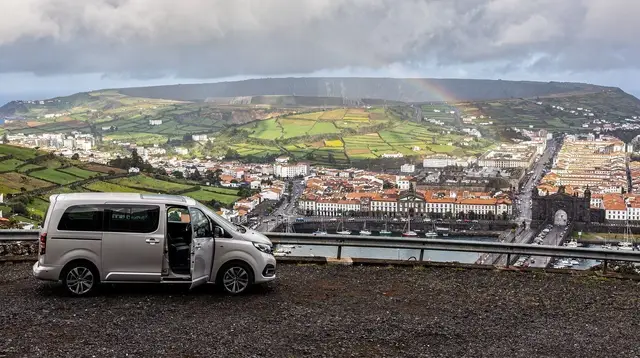
Terceira — the UNESCO port town. Angra do Heroísmo, Terceira’s historic centre, has been a UNESCO World Heritage site since 1983, a legacy of its centuries as a stopover port between Europe, Africa, and the Americas. Add the lava tube of Algar do Carvão, vines grown straight into black lava rock at Biscoitos, and a summer calendar built around the Holy Spirit festivities and the touradas a corda — bulls run on a long rope through village streets. The Terceira destination guide and the dedicated Angra do Heroísmo UNESCO guide are the next stop if this one caught your attention.
Graciosa — the sulphur cave and the quiet. The smallest island in the central group, and a UNESCO biosphere reserve, Graciosa’s headline feature is underground: the Furna do Enxofre, the largest volcanic cave in Europe, with a lake and sulphur fumaroles beneath its caldera. White windmills above Santa Cruz da Graciosa complete the picture. It’s also, as far as I could find, the one island in this archipelago with nothing bookable online through GetYourGuide — which tells you something about how far off the main circuit it sits. The Graciosa destination page has the practical details for getting there.
São Jorge — the fajãs. A long, narrow island defined by roughly forty fajãs, flat shelves of land created by lava flows or landslides meeting the sea, each one its own tiny world. Fajã da Caldeira de Santo Cristo has a lagoon known for its clams; Fajã dos Vimes is another favourite. This is also where São Jorge cheese, a protected raw-milk cheese, is made. The São Jorge destination guide is where the fajãs get the space they deserve.
Pico — the mountain. You can see Pico’s volcanic cone from three neighbouring islands on a clear day, and the mountain itself, at 2,351 m, is mainland Portugal’s highest point — despite sitting in the middle of the Atlantic. Climbing it means registering with the Casa da Montanha and carrying a GPS tracker, not just showing up with boots. Lower down, the island’s UNESCO-listed vineyard landscape is a grid of small stone-walled plots called currais, protecting vines from salt wind since the 15th century. The Pico destination page and the climbing Mount Pico guide cover the logistics I’ve only skimmed here.
Faial — the sailors’ port. Horta’s marina is a tradition in itself: generations of sailors have painted their boat names and crests onto the harbour walls before continuing across the Atlantic, and Peter Café Sport nearby has poured their drinks for just as long. Faial’s other landmark is newer and starker — the Capelinhos volcano, born from a submarine eruption in 1957–58, left a stretched, lunar coastline that’s hard to photograph badly. The Faial destination guide and the Capelinhos volcano guide fill in what one line skips over.
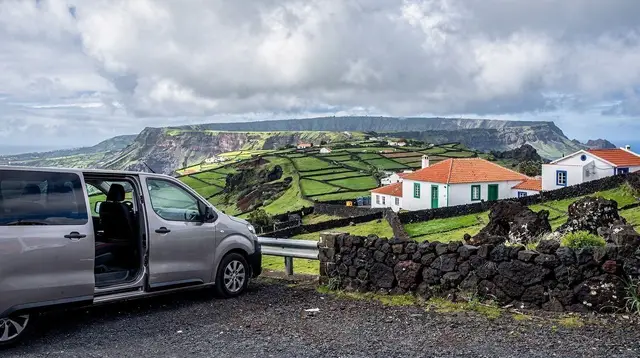
Flores — waterfalls and crater lakes. True to its name, Flores is soft where Pico is dramatic: crater lakes like Lagoa Funda and Lagoa Comprida, waterfalls dropping straight off green cliffs, and a UNESCO biosphere reserve designation to match Graciosa and Corvo’s. The Flores destination page is the deeper read.
Corvo — the quietest island of all. The smallest inhabited island in the Azores, Corvo is dominated by a single crater, the Caldeirão, and by how little else there is — no crowds, thin flight and ferry links, and a biosphere reserve status that fits an island this untouched. If Graciosa felt quiet on paper, Corvo is quieter still in person, or so I’m told by everyone who’s actually made it out there before the weather turned them back. The Corvo destination guide is honest about how fragile the logistics are.
Where to go from this list
If one or two of those one-liners pulled at you more than the rest, that’s the whole point of this post — it’s meant to be a starting line, not a decision. Working out which island actually fits your trip, your dates, and your patience for ferries is a longer conversation, and it lives in the guide to choosing which Azores island to visit. If you’re already torn between settling into one island or stringing a few together, that trade-off gets its own full treatment in one island versus island-hopping. I’ll leave both of those for when you’re ready to go past the teaser.
Quick questions about the nine Azores islands
How many islands does the Azores have, and how are they grouped?
Nine. They split into three groups: the eastern group (São Miguel, Santa Maria), the central group (Terceira, Graciosa, São Jorge, Pico, Faial), and the western group (Flores, Corvo).
Which Azores island is the largest and the one most people visit first?
São Miguel. It’s the biggest island, holds the regional capital Ponta Delgada, and has the archipelago’s busiest airport, so it’s where most first trips to the Azores begin.
Which island has mainland Portugal’s highest mountain?
Pico. The Montanha do Pico rises to 2,351 m, and climbing it requires registering in advance and picking up a GPS tracker at the Casa da Montanha.
Which island is known for the fajãs?
São Jorge. It has around forty of these flat coastal shelves formed by old lava flows or landslides, and it’s also where São Jorge cheese is made.
Are Graciosa and Corvo hard to reach?
They’re the two most isolated islands in the archipelago. Graciosa and Corvo have the archipelago’s lightest flight and ferry schedules, and Corvo in particular can go quiet for days when the sea turns.
Which island did Christopher Columbus visit?
Santa Maria. His ship stopped at the bay of Anjos in February 1493, on the way back from his first voyage to the Americas.
Do all nine islands have bookable tours online?
No. Graciosa, as of this writing, has no activities listed on GetYourGuide, unlike the more visited islands such as São Miguel, Terceira, or Pico.
Is this the guide I need to decide which island to visit?
Not quite — this post is just the one-line teaser for all nine. For picking an island to match your trip, or deciding between one base and island-hopping, those are separate, more detailed guides.
Trip-planning essentials on GetYourGuide
Verified deep-linked GetYourGuide tours. Book through these links and we earn a small commission at no cost to you.
GetYourGuide does not provide a product photo for this activity — the image shows the meeting point, photographed by us.