Visiting Gorreana Tea Plantation
Is Gorreana tea plantation free to visit, and what will I actually see?
Yes, entry to the factory floor, gardens, and tasting room at Gorreana is free. You can walk past the original processing machinery while it is running (on weekday mornings), then taste the teas and buy them in the on-site shop. Gorreana and nearby Porto Formoso are the only two working tea plantations left in Europe, and both are on São Miguel.
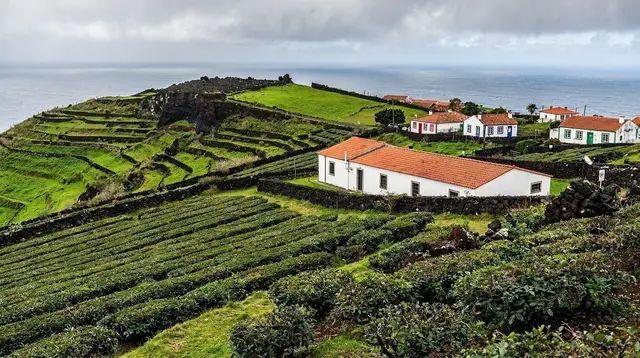
Green rows of tea bushes running down to the Atlantic are not something most people expect on a Portuguese island, which is exactly why a stop at Gorreana ends up on so many north coast itineraries. This is a practical guide to the visit itself: what is actually on site, what it costs (nothing, for the most part), how long to set aside, and where it fits if you are already spending the day around Ribeira Grande or heading further east toward Furnas.
A Working Factory, Not a Museum
Gorreana is not a recreation or a heritage display. It is a functioning tea estate that has been growing and processing Camellia sinensis on this stretch of São Miguel’s north coast since the 1880s, making it the oldest tea plantation still operating in Europe. The bushes climb the hillside above the factory in neat, contoured rows, planted to follow the slope rather than a grid, which is part of what makes the gardens photogenic without anyone having designed them for that purpose.
The factory building itself is modest and largely unchanged: a low structure housing rolling machines, sorters, and drying equipment that in some cases dates back generations, kept running rather than replaced because it still does the job. A raised walkway lets visitors look down onto the floor without getting in the way of the small production team, which is the whole point of the free-access model — the plantation would rather show you the real process than build a separate visitor experience around it.
If you want the mechanics explained rather than just observed, a guide who has done this stretch of coast before makes a real difference, since the machinery itself carries no signage explaining what each stage does; this is one of the few stops on São Miguel where a certified local guide genuinely earns their keep on a route that otherwise looks straightforward on a map.
Why São Miguel’s North Coast Suits Tea
Camellia sinensis is a fussy plant that thrives inside a fairly narrow climate window, and São Miguel’s north coast happens to fall inside it. The Azores sit on the meeting point of three tectonic plates, and that volcanic origin left the islands with the same mineral-rich soils that support the archipelago’s dairy pastures and vineyards elsewhere in the group — on São Miguel itself, that soil combines with steady Atlantic humidity and mild year-round temperatures to give the tea bushes conditions closer to a subtropical hillside than a typical mid-Atlantic island.
It’s the same underlying geology that produces the hot springs around Furnas a short drive inland, even though the tea gardens themselves have nothing to do with the thermal activity there. None of the other islands share quite this combination on a coastal stretch large enough to support a working plantation, which is part of why the crop never spread beyond this one corner of São Miguel.
Only Two Plantations, Both on São Miguel
It is worth being precise about this, because it gets flattened into vague language often enough to cause confusion: there is no archipelago-wide network of Azorean tea estates. Gorreana and the smaller Porto Formoso plantation, a little further along the same coast, are the only two commercial tea gardens left in Europe, and both happen to sit on this one island. Terceira, Pico, Faial and the rest of the group grow grapes, dairy, and plenty else, but not tea. If a itinerary or a brochure mentions “the Azores’ tea plantations” as if they were scattered across several islands, that phrasing is simply wrong — treat any claim like that as a mistake to correct, not a detail to shrug off.
The two estates are not really rivals so much as different scales of the same tradition. Gorreana is larger, more visited, and set up for a casual drop-in; Porto Formoso runs a smaller, more tightly guided visit. For a first stop on São Miguel, Gorreana’s free and flexible format suits most travelers better.
What the Visit Actually Involves
There are three parts to a Gorreana stop, and none of them requires booking ahead:
- The gardens. A short walk among the tea rows, with the ocean as a backdrop on clear days. There are no fences keeping you to a fixed path, so it’s an easy amble rather than a guided botanical circuit.
- The factory floor. Viewed from the elevated walkway inside the building. The machines only run during active production, generally on weekday mornings in season, and stand idle the rest of the time — see them running is a matter of timing, not something guaranteed by opening hours alone.
- The tasting room and shop. A counter where you can try the current teas — usually a green and a black or orange pekoe style — before deciding what to buy. Prices in the shop are noticeably lower than what the same tins cost once exported off the island.
Most visits run 30 to 45 minutes end to end. It is not a half-day outing, and treating it as one usually means standing around a small factory that has already shown you what it has to show.
Cost, Timing, and Getting There
Entry to Gorreana — the gardens, the factory viewing area, and the tasting room — is free. The plantation makes its money from tea sales rather than admission, and that is a large part of why the whole experience feels understated rather than packaged. There is no ticket booth and no turnstile.
Because it is a working farm rather than a tourist attraction built for a schedule, the busiest production activity lines up with the plantation’s own working hours, which skew toward weekday mornings, especially during the harvest months. A visit outside those windows still gives you the gardens, the shop, and a look at the stationary machinery — just not the sight of it in motion. If seeing the rollers and sorters actually working matters to you, plan an arrival before midday on a weekday rather than a weekend afternoon.
Gorreana sits on the north coast of São Miguel, close enough to Ribeira Grande that most visitors treat it as a short detour rather than a destination requiring its own trip. There is no dedicated tourist bus service timed to the plantation, which makes a rental car the practical way in for most travelers — the general notes on driving in the Azores and car rental apply here as much as anywhere else on São Miguel. If you would rather not drive, several operators fold Gorreana into a wider north coast or Furnas itinerary, which removes the routing question entirely.
| Way to visit | What it covers | Good for |
|---|---|---|
| Self-drive stop | Gardens, factory, tasting room, at your own pace | Travelers already touring the north coast independently |
| half-day tour combining Furnas and the tea plantation | Gorreana plus the Furnas valley in one outing | Visitors without a car who also want Furnas the same day |
| guided e-bike tour through Ribeira Grande | Ribeira Grande’s coastline, with the plantation nearby | Travelers who want a slower, active way to see the coast |
Where It Fits in a North Coast Day
Gorreana works best as one stop inside a longer loop rather than a stand-alone trip. Paired with Ribeira Grande itself, or slotted between Ponta Delgada and Furnas, it adds maybe 45 minutes to a day that already has other things to see. It is a poor fit for a tightly packed Sete Cidades morning, since that circuit runs on the opposite side of the island and adding Gorreana would mean backtracking across São Miguel rather than continuing along a single route.
If you’re weighing how a north coast stop like this fits into a wider São Miguel plan, the 3-day São Miguel itinerary and the tighter one-day São Miguel route both give a sense of what else competes for the same time slot. For travelers assembling their own day rather than following a fixed itinerary, our broader look at free things to do in the Azores places Gorreana alongside the archipelago’s other no-cost stops, and the Azorean food guide covers where tea fits next to cheese, wine, and the cozido das Furnas in the island’s food story more broadly.
Travelers heading on to the thermal side of Furnas the same day might also want the separate practical notes on Terra Nostra’s thermal pool, since that stop has its own admission and timing rules that are nothing like Gorreana’s free, drop-in model. And if pineapples rather than tea are the other agricultural curiosity on your list, the pineapple plantations guide covers São Miguel’s other well-known crop, grown under glass rather than in open rows.
Fitting Gorreana Into a Longer Stay
Most visitors reach Gorreana on a single north coast day, but it also works as a fixed point inside a longer São Miguel stay. Travelers following the 5-day São Miguel itinerary or the fuller 7-day route usually have more flexibility to slot in a quiet stop like this on a day that isn’t already built around a single big destination, rather than squeezing it into an already packed morning.
Timing matters less here than at most Azorean sights, since the factory and gardens keep a regular schedule rather than a seasonal one — see our notes on the best time to visit the Azores for how that compares to weather-dependent stops like whale watching. The gardens themselves stay green year-round, so a visit in spring or autumn looks much the same as one in peak summer.
An E-Bike Alternative for the Same Stretch
Drivers get to Gorreana in a few minutes off the main road, but the same north coast lends itself to a slower pace if you’d rather not be behind a wheel all day. A guided e-bike tour through Furnas with cheese tasting covers different ground — inland toward the thermal valley rather than along the coast — but it illustrates the kind of active, guided alternative available on this side of São Miguel if a straight drive-and-park stop isn’t what you’re after. For the coastal road itself, the Ribeira Grande e-bike route mentioned above stays closer to Gorreana’s own stretch of coastline.
Practical Notes Before You Go
A few details worth knowing before setting out: bring a bit of cash for the shop even though cards are generally accepted, since small purchases at a rural counter can be simpler that way. There is limited parking directly at the plantation, so on a weekday morning when a tour bus or two is already there, expect a short wait for a space rather than a full car park turning you away. And because this is farmland rather than a manicured garden, paths can be uneven and occasionally muddy after rain — reasonable shoes make more difference here than at almost any other stop on this list.
Getting There Without a Car
Travelers relying on public transport in the Azores will find Gorreana harder to reach independently than most stops on this list, since no scheduled bus route is timed around the plantation’s opening hours. That makes it one of the clearer cases on São Miguel where joining a tour or renting a car for the day genuinely changes what’s feasible, rather than just being more convenient.
Families traveling without a car face the same constraint, though once on site the flat gardens and short factory walkway make Gorreana an easy stop with children — there’s no strict path to follow and no rush to keep to, which is more than can be said for some of the busier São Miguel attractions; our broader guide to Azores with kids covers how a stop like this compares to the archipelago’s more demanding hikes and boat trips.
Frequently Asked Questions About Visiting Gorreana
Is Gorreana tea plantation really free to visit?
Yes. There is no admission charge for the gardens, the factory viewing area, or the tasting room. The plantation earns its revenue from selling tea rather than from ticket sales, which is part of why the visit feels low-key compared to a paid attraction.
Can I see the tea actually being made?
You can watch the antique rolling, sorting, and drying machines from a walkway above the factory floor. The equipment only runs during working hours on production days, mainly weekday mornings in harvest season, so an afternoon or weekend visit may show a quiet floor with the machines standing still.
How long does a visit to Gorreana take?
Most visitors spend 30 to 45 minutes: a short walk through the gardens, a look at the factory floor, and a tasting. It works well as a stop rather than a half-day destination on its own.
Is Gorreana the only tea plantation in the Azores?
No, but it is one of only two, and both are on São Miguel. The other is Porto Formoso, a smaller estate a little further along the north coast. Neither exists on any other Azorean island.
Where exactly is Gorreana, and how do I get there?
Gorreana sits on the north coast of São Miguel, a short drive from Ribeira Grande. There is no public bus timed for visitors, so most people arrive by rental car or as part of a guided tour that already includes a north coast or Furnas itinerary.
What can I buy in the shop?
Loose-leaf and bagged green and black tea grown and processed on site, in a range of blends, at prices well below what the same teas cost once exported. Tins travel well and are one of the few genuinely Azorean souvenirs that are not made elsewhere and shipped in.
Does Gorreana get crowded?
It can, around midday when tour buses stop between Ribeira Grande and Furnas or Nordeste. Arriving early or later in the afternoon usually means a quieter walk through the gardens, though the factory machinery itself only runs during working hours regardless of how busy the car park is.
Is Gorreana a good stop for families with children?
Yes. The gardens are flat and open with no fixed route to follow, and a visit rarely runs longer than 45 minutes, which suits shorter attention spans better than a half-day hike or boat trip. There’s no strict quiet-please museum atmosphere either, since it’s a working farm rather than a formal exhibit.
tours.food-gastronomy
Verified deep-linked GetYourGuide tours. Book through these links and we earn a small commission at no cost to you.
GetYourGuide does not provide a product photo for this activity — the image shows the meeting point, photographed by us.