Azores Pineapple Plantations: São Miguel's Greenhouse Fruit
Where can you visit pineapple plantations in the Azores?
São Miguel is the only Azores island with commercial pineapple plantations, clustered in greenhouses on the edge of Ponta Delgada. The fruit is forced into ripening with smoke over roughly two years, because the island's ocean climate is too cool for open-field tropical growing. Short self-guided visits usually end with a tasting or a bottle of pineapple liqueur.
A greenhouse fruit, not a tropical crop
Pineapple is one of the most photographed crops in the Azores, and also one of the most misunderstood. Visitors arriving with images of Central American or Southeast Asian plantations — open fields, blazing sun, red volcanic soil under a tropical sky — are almost always surprised by what they actually find on São Miguel: rows of low glass and stone greenhouses, misted and shaded, packed close together on the edge of Ponta Delgada.
There is no open-field pineapple farming anywhere in the Azores, and there never really has been. The archipelago’s climate — mild, damp, and cloudy nearly all year — is the reason the greenhouse became the only way to grow this fruit here at all, and understanding that constraint is the key to understanding everything else about the plantations: why they look the way they do, why the fruit takes so long to ripen, and why a visit here is a genuinely different experience from a pineapple farm anywhere in the tropics.
This guide covers only the pineapple side of São Miguel’s greenhouse agriculture: how the plants are grown, what a short visit involves, and where it fits into a day based in Ponta Delgada. It does not attempt to cover Azorean food and drink as a whole — for that, see the separate Azorean food guide — and it deliberately keeps its distance from the island’s other famous greenhouse-adjacent crop.
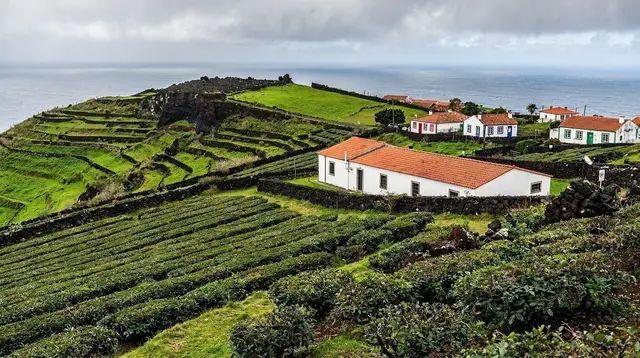
Tea is grown in open fields, not glasshouses, at Gorreana, and it has its own dedicated write-up in the Gorreana tea plantation guide. The two crops are often mentioned in the same breath because they sit on the same island and appeal to the same curious visitor, but the growing methods, the visitor experience, and the history behind each are different enough to deserve separate treatment.
Why São Miguel grows pineapples under glass
Pineapple cultivation arrived on São Miguel in the second half of the nineteenth century, brought over as an experiment by island families with the capital to build the necessary infrastructure — infrastructure being, in this case, greenhouses built from local basalt and imported glass, designed to trap heat and hold humidity in a climate that otherwise offers neither in tropical quantities. The Azores sit in the North Atlantic, cooled and dampened by the surrounding ocean, with mild winters and mild summers rather than a hot, dry, sun-drenched growing season. That climate is excellent for hydrangeas, dairy pasture, and the kind of lush, permanent green the archipelago is known for; it is not, on its own, capable of ripening a pineapple.
The solution the growers settled on, and the one still used today, was to recreate a tropical microclimate artificially, plant by plant, inside stone-walled greenhouses. Glass roofs trap solar heat, high stone walls block the Atlantic wind, and controlled watering keeps humidity high. It is labour-intensive in a way that open-field tropical pineapple growing simply is not, which is part of why São Miguel pineapple has always been a boutique, small-scale crop rather than a mass export commodity — a curiosity and a local specialty first, an industry a distant second.
The smoke-forcing technique: a fruit grown on a two-year clock
The detail that most separates São Miguel’s pineapples from anywhere else in the world is how flowering is triggered. In naturally tropical growing regions, pineapple plants flower on their own schedule, influenced by day length and temperature. In the greenhouses of São Miguel, growers do not wait for that to happen naturally — instead, they force it, deliberately, using smoke.
Once a pineapple plant has grown enough leaf mass, growers place it in an enclosed space and expose it to smoke for a period of time, traditionally produced by smouldering straw or similar plant matter. The smoke releases ethylene gas, which is the same natural plant hormone that ripening fruit gives off, and the plant reads that ethylene as a signal to stop growing leaves and start flowering. It is essentially a controlled, deliberate trick played on the plant’s own hormonal signalling — and it lets growers decide roughly when a batch of pineapples will flower, and therefore roughly when it will be ready to harvest, rather than leaving that to chance.
Even with forcing under the grower’s control, the overall cycle from planting a new sucker to picking a ripe pineapple is long by any standard:
| Stage | Approximate duration | What happens |
|---|---|---|
| Vegetative growth | 12–14 months | The young plant builds leaf mass in the greenhouse before it is ready to be forced |
| Smoke forcing | Days to a few weeks | Controlled smoke exposure triggers flowering on the grower’s schedule |
| Flowering to fruit set | A few months | The forced plant produces its flower stalk and the fruit begins to form |
| Fruit ripening | Several months | The pineapple matures slowly in the cooler Azorean greenhouse climate |
| Total, sucker to harvest | Roughly two years | Far longer than pineapple grown in an open tropical field |
That roughly two-year timeline, from a young plant to a ripe fruit, is the single fact worth remembering from a visit here: it is the direct, visible consequence of growing a tropical plant in a temperate Atlantic climate, and it is the reason greenhouse plantations exist on São Miguel at all rather than open fields.
Where the plantations are: greenhouses on the edge of Ponta Delgada
The pineapple greenhouses sit close to the city, in the semi-rural fringe around Ponta Delgada rather than out toward the island’s more dramatic natural landmarks. That proximity is part of the appeal: unlike a trip out to Sete Cidades or Furnas, a pineapple plantation visit does not require a long drive, a rental car, or a half-day commitment.
A handful of family-run operations open their gates to visitors, generally on an informal, walk-in basis rather than through timed, ticketed entry — which also means opening hours can be modest and can shift with the season, so it is worth confirming locally on the day rather than planning around a fixed timetable found online.
Inside, the layout is straightforward: narrow stone-walled greenhouses, low enough to feel almost tunnel-like, with plants at every stage of the roughly two-year cycle growing side by side — some newly potted, some mid-cycle, some carrying a single ripening fruit at the crown of the plant. It is a small-scale, hands-on kind of agriculture, closer in feel to a walled kitchen garden than to a commercial farm, and that scale is exactly what makes a short visit worthwhile rather than a chore.
What a short visit actually looks like
Set expectations correctly and this becomes one of the most satisfying quick stops on the island. A typical visit runs thirty to forty-five minutes: a self-guided walk through one or two greenhouse buildings, informational signage or a brief chat with staff explaining the smoke-forcing method, and then a stop in a small shop or tasting room. There, visitors can usually sample fresh pineapple, pineapple jam, and — the most popular takeaway — a glass of pineapple liqueur.
This is not a plantation tour in the sense of a guided, narrated walk with a fixed script; it is closer to a self-directed curiosity stop, and it rewards visitors who read the signage rather than rush through. Because the greenhouses are compact, there is no risk of it turning into a long outing even for a traveller working around a tight Ponta Delgada schedule, which is exactly why it pairs so easily with other things nearby, covered in the free things to do in the Azores guide alongside other low-cost or no-cost stops on the island.
Tasting and buying: fresh fruit, jam, and licor de ananás
The tasting is the payoff for the visit, and the star of it is almost always licor de ananás — a bright yellow, distinctly sweet liqueur made by macerating pineapple flesh in sugar and spirit. It is sold at plantation shops in bottles of varying sizes, alongside jars of pineapple jam and, depending on the season, fresh whole pineapples or peeled slices to eat on the spot. None of these are expensive, and buying a small bottle of liqueur or a jar of jam is a natural, compact souvenir that travels far better than most — a point worth pairing with the ideas in the Azores crafts and souvenirs guide for travellers building a shortlist of things to bring home.
Visitors curious about a wider tasting of Azorean produce and cooking, rather than pineapple specifically, are better served by a dedicated food outing. A guided option like a gourmet tapas-style food tour through Ponta Delgada covers a broader spread of local specialties in one afternoon, including items the pineapple greenhouses do not touch on at all, such as the island’s famous slow-cooked stew — see the separate cozido das Furnas guide for that dish specifically.
Pairing a plantation stop with the rest of Ponta Delgada
Because a pineapple greenhouse visit is short, it works best stitched into a longer day rather than treated as a standalone outing. A few natural combinations:
| Pairing | Why it works | Rough time needed together |
|---|---|---|
| Pineapple greenhouses + city walk | Both sit in or near Ponta Delgada; easy to combine on foot or with a short taxi ride | Half a day |
| Pineapple greenhouses + tapas food tour | Rounds out a short fruit tasting with a fuller spread of local dishes | Half a day to a full evening |
| Pineapple greenhouses + Furnas day out | A short morning stop before heading east for the thermal valley and tea fields | A full day |
| Pineapple greenhouses + dairy farm visit | Two small-scale, family-run agricultural stops that pair naturally on a quieter itinerary day | Half a day |
For the city-walk pairing, the Ponta Delgada walking guide lays out a route through the historic centre that slots neatly either side of a greenhouse visit. Travellers heading further east for the day, toward the thermal valley and its tea fields, might instead consider a full-day Furnas and tea plantations tour with lunch included, which covers ground the pineapple greenhouses deliberately do not, since São Miguel’s tea-growing side has its own dedicated coverage elsewhere on this site.
For a quieter, more rural pairing on the same island, a half-day dairy farm tour sits well alongside a short pineapple stop, since both are small, family-scale agricultural visits rather than headline attractions. Travellers planning a broader loop of the island’s interior sometimes fold a plantation stop into a wider day that also covers craters and viewpoints, an option covered by a São Miguel and Furnas 4WD tour.
Anyone building a first visit around these pairings from scratch may find it useful to start from a structured plan such as the one in São Miguel in 3 days or the tighter São Miguel in one day itinerary, both of which leave room for a short, low-cost detour like this one.
Practical tips for visiting
A short greenhouse visit like this rarely goes wrong, but a few practical notes make it smoother:
- Hours are informal and can be short. These are small, family-run operations, not staffed attractions with published year-round timetables. Confirm locally, especially outside the main summer season.
- Bring small change. Tastings and small purchases — jam, a single bottle of liqueur — are usually modest in price and easiest to pay for in cash.
- It is a short stop, not a half-day plan. Budget thirty to forty-five minutes and build the rest of the day around it, using the pairing ideas above.
- This is a fair-weather-agnostic stop. Because everything happens inside greenhouses, it is one of the more reliable things to do regardless of what the sky is doing outside — genuinely useful on an island where, as covered in the Azores weather month by month guide, conditions can shift within a single afternoon.
- Budget for it as a minor line item. A plantation visit and a bottle of liqueur fit comfortably into even a tight daily spend; see the Azores daily budget guide for how a stop like this compares with the island’s bigger-ticket activities.
- Combine it, don’t isolate it. On its own it is a pleasant curiosity; paired with a walk through Ponta Delgada, a food tour, or a longer day trip east, it becomes a genuinely memorable half-hour rather than an afterthought.
FAQ: Visiting the São Miguel Pineapple Plantations
Are Azores pineapples grown outdoors or in greenhouses?
Always in greenhouses. São Miguel’s mild but distinctly non-tropical, cloudy Atlantic climate cannot ripen pineapples in open fields, so growers raise every plant under glass and force it artificially with smoke.
Why does it take about two years to grow an Azores pineapple?
Smoke-forcing triggers flowering on a schedule the grower controls, but the plant still needs many months of leaf growth before forcing and many more for the fruit to mature afterward. Counted from a new sucker to a ripe pineapple, the full cycle runs close to two years, far longer than pineapples grown in a genuinely tropical climate.
Which island grows pineapples in the Azores?
São Miguel is the pineapple island of the archipelago. The greenhouses sit close to Ponta Delgada, not scattered across the other eight islands.
Can you visit a pineapple plantation near Ponta Delgada?
Yes. A handful of family-run greenhouse plantations on the edge of the city welcome visitors for short, mostly self-guided walks past the growing stages, usually finishing at a small shop for a tasting.
Do I need to book a plantation visit in advance?
Most of these visits are informal, walk-in stops rather than ticketed tours with fixed time slots, but opening hours can be short and vary by season, so it is worth checking locally on the day rather than assuming a set schedule.
What is Azores pineapple liqueur?
Licor de ananás is a sweet, bright yellow liqueur made by macerating pineapple in alcohol and sugar. It is the classic souvenir from a plantation visit and is widely sold in Ponta Delgada shops as well.
How much time should I set aside for a pineapple plantation visit?
Thirty to forty-five minutes covers a walk through the greenhouses and a tasting. It works best as a short add-on before or after another stop in or around Ponta Delgada, not as a half-day activity on its own.
tours.food-gastronomy
Verified deep-linked GetYourGuide tours. Book through these links and we earn a small commission at no cost to you.
GetYourGuide does not provide a product photo for this activity — the image shows the meeting point, photographed by us.