Azores with Kids: A Practical Planning Guide
Is the Azores a good destination for a family trip with young children?
São Miguel offers the archipelago's widest range of family infrastructure, from a regional hospital and multiple pharmacies in Ponta Delgada to shallow thermal pools in Furnas, making it the easiest first stop for families. Mountain roads can turn foggy with little warning and many whale-watching operators set a minimum age of around 6 to 8 on fast boats, so both are worth checking before you travel. A rental car is close to essential once you leave the main town of any island.
Planning a Family Trip to the Azores
The Azores are an easy sell to parents on paper: green volcanic scenery, thermal pools instead of crowded beaches, and a slower pace than most European city breaks. The part that rarely gets covered is the logistics — which island actually has the infrastructure for young children, how nerve-wracking the driving really is, what happens if someone gets sick on a small island, and which of the archipelago’s famous boat trips will actually let a six-year-old on board.
This guide is about that layer of planning, not about which activities to book once you land. For the activity list itself, see our guide to family-friendly things to do in the Azores, and for a day-by-day structure, our one-week family itinerary.
Which Azorean Island Works Best for Families
Not all nine islands are equally practical with young children, and the difference is mostly about distance from help, not about how pretty an island is.
São Miguel is the default recommendation for a first family visit. It’s home to the region’s main hospital and by far the largest concentration of pharmacies, concentrated in and around Ponta Delgada. Driving distances between attractions are shorter than on any other island of comparable interest, and Furnas offers shallow, low-drama thermal pools that work well with children — as opposed to, say, a boat trip that depends on calm seas and a cooperative toddler.
Terceira is the next most practical choice. Angra do Heroísmo has a hospital and a reasonable pharmacy network, and the island’s road layout is gentler than São Miguel’s mountain interior, since much of what there is to see sits closer to the coast.
Pico and Faial work well for families who are comfortable with a slower, more improvised pace — Horta has a small hospital, but choice of pharmacies and specialists is more limited than on São Miguel or Terceira.
Flores, Corvo, Graciosa and Santa Maria are the islands to be cautious with if you’re travelling with a baby or a child with any ongoing medical need. These are wonderful islands to visit, but they have only a basic health centre each, inter-island transport can be disrupted by weather for days at a time (this is especially true for the Flores–Corvo route), and evacuation for anything serious means waiting for a flight. None of that should rule these islands out of a family trip — it just argues for building in slack and good insurance rather than a tight connecting schedule.
| Island group | Hospital / pharmacy access | Typical driving distances | Best suited to |
|---|---|---|---|
| São Miguel | Regional hospital, many pharmacies in Ponta Delgada | Short to moderate | First-time family visits, all ages |
| Terceira | Hospital and pharmacies in Angra do Heroísmo | Short | Families wanting a calmer island |
| Pico / Faial | Small hospital in Horta, limited specialists | Moderate | Families comfortable with slower logistics |
| São Jorge | One pharmacy area, basic health centre | Long, narrow roads to the fajãs | Older children, hiking-oriented families |
| Flores / Corvo / Graciosa / Santa Maria | Basic health centre only, no hospital | Short island size, but isolated | Families with flexible schedules and strong insurance |
If choosing between islands is still the open question, our full comparison of which Azores island to visit covers the trade-offs beyond the family angle too.
Getting There and Around with Children
Most international flights route through Lisbon or Ponta Delgada, and inter-island connections run on SATA Air Açores. Two family-specific points matter here. First, the Azores sit on UTC-1, one hour behind mainland Portugal — an easy thing to miscalculate on a tight connection through Lisbon with overtired children in tow, so double-check local arrival times rather than assuming the same offset as at home. Second, direct flights from Pico or Horta (Faial) to Lisbon run only seasonally, so a family routing through the central group outside peak months should expect a connection via Ponta Delgada rather than a direct hop.
Ferries matter for families splitting time between islands. The Madalena (Pico)–Horta (Faial) crossing, about 30 minutes, runs year-round several times a day and is genuinely stress-free with children — it’s the one inter-island link in the archipelago you can build a schedule around with confidence. The wider network connecting the rest of the central group (Terceira and Graciosa included) only operates from June to September, and the western group’s Flores–Corvo link is the most weather-sensitive crossing in the Azores, capable of cancelling for several days running outside summer. Don’t schedule a small child’s only chance to see Corvo on the last full day of a trip — build a buffer day around any western-group crossing.
Driving Azores’ Mountain Roads with Kids in the Car
A rental car is close to essential once you leave the main town on any island — bus networks connect villages but not attractions, and each island’s rental fleet is separate from the others, so a car booked on São Miguel doesn’t travel with you to Terceira. Our car rental guide covers booking specifics; the family-relevant point is to reserve a child seat directly with the rental company well ahead of time, since stock is limited, especially outside São Miguel.
On the road itself, three things catch first-time visitors off guard, and all three matter more with children in the back seat:
- Fog at altitude. Roads climbing into the interior of São Miguel, Pico and São Jorge can go from clear to near zero-visibility in minutes. Slow right down, use fog or dipped headlights, and don’t push through if visibility drops sharply — pull over rather than press on.
- Free-roaming cattle. Ridge and pasture roads, particularly on the smaller islands, sometimes have cows crossing or simply standing in the road. This is a genuine daily hazard on rural routes, not a postcard cliché.
- Narrow, cliff-edge roads. Many of the most scenic stretches — the approach to São Jorge’s fajãs is a good example — are narrow with limited passing space. Budget more driving time than a map suggests, and take breaks; a two-hour drive on these roads is a different two hours than a motorway.
Our dedicated driving in the Azores guide goes deeper on routes and conditions island by island.
If you’d rather hand a chunk of the driving to someone else for a day, a guided outing can take the pressure off with young kids in tow — an option like a guided day around Sete Cidades with a local host lets everyone look at the crater lakes instead of the road.
Pharmacies, Doctors and Health Care for Families
The Azores are part of Portugal and the EU, so European Health Insurance Card coverage applies for EU residents, but private travel insurance with medical evacuation cover is still worth having, and matters more the smaller the island on your itinerary.
In practice:
- São Miguel and Terceira have well-distributed pharmacies in their main towns, staffed by pharmacists able to advise on minor illnesses, fevers, ear infections and the like without a doctor’s visit — useful with young children, where a pharmacist’s opinion is often the fastest first step.
- Pico and Faial have pharmacies in Horta and Madalena, with more limited stock and specialist access than the larger islands.
- Flores, Corvo, Graciosa and Santa Maria have very limited health infrastructure — often a single pharmacy and a basic health centre, with no hospital. A serious issue on Corvo, the smallest inhabited island in the archipelago, typically means transfer to Flores first and then onward, since Corvo’s own health centre isn’t equipped for anything beyond first response.
Our detailed pharmacies and health care guide lists what to expect island by island, including opening hours and what pharmacies do and don’t stock. If mobility or a specific medical condition is part of your planning, our accessibility guide is worth reading alongside this one, since much of the same infrastructure question applies.
Age Minimums on Boat Trips and Whale Watching
This is the single most common surprise for parents booking Azores activities in advance: not every whale-watching or boat trip accepts young children, and it’s easy to assume otherwise given how central whale watching is to the region’s identity. Many operators set a minimum age, commonly in the range of 6 to 8 years old, particularly on fast rigid inflatable boats (RIBs), which bounce hard on open Atlantic swell and aren’t considered safe for very young passengers.
Larger, slower catamarans and motor launches are more likely to accept younger children, but this varies operator to operator and isn’t something to assume — always check the specific age policy before booking rather than after arriving at the harbour with a disappointed six-year-old. Our whale-watching guide has more detail on how the different boat types and operators compare.
| Activity type | Typical minimum age | Notes |
|---|---|---|
| Fast RIB whale watching | Around 6–8 years | Bumpy ride on open sea; varies by operator |
| Larger boat / catamaran whale watching | Often lower, sometimes no strict minimum | Slower and more stable, but still check with the operator |
| Snorkelling or swim excursions | Often 8+ or requires swimming ability | Depends on water conditions and depth |
| Land-based wildlife watching (vigias, coastal viewpoints) | No age restriction | Land-based, no boat involved |
None of this means a family trip has to skip the water entirely. Land-based and gentler options exist without an age gate attached: a supervised half-day kids’ club on São Miguel gives younger children a few hours of age-appropriate activity while older siblings or parents do something more physical, and a day visiting a working farm with a traditional lunch is an easy, unhurried option that doesn’t depend on sea conditions or age limits at all.
For an evening that works for the whole family without any logistics beyond turning up, an evening meal with a local family is worth considering as a low-effort way to end a driving-heavy day.
Weather, Timing and Small Practicalities
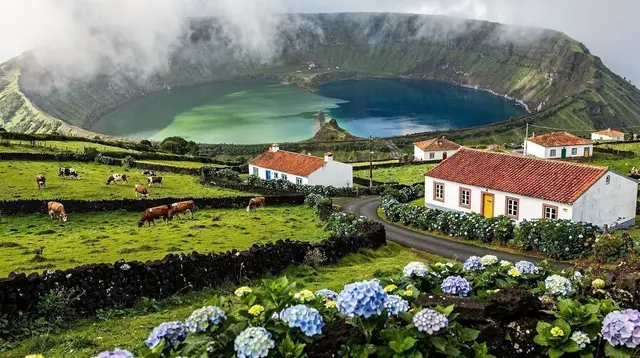
The local saying — four seasons in one day — is not an exaggeration, and it matters more with children than adults, since a soaked, cold toddler ends a day faster than a soaked, cold adult does. Pack layers and rain gear regardless of the month you’re travelling, and don’t plan an entire day’s schedule around a clear morning sky; carry a change of clothes in the car as a matter of course. If you’re travelling in the window when hydrangeas are in bloom (roughly June to August), roadside stops are easy and require no booking, which is a useful way to break up a longer drive with children who need to get out of the car.
A few smaller points worth knowing before you go: SIM cards and data are easy to arrange in Ponta Delgada or Angra do Heroísmo but far more limited on the smaller islands, so download offline maps in advance; and if you’re travelling with a very young child, our blog account of a real trip with a toddler is a useful companion read alongside the practical points covered here.
Frequently Asked Questions About Taking Kids to the Azores
Which Azores island is easiest for families with young children?
São Miguel is generally the easiest choice: it has the region’s main hospital and the widest network of pharmacies in Ponta Delgada, shorter average driving distances between sights, and family-friendly attractions such as the thermal pools of Furnas.
Do I need a car seat when renting a car in the Azores?
Yes. As part of Portugal and the EU, the Azores require age- and size-appropriate child seats or boosters for young passengers. Reserve one directly with the rental company when you book, since stock on smaller islands is limited.
Are the mountain roads safe to drive with children in the car?
They are manageable at a moderate pace, but fog can descend quickly at altitude on São Miguel, Pico and São Jorge, and free-roaming cattle sometimes cross ridge and pasture roads. Slow down, use headlights in mist, and build extra time into any route that climbs above the coast.
Is it easy to find a pharmacy or doctor in the Azores?
On larger islands such as São Miguel and Terceira, pharmacies are well distributed in the main towns and staffed by pharmacists who can advise on minor ailments. On smaller islands such as Corvo, Graciosa or Flores, services are limited to one or two pharmacies and a small local health centre.
What happens if my child needs a hospital on a small island like Corvo or Flores?
Small islands have only a basic health centre. Serious cases are stabilised locally and, if needed, transferred by SATA Air Açores or a dedicated medical flight to the regional hospitals in Ponta Delgada (São Miguel) or Angra do Heroísmo (Terceira).
What is the minimum age for whale-watching and boat trips?
It varies by operator, but a minimum age of around 6 to 8 years old is common, particularly on fast rigid inflatable boats (RIBs). Larger, slower vessels sometimes accept younger children. Always confirm the age policy with the specific operator before booking.
Should I buy travel insurance that covers medical evacuation?
It is strongly recommended, especially if your itinerary includes smaller islands such as Corvo, Flores, Graciosa or Santa Maria, where a serious medical issue can mean an inter-island flight to reach full hospital care.
Family-friendly things to do on GetYourGuide
Verified deep-linked GetYourGuide tours. Book through these links and we earn a small commission at no cost to you.
GetYourGuide does not provide a product photo for this activity — the image shows the meeting point, photographed by us.