Accessibility in the Azores for Travelers with Limited Mobility
Which Azores islands are the most accessible for travelers with limited mobility?
São Miguel is the most realistic base: Ponta Delgada has step-free stretches, ramped museums and a paved thermal pool at Terra Nostra Park. Terceira's Angra do Heroísmo is manageable in short doses despite UNESCO cobblestones. Smaller islands like Corvo, Flores and São Jorge have rougher terrain and far fewer adapted facilities.
The Azores are marketed as green, dramatic and easy to fall for in photographs, and almost none of that marketing mentions the ground underfoot. Anyone traveling with limited mobility, using a wheelchair or a walker, recovering from surgery, or simply unable to manage long uneven walks, needs a different kind of trip-planning question than the usual “which island is prettiest.” The honest question is: which islands, which towns and which specific sites are realistic, and which ones will turn a relaxing holiday into an exhausting one.
This guide does not pretend every island in the archipelago is equally workable. It is not.
What actually determines accessibility here, island by island
Three things decide whether a place in the Azores works for someone with limited mobility, and none of them is how famous the site is.
The first is surface. Volcanic archipelagos are not flat by nature, and the historic centres layered on top of that terrain are paved with calçada portuguesa — small hand-set cobbles, usually black basalt and white limestone, laid in decorative patterns. It looks beautiful in every postcard of Ponta Delgada and Angra do Heroísmo. It is also uneven, has gaps between stones, and turns slick within minutes of rain — and rain arrives often in the Azores.
The second is infrastructure age. A newer building, a recently renovated museum, or a purpose-built visitor centre is far more likely to have a ramp, a lift or a level entrance than a centuries-old structure inside a UNESCO-protected historic core, where heritage rules can prevent structural changes altogether.
The third, and the one visitors underestimate most, is which island you are on. São Miguel has the population, the visitor numbers and the budget to have built out some accessible infrastructure. Corvo, with barely 400 residents, does not, and never will to the same degree — not because anyone is negligent, but because the tourism economy there cannot support it.
Which Azores islands are realistic for limited mobility
Treat this as a rough map of where to focus effort, not a guarantee.
| Island | Overall realism | Why |
|---|---|---|
| São Miguel | Most workable | Largest towns, paved gardens at Terra Nostra, more taxis and adapted lodging options |
| Terceira | Workable in short doses | Angra do Heroísmo has cobbled UNESCO streets but also wider modern avenues nearby |
| Faial | Moderate | Horta’s marina front is relatively flat and walkable |
| Pico | Limited to lower areas | Lava-field terrain and the currais vineyards are uneven; the mountain itself is off the table |
| Santa Maria | Limited | Smaller infrastructure base, fewer adapted facilities |
| São Jorge | Rugged | Access to the fajãs is by steep, often unpaved roads and trails |
| Graciosa | Rugged, thin infrastructure | Small population, limited services beyond the main town |
| Flores | Rugged | Waterfall and crater-lake viewpoints often require walking on uneven ground |
| Corvo | Least accessible | Smallest inhabited island, most basic infrastructure, most fragile transport links |
The mistake to avoid is assuming a nine-island archipelago behaves like one place. It is closer to nine small countries that happen to share a currency and a government.
São Miguel: the most workable base
If a mobility-limited traveler can only realistically build a trip around one island, it is São Miguel. Ponta Delgada, the capital, has stretches of level, modern paving along its waterfront and marina area that avoid the worst of the old-town cobbles, along with the largest concentration of taxis, adapted-enough lodging, and restaurants with step-free entrances on the archipelago.
Furnas is the other strong option on this island. Parque Terra Nostra, the historic botanical garden built around a large thermal pool, has paved and largely level garden paths, and the iron-rich pool itself has a gently sloping entry rather than a ladder-only drop, which makes it one of the more workable thermal experiences in the Azores for someone with limited mobility.
Poça da Dona Beija, the other well-known Furnas hot spring, is more mixed: its individual pools are separated by stone edges and small steps, so it is worth asking staff which pool is easiest to reach before undressing. And whichever pool is used, the iron-rich water stains light-coloured swimwear and towels a rust-orange — worth knowing before, not after.
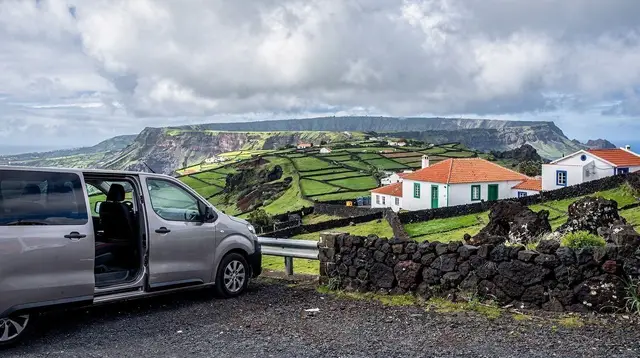
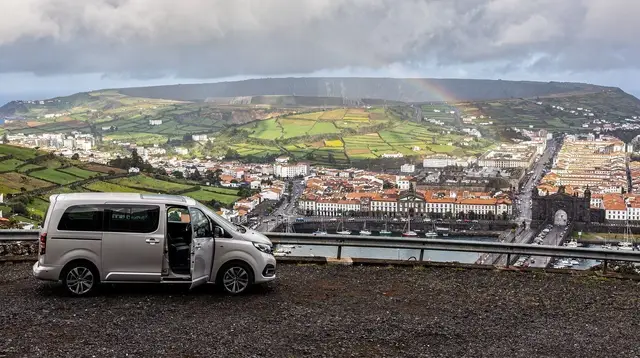
Sete Cidades, the twin-crater-lake valley that appears on every Azores brochure, is best experienced from its rim-road viewpoints by car rather than on the steep descending trails into the caldera itself, which are long, uneven and not step-free. A guided option that lets someone else manage the driving and the pacing is often the more comfortable route here.
a guided minivan tour around the Sete Cidades viewpoints with a local driver-guide covers the crater’s best angles without requiring the descent on foot, which matters if steep, uneven trails are off the table.
The Lagoa do Fogo viewpoint is reachable by road, but the lake itself sits well below the rim and is not a level walk.
Angra do Heroísmo: UNESCO cobbles in a compact core
Angra do Heroísmo on Terceira earned its UNESCO World Heritage listing in 1983 for a historic centre that still functions as a working town, not a museum piece — which means the same calçada portuguesa that makes it photogenic is genuinely difficult underfoot. The steepest, narrowest lanes near the old fortifications are the hardest going; the broader streets closer to the marina and the modern commercial stretches are considerably easier.
a guided walking tour through Angra’s historic core is worth choosing over a self-guided wander here specifically because a local guide will route around the worst cobblestones and set a realistic pace, rather than pushing straight through the steepest lanes because that is where the map says to go.
The Algar do Carvão, a collapsed volcanic chimney open to visitors, involves a staircase down into the cave and is not adaptable for wheelchair users or anyone unable to manage stairs; it is one of the clearer “skip this one” calls on the island for significant mobility limitations.
Faial and the smaller central islands
Horta’s marina front on Faial is one of the more genuinely level stretches of waterfront in the archipelago, lined with the murals left by generations of sailors and anchored by the Peter Café Sport. It is a place where a wheelchair or a walker can cover real ground without fighting the pavement at every step.
a guided walking tour of Horta’s marina and old town with a local guide is a reasonable way to see the highlights at a set, manageable pace rather than improvising a route through the parts of town that turn hilly fast.
Pico itself is a harder case. The UNESCO-listed vineyard landscape around Criação Velha is beautiful but sits on uneven lava-rock ground crossed by low stone currais walls, and walking among the vines is not a level or paved experience. Montanha do Pico, at 2,351 metres the highest point in Portugal, is out of the question for anyone with significant mobility limitations — the trail is loose volcanic scree from the first metre, the ascent is registered and quota-limited through the Casa da Montanha specifically because it is a serious mountain climb, and there is no accessible alternative route to the summit or the crater rim.
A boat-based view of Pico’s coastline is a workable substitute for a traveler who cannot manage the island’s rougher ground on foot.
a sunset boat tour along the coast keeps the experience seated and level rather than trading it for a walk over lava rock.
The islands that are honestly difficult
This is the section most Azores guides skip, and it is the one that matters most for planning.
São Jorge is built around its fajãs — around forty coastal platforms formed by lava flows or landslides, reached almost exclusively by steep, winding, often unpaved roads down the island’s cliff faces, followed by walking trails once you arrive. There is no accessible route into a fajã; the terrain and the road grades rule it out.
Flores and Corvo, the westernmost group, combine the roughest scenery in the archipelago — waterfalls, crater lakes, the Corvo caldeirão — with the thinnest infrastructure and the most fragile inter-island transport links of any islands in the Azores. Flores’s crater-lake viewpoints and waterfall trails generally require walking on uneven, sometimes muddy ground with no paved alternative. Corvo, the smallest inhabited island in the archipelago, has one small village and very little built for tourism beyond it.
Graciosa sits in a similar category: its standout site, the Furna do Enxofre volcanic cave with its underground lake, is reached by a staircase down into the crater and is not step-free by any measure.
None of this means these islands should be struck off a Portugal or Azores trip altogether — a car-based visit that stops at roadside and clifftop viewpoints without attempting the trails still delivers real scenery. It means budgeting time and energy realistically, and not scheduling a fajã hike or a Corvo caldeirão descent as the centrepiece of a day for someone who cannot manage rough, uneven ground.
Plane or ferry: which is easier between islands
Anyone island-hopping with limited mobility eventually has to choose between flying and taking the ferry, and the two are not equally predictable.
Flying with SATA Air Açores for the inter-island network, or Azores Airlines for longer routes, generally means short flight times, straightforward check-in, and boarding that is either through a jet bridge at Ponta Delgada or a short, level walk across the tarmac at the smaller island airports. It is the more consistent option for someone who tires quickly or cannot manage a rocking gangway.
Ferries, run by Atlânticoline, are the only way to reach some islands and are a genuinely pleasant, scenic way to travel — the Madalena-Horta crossing between Pico and Faial takes about 30 minutes and runs year-round, several times daily, alongside São Jorge in what locals call the “Triangle,” the one inter-island network reliable in every season.
Boarding involves a ramp or gangway whose steepness shifts with the tide, and the open Atlantic swell on the wider central-group and western-group routes can make walking around the boat difficult even for able-bodied passengers. The extended network linking the rest of the central group, including Terceira and Graciosa, only runs June to September, and the western routes to Flores and Corvo are the most weather-sensitive links in the archipelago, capable of being cancelled for days at a stretch outside summer.
| Factor | Flight (SATA / Azores Airlines) | Ferry (Atlânticoline) |
|---|---|---|
| Typical duration | 30-50 minutes | 30 minutes to several hours |
| Boarding | Jet bridge or short level tarmac walk | Ramp or gangway, steepness varies with tide |
| Motion | Minimal once airborne | Can be significant on open-water routes |
| Year-round reliability | High | High only on the Pico-Faial-São Jorge Triangle |
| Best for limited mobility | Longer or rougher-sea routes | Short, sheltered crossings like Pico-Faial |
The practical rule: use the ferry for the short, sheltered Pico-Faial-São Jorge triangle, where the crossing is brief and usually calm, and lean on flights for anything longer or for the seasonal central and western routes that can leave a traveler stranded or seasick.
Guided tours as a mobility strategy, not just a convenience
For a traveler managing limited mobility, a small-group or private guided tour is not simply a nicer way to see a site — it is often the difference between seeing it at all and not attempting it. A guide can adjust the pace, choose the more level path when one exists, arrange vehicle drop-offs closer to an entrance, and know in advance which stretch of a route to skip.
a guided day tour of Nordeste’s waterfalls with lunch included is a good example of the format working in someone’s favour: transport, pacing and stops are all handled by someone who has done the route before, rather than left to a self-drive itinerary built from a map alone.
Practical checklist before booking
- Book accommodation in Ponta Delgada or central Angra do Heroísmo rather than remote guesthouses, and ask specifically about step-free entry and bathroom fittings — Azorean listings do not always state this clearly.
- Treat any UNESCO historic centre’s calçada portuguesa as a genuine obstacle, not decoration; route along wider modern streets where the itinerary allows it.
- Call ahead to specific museums and sites rather than assuming ramps exist — older heritage buildings may not have them and cannot always add them.
- Choose flights over ferries for longer or rougher-sea inter-island legs; reserve ferries for the short, sheltered Pico-Faial-São Jorge crossing.
- Build São Miguel and, to a lesser extent, Faial into the core of the trip, and treat Corvo, Flores and São Jorge as viewpoint-and-drive destinations rather than walking destinations.
- Favour guided small-group tours over self-guided hikes for sites like Sete Cidades, Nordeste and the Horta old town, where a guide can manage pacing and route choice.
- Ask about adapted rental vehicles weeks in advance rather than on arrival — supply on the islands is thin compared with mainland Portugal.
Accessibility in the Azores: common questions
Is the calçada portuguesa pavement wheelchair-friendly?
Not reliably. The black-and-white calçada portuguesa found in Ponta Delgada, Angra do Heroísmo and most historic centres is made of small, hand-set limestone and basalt cobbles that are often uneven, gapped and slippery when wet. It suits a manual wheelchair or a walker far less well than a smooth asphalt path, so plan routes along wider, flatter avenues rather than the narrowest cobbled lanes.
Are the Azores hot springs accessible to wheelchair users?
Partially. Parque Terra Nostra in Furnas has paved garden paths and a large thermal pool with a gently sloping entry point, making it the most workable option on São Miguel. Poça da Dona Beija has more uneven stone surrounds and steps between its individual pools, so ask staff on arrival which pool has the easiest access before committing to a change of clothes.
Is it easier to fly or take the ferry between Azores islands with limited mobility?
Flying with SATA Air Açores or Azores Airlines is generally the more predictable option: airport transfers use jet bridges or short ground-level boarding at smaller strips, and flight times are short. Atlânticoline ferries, such as the Pico-Faial crossing, involve a gangway that can be steep depending on tide, and rougher seas on the western and central routes can make onboard movement difficult.
Can someone with limited mobility climb Montanha do Pico?
No. The ascent to Portugal’s highest peak is a demanding, unpaved volcanic trail with loose scree, steep grades and no vehicle or accessible alternative, and the Casa da Montanha registration process assumes hikers capable of a multi-hour mountain climb. It is not adaptable for wheelchair users or anyone with significant walking limitations.
Which Azores islands should be avoided by travelers with significant mobility limitations?
Corvo, Flores and São Jorge combine the roughest terrain in the archipelago with the thinnest tourism infrastructure: narrow unpaved trails to the fajãs, limited paved parking near viewpoints, and few or no adapted restrooms outside the main village. These islands can still be visited from a vehicle for viewpoint stops, but on-foot exploration is limited.
Do Azores museums and cultural sites have ramps?
Many of the larger, newer or recently restored sites do, including parts of Angra do Heroísmo’s cultural circuit and some São Miguel museums, but older buildings in a UNESCO historic centre are under heritage restrictions that can rule out structural changes like added ramps. Call ahead to the specific site rather than assuming any Azorean museum is step-free.
Are accessible or adapted rental cars available in the Azores?
Adapted vehicles (hand controls, extra transfer space) exist in very limited numbers, mainly through mainland Portugal rental brokers who can pre-position a car on São Miguel or Terceira. Availability is far lower than on the Portuguese mainland, so this needs to be requested weeks in advance rather than assumed on arrival.
Trip-planning essentials on GetYourGuide
Verified deep-linked GetYourGuide tours. Book through these links and we earn a small commission at no cost to you.
GetYourGuide does not provide a product photo for this activity — the image shows the meeting point, photographed by us.