Is the Azores Safe? A Realistic Travel Safety Guide
Is the Azores safe to visit?
Yes — violent and street crime are both very low across the islands. The real risks are environmental: fast-moving fog on mountain roads, unpredictable Atlantic swell at unsupervised natural pools, and cliff edges without guardrails. Most incidents involve weather, water or driving, not other people.
Ask anyone who has visited the Azores whether it feels safe, and most will answer instantly: yes, obviously. They’re not wrong about crime — but they’re usually describing the wrong risk category. The islands post some of the lowest violent and street crime figures in Europe, and that reputation is well earned. The risk that actually sends visitors home with a story, or occasionally an injury, comes from somewhere else entirely: the weather, the ocean and the terrain. This guide sets out what’s genuinely worth planning around before you book, without turning nine calm volcanic islands into something to fear.
Crime Is Low — This Isn’t Where the Real Risk Lives
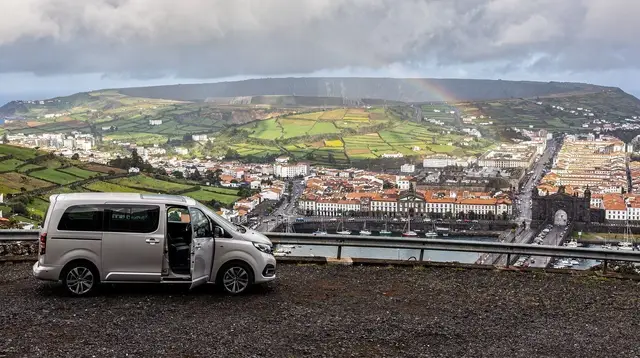
Start with what you can mostly stop worrying about. Petty theft, pickpocketing and violent crime are all uncommon across the Azores, including in the two largest towns, Ponta Delgada on São Miguel and Angra do Heroísmo on Terceira. Rental cars and unattended bags at trailheads occasionally go missing, so don’t leave valuables visible through a car window at a remote miradouro or trilho car park — that’s an opportunistic-theft risk found anywhere tourists park and hike out of sight, not an Azores-specific one.
Walking around after dark in the main towns doesn’t carry any particular documented risk beyond ordinary city-sense precautions. Festival periods — the Divino Espírito Santo celebrations on Terceira, for instance, or Sanjoaninas — bring larger crowds and the kind of bag-watching vigilance that applies at any busy outdoor event anywhere. None of this is what should shape your packing list or your itinerary. What should is the section below.
The Real Risk Is Environmental, Not Urban
The Azores sit in the middle of the North Atlantic, on volcanic terrain barely a few hundred thousand years old in places, and the two forces that built these islands — weather systems and ocean swell — are also what generates almost every real safety incident visitors encounter. Three things recur:
- Fog that arrives faster than it looks on a forecast, especially on mountain and crater roads above roughly 400–500 metres.
- Ocean swell at natural pools and unsupervised coastal spots that can rise with no lifeguard, no flag system and little warning.
- Cliff edges and coastal viewpoints without guardrails, common across all nine islands’ miradouros and crater rims.
None of these should keep you away. They should shape how you drive, when you swim, and how close you stand to an edge for a photo. Local proverb sums up the underlying cause well: the Azores can deliver “four seasons in one day,” and most of the risk below traces back to exactly that unpredictability. For the seasonal pattern behind it, see best time to visit the Azores and the month-by-month breakdown in Azores weather month by month.
Driving: Fog, Narrow Roads and Free-Roaming Cattle
A rental car is close to essential for exploring any single island in depth — see driving in the Azores and car rental in the Azores for the practical basics. The safety issue isn’t the roads themselves so much as three predictable hazards layered on top of them:
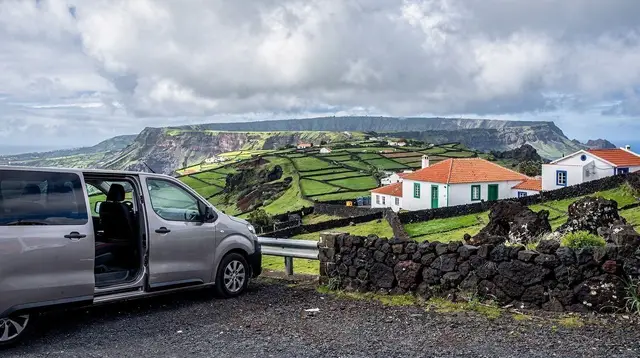
- Fog at altitude. Roads climbing toward crater rims and viewpoints — around Lagoa do Fogo, the upper routes on Pico and São Jorge, and the Serra de Santa Bárbara on Terceira — can go from clear to near-zero visibility within minutes. Slow down, use headlights, and if visibility drops sharply, pull over safely rather than continue at speed.
- Narrow, unlit rural roads. Many secondary roads are single-lane with passing bays, unlit at night, and edged by low or absent barriers above drops. Night driving on unfamiliar rural roads is worth avoiding where you can.
- Free-roaming cattle. Cows on the road, particularly on upland pasture routes on São Jorge, Pico, Terceira and inland São Miguel, are a genuine and recurring hazard, not a postcard cliché — slow well in advance of blind bends on rural stretches.
If you’d rather hand the fog-prone highland driving to someone who already knows every bend, a guided 4WD tour through the Furnas highlands is a straightforward way to see the crater roads without doing the driving yourself.
Natural Pools, Coastal Rocks and the Ocean
This is the single biggest gap between how the Azores look and how they behave. Calm, glassy natural pools carved into black lava rock — at natural swimming pools across the archipelago — sit directly on the open Atlantic coastline in most cases, with no lifeguard, no flag system and no barrier separating a sheltered-looking pool from incoming ocean swell. A pool that looks flat can take a wave over its rim within a single set, particularly on north-facing coasts and in the hours around high tide.
Practical rules that cover most of the real risk:
- Never turn your back on the sea at a coastal pool, even a well-known and popular one.
- Check for posted warnings or closed access — some pools close entirely during high-swell periods.
- Wet volcanic rock is far more slippery than it looks; footwear with grip matters more here than at a typical beach.
- If a spot has no other visitors and no clear access path, that’s usually a sign to look elsewhere rather than a discovery.
The same caution extends to the archipelago’s black-sand and rock beaches — see best beaches in the Azores — where currents and undertow can be stronger than the calm surface suggests. For visitors who want ocean time with a trained instructor managing entry and exit points rather than judging conditions solo, a beginner surf lesson with an instructor is a lower-risk way to get in the Atlantic than paddling out on an unfamiliar break alone.
Boat-based activity carries a different, generally lower risk profile, since licensed operators monitor sea state professionally before departure. Whale watching (see whale watching in the Azores and the broader Azores boat tours guide) and evening trips such as a sunset boat tour put an operator’s judgment between you and the open water, which is exactly the trade-off worth making if you’re unsure how a given day’s swell will behave.
Coasteering and Guided Water Activity
Because so much of the coastline is exposed rock and open swell, one of the more reassuring ways to experience it — rather than avoid it — is with a licensed operator who supplies safety equipment, reads the swell in real time, and chooses entry and exit points accordingly. A guided coasteering session along the São Miguel coast covers cliff-jumping, swimming and scrambling sections of coastline that would be genuinely risky to attempt solo, with a certified guide making the calls a first-time visitor can’t.
Cliffs, Miradouros and Crater Rims
Portugal doesn’t mandate guardrails at every scenic viewpoint, and the Azores’ volcanic geography produces a lot of dramatic, unfenced edges — crater rims, coastal miradouros, and the upper reaches of hiking trails alike. This is worth flagging plainly for families: children should be kept well back from any edge without a barrier, and the “great photo” instinct to step closer than the path suggests is the most common way visitors get hurt at a viewpoint anywhere in the world, the Azores included. Fog compounds this risk at altitude — a rim that’s obvious in clear weather can become disorienting in cloud with almost no notice.
Hiking Safety
Most of the marked trilhos across the islands — covered in best hikes in the Azores and the trail-difficulty context in Azores trail grading explained — are well maintained and moderate in difficulty. The routes that call for more caution tend to be those along unfenced crater rims or exposed coastal cliffs, including sections through the São Jorge fajãs, where trails descend steep, sometimes slippery paths between the plateau and the coastal fajã platforms below.
The ascent of the Montanha do Pico deserves a specific note: it’s a regulated, quota-controlled climb requiring registration through the Casa da Montanha and issued with a GPS tracker, precisely because fog and weather changes at altitude have made unguided attempts genuinely hazardous in the past — see climbing Mount Pico for the registration process. Treat that regulation as a safety measure, not paperwork.
General hiking precautions that matter more here than in drier hiking destinations: check the forecast the morning of, not the night before; carry a charged phone even on short routes, since fog can turn a familiar trail disorienting fast; and tell someone — a host, a guide, a hiking partner — which route you’re taking and roughly when you expect to finish.
Emergency Numbers and What They Cover
| Number | Covers | Notes |
|---|---|---|
| 112 | Police, fire, ambulance — the single European emergency number | Works from any phone, including without a local SIM; used identically across mainland Portugal and the Azores |
| 112 (ask for maritime/coastal rescue) | Sea rescue, coastal incidents | Portuguese maritime authorities coordinate through the same 112 line |
| Local health centre or hospital | Non-emergency medical needs | Covered separately in Azores health and pharmacies, not detailed here |
Save 112 in your phone before you land, and know that it functions the same way across every one of the nine islands, from Ponta Delgada to Corvo. Because the outer islands — Flores, Corvo, Graciosa — have far thinner medical infrastructure than São Miguel, response times for a serious incident there will naturally be longer; that’s a fact worth factoring into how cautiously you approach any borderline-risky activity on the smaller islands specifically.
A Quick Risk Snapshot by Activity Type
| Activity type | Typical real risk | How to reduce it |
|---|---|---|
| Walking in towns, day or night | Low | Ordinary city-sense precautions |
| Driving rural/mountain roads | Moderate | Slow down in fog, watch for cattle, avoid unfamiliar roads at night |
| Unsupervised natural pools | Moderate to high in swell | Check conditions, never turn your back on the sea |
| Guided boat tours (whale watching, sunset cruises) | Low | Operator manages sea-state decisions |
| Unfenced viewpoints and crater rims | Moderate | Keep well back from edges, especially with children |
| Hiking marked trails in clear weather | Low to moderate | Check forecast, turn back if fog sets in |
| Solo coasteering or cliff jumping | High without a guide | Book a licensed guided session instead |
Traveling With Kids: What Actually Needs Watching
Family travel in the Azores is genuinely well suited to relaxed, low-crime destinations — see Azores with kids and Azores family-friendly activities for what works well. The safety-specific advice narrows to two things: keep children back from natural pool edges when swell is up, since a wave can arrive with almost no warning, and keep them well clear of any unfenced viewpoint or crater rim, where a step back for a photo is the realistic accident scenario.
A half-day activity built around supervised interaction with animals rather than open water or heights — such as the sunset boat tour mentioned above, or a farm-based outing — is an easy way to fill a day with lower objective risk than a coastal scramble.
Packing and Preparation That Reduce Real Risk
A short packing list genuinely reduces the environmental risks covered above, more than any urban-safety habit would: sturdy, grippy footwear for wet volcanic rock, a light waterproof layer for the “four seasons in a day” pattern, and a fully charged phone with offline maps downloaded before you head into an area with patchy signal. The full version of this list is in Azores packing list; for connectivity specifically, see Azores SIM cards and internet, since a working phone is one of the more effective safety tools you can carry on a fog-prone mountain road or an isolated trilho.
The Bottom Line
The Azores are not a dangerous destination by any conventional measure — crime rates confirm that clearly, and nothing in this guide changes it. What deserves real attention is the same volcanic, oceanic geography that makes the islands so striking: fog that can close in over a mountain road within minutes, natural pools that sit unguarded against open Atlantic swell, and viewpoints with no barrier between you and a long drop. Respect those three things specifically — slow down in cloud, never turn your back on the sea, and keep a sensible distance from unfenced edges — and the Azores are exactly as safe as their calm, green reputation suggests.
Trip-planning essentials on GetYourGuide
Verified deep-linked GetYourGuide tours. Book through these links and we earn a small commission at no cost to you.
GetYourGuide does not provide a product photo for this activity — the image shows the meeting point, photographed by us.