Best Beaches in the Azores: Where to Actually Find Sand
Which Azores island has the best beaches?
Santa Maria is the only island with an extensive stretch of pale, golden sand, at Praia Formosa, because it is the archipelago's oldest and driest island. Elsewhere the Azores are young and volcanic: São Miguel has a few black sand beaches, and on most of the other seven islands swimming means natural pools cut into lava rock rather than a sandy shore.
Sand Is the Exception, Not the Rule
Photos of the Azores travel well online, and a fair number of them show pale sand, turquoise water, and a beach chair. It is easy to come away assuming that is what most of the archipelago looks like at the coast. It isn’t. These are nine young volcanic islands sitting on the join of three tectonic plates, and volcanic islands generally do not manufacture soft, pale sand quickly. What they do produce, in abundance, is lava rock, and lava rock does not erode into a beach overnight.
That single fact reshapes how you should plan a “beach day” anywhere in the Azores except one island. If a classic sand beach is the goal, there is really one answer, one island where it exists at meaningful scale. Everywhere else, “swimming spot” more often means a natural pool cut into rock than a stretch of sand you can lay a towel on. This page walks through the comparison directly: Praia Formosa on Santa Maria, the black sand beaches of São Miguel, and what “beach” actually means on the other seven islands, so you don’t build a beach-focused day around an island that can’t really deliver one.
Praia Formosa: Where the Azores Actually Look Like a Postcard
Praia Formosa sits on Santa Maria, the southernmost and geologically oldest island in the archipelago, and it is the closest thing the Azores have to a conventional sand beach. The sand here is genuinely pale and golden rather than the dark volcanic grey or black found almost everywhere else in the region, and the beach runs long enough to feel like an actual beach outing rather than a cove squeezed between cliffs.
The reason Praia Formosa exists at all comes down to Santa Maria’s age and climate. It is the oldest island in the Azores geologically, and also the driest and sunniest, with a noticeably different feel from the younger, wetter, greener islands further north and west. Older rock has had far longer to weather down into fine, light-coloured sediment, and a drier climate with less dramatic volcanic activity has let that process run largely undisturbed. On a young, still-active island like Pico or Faial, the coastline simply hasn’t had the same stretch of calm geological time to turn lava into sand.
Practically, this makes Santa Maria the island to prioritise if a real beach day, not a rock pool afternoon, is the point of your trip. It pairs naturally with the island’s reputation as the driest and most reliably sunny corner of the Azores, though as with everywhere in this archipelago, no single day of good weather is ever guaranteed. If you’re weighing whether a dedicated trip to Santa Maria is worth it against staying on São Miguel, that comparison deserves its own look at which Azores island to visit and how a short Santa Maria itinerary fits around a São Miguel base.
Why São Miguel’s Beaches Are Black, Not White
São Miguel is the largest, most populated, and most visited island in the Azores, and it does have real sand beaches, not just rock pools. The difference from Santa Maria is the colour and origin of that sand: São Miguel is younger and still volcanically active in the geological sense, so its beaches are made of dark volcanic sand rather than the pale, weathered sand at Praia Formosa.
Praia do Pópulo, close to the capital Ponta Delgada, is the most convenient example: a genuine sandy beach with the dark grain typical of São Miguel, easy to reach without a long drive if you’re based near the capital. A short guided outing built around exactly this stretch of coast, the Praia do Pópulo beach tour near Ponta Delgada, is a straightforward way to see it without renting a car for the day.
Further along the coast, Mosteiros is known for its own black sand beach, backed by dramatic sea stacks and cliffs on São Miguel’s west coast, a striking setting even if the water can be more exposed than on the sheltered south coast.
Black sand beaches are a real, recommendable option on São Miguel, and they’re worth building into a coastal day if you’re on this island rather than travelling on to Santa Maria. Just don’t expect them to look like Praia Formosa. The colour difference is not a quality difference, but it is a real difference, and expecting pale sand on São Miguel is the single most common mismatch between what visitors picture and what they find.
Vila Franca do Campo: A Beach-Shaped Crater, Not Quite a Beach
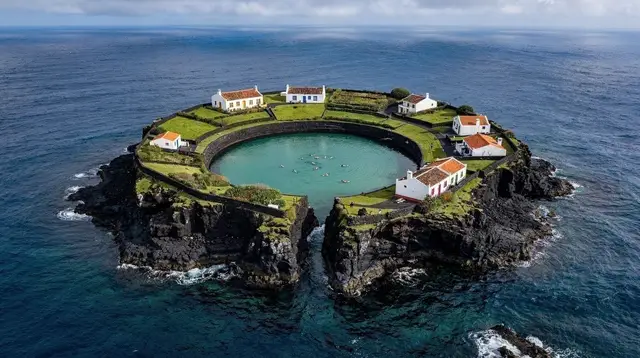
One São Miguel spot gets photographed constantly and is often mistaken for a beach: the islet off Vila Franca do Campo, a short boat ride from the harbour on the south coast. It is a small, roughly circular islet that is, in effect, the rim of a former volcanic crater, with a pool of seawater sitting inside it. In calm summer conditions it becomes a natural swimming lagoon, sheltered from the open Atlantic swell in a way the mainland coast rarely is.
It’s worth being precise about what this place is and isn’t, because the photos oversell the “beach” part. There is little to no long stretch of sand here; you’re mostly dealing with rock, a shallow sheltered pool, and boat access that tends to run only in the warmer months rather than year-round. It belongs in a different mental category from Praia Formosa or Praia do Pópulo: closer to a natural pool experience than a beach day, even though it’s most often marketed and photographed as if it were the latter.
If this kind of sheltered volcanic swimming spot is what actually appeals to you, rather than sand specifically, it’s worth reading the dedicated Vila Franca islet guide and the broader guide to the Azores’ natural swimming pools, which covers this style of site across the archipelago in far more depth than this comparison does.
What “Swimming” Means on the Other Seven Islands
Once you move past São Miguel and Santa Maria, the picture changes again. Terceira, Pico, Faial, São Jorge, Flores, Corvo, and Graciosa are all steep, young, volcanic islands where the coastline drops fairly abruptly into the Atlantic. Long stretches of sand are rare to nonexistent on most of them. What you find instead is a swimming culture built entirely around natural pools, called piscinas naturais locally: seawater pools formed where old lava flows meet the ocean, sometimes with concrete access ladders and changing areas added, sometimes left completely wild.
This isn’t a lesser version of a beach day, just a different one, and treating it that way changes how you should pack and plan. Water shoes matter more than on a sand beach, since the rock underfoot can be sharp and uneven. Swell and tide matter more too, since these pools can go from calm to rough with the kind of fast weather shift the Azores are known for. If natural pools, rather than sand, are genuinely what you’re after on this trip, that subject deserves its own dedicated read rather than a summary here, so see the full Azores natural swimming pools guide for specific sites island by island.
For an active alternative to simply swimming, several of these islands also lend themselves well to guided coastal activity that doesn’t depend on finding sand at all. A route like the São Miguel coasteering trip along the volcanic coastline works precisely because it’s built around rock, cliffs, and pools rather than a beach, and a beginner surf lesson on one of São Miguel’s beach breaks makes good use of the archipelago’s dark sand beaches where they do exist, without expecting them to be something they’re not.
Beach Type by Island: A Quick Comparison
| Island | What you’ll actually find | Sand colour | Best suited for |
|---|---|---|---|
| Santa Maria | Extensive sand beach (Praia Formosa) | Pale, golden | A genuine beach day |
| São Miguel | Sand beaches (Praia do Pópulo, Mosteiros) plus one crater-pool islet | Dark, volcanic | Beach day close to the capital |
| Terceira | Natural rock pools | No sand beaches of note | Sheltered pool swimming |
| Pico, Faial | Natural rock pools | No sand beaches of note | Pool swimming, boat and coastal activity |
| São Jorge | Natural pools inside fajãs | No sand beaches of note | Pool swimming with dramatic scenery |
| Flores, Corvo, Graciosa | Natural rock pools, crater lakes inland | No sand beaches of note | Pool swimming, scenery over sand |
This table is a starting point, not a substitute for planning: exact conditions change with the season and with each stretch of coast, and some of these islands have far more swimmable rock pools than others. Treat “no sand beaches of note” as a planning cue to look up pools rather than a claim that these islands aren’t worth a coastal day.
Choosing Your Island for a Beach Day
If a sand beach is genuinely the point, the honest answer is Santa Maria first, São Miguel second, and the rest of the archipelago only if you’ve recalibrated to expect rock pools instead of sand. That doesn’t make the other seven islands worse for a coastal day, only different, and for many visitors the volcanic pools, dramatic cliffs, and fajã landscapes end up being the more memorable part of the trip regardless of the sand question.
A few sequencing notes worth building into your itinerary. If you’re spending most of your trip on São Miguel and only have a day or two to spare, a three-day São Miguel itinerary can realistically include both a black sand beach morning and a boat trip past the Vila Franca islet without feeling rushed.
If a genuine sand beach day matters enough to justify the extra flight, treat Santa Maria as a short, focused add-on rather than trying to combine it with a full island-hopping route; the three-day Santa Maria itinerary is built around exactly that kind of trip. And if you’re still deciding how to split time across islands at all, how many days you actually need in the Azores and the broader which island to visit comparison are the better starting points than this page.
Practical Notes for an Azores Beach Day
Timing matters more here than at most beach destinations. Summer, roughly June through September, gives the calmest seas and the best odds of the kind of sunny, still day a beach outing needs, though the Azores’ famous “four seasons in one day” pattern means even a summer morning can turn on you. Check the forecast the same day you plan to go rather than the night before, and have a rock-pool or indoor backup in mind regardless of the season; the general best time to visit and month-by-month weather guides cover this pattern in more depth than a beach-specific page needs to.
A rental car is close to essential if you want to reach more than one beach or pool in a day, since public transport between coastal spots is limited and each island’s rental fleet is separate from the others; see the guide to renting a car in the Azores before you commit to a route. Pack reef-safe sunscreen, a light rash guard for the rock pool sections of any coastal day, and water shoes even if your main destination is a sand beach, since getting into the water on most Azorean coastlines still means a few steps over volcanic rock first.
If you’d rather see the coastline from the water than stand on it, a low-effort alternative to a strict beach day is a boat trip along the shoreline. Both the Azores sunset boat tour along the coast and general fishing trips like a fishing excursion off the Azores coast give you the same dramatic volcanic coastline that makes swimming here distinctive, without needing a single stretch of sand to make the outing worthwhile.
Common Questions About Azores Beaches
Is there a white sand beach in the Azores?
Not white in the Caribbean sense, but Santa Maria’s Praia Formosa comes closest, with pale golden sand rather than the black volcanic grains found on São Miguel. It is the only beach of this kind at any real scale in the archipelago.
Why does Santa Maria have sand and the other islands don’t?
Santa Maria is the geologically oldest and driest Azorean island, which has given its coastline far longer to break down into a genuine sandy beach. The other eight islands are younger and more actively volcanic, so their shorelines are mostly raw lava rock or black volcanic sand rather than eroded pale sand.
Are there black sand beaches in the Azores?
Yes, mainly on São Miguel, where beaches such as those near Mosteiros and Praia do Pópulo near Ponta Delgada sit on dark volcanic sand rather than pale sand. They look and feel different from Santa Maria’s Praia Formosa but are genuine sandy beaches, not rock pools.
Is Vila Franca do Campo islet a beach or a pool?
It is closer to a natural swimming lagoon than a beach: a small islet off São Miguel’s south coast with a pool of seawater inside a former volcanic crater, reached by boat and usually only accessible in the warmer months. It has no long stretch of sand, so plan for rock and shallow water rather than a beach towel afternoon.
Can you swim in the ocean on Pico, Faial or São Jorge?
Yes, but almost always in natural pools cut into lava rock rather than on sand, since these central-group islands are steep, young, and volcanic to the shoreline. It is a different style of swimming spot, worth planning for rather than expecting a beach.
Which island should I pick for a beach holiday in the Azores?
Santa Maria is the clear choice if a sandy beach day is the priority, thanks to Praia Formosa. São Miguel is the practical alternative if you also want easy flight connections, with black sand beaches as a bonus rather than the main event.
Is Praia Formosa sand actually white?
It reads as pale golden sand in most light rather than bright white, closer to a mainland Portuguese beach than a tropical one. It is still the lightest, most conventional-looking sand anywhere in the Azores.
When is the best time of year for Azores beaches?
Summer gives the calmest seas and the best odds of dry, sunny weather for a beach day, though the Azores’ fast-changing weather means no day is guaranteed. Outside July and August, expect more wind and cloud, which matters more on an exposed sand beach than in a sheltered rock pool.
tours.beaches-natural-pools
Verified deep-linked GetYourGuide tours. Book through these links and we earn a small commission at no cost to you.
GetYourGuide does not provide a product photo for this activity — the image shows the meeting point, photographed by us.