Azores in Autumn: Weather, Crowds and What to Expect
Is autumn a good time to visit the Azores?
Yes, especially September, which keeps summer-like warmth with noticeably fewer visitors and lower prices. October cools gradually and stays workable for hiking, while November brings a sharp rise in rainfall and shorter daylight, so it suits travelers who accept more indoor days in exchange for quiet trails and green scenery.
Why autumn is the quiet season worth considering
Most first-time visitors default to July or August because that is when the Azores photos circulating online were taken: green craters under a blue sky, boats heading out for whale watching, hydrangeas lining the roads. What those photos don’t show is the volume of people booking the same tours, the same rental cars, and the same restaurant tables at the same time. Autumn, running roughly from September through November, is the trade-off season: you give up some warmth and daylight in exchange for thinner crowds, easier bookings, and lower prices, without losing the archipelago’s defining feature — a landscape that stays green because there is no real dry season here.
This guide focuses specifically on that three-month window and how it changes through the season, not on the full year (see Azores weather month by month for that) and not on the other seasons individually (see Azores in spring, Azores in summer and Azores in winter). If you are trying to decide between autumn and the summer peak, this is the comparison to read.
September: still summer, minus the crowds
September is, for most travelers, the sweet spot of Azorean autumn. Air and sea temperatures are still close to August’s, days remain long enough for full outings, and the archipelago’s ever-present cloud cover is no worse than in summer. What changes is the volume of people: school holidays end across Europe, and the islands that felt busy in August, particularly São Miguel around Ponta Delgada and Sete Cidades, noticeably quieten down.
This is also usually the last realistic month to catch any lingering hydrangea color, though by September the peak bloom of June-July has generally passed and many roadside hedges are past their best (see Azores hydrangeas guide for the full bloom calendar). Hiking conditions in September are close to ideal: trails are dry enough after summer, temperatures are comfortable for exertion, and the landscape is still fully green, since the Azores’ Gulf Stream-moderated climate doesn’t have a dry season the way the Canary Islands or Madeira do.
October: the turning point
October is where the season visibly shifts. Daytime temperatures ease further, rainfall becomes more frequent, and the days get shorter at a faster clip. It is still a workable month for most outdoor plans — hiking trails remain in good shape and the landscape hasn’t lost its green — but it rewards travelers who build flexibility into their itinerary rather than locking every day to a fixed outdoor plan.
This is a reasonable month to combine outdoor time with more sheltered options. A dairy farm tour or a half-day exploring a museum or historic town works well as a fallback when a front rolls through. If you want a full day built around the water while conditions are still cooperative, an evening boat trip along the coast is a good way to use the still-mild October evenings before the season turns further toward November’s shorter days.
November: rain increases, daylight shortens
November is the clearest departure from summer. Rainfall rises sharply compared to September and October, fronts move through more frequently, and daylight hours shrink noticeably at this latitude. It is not a month to plan around outdoor activity as the backbone of every day — indoor and semi-sheltered options need to be built in from the start, and inter-island transport becomes less predictable, particularly ferry links beyond the reliable Pico-Faial-São Jorge triangle.
This guide does not attempt to detail November’s specific weather patterns day by day; for that level of detail see The Azores in November. What matters for planning purposes here is the broader shift: November sits at the wetter end of the year, and travelers who come expecting September conditions will be caught off guard.
Autumn at a glance: September vs October vs November
| September | October | November | |
|---|---|---|---|
| Typical feel | Warm, summer-like | Mild, cooling | Cool, wetter |
| Rainfall trend | Moderate | Increasing | Highest of the three |
| Daylight | Long | Shortening | Shortest of the three |
| Crowd level | Moderate, thinning from August | Low | Low |
| Prices | Easing from peak | Lower | Lowest of the three |
| Hiking conditions | Very good | Good, more variable | Workable, muddier at altitude |
| Landscape | Green | Green | Still green |
Prices and crowd levels are relative descriptions of the season’s trend, not fixed figures — always check current rates before booking.
Hiking in autumn: still green, but pack for rain
One of the more counterintuitive facts about the Azores is that the landscape looks essentially the same in November as it does in July. There is no dry season here to brown out the hillsides, so crater lakes, fern-lined trails and volcanic ridgelines stay green through the whole of autumn. That’s a real advantage over destinations where late-year travel means a faded landscape.
What does change is underfoot conditions and visibility. Trails that were dusty and firm in August can turn muddy by October, and fog at altitude — already a feature of São Miguel, Pico and São Jorge in any season — becomes more frequent as autumn fronts move through. Waterproof boots, a proper rain shell, and a realistic expectation that a planned crater-rim walk might need to be swapped for a lower, sheltered trail at short notice will serve you better than assuming summer conditions. If a full week of trail time is the goal, autumn works, but check current trail advisories on the day rather than planning purely from a forecast made days in advance.
Whales and dolphins in autumn: resident species, not the spring peak
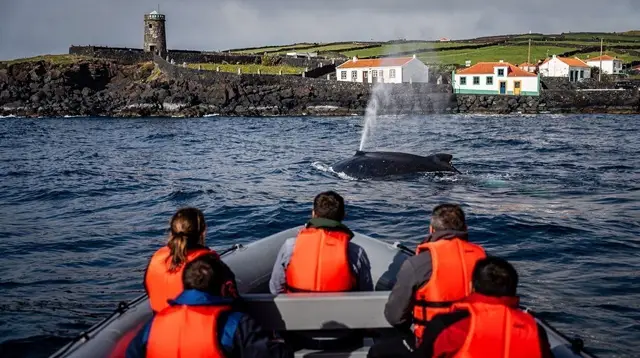
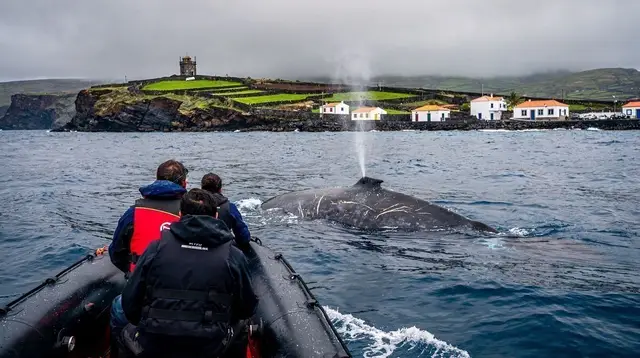
It’s tempting to assume that any month with boats still running for whale watching is peak season, but that’s not accurate for autumn. The Azores’ resident species — sperm whales, common dolphins, bottlenose dolphins and Risso’s dolphins — are seen through much of the year, autumn included, and operators do run trips throughout the season.
What autumn does not offer is the passage of the great migratory whales: blue whales, fin whales and sei whales move through the archipelago mainly in spring, not autumn, so anyone specifically hoping to see those larger migratory species should look at a spring trip instead (see whale season in the Azores for the full calendar).
None of this means autumn is a poor season for a boat trip. Sperm whales are sighted across much of the year, and a calmer, less crowded boat with fewer other vessels competing for the same sighting is a genuine upside of traveling outside summer. Combining a whale watching trip with a broader look at the coastline works well; a half-day fishing trip off São Miguel is a good alternative on days when the sea state favors a shorter, calmer outing over a full watching excursion.
What slows down, and what stays open
Autumn is not a shutdown season — restaurants, tour operators and attractions on the main islands operate close to their full schedule through September and October, with some easing of hours by November on the smaller islands. What does change is the margin for error: fewer daily departures on some boat tours, more weather-dependent cancellations as the season advances, and smaller islands like Flores and Corvo seeing their ferry and flight links become noticeably less reliable than in the June-September window.
If your itinerary depends on a specific activity happening on a specific day, book it in advance and build a backup day around it. A land-based alternative such as an off-road tour through the Furnas valley is a useful way to keep a day productive even if a boat excursion gets postponed for weather.
Which island suits an autumn trip best
Not every island handles the shift toward autumn the same way. São Miguel and Terceira have the widest range of activities and the most resilient flight schedules, which matters more once fronts start moving through in October and November. Pico and Faial, connected by the reliable Madalena-Horta ferry, remain a solid pairing through the season.
The western group, Flores and Corvo, is the part of the archipelago most exposed to autumn’s rougher seas and less frequent transport links, so an autumn visit there benefits from extra flexibility in the schedule (see which Azores island to visit for a fuller comparison).
A day built around Pico’s volcanic landscape and vineyards still works well in autumn light. If you want a guided overview of the island’s wine terraces and lava-rock currais without committing to a full independent itinerary, a guided day tour of Pico covers the highlights in a single outing, with enough flexibility built in to adapt to the day’s conditions.
Packing and planning notes for autumn
A rain shell, layers, and waterproof footwear matter more from October onward than they do in July. Daylight hours shrink through the season, so outdoor plans that assumed a long summer evening need to shift earlier. Car rental remains close to essential for exploring any island beyond its main town (see car rental in the Azores and driving in the Azores), and booking key activities a few days ahead is still worthwhile even in the quieter months, since some operators reduce their daily frequency as the season advances.
For a broader seasonal comparison across the whole year, including how autumn stacks up against winter’s lower prices and spring’s whale migration, see best time to visit the Azores.
FAQ: visiting the Azores in autumn
Is September a good month to visit the Azores?
September is often the best compromise of the year: sea and air temperatures are close to August’s, crowds have thinned since the summer peak, and accommodation prices start to ease. Rain is still relatively infrequent compared to what follows in November.
How much does it rain in the Azores in autumn?
Rainfall increases steadily through the season. September and October are moderate, while November is one of the wetter months of the year across the archipelago, with more frequent fronts and shorter, cloudier days.
Can you see whales and dolphins in the Azores in autumn?
Yes, but autumn is not the peak season for the great migratory whales. Resident species such as sperm whales and several dolphin species are seen year-round, while the blue, fin and sei whales that pass through the Azores migrate mainly in spring, not autumn.
Are the hydrangeas still in bloom in autumn?
Rarely by the time autumn arrives. Hydrangeas peak in July and August and are usually fading or finished by September, so travelers chasing that specific view should look at a summer trip instead.
Is October or November better for visiting the Azores?
October is the more reliable of the two, with milder weather and trails still in good shape. November brings noticeably more rain and wind, more disrupted inter-island ferries, and shorter daylight, so it favors flexible itineraries over tightly packed ones.
Do hotel and tour prices drop in the Azores in autumn?
Yes, generally. Rates on accommodation and some tours ease once the July-August peak passes, with September still busy in places but noticeably less pressured than summer, and prices continuing to soften into October and November.
Is hiking still good in the Azores in autumn?
Yes. The islands stay green well into autumn since the climate does not have a dry season, so crater lakes, coastal trails and volcanic landscapes still look lush. Trails can be muddier and foggier at altitude, especially in November, so waterproof layers and good footwear matter more than in summer.
Which Azores islands work best for an autumn trip?
São Miguel and Terceira are good choices because they have the most reliable flight schedules and the widest range of indoor and outdoor options if weather turns. Inter-island travel to the western group (Flores and Corvo) becomes less predictable as autumn advances, so build in flexibility if those islands are on the plan.
Seasonal experiences on GetYourGuide
Verified deep-linked GetYourGuide tours. Book through these links and we earn a small commission at no cost to you.
GetYourGuide does not provide a product photo for this activity — the image shows the meeting point, photographed by us.