The Azores in Winter: What to Really Expect (Dec-Feb)
Is winter a bad time to visit the Azores?
No, but it is a different trip. December to February brings mild temperatures, usually not below 10°C, with the real challenge being frequent wind and rain rather than cold. Expect lower prices, thinner crowds, some tours running fewer days per week, and the western ferry network occasionally suspended by swell.
Mild, Wet and Windy: The Real Winter Picture
December, January and February are the Azores’ quietest months, and also its most misunderstood ones. Ask most travellers what “winter in the Atlantic” sounds like and they picture frost, short grey days and a coat you never take off. That is not what happens here. The Gulf Stream keeps the nine islands within a narrow temperature band all year, and winter daytime highs in São Miguel, Terceira or Pico usually sit in the low-to-mid teens Celsius, rarely dipping below 10°C even overnight. The islands do not get cold. What they get is wet and windy, and that distinction should shape every decision in your itinerary far more than the temperature does.
This page is about that specific three-month window and the practical trade-offs it brings: softer prices, thinner crowds, a genuine chance of whale watching in rougher water, ferries that occasionally stop running, and the complete absence of the flowering hydrangeas the islands are known for in photos.
If you want the month-by-month breakdown across the full year, that lives in our weather by month guide; if you are still choosing when to go at all, our best time to visit guide compares every season side by side. Here, the question is narrower and more useful if winter is already the season you are looking at: what actually happens on the ground, and what should you plan around.
Temperature vs. the Real Constraint
The numbers are reassuring. Across the archipelago, winter daytime temperatures typically run from around 13 to 17°C, cooling only a few degrees at night. Even Pico and the more exposed western islands rarely see anything close to a frost at sea level. Pack layers for wind, not a heavy winter coat for cold.
What winter does bring is the region’s highest concentration of Atlantic frontal systems: fast-moving bands of wind and rain that can turn a bright morning into a downpour within the hour, then clear again by lunch. The Azorean saying about “four seasons in one day” applies year-round, but it is at its most literal from November through February, when successive fronts roll through in quick succession. Humidity and cloud cover are also at their highest in this window, and November to February statistically holds the wettest weeks of the year, while July and August are the driest, without ever being guaranteed dry.
The practical upshot: build slack into each day rather than a tight back-to-back schedule, keep a rain-friendly plan B for every outdoor block, and do not judge the whole day by the sky at 8am. Our rainy day activities guide is worth bookmarking before you land, and a proper shell jacket does more work here than an extra jumper — see our packing list for the full rundown.
What Runs, What Doesn’t, and What Runs Less Often
Winter does not shut the Azores down, but it thins the schedule. Whale-watching boats, coasteering trips, sunset cruises and jeep tours all continue to operate, run by local skippers and guides who read the swell and wind forecast day by day rather than following a fixed summer timetable. The difference is frequency and certainty: a tour that departs multiple times daily in July might run once a day, or skip a day entirely, in January if conditions call for it.
This matters for how you book. A same-day walk-up that works in August is a riskier bet in winter — operators consolidate departures and cancel outright more readily when the sea is too rough for a comfortable, safe trip. Booking ahead online gives you a confirmed slot and, with most local operators, the ability to rebook or refund if the weather closes the window entirely.
A few winter-friendly options worth building a day around:
a half-day sport-fishing trip out of São Miguel, which runs on calmer winter mornings and gets you onto the Atlantic without depending on flat-calm conditions the way a small tender does.
an Azores sunset boat tour for an easier, shorter outing when a full-day excursion feels like too much of a weather gamble.
a half-day dairy farm visit, a largely indoor-and-covered option that keeps a day productive even under grey skies.
a Furnas 4WD tour on São Miguel, which pairs sightseeing with the thermal valley’s hot pools — a genuinely pleasant way to spend a damp winter afternoon.
Ferries: The Triangle Holds, the Rest Doesn’t
Inter-island travel is where winter planning most needs a second look. Atlânticoline’s ferry network does not run at one uniform level of service across the year, and the gap between islands widens sharply in winter.
The Pico-Faial-São Jorge triangle — anchored by the roughly 30-minute Madalena-Horta crossing — runs year-round, several times a day, and is the one link in the network you can plan around with real confidence in December or February. See our dedicated inter-island ferries guide for current timetables.
Everything else contracts. The wider central-group network that also reaches Terceira and Graciosa operates only from June to September, so a winter visitor wanting to combine those islands by boat with the triangle simply cannot — flights are the only option outside that window. The western group, linking Flores and Corvo, is the most exposed stretch of water in the archipelago and the most likely to be cancelled by winter swell, sometimes for several consecutive days. If Corvo is on your list for a winter trip, build in a buffer day either side and do not schedule a same-day return flight immediately after a planned crossing.
Flights fill the gap the ferries leave in winter. SATA Air Açores runs the regular inter-island network to all nine islands, with the busiest routes — Ponta Delgada to Terceira, Pico, Horta and Flores — reinforced in peak season and thinner in winter, though still operating. Long-haul and mainland connections run on Azores Airlines, and it is worth noting that direct links from Pico and Faial to Lisbon are seasonal rather than year-round, which can affect how you route a winter multi-island trip. Our SATA inter-island flights guide and driving in the Azores guide cover the logistics once you land.
| Route or link | Winter status |
|---|---|
| Pico - Faial (Madalena-Horta) | Runs year-round, multiple daily sailings |
| Pico - Faial - São Jorge triangle | Reliable year-round core network |
| Central group incl. Terceira, Graciosa | Ferries June-Sept only; fly the rest of the year |
| Flores - Corvo (western group) | Most swell-sensitive link; can be suspended for days |
| SATA inter-island flights | Run year-round; busiest routes reinforced in summer |
| Pico/Faial direct to Lisbon | Seasonal, not guaranteed in winter |
Whale Watching: Possible, Not Guaranteed, Rougher
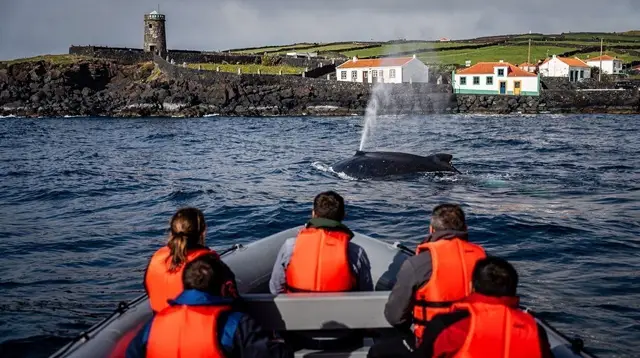
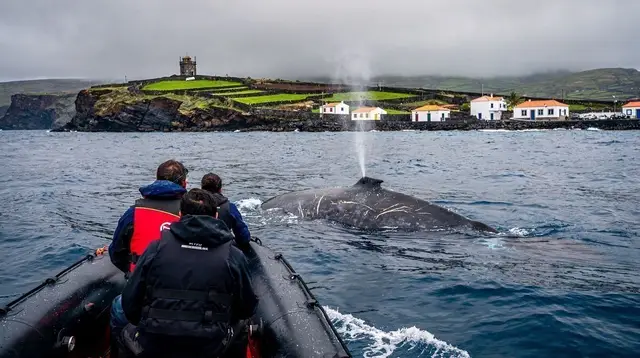
Winter does not close the whale-watching season, and this is one of the more genuinely underrated reasons to consider the Azores off-peak. Sperm whales, the archipelago’s signature resident species, are recorded in most months, alongside resident common and bottlenose dolphins. What changes in winter is sea state: swell is typically higher, boats spend more time working around it, and comfort on board drops compared with the flatter summer Atlantic.
Do not plan a winter trip around seeing the great migratory rorquals — blue, fin and sei whales pass through mainly in spring, from around April to June, not in winter. And no operator, in any season, promises a guaranteed sighting; year-round success rates run high but are never absolute. For the full seasonal breakdown of which species show up when, our whale season guide goes deeper than this page can, and our general whale watching guide covers how the trips themselves work, including the shore-based vigias that still spot for boats today.
If you do book a winter outing, choose an operator with a larger, more stable vessel over a small rigid inflatable if you are prone to seasickness, and treat a cancellation notice the morning of your trip as normal rather than a sign something is wrong — it usually means the crew judged the swell too rough for a safe or enjoyable trip, not that the season is over.
No Hydrangeas, and That’s Fine
If your mental image of the Azores is a lane lined with blue and pink hydrangea hedges, winter will not deliver it. The flowers begin appearing around May and June and reach full bloom in July and August, fading toward the end of summer. From December through February the hedgerows are simply green, dormant shrubs — not a failure of timing on your part, just outside the window entirely. Our hydrangea season guide covers exactly when to go if that bloom is the point of the trip; if it is not, winter loses nothing by comparison, since the islands’ volcanic scenery, crater lakes and coastline read just as dramatically green and lush without a single flower open.
The Case for Winter: Lower Prices, Thinner Crowds
The trade-off for wind, rain and a shorter activity calendar is cost and space. Accommodation rates across the islands soften outside the June-to-September peak, car rental — already close to essential for exploring any island in depth — is typically cheaper to book, and flights from mainland Europe can undercut summer fares by a wide margin. Popular viewpoints, restaurants and thermal pools that queue up in August are calm and easy to walk into in January. Our daily budget guide breaks down what a realistic winter-rate trip costs, and our week-long budget itinerary is built with exactly this season in mind.
One exception worth flagging: the last two weeks of December and the first days of January count as a local high season of their own, driven by Christmas and New Year travel and local festivities rather than the weather, so prices and availability tighten noticeably around the holidays even though it is still meteorological winter.
Which Island Works Best in Winter
Not every island handles a winter visit equally well, mostly because of the ferry and flight gaps described above. São Miguel is the easiest base: the best-connected airport in the archipelago, the deepest roster of activities that do not depend on calm seas — starting with the Furnas thermal valley — and no need to gamble on an inter-island crossing at all if you stay put.
A Pico-Faial-São Jorge combination works well too, since that triangle is the one ferry link that holds up reliably through the season. Terceira, Graciosa, Flores and Corvo are all still worth visiting in winter, but each one adds a flight-dependent or swell-dependent leg to the plan, so build in a spare day rather than a same-day connection either side of any inter-island hop. Our island-choosing guide can help you weigh a single-base winter trip against island hopping in more detail.
Booking a Winter Trip Without Overplanning It
The single most useful mindset for a winter Azores trip is to plan the destinations and book the logistics — flights, inter-island transport, key accommodation — well ahead, while leaving day-to-day activities loosely scheduled rather than locked to a strict hour-by-hour itinerary. A whale-watching trip, a boat tour or a coasteering session should be booked with an operator who confirms availability close to the date and offers a rebooking option, not treated as a fixed slot you build the rest of the day rigidly around.
A traditional boat sunset tour is a good example of a low-commitment outing to hold in reserve: short, flexible on timing within a given evening, and easy to reschedule a day if the wind is up. Pair one or two flexible bookings like that with a couple of indoor or covered anchors — a thermal pool afternoon, a museum, a tasting — and a winter Azores week reads less like a weather gamble and more like a quieter, cheaper version of the same trip everyone else takes in August.
Seasonal experiences on GetYourGuide
Verified deep-linked GetYourGuide tours. Book through these links and we earn a small commission at no cost to you.
GetYourGuide does not provide a product photo for this activity — the image shows the meeting point, photographed by us.