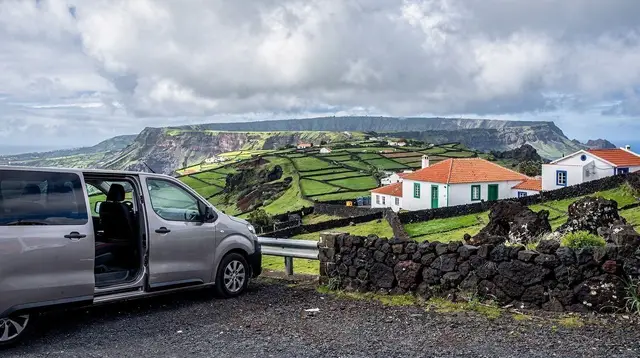
One Island or Island Hopping in the Azores?
Is it better to stay on one Azores island or hop between several?
With five days or fewer, staying on a single island (usually São Miguel) almost always beats hopping, because a single inter-island transfer can eat half a day. Island hopping starts paying off from about a week onward, once you have enough days to absorb one or two transfer days without losing your trip to logistics.
The real question: what does a transfer cost you in time
Before picking islands, most visitors are actually deciding something simpler: do I want a single base for my whole trip, or am I willing to spend part of a day moving between islands to see more variety? That single decision shapes everything else about a short Azores trip — where you sleep, how much you rent a car, and how much of your itinerary survives contact with real flight and ferry schedules.
This page is about that arbitrage, not about which specific island to choose if you stay put (see which island to visit for that), and not about the mechanics of a specific multi-island itinerary (the 7-day two-island and 10-day three-island itineraries cover those in detail). It also isn’t a head-to-head between two named islands — for that, see São Miguel vs Terceira or Pico vs Faial. This is for a traveler with under a week who hasn’t yet decided the shape of the trip.
Why “just add another island” is rarely free
The Azores are nine islands spread across roughly 600 km of Atlantic Ocean, grouped into an eastern group (São Miguel, Santa Maria), a central group (Terceira, Graciosa, São Jorge, Pico, Faial) and a western group (Flores, Corvo). Unlike a single large island with an internal road network, moving between two Azores islands always means a flight or a ferry, and both carry more overhead than their scheduled duration suggests.
A domestic SATA Air Açores flight between islands might show as a 40-minute flight, but by the time you add getting to the airport, check-in, boarding, the flight itself, disembarking, and collecting a rental car on the other side, a “quick hop” routinely consumes half a day. Ferries are similar: the Atlânticoline crossing between Madalena (Pico) and Horta (Faial) takes about 30 minutes on the water, but factoring in driving to the dock, waiting for boarding, the crossing, and picking up transport on arrival, the practical cost is still measured in hours, not minutes.
This is the single most common planning mistake on a short Azores trip: treating an inter-island transfer as a footnote rather than as an activity that occupies real time on the itinerary. A five-day trip that adds a second island is not a five-day trip with an extra island bolted on — it is closer to a four-day trip on two islands, once the transfer day is honestly accounted for.
When one island wins
For most trips of five days or fewer, staying on a single island is the stronger choice, and for a first Azores trip that island is usually São Miguel. It is the largest and most visited island, based around the capital Ponta Delgada, and it alone contains an unusually dense set of headline sights: the twin crater lakes of Sete Cidades, the thermal valley of Furnas (with Terra Nostra Park, Poça da Dona Beija, and the earth-cooked cozido das Furnas), the Gorreana tea plantation, the volcanic Lagoa do Fogo, and the boat-accessible islet of Vila Franca do Campo.
Because São Miguel is the busiest hub for both flights and inter-island connections, staying there also means every day is a full day of activities rather than a transfer day. A five-day São Miguel-only itinerary can comfortably fit a crater-lake day, a Furnas thermal day, a whale-watching excursion, a hiking day, and a slower coastal day — without a single flight or ferry eating into it. Compare that to the same five days split across two islands, where one full day (sometimes closer to one and a half) disappears into transfer logistics, leaving roughly the same number of “real” activity hours spread more thinly.
Single-island trips also simplify the practical side of a visit: one car rental instead of two, one set of driving conditions to learn (Azores roads are narrow, sometimes cliff-edge or ridge-line, with frequent fog at altitude and free-roaming cattle on higher pasture roads), and no risk of a delayed ferry or grounded flight cascading into a missed onward connection.
If your trip is built around one specific target — the Pico ascent, whale watching from Faial, or the wine landscape of Pico — a single island focused entirely on that goal, with day trips layered around it, usually beats spreading the same days across multiple bases.
a full-day São Miguel jeep tour covering the island’s highlights in one base is a good example of how much ground a single well-planned island can cover without ever touching a departure schedule.
When island hopping starts to pay off
Island hopping earns its cost once you have enough days that a transfer day becomes a small fraction of the trip rather than a large one. As a rule of thumb, seven days is roughly the point where adding a second island stops feeling like a tax on the itinerary, and ten days or more is where a third island becomes reasonable without every other day feeling compressed.
The math is straightforward: if a transfer costs half a day, a five-day trip loses 10 percent of its time to one transfer, but the same half-day transfer on a ten-day trip only costs 5 percent — and a fourteen-day trip barely notices it. This is why the 7-day two-island and 10-day three-island itineraries exist as separate, dedicated plans rather than being folded into a single-island guide: past a certain trip length, the calculation genuinely flips.
Island hopping also becomes worthwhile when your priorities can’t be satisfied by one island. São Miguel does not have the UNESCO-listed Pico vineyard landscape, Terceira’s Angra do Heroísmo old town, or São Jorge’s fajã coastal plains — each of those is specific to its own island. A traveler who wants both São Miguel’s variety and a serious hike on Pico, or both whale watching from Faial and a walk through Angra do Heroísmo’s historic streets, is choosing between two genuinely different experiences that no single island offers together.
The one combination that behaves differently: the Triangle
Not all inter-island transfers carry the same risk. Pico, Faial and São Jorge form what locals call the “Triangle,” and it is the one part of the archipelago where ferries run year-round, multiple times a day — in particular the roughly 30-minute Madalena-Horta crossing operated by Atlânticoline. This is meaningfully more reliable than the wider central-group ferry network (which links in Terceira and Graciosa only from June to September) or the western-group connections between Flores and Corvo, which are the most weather-sensitive routes in the archipelago and can be suspended for several days at a stretch outside summer.
Practically, this means a short multi-island trip built around the Triangle carries far less schedule risk than one that tries to combine, say, São Miguel with Corvo. If your available time is tight and you still want to try island hopping, the Pico-Faial pairing (with or without a São Jorge extension) is the most forgiving place to start — see the dedicated Pico-Faial ferry day trip guide for the specific crossing details.
a guided day tour across Pico’s volcanic landscape and vineyard country and a whale-watching trip from Pico’s historic whaling port both work well as anchor activities on the Pico side of a Triangle itinerary, without needing a flight at all.
A side-by-side comparison
| Stay on one island | Island hop (2+ islands) | |
|---|---|---|
| Best trip length | Under 5-6 days | 7+ days (10+ for three islands) |
| Transfer time cost | None | Roughly half a day per transfer, sometimes more |
| Car rental | One rental for the whole trip | A separate rental on each island |
| Schedule risk | Low — no flights or ferries to miss | Higher, especially outside the Pico-Faial-São Jorge Triangle |
| Depth vs. breadth | Deeper coverage of one island’s sights | Broader variety, thinner coverage of each island |
| Typical first choice | São Miguel | Pico + Faial (+ São Jorge) |
| Good fit for | First-time visitors, short trips, single-focus trips (hiking, whale watching, one volcano) | Repeat visitors, longer trips, travelers wanting UNESCO sites on two different islands |
Estimating transfer time honestly
When you’re mapping out a possible itinerary, it helps to build in a buffer rather than trusting the shortest scheduled option. A few reference points:
- The Madalena-Horta ferry (Pico-Faial) is the archipelago’s most dependable inter-island link, running year-round, several times daily — still budget a half-day around it once dock transfers are included.
- SATA Air Açores domestic flights connect all nine islands, with the busiest routes (Ponta Delgada-Terceira, Ponta Delgada-Pico, Ponta Delgada-Horta, Ponta Delgada-Flores) seeing the most frequent service; see inter-island flights for route-by-route detail.
- The wider central-group ferry network, which also links Terceira and Graciosa, only operates from June to September — outside that window, flying is the only inter-island option for those two islands.
- Western-group connections (Flores-Corvo) are the least predictable in the archipelago and should never be scheduled on a tight timeline with no slack day.
For a deeper look at the ferry network specifically, see inter-island ferries in the Azores; for the full mechanics of flying between islands, see flights to the Azores explained and the SATA-specific guide above.
Budget: what an extra island actually adds
Beyond time, adding an island adds cost in three places: the transfer itself (a domestic flight fare or ferry ticket), a second car rental (Azores car rentals are booked island by island — there is no single archipelago-wide rental network), and often an extra night of accommodation absorbed by the transfer day itself, since arriving on a new island in the afternoon rarely leaves enough daylight for a full activity day. None of this is prohibitive on a longer trip, but on a short one it competes directly with your accommodation and activity budget. The Azores daily budget guide breaks these costs down in more detail if you’re planning the money side of a multi-island trip.
a small-group van tour on Flores and a sailboat excursion off Terceira are both good examples of activities that make more sense once you’ve already committed to visiting that specific island as part of a longer, multi-island trip — booking them onto a short single-island itinerary usually means displacing something else on your one available island.
How to decide, in practice
If you have five days or fewer, default to one island — for most first trips, that means São Miguel, because it holds the broadest single-island mix of scenery, hiking, thermal springs and whale watching. Use the extra planning time this saves to go deeper: an extra hike, a slower thermal-spa afternoon, a proper whale-watching outing rather than a rushed one.
If you have seven days or more, island hopping becomes reasonable, and the Pico-Faial-São Jorge Triangle is the safest place to start because its ferry network is the most reliable in the archipelago. Ten days or more opens the door to a third island without the trip feeling compressed by transfer days.
Whatever you decide, build the transfer day into your itinerary as its own day, not as a free bonus tacked onto a travel day already carrying other plans. The single biggest source of disappointment on short Azores trips isn’t the wrong island choice — it’s an itinerary that never accounted for how much a “quick” inter-island hop actually costs in hours. For a broader walkthrough of building a longer, multi-island trip once you’ve settled on hopping, see the Azores island hopping guide, and for a general sense of how many days different kinds of trips need, how many days in the Azores is a useful starting point before you commit to either approach.
Frequently asked questions about staying on one island vs. island hopping
How many days do I need to justify island hopping in the Azores?
Most travelers need at least seven days to add a second island comfortably, and ten or more to add a third without the trip feeling rushed. Below that, a single transfer day can consume 15 to 25 percent of a short trip.
Is São Miguel enough for a first trip to the Azores?
Yes. São Miguel alone holds crater lakes, hot springs, whale watching, a working tea plantation and a UNESCO-listed hiking network, which is why most first-time, one-island itineraries are built around it rather than around a smaller island.
How long does an inter-island transfer really take?
Plan on half a day minimum, even for a short hop. A 30-minute Pico-Faial ferry crossing still involves getting to the dock, checking in, the crossing itself, and onward transport, while a domestic SATA flight adds airport arrival times and possible schedule changes on top of a short flight.
Which islands can I combine most reliably?
Pico, Faial and São Jorge form the “Triangle”, linked by Atlânticoline ferries that run year-round, several times a day, on the Madalena-Horta crossing in particular. That makes this trio the most forgiving combination for a first attempt at island hopping.
What is the biggest mistake travelers make when planning multi-island trips?
Underestimating transfer time. A flight or ferry that looks like “45 minutes” on a schedule can absorb an entire morning or afternoon once airport and dock logistics are added, leaving less on-island time than the itinerary implied.
Does island hopping cost more than staying on one island?
Usually yes. Each added island brings a domestic flight or ferry fare, a new car rental (Azores car rentals are booked separately per island), and often one extra night of accommodation absorbed by transfer-day logistics.
Can I island-hop in the Azores without a rental car?
It is difficult. Inter-village public transport is limited on every island, so most visitors rent a car separately on each island they visit, which is part of why adding islands adds cost and planning overhead, not just travel time.
Popular Azores experiences on GetYourGuide
Verified deep-linked GetYourGuide tours. Book through these links and we earn a small commission at no cost to you.
GetYourGuide does not provide a product photo for this activity — the image shows the meeting point, photographed by us.