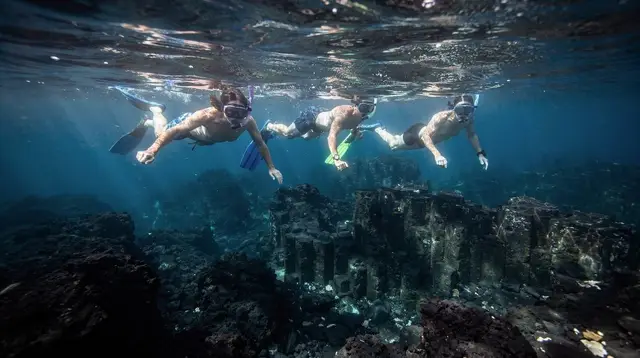
Princess Alice Bank: Diving and Snorkeling with Mobulas in the Azores
What is Princess Alice Bank and why do divers go there?
Princess Alice Bank is a submerged seamount in open water off the Faial-Pico-São Jorge triangle, reachable only by boat from Horta or Madalena. It draws experienced divers and snorkelers for seasonal pelagic encounters — mobula rays and ocean sunfish are the most consistent sightings, with manta rays or whale sharks possible but never guaranteed on any given trip.
If you have already read a general overview of diving in the Azores and are now comparing specific sites before booking a boat, Princess Alice Bank is probably the name that keeps coming up. It is not a beach, not a bay, and not somewhere you can simply walk into the water — it is a patch of open Atlantic off the Faial-Pico-São Jorge triangle where the seabed rises close enough to the surface to concentrate currents, plankton, and, in turn, the larger animals that feed on them. This page focuses specifically on that one site: what it is, what you might see there, who it suits, and how a trip actually runs.
What Makes Princess Alice Bank Different From a Coastal Dive
Most diving and snorkeling described in our general guide to diving in the Azores or in the snorkeling guide happens close to shore — around an islet, a cove, or a stretch of coastline you can see from the boat the entire time. Princess Alice Bank is a different kind of destination altogether. It is a submerged seamount sitting in open water beyond the channel that separates Faial and Pico, with no coastline, no anchor point on land, and no reference to swim back to if conditions change. Boats reach it purely by GPS navigation, and the entire experience takes place over blue water with the seabed well below comfortable free-diving depth.
That isolation is precisely what makes the site interesting. Seamounts like this one act as a kind of underwater magnet: upwelling currents pull nutrients toward the surface, plankton concentrates around the structure, and larger pelagic animals follow the food. Unlike a coral reef or a rocky wall you can return to every day and expect roughly the same residents, a seamount site is defined by movement — what passes through changes with the season, the current, and simple chance on the day.
This is also why Princess Alice Bank is not a beginner’s introduction to the underwater Azores. It is not covered in our coastal snorkeling guide because it does not work the same way: there is no shallow reef to explore at your own pace, no shore to swim back to, and no guarantee that the boat crew can spot land-based landmarks to orient the group. It is a trip for people who already know they enjoy being in open water and want to see what a seamount site adds to that experience.
What You Might See There
The animals most consistently reported by operators working this site are mobula rays and ocean sunfish, known locally and internationally as mola mola. Mobulas often move in small groups, gliding near the surface or through mid-water, and sunfish are frequently seen basking closer to the top, distinctive for their flattened, almost fin-less silhouette. Both are genuinely wild encounters rather than staged ones — the boat crew reads currents, birds, and surface activity to decide where to position the group, and what happens once you are in the water is up to the animals.
Manta rays and, on rarer occasions, whale sharks also pass through the area, and this is the point where expectations need to be set carefully. Both species are seasonal visitors to Azorean waters generally, not residents of this specific bank, and no operator — here or anywhere else in the archipelago — can promise a sighting of either on a booked date. Treat a manta or whale shark encounter as the best possible outcome of a trip, not the reason to book one. If the trip is memorable purely for the setting, the current, and whatever smaller life you do encounter, it has still delivered what an open-ocean seamount site is meant to deliver.
a guided snorkeling trip out to Princess Alice Bank is the most direct way to experience the site without a scuba certification, built around exactly this kind of open-water wildlife spotting rather than a fixed itinerary.
Comparing Princess Alice Bank to Other Dive and Snorkel Options
Because the bank sits offshore and demands a certain comfort level in open water, it helps to see where it fits next to other options available around Faial, Pico, and neighboring islands before deciding which trip matches your experience and appetite for open water.
| Experience | Departure point | Setting | Best suited to |
|---|---|---|---|
| Princess Alice Bank snorkel/dive | Horta or Madalena | Open-ocean seamount | Confident swimmers and certified divers comfortable with no shore reference |
| an introductory scuba dive | Coastal bay | Sheltered, shallow | First-time divers with no certification |
| a two-dive half-day trip off São Jorge | São Jorge coastline | Coastal reef and wall | Certified divers wanting a shorter, closer trip |
| a shark-swimming trip from Horta | Horta marina | Coastal open water | Snorkelers curious about a different pelagic encounter, closer to shore |
| Double dive in Santa Maria | Santa Maria | Coastal reef | Divers based on the eastern group of islands rather than the central triangle |
None of these substitute for one another — a coastal dive off São Jorge and an offshore seamount trip are simply different products, and comparing prices without comparing setting is the most common mistake first-time bookers make.
Getting There: Horta or Madalena
Every trip to Princess Alice Bank departs from one of two marinas: Horta on Faial, or Madalena on Pico. Both towns sit on the narrow channel that separates the two islands, and both host the boat operators licensed to run open-water trips out to the bank. There is no third departure point and no way to reach the site independently — it is always booked as an organized outing with a skipper who knows the current conditions and the navigation required to find the seamount rather than a fixed, marked location.
Because the bank lies in open water beyond the sheltered channel, crossing time varies with sea conditions on the day, and trips can be adjusted, shortened, or occasionally rescheduled if the swell makes the site unworkable. This is normal for offshore trips throughout the archipelago and is worth expecting rather than being surprised by. If you are staying on Pico and the crossing to Faial is part of your plan for other reasons too, our guide to the Pico-Faial day trip by ferry and the wider inter-island ferry guide cover how the connection between the two islands works outside of any dive trip.
Who This Trip Suits — and Who It Doesn’t
Princess Alice Bank is aimed at people who already have some open-water experience, whether as certified divers or as strong, confident swimmers comfortable snorkeling without a shoreline in sight. If you are trying diving for the very first time, a sheltered introductory dive close to the coast is a far better starting point than an offshore seamount — a first scuba experience in calmer water gives you the basics of breathing underwater and equalizing before you consider a trip with real current and depth involved.
Families traveling with young children, or anyone prone to seasickness on longer open-water crossings, should also weigh this carefully against a shorter coastal trip. The seamount setting is part of what makes the site special, but it also means more time on open water before and after the actual dive or snorkel, compared to a trip that stays within sight of the coastline the entire time.
When to Go
The Azores dive season overall runs broadly in line with the warmer months, and local operators generally associate the most pelagic activity at Princess Alice Bank with that same stretch of the year — but exact timing for mobulas, and any chance of a manta or whale shark, shifts from one year to the next with sea temperature and current patterns.
Rather than fix a single “best month” here, it is worth checking current reports directly with the operator you book with, and cross-referencing our broader best time to visit the Azores guide and month-by-month weather guide for how conditions on Faial and Pico typically evolve through the year. Sea state, more than a calendar date, determines whether a trip runs at all on any given day.
Booking a Trip in Advance
Because trips to Princess Alice Bank depend on weather, sea state, and a limited number of licensed boats working the site, they are worth booking ahead rather than trying to arrange once you have already arrived on Faial or Pico. Our guide on booking Azores tours in advance covers the general reasoning behind this across the archipelago, and it applies especially here: an offshore trip that gets cancelled for weather is far easier to rebook if you still have a few days of your stay left, rather than trying to fit it into your last available afternoon.
It is also worth thinking about what else you want from your time on Faial or Pico before committing to a date. Bring practical gear regardless of the forecast — the same general advice in our Azores packing list about layering for changeable weather applies just as much on the water as on land, since open-ocean trips can feel considerably cooler than a sunny morning on shore suggests. If diving and snorkeling more broadly across the islands is on your list rather than just this one site, our category page for diving and snorkeling rounds up the full range of options by island, from sheltered bays to offshore excursions like this one.
Setting Realistic Expectations
The single most useful thing to carry into a Princess Alice Bank trip is a realistic sense of what “seasonal pelagic encounters” actually means. Mobula rays and sunfish are seen often enough that operators build trips specifically around them, which is a genuinely good sign for your odds on any given outing. Manta rays and whale sharks are a different matter — they pass through occasionally, and a lucky group might have a trip they talk about for years, while another group on a similar day might not see either.
That unpredictability is not a flaw in how the trips are run; it is simply what open-ocean wildlife encounters are, here as much as they are for whale watching elsewhere in the archipelago, where the same rule about seasonal, never-guaranteed sightings applies to cetaceans rather than rays.
Go into the trip valuing the setting itself — a genuine seamount, open Atlantic water, and a boat crew reading currents in real time — and any larger animal that shows up becomes a bonus rather than the entire point. That mindset, more than anything printed on a ticket, is what makes a Princess Alice Bank trip feel worthwhile even on the days when the sea keeps its biggest visitors out of sight.
Princess Alice Bank Diving and Snorkeling FAQ
What is Princess Alice Bank?
Princess Alice Bank is a seamount — a section of seabed that rises toward the surface without breaking it — located in open water off the Faial-Pico-São Jorge triangle. It has no coastline, no beach, and no direct land access, which is exactly what draws pelagic species to its currents.
Where is Princess Alice Bank located?
It sits offshore between Faial and Pico, in the open Atlantic beyond the sheltered channel that separates the two islands. There is no fixed address or marker on land — operators navigate to the site by GPS, and trips launch from the marinas in Horta (Faial) or Madalena (Pico).
What might you see diving or snorkeling at Princess Alice Bank?
Mobula rays and ocean sunfish (mola mola) are the encounters most often reported by local operators. Manta rays and, more rarely, whale sharks pass through on occasion, but both are seasonal visitors rather than resident species and should be treated as a bonus, not an expectation.
Is a manta ray or whale shark sighting guaranteed at Princess Alice Bank?
No. As with every open-ocean wildlife trip in the Azores, operators cannot promise an encounter with any specific species — conditions, currents, and animal movement change from one outing to the next. A trip is worth booking for the seamount experience itself, with any pelagic sighting as a possible highlight rather than a certainty.
Do you need to be a certified diver to visit Princess Alice Bank?
Most boats visiting the bank are set up for certified divers, since the site is open water with currents and no easy surface reference point. Confident swimmers can often join as snorkelers on the same trips, but check with the specific operator, since not every departure accommodates both groups on the same boat.
How do you get to Princess Alice Bank?
The only way to reach it is by boat, departing from Horta on Faial or Madalena on Pico. There is no shore access, so every visit is booked as an organized trip with a licensed operator rather than arranged independently.
When is the best time to go for mobula sightings?
Local operators generally associate pelagic activity at the bank with the warmer months of the Azorean season, but exact timing shifts from year to year with sea conditions. Check current-season reports with the operator before booking, and see our guide to the best time to visit the Azores for the broader seasonal picture.
Is Princess Alice Bank suitable for beginners?
It suits divers and confident open-water swimmers who already have some experience, rather than complete beginners. If you are new to diving, an introductory dive in a sheltered bay is a better first step before an open-ocean seamount trip; see the comparison table above for where each experience level fits.
tours.diving-snorkeling
Verified deep-linked GetYourGuide tours. Book through these links and we earn a small commission at no cost to you.
GetYourGuide does not provide a product photo for this activity — the image shows the meeting point, photographed by us.