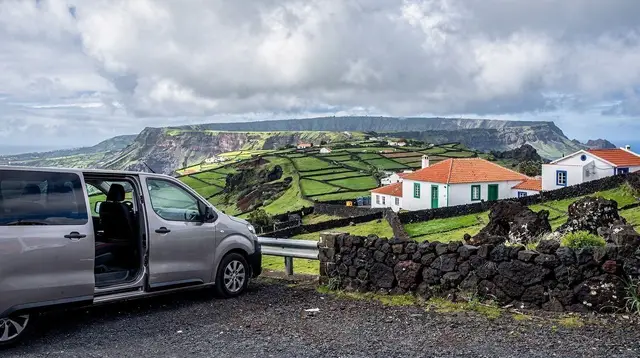
Azores in Summer vs Winter: Which Season Should You Choose?
Is it better to visit the Azores in summer or winter?
Summer (June to August) brings hydrangeas in full bloom, the most reliable inter-island ferries, and the busiest, priciest weeks of the year. Winter brings resident sperm whales, thinner crowds and lower prices, but rougher seas and a higher chance of cancelled ferry crossings, especially in the western group.
Two very different Azores, six months apart
Ask ten travellers what the Azores look like and you may get two completely different pictures, depending on whether they went in July or in January. Summer here means hydrangea hedges in full bloom along country lanes, ferries running at full frequency between islands, and a steady stream of visitors filling the better-known trails and thermal pools. Winter means a quieter, greyer archipelago where the resident sperm whales are closer to shore than at almost any other time of year, hotel prices drop, and a handful of ferry routes become unreliable enough to reshape an itinerary.
Neither season is objectively “better.” They suit different priorities, and the right call depends on what you are actually optimising for: guaranteed flowering scenery, budget, crowd levels, or a realistic shot at watching a cachalot surface a few hundred metres from a whale-watching boat. This guide sets the two seasons side by side so you can decide with your own priorities in mind, rather than a generic “best time to visit” list. For the month-by-month detail behind each season, see our dedicated guides to the Azores in summer and the Azores in winter, and for a full calendar view, Azores weather month by month.
Weather: mild all year, but not the same mild
The Azores sit in the middle of the North Atlantic, warmed and cooled by the Gulf Stream, which keeps the climate temperate rather than extreme in either direction. There is no true dry season here the way there is in the Canary Islands or Madeira - expect cloud and the occasional shower even in August, and expect days that are merely cool rather than cold even in January.
| Summer (June-Aug) | Winter (Dec-Feb) | |
|---|---|---|
| Typical daytime temperature | ~23-25°C | ~13-14°C |
| Rainfall | Statistically the driest months, not rain-free | Statistically the wettest months |
| Sea state | Generally calmer, better for boat trips | Rougher, more swell-dependent cancellations |
| Daylight | Long evenings, good for sunset boat trips | Shorter days, earlier sunsets |
| Local saying | “Four seasons in one day” still applies | “Four seasons in one day” still applies |
That last row matters more than the averages: locals describe the Azores weather pattern as four seasons in a single day, because fast-moving Atlantic fronts can swing the sky from bright sun to a squall and back within hours, in any month. Whichever season you pick, build flexibility into your plans rather than betting a single hike or boat trip on a morning forecast.
Hydrangeas: a summer-only reason to come
If the picture that made you want to visit the Azores involves a country road lined with blue and pink hydrangea hedges, that is a summer phenomenon, not a year-round one. The flowers typically begin appearing in May-June and reach full bloom in July-August, fading again toward the very end of summer. Visit in winter and those same hedges are simply green shrubs - attractive in their own way, but not the postcard image.
This page will not go deep into which islands and roads show the best hydrangea displays or the exact week-by-week bloom pattern - that level of detail lives in our hydrangea season guide and in the broader Azores hydrangeas guide. For this comparison, the takeaway is simple: if hydrangeas in bloom are a non-negotiable part of your trip, winter is off the table, and even May or September are a gamble on catching them at their peak.
Whales: winter’s quiet advantage
Where summer has flowers, winter has whales - specifically, the sperm whale, the Azores’ signature resident species, seen close to the islands through much of the year including the winter months, when boats often report calmer competition for sightings and fewer other boats on the water. This is a genuinely underrated reason to consider a cooler-season trip: while summer visitors are chasing hydrangeas, winter visitors can have a comparatively empty sea for spotting cachalots from a Pico or São Miguel-based boat.
Two things worth knowing before assuming winter is automatically the “whale season,” though. First, the great migratory whales - blue, fin and sei whales - pass through the Azores mostly in spring (April to June), not winter, so a winter trip trades a chance at the big migratory rorquals for a good chance at resident sperm whales and dolphins instead. Second, no operator can promise a sighting in any season; success rates are high but never guaranteed. The full detail on which species show up when belongs in our whale season guide and our broader whale watching in the Azores guide - this page is only flagging the seasonal trade-off, not replacing that research.
If watching whales and dolphins from the water is a priority whichever season you land in, a half-day boat trip is one of the more reliably bookable activities year-round:
an evening boat trip along the coast gives you a good chance of dolphins alongside the light show, in summer or winter alike.
Crowds and prices: the clearest-cut difference
Of every axis compared here, crowd levels and cost are the least ambiguous. June through August is Azores high season: flights fill up earlier, popular thermal pools like Poça da Dona Beija and Terra Nostra Park see longer queues, and whale-watching boats and rental cars book out days or weeks in advance rather than the same morning. Winter is close to the opposite: fewer visitors overall, more flexible last-minute bookings, and noticeably lower prices on flights, accommodation and car rental.
| Summer | Winter | |
|---|---|---|
| Flights & accommodation | Peak pricing, book well ahead | Lower prices, more last-minute availability |
| Popular sites (Sete Cidades, Furnas pools) | Busiest of the year | Quiet, sometimes near-empty |
| Car rental | Book early, especially in São Miguel and Pico | Easier to arrange with short notice |
| Restaurant reservations (e.g. cozido) | Book 24-72h ahead, longer in peak weeks | Usually easier to secure a table |
For a sense of what a trip actually costs across the year, see our Azores daily budget guide; for planning how many days to allow either season, how many days in the Azores is a useful starting point.
Ferries: the piece that actually changes your itinerary
This is the trade-off most first-time visitors underestimate, and it deserves more space than a simple “book ahead” line. Inter-island ferries in the Azores are not uniformly reliable across the calendar, and the difference between summer and winter here is not just about comfort - it can force you to redraw an island-hopping plan altogether.
The one exception to all of this is the short crossing linking Pico, Faial and São Jorge - informally known as the Triangle. That route runs year-round, multiple times a day, and is by far the steadiest maritime link in the archipelago, in both summer and winter. If your plan centres on those three islands, ferries are a reasonable bet whichever season you travel in.
Move outside the Triangle and the picture changes. The wider central-group network that also reaches Terceira and Graciosa typically operates only from June to September - in effect, a summer-only service. And the western-group link between Flores and Corvo is the most weather-sensitive route in the whole archipelago: it is genuinely fragile even in good weather, and winter’s rougher seas make cancellations and multi-day suspensions more likely there than anywhere else on the map.
The trap to avoid: do not assume that because one ferry route runs fine, all of them do, or that any of them runs on a fixed schedule regardless of season. A winter itinerary that depends on reaching Graciosa by boat, or on a same-week Flores-Corvo crossing, needs a backup plan - extra buffer days, a flight alternative, or an itinerary redesigned around the Triangle instead. Full route-by-route detail is in our inter-island ferries guide; for the flight alternative, see inter-island flights on SATA.
Activities: what actually shifts between seasons
Not every activity cares which season it is. Hiking trails, lava caves, and most cultural sites in places like Angra do Heroísmo are open and worthwhile year-round, weather permitting on any given day. What does shift is sea-dependent activity and daylight.
Summer’s calmer, warmer sea and long evenings make it the more comfortable season for swimming in natural pools, snorkelling, and sunset outings on the water - and for the Montanha do Pico ascent, where clearer, longer summer days make both the climb and the descent more manageable within daylight hours. A Pico Island day tour built around the volcanic landscape and vineyards works well in either season, but the mountain climb itself is more forgiving in summer conditions.
A guided day exploring Pico’s volcanic scenery and UNESCO-listed vineyards is a good anchor for a Pico stop whichever month you visit, since it does not depend on the summit ascent.
Winter’s rougher water makes some coasteering, snorkelling and open-water swimming outings weather-dependent on the day, with operators more likely to reschedule around conditions - not a reason to avoid winter, just a reason to build a day or two of slack into a coastal-activity-heavy plan. Land-based activity, on the other hand, holds up well in winter: a dairy farm visit or a fishing trip off the coast are both low-drama choices that do not hinge on calm seas in the way a coasteering session does.
A half-day dairy farm visit is a reliable rainy-day-friendly option when winter weather rules out something more sea-dependent, and a half-day sport fishing trip runs comfortably across much of the year, sea conditions allowing.
For travellers keen on water sports specifically, note that summer’s warmer air and calmer swell make it the friendlier season for a first attempt:
a beginner surf lesson is easiest to enjoy in the calmer, warmer stretch of summer, though some winter swells do attract more experienced surfers to the islands.
Which season fits which traveller
- Choose summer if: hydrangeas in bloom are important to you, you want the most reliable inter-island ferry network for a multi-island trip, you prefer long evenings for sunset boat trips, and you are comfortable booking well ahead and paying peak-season prices.
- Choose winter if: budget and quiet trails matter more than flowering scenery, you specifically want a good shot at resident sperm whales without summer’s crowds on the water, you are building a trip around one or two islands rather than an ambitious multi-island itinerary, and you are willing to keep a flexible schedule around sea-dependent activities.
- Consider the shoulder months if neither extreme appeals: spring brings the migratory great whales and the first hydrangeas of the year, while autumn tends to combine milder crowds with sea conditions that are usually calmer than deep winter. Neither is covered in depth here, but both sit between the two poles this page compares. For a broader look at picking the right month overall, see best time to visit the Azores.
Whichever season you land on, a short island-hopping plan built around the Pico-Faial-São Jorge Triangle is one of the safer structures to build an itinerary on, since it is the one ferry route that behaves consistently in both summer and winter - see our Azores island hopping guide and the Pico-Faial day trip by ferry for how that route works in practice.
Azores summer vs winter: frequently asked questions
Is the Azores warm in winter?
It stays mild rather than warm, with average daytime temperatures around 13-14°C thanks to the Gulf Stream. There is no harsh cold, but rain, wind and cloud cover are frequent, and sea crossings get rougher.
Do hydrangeas bloom in the Azores in winter?
No. Hydrangeas flower from roughly May-June through July-August, with peak bloom in high summer. Outside that window, most hedgerows show green foliage rather than the blue and pink flowers the islands are known for.
Are whales easier to see in summer or winter?
Neither season is empty of them, but the resident sperm whale is seen close to shore in the Azores through the winter months, while the passing great whales - blue, fin and sei - are a spring event rather than a summer or winter one.
Are ferries between the islands reliable in winter?
Only on some routes. The short Pico-Faial-São Jorge crossing runs year-round and is the most dependable link in the archipelago, but wider central-group routes to Terceira and Graciosa are largely a June-to-September service, and the western-group link between Flores and Corvo is the most weather-sensitive of all, with winter cancellations more common.
Is it cheaper to visit the Azores in winter?
Generally yes. Flights, car rental and accommodation both tend to sit lower outside the June-to-September peak, and popular whale-watching boats and thermal pools are easier to book at short notice.
What is the best month to visit the Azores if I want to avoid crowds but still get decent weather?
Late spring (May) or early autumn (September-October) are usually cited as the compromise: milder crowds and prices than high summer, without winter’s roughest seas, though the Azores never truly has a dry, guaranteed-sunshine season.
Should I island-hop in summer or stick to one island in winter?
Island-hopping is easier in summer because more ferry and flight routes are running at full frequency. In winter, a plan built around one or two islands connected by the year-round Pico-Faial-São Jorge Triangle is more realistic than a multi-island itinerary that depends on the western or wider central-group ferries.
Popular Azores experiences on GetYourGuide
Verified deep-linked GetYourGuide tours. Book through these links and we earn a small commission at no cost to you.
GetYourGuide does not provide a product photo for this activity — the image shows the meeting point, photographed by us.