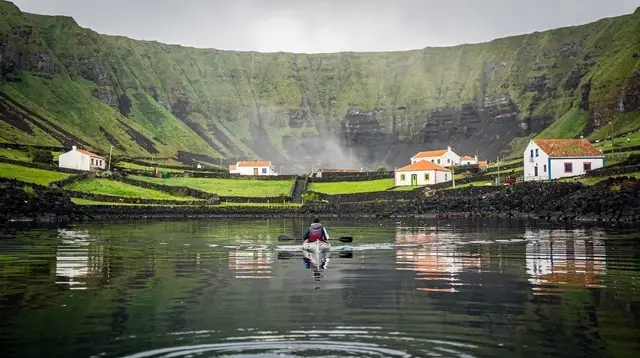
Surfing in the Azores
When is the best time to surf in the Azores?
The strongest and most consistent Atlantic swells generally arrive in autumn and winter, not summer, when the ocean is at its flattest. São Miguel's north coast, around Ribeira Grande and Mosteiros, holds most of the archipelago's surf schools and breaks. The water stays cool year-round, so a wetsuit is worn in every season, including August.
Where the Waves Actually Are
The Azores sit in the open North Atlantic, roughly 1,500 km from mainland Europe, with nothing but ocean between them and the swells generated by low-pressure systems tracking across the north of the basin. That exposure is what makes the archipelago interesting for surfing at all — but it is concentrated in one place far more than visitors expect. If you search for surf in the Azores, almost everything you find points to a single stretch of coastline: the north shore of São Miguel, between roughly Ribeira Grande and Mosteiros, with Capelas also part of that same run of coast.
This is where the surf schools operate, where board rental exists, and where the handful of local surfers you’ll see in the water actually live. The north coast faces directly into the swell window that matters here, and it sits close enough to Ponta Delgada that it works as a base for a surf trip without needing to relocate for the week.
That does not mean São Miguel is the only island where waves break. Faial, Pico, Terceira and Santa Maria all have coastlines exposed enough to produce surfable conditions when swell, wind and tide line up. What they lack is the infrastructure around it — no established schools built for visitors, little to no board rental, and none of the accumulated local knowledge of which reef or beach break is working on a given day.
A surfer who already knows how to read a coastline and travels with their own board can find waves on these islands. A visitor who wants lessons, rental gear and a realistic shot at getting into the water safely should plan around São Miguel’s north coast and treat the other islands as a bonus if conditions happen to cooperate during an inter-island trip.
Within that north coast stretch, the breaks vary between beach-break sand bottoms that shift with the season and more exposed reef and point setups that hold shape better when the swell has size. Exactly which spot is “on” changes with the swell direction and the wind, which is one of the reasons a rental car and a bit of local advice from a surf school matter more here than a fixed itinerary decided from home. See driving in the Azores before you commit to a fly-drive plan built around chasing conditions.
Swell and Season: Resist the Summer Reflex
This is the single most important thing to get right before booking an Azores surf trip, and it is also the point where visitors coming from a Mediterranean surf background — or no surf background at all — get it backwards. In the Mediterranean, and in a lot of popular sun-and-sand thinking generally, summer means good weather, and good weather gets mentally filed as “the season” for everything, water sports included. The North Atlantic does not work that way.
Surfable swell in the Azores is generated by the same autumn and winter storm systems that move across the north Atlantic toward Europe. Those systems are more frequent, more organized and stronger from roughly October through March than they are in summer. Through the warmer months, especially July and August, the ocean tends to go quieter: smaller, less consistent swell, longer flat spells, and a sea state that is far friendlier to a first lesson than to anyone chasing size. In other words, the months when the Azores are busiest with visitors and the weather feels most like a classic beach holiday are, for surf purposes, close to the opposite of peak season.
That inversion matters for how you plan. If your goal is to learn, or to surf small, manageable waves in a wetsuit under a mild sky, summer works well and lines up conveniently with when most people are visiting the islands anyway — see the best time to visit the Azores and the month-by-month weather guide for how that season compares across the rest of the archipelago’s activities.
If your goal is size and consistency, you are looking at autumn or winter, which bring bigger, more frequent groundswells at the cost of shorter days, more unsettled weather generally, and conditions that are more exposed and less beginner-friendly. Neither season is objectively “the” surf season — they serve different kinds of surfer — but conflating summer with good surf, the way you might for a Mediterranean beach trip, is the mistake to avoid.
Wind matters as much as swell size. The islands’ position in the open Atlantic means conditions can shift within a single day, in keeping with the Azorean saying about four seasons in one day: what looks clean and glassy in the morning can turn choppy and blown-out by early afternoon, and vice versa. A surf school or local rental shop checking conditions that morning will always know more than a swell forecast checked from home the week before.
Water Temperature: Cold Enough, Every Month
The Gulf Stream keeps the Azores milder than their Atlantic latitude might suggest on land, softening the swing between summer and winter air temperatures. It does not, however, make the ocean warm. Sea temperatures here stay on the cool side across the whole year, generally at their lowest in late winter and early spring, and mildest in early autumn once the sea has had all summer to pick up a little warmth. At no point does the water reach a temperature where surfing without a wetsuit is realistic.
Practically, this means every surfer in the Azores, at every time of year, is in some thickness of neoprene. It is one of the clearest ways the islands differ from the Mediterranean or the Canary Islands, where a summer session can sometimes be done in boardshorts alone — see Azores versus the Canary Islands if you’re weighing the two archipelagos for a trip. Here, even a warm, sunny August day in the water calls for a wetsuit.
| Season | Typical water feel | Usual wetsuit |
|---|---|---|
| Summer (Jun–Aug) | Coolest it gets, but still not warm | 3/2mm full suit |
| Autumn (Sep–Nov) | Mildest of the year | 3/2mm or 4/3mm |
| Winter (Dec–Feb) | Coldest, alongside bigger swell and rawer weather | 4/3mm or 5/4mm, boots recommended |
| Spring (Mar–May) | Still cool, slowly warming | 4/3mm, boots useful |
Treat these as general seasonal patterns rather than a guarantee for any single day — sea temperature, like the weather on land, can vary from one week to the next. Bring or rent a wetsuit rated for the season you’re travelling in, not the one you’d pack for a Mediterranean summer; a general sense of what else to pack for the trip is covered in the Azores packing list.
Learning to Surf on São Miguel
For anyone starting from zero, or picking the sport back up after time away, São Miguel’s north coast is where that happens. Surf schools based around Ribeira Grande and the surrounding coastline run lessons aimed squarely at beginners, working the smaller, more forgiving days that are common outside the winter storm season — which is one more reason a spring or summer trip suits a first-timer better than a winter one, even though winter holds the bigger swells.
a multi-level surf lesson on São Miguel is built to take a mixed group from a flat-water pop-up drill through to riding whitewater on a soft-top board, with an instructor reading the conditions and choosing a suitable beach for the day rather than committing to one spot in advance. If you know you’re starting from nothing and want a lesson pitched specifically at that level, a dedicated beginner surf lesson keeps the group and the coaching focused on people in the same position as you, which tends to mean more individual attention and a gentler pace than a mixed-level class.
Either way, a lesson solves two problems at once for a visitor: it puts you with an instructor who already knows which stretch of the north coast is working that morning, and it removes the need to own or rent a board and wetsuit before you’ve even confirmed you’ll enjoy it.
Already Surf? Renting Independently
If you already know how to surf and just need equipment, board rental is available on São Miguel rather than requiring you to travel with your own board — a genuine convenience given how much airline surfboard fees can add to a flight. board rental at Pópulo Surfshop gives an independent surfer a board and, typically, a wetsuit to go with it, freeing you to chase the day’s conditions along the north coast on your own schedule rather than around a lesson time slot.
Renting independently puts more responsibility on you to read the ocean correctly: checking the swell and wind before heading out, knowing which beach or reef suits the size and direction on a given day, and being honest about whether conditions match your level, particularly once autumn and winter swells start to add real size and power. A quick conversation with the rental shop about that day’s conditions is worth having even if you’ve surfed elsewhere for years — this is a small, specific stretch of coastline, and local knowledge of exactly where the swell is wrapping in that week is not something a general forecast website will tell you.
Building a Surf-Focused Trip Around São Miguel
A trip built around surfing doesn’t need to be surfing from morning to night — the days when the swell or wind isn’t cooperating, or when you simply want a change of pace, are easy to fill without leaving the same base. If you’d rather stay in the water than on land, a coasteering trip along São Miguel’s coastline is a reasonable way to spend a flat day, combining cliff jumps, swimming and scrambling along the shore rather than waiting out a lull for the next swell.
Since São Miguel is also the island with the archipelago’s fullest calendar of things to do, a surf trip pairs easily with a day or two spent inland or on the water in other ways — for a broader sense of how those pieces fit together across a week, see things to do on São Miguel by category and a general 5-day São Miguel itinerary to build the rest of the trip around your surf sessions rather than the other way around.
It’s worth being clear about what this guide does not cover. If your priority is simply time in the water rather than riding waves specifically, snorkelling and kayaking and paddleboarding are gentler, less swell-dependent ways to get on or under the Atlantic, and the general beaches guide is the better starting point if you’re planning a beach day rather than a surf session. This page stays focused on the surfer’s version of the question: which coast, which season, and what to wear in the water.
Getting There and Around
Reaching the surf means reaching São Miguel first, almost always via Ponta Delgada’s airport, and then getting yourself to the north coast — a 20 to 30 minute drive from Ponta Delgada depending on exactly where you’re headed along the Ribeira Grande–Mosteiros stretch. A rental car is close to essential for this kind of trip: conditions change through the day and between spots, and the ability to drive 15 minutes down the coast to check a different break is a real advantage over being tied to a single beach reachable on foot or by limited local transport.
If your trip includes island-hopping beyond São Miguel, keep in mind that inter-island transport works on its own logic separate from the surf: ferries and flights connect the islands on their own schedules, not around swell forecasts, so treat a surf day on another island as an opportunistic bonus rather than the anchor of your itinerary. A calm-water day trip like a sunset boat tour off São Miguel or a longer excursion such as a day tour of Pico makes sense as a complement to a surf-based week, not as a substitute for the north coast sessions that are the actual reason to bring a wetsuit in the first place.
Surf Trip to the Azores: Common Questions
What is the best time of year to surf in the Azores?
Autumn and winter, roughly October through March, tend to bring the biggest and most reliable north Atlantic groundswells to the Azores. Summer is calmer and more forgiving, which suits beginners and lessons, but it is not the season for size or consistency.
Do I need a wetsuit to surf in the Azores?
Yes, in every month of the year. The Atlantic around the islands stays cool even in summer, and most surfers wear at least a 3/2mm wetsuit in August and a thicker 4/3mm or 5/4mm suit with boots in winter.
Where are the best surf spots in the Azores?
Most of the Azores’ surf infrastructure, schools and known breaks are concentrated on the north coast of São Miguel, particularly around Ribeira Grande, Mosteiros and Capelas. Other islands have surfable waves at times, but far less in the way of schools, rentals or local knowledge to draw on.
Can beginners learn to surf in the Azores?
Yes. São Miguel has surf schools offering lessons for all levels, usually on the more sheltered, smaller-wave days that are common in spring and summer, which are far better suited to a first lesson than a winter groundswell.
Is São Miguel the only island with surfable waves?
No, but it is by far the most practical one for a visiting surfer. Faial, Pico, Terceira and Santa Maria can all produce rideable waves when the swell and wind line up, yet they lack São Miguel’s concentration of schools, board rental and local surf knowledge.
How cold is the Atlantic water in the Azores?
It stays moderate rather than warm all year, generally cooler in late winter and early spring and mildest in early autumn after the summer has warmed it slightly. It never reaches the kind of warmth that lets you surf without a wetsuit.
Do I need a car to reach the surf spots?
A rental car makes it far easier to check conditions along São Miguel’s north coast and move between spots as the swell, wind and tide change through the day. Public transport along this coast is limited and not built around a surfer’s schedule.
Is the Azores good for experienced surfers looking for big swell?
It can be, particularly from autumn through winter when north Atlantic storms send well-organized groundswell toward the islands. Exposed reef and point setups on São Miguel’s north coast can hold genuine size, though conditions are more exposed and less forgiving than the summer lesson breaks.
tours.surfing-watersports
Verified deep-linked GetYourGuide tours. Book through these links and we earn a small commission at no cost to you.
GetYourGuide does not provide a product photo for this activity — the image shows the meeting point, photographed by us.