Azores vs Canary Islands: Which Atlantic Islands Fit You
Should I visit the Azores or the Canary Islands?
Choose the Azores for cool, green, volcanic scenery, whale watching and hiking in an EU-Schengen-euro region with changeable weather year-round. Choose the Canary Islands for warm, dry, sunny beach weather in a Spanish archipelago with more built-up resort infrastructure.
Two Atlantic Archipelagos, One Very Different Climate
The Azores and the Canary Islands are both volcanic island groups scattered across the Atlantic Ocean, both popular with travelers chasing nature, hiking and boat trips away from mainland Europe. That is roughly where the similarity ends. Pick the wrong one for what you actually want and you will spend a week either shivering under a rain jacket on a black-sand beach, or wondering why every hillside looks like a desert instead of the emerald crater lakes you saw in a photo.
This guide sets the two archipelagos side by side on the points that actually change a trip: political status, climate, landscape, wildlife, cost and how you get around, so you can decide which one matches the holiday you are actually planning. If your confusion is specifically with Madeira rather than the Canaries, that comparison lives on its own page at Azores vs Madeira, and the Azores-vs-Iceland question is answered separately at Azores vs Iceland.
Quick Verdict
| If you want… | Choose |
|---|---|
| Guaranteed warm, dry, sunny weather | Canary Islands |
| Cool green landscapes, crater lakes, hydrangeas | Azores |
| Big sandy beaches and resort infrastructure | Canary Islands |
| Whale watching, hiking, a quieter, less built-up feel | Azores |
| A short flight from continental Europe with year-round package deals | Canary Islands |
| An EU region with no special border regime and a slower pace | Azores |
| Volcanic desert scenery (Lanzarote-style) | Canary Islands |
| Volcanic green scenery (crater lakes, ferns, pastures) | Azores |
Geography and Political Status
The Azores are a Portuguese autonomous region, nine volcanic islands roughly 1,500 km off the coast of Lisbon, split into an eastern group (São Miguel, Santa Maria), a central group (Terceira, Graciosa, São Jorge, Pico, Faial) and a western group (Flores, Corvo).
Because they are a Portuguese region, the Azores are fully inside the European Union, the Schengen area and the eurozone, with no special customs or border regime for travelers arriving from another Schengen country. One quirk worth flagging before you book flights: the Azores run on their own time zone, UTC-1, a full hour behind mainland Portugal, which occasionally trips up travelers connecting through Lisbon.
The Canary Islands are an autonomous community of Spain, sitting much further south, closer to the coast of West Africa than to mainland Europe. Like the Azores, the Canaries are an EU outermost region and use the euro, and they fall within the Schengen area’s legal framework. In practice, though, Canary Islands airports and ports see noticeably closer document checks on international arrivals than a typical Azores flight from Lisbon or Porto, a legacy of the archipelago’s position on Atlantic migration routes from Africa. The Canaries also sit outside the EU’s common VAT and customs territory, with their own local indirect tax, which shows up in slightly different retail pricing on some goods compared to the Azores or mainland Spain.
Climate: The Real Line of Separation
This is the single most important difference between the two archipelagos, and the mistake most first-time researchers make. The Azores sit in the open North Atlantic, cooled and humidified by ocean currents, with no dry season at all. Locals sum it up with a well-worn phrase: you can get four seasons in one day. Expect changeable skies, frequent short showers even in summer, and daily temperatures that stay fairly mild year-round rather than swinging to extremes, roughly 13 to 14 degrees Celsius in winter and 23 to 25 degrees in summer. For a full month-by-month breakdown, see Azores weather month by month and Best time to visit the Azores.
The Canary Islands sit far enough south, and close enough to the Sahara, to have a genuinely subtropical, largely dry climate, warmed further by their latitude. Rain is rare for long stretches of the year on islands like Lanzarote and Fuerteventura, sunshine is close to guaranteed for beach days, and winter daytime temperatures rarely dip much below the high teens Celsius, which is exactly why the Canaries built a year-round package-holiday industry around them. If your primary goal is a dependable sun-and-pool holiday booked months in advance with confidence in the forecast, the Canary Islands deliver that far more reliably than the Azores ever will.
| Factor | Azores | Canary Islands |
|---|---|---|
| Climate type | Cool, humid, oceanic | Warm, dry, subtropical |
| Dry season | None | Long, reliable |
| Winter daytime temps | ~13-14°C | ~18-22°C |
| Summer daytime temps | ~23-25°C | ~24-29°C |
| Rain risk | Any month, any day | Low most of the year |
| Sea temperature | Cool Atlantic | Warmer Atlantic |
Do not let a glossy photo of green Azorean crater lakes convince you the climate behind it is warm and dry; it almost never is. And do not assume every Canary Island looks the same either, since Tenerife and La Palma have far greener, cloud-forested zones at altitude than the desert flatlands of Lanzarote or Fuerteventura.
Landscape: Green Volcanic vs Desert Volcanic
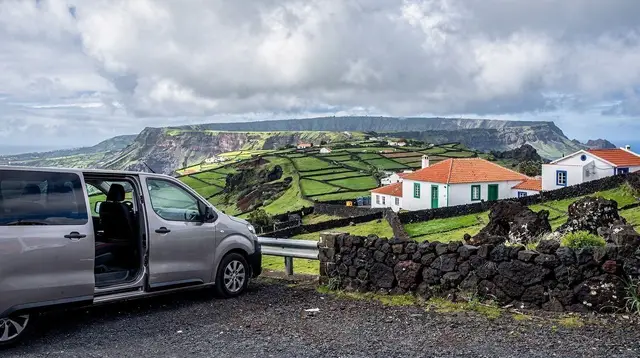
Both archipelagos are volcanic in origin, and both wear that history openly, but the results look almost opposite. In the Azores, constant humidity turns volcanic slopes into dense green pasture, ferns and hydrangea hedges; the crater lakes of Sete Cidades, the thermal valley of Furnas, and the currais of Pico’s UNESCO-listed vineyards are all shaped by rain as much as by lava. Hydrangeas famously line the roads from June to August; outside that window, see Hydrangea season in the Azores and the Azores hydrangeas guide before planning a trip around them.
In the Canary Islands, low rainfall on several islands leaves the volcanic bones exposed: Lanzarote’s Timanfaya lava fields and Fuerteventura’s dune-backed beaches look closer to a desert than a garden. Tenerife, home to Mount Teide, and La Palma break that pattern with more forest and cloud cover at higher elevation, but even there, the lowland coast stays dry and sun-baked. If lush, constantly green scenery is what you picture, the Azores deliver it far more consistently across all nine islands than the Canaries do across their eight.
Wildlife and Ocean Activities
Whale and dolphin watching is a strong draw in both archipelagos, and neither disappoints, but the resident species differ. The Azores, especially waters around Pico and Faial, are known for resident sperm whales tracked from shore-based vigias, plus seasonal blue, fin and sei whales passing through mostly in spring. The Canary Islands, particularly the strait between Tenerife and La Gomera, are known for an unusually stable resident population of pilot whales and bottlenose dolphins visible almost year-round thanks to warm, deep water close to shore.
a full-day tour around Pico’s volcanic coastline and vineyard landscapes is one of the more complete ways to see the Azores’ central group in a single outing, and pairing it with a sunset boat trip along the Azorean coast gives a very different, warmer light on the same volcanic scenery.
Anglers comparing the two archipelagos should know the Azores’ deep offshore trenches produce serious sport fishing; a half-day sport fishing trip out of the islands is a common way to try it without chartering a full expedition. For a more physical, coastline-level way to experience the volcanic rock itself, a guided coasteering session along São Miguel’s lava coast beats anything comparable most Canary operators offer, since the Azores’ cooler, rougher Atlantic edge lends itself to that kind of activity more than the calmer, warmer Canary coastline does.
Beach quality is where the Canaries clearly win. Golden dune beaches in Fuerteventura, black volcanic sand in Tenerife and Lanzarote, and warm swimmable water for most of the year give the Canaries an edge that the Azores cannot match; see Best beaches in the Azores for realistic expectations before comparing photos side by side.
Getting There and Getting Around
Both archipelagos require a flight from the mainland, but connectivity differs. The Canary Islands have dense, competitively priced flight networks from across mainland Europe, supporting a long package-holiday season and easy inter-island hopping on short domestic flights. The Azores are served mainly through Lisbon and Porto, with fewer direct routes from other European cities and seasonal, rather than year-round, direct connections from islands like Pico or Faial to the mainland; see Getting to the Azores for the current picture.
Once on the ground, a rental car is close to essential on either archipelago if you want to see more than the main town; see Car rental in the Azores for Azorean specifics, including narrow, sometimes cliff-edge roads and grazing cattle that can appear on upland routes without warning.
Inter-island travel differs sharply too: the Azores’ most reliable ferry link, the Pico-Faial-São Jorge “Triangle,” runs year-round, but wider inter-island ferry service across the rest of the archipelago is seasonal and weather-dependent, detailed at Inter-island ferries in the Azores. The Canary Islands, by contrast, run dense, largely year-round ferry and short-hop flight networks between their more populous islands, making island-hopping considerably easier to plan on short notice.
Cost Comparison
Neither archipelago is a genuinely cheap destination by European standards, but the shape of the cost differs. The Canary Islands benefit from high flight volume and a mature package-holiday market, which tends to push flight and all-inclusive accommodation prices down, especially outside peak weeks. The Azores generally cost more for car rental, inter-island flights and boat-based activities, partly because tourism infrastructure is smaller and more seasonal, and partly because fewer operators compete on each route.
| Cost area | Azores | Canary Islands |
|---|---|---|
| Flights from mainland Europe | Moderate to high, fewer routes | Often lower, dense competition |
| Accommodation | Mid-range, fewer resort deals | Wide range, strong package deals |
| Car rental | Higher, smaller local fleets | Generally lower, larger fleets |
| Inter-island transport | Costlier, seasonal gaps | Cheaper, frequent |
| Activities and tours | Mid to high | Wide price range |
Who Should Choose Which
Choose the Azores if you want green, volcanic, slightly wild scenery; you don’t mind unpredictable weather and packing layers regardless of season; whale watching, hiking and quiet island life matter more to you than beach time; and you would rather stay inside a familiar EU-Schengen-euro framework without a special border regime. A good starting point for planning is Which Azores island to visit or a ready-made route like Azores in 7 days across two islands.
Choose the Canary Islands if warm, dependable, sunny weather is close to non-negotiable for your trip; you want long sandy beaches and a mature resort and package-holiday infrastructure; you would rather island-hop easily on short domestic flights and frequent ferries; and you are comfortable with slightly closer border checks as part of the archipelago’s position facing Africa. Neither choice is objectively better. They answer different questions, and conflating them, expecting Canary-style sunshine on an Azores trip, is the single most common planning mistake travelers make when they research the two together.
Azores or Canary Islands: Common Questions Answered
Is the weather in the Azores as warm as in the Canary Islands?
No. The Azores have a cool, humid, oceanic climate with rain possible in any month and no real dry season, while the Canary Islands enjoy a warm, dry, subtropical climate closer to North Africa, with reliable sunshine most of the year.
Are the Canary Islands in the Schengen area like the Azores?
Both archipelagos are EU outermost regions that use the euro and fall within Schengen rules, but Canary arrivals from outside the EU often face closer document checks, because the islands sit on a frontline for Atlantic migration routes, a control layer the Azores do not have.
Which archipelago is better for beaches, the Azores or the Canary Islands?
The Canary Islands have far more sand, including golden and black volcanic beaches, and warm swimmable water most of the year. The Azores have fewer sandy beaches, cooler Atlantic water, and rely more on natural volcanic pools and crater lakes.
Can I see whales in both the Azores and the Canary Islands?
Yes. Both archipelagos offer whale and dolphin watching thanks to deep offshore water, but the Azores are known for resident sperm whales and seasonal blue and fin whales, while the Canary Islands are especially known for resident pilot whales and bottlenose dolphins.
Is it more expensive to travel in the Azores or the Canary Islands?
Both are mid-range European destinations. Higher flight capacity and a longer package-holiday season tend to make the Canary Islands cheaper on average for flights and resort stays, while the Azores often cost more for car rental and inter-island transport.
Which islands are greener, the Azores or the Canary Islands?
The Azores are green year-round thanks to constant Atlantic humidity, with pastures, hydrangea hedges and crater lakes. Several Canary Islands, particularly Lanzarote and Fuerteventura, are dry and desert-like, though Tenerife and La Palma have greener, forested zones at altitude.
Should I combine the Azores and Canary Islands in one trip?
It is possible but not efficient. The two archipelagos sit roughly 1,500 to 2,000 km apart with no direct inter-archipelago flights, so most travelers treat them as separate trips built around different goals: cool green hiking versus warm beach time.
Popular Azores experiences on GetYourGuide
Verified deep-linked GetYourGuide tours. Book through these links and we earn a small commission at no cost to you.
GetYourGuide does not provide a product photo for this activity — the image shows the meeting point, photographed by us.