Azores vs Iceland: Two Volcanic Worlds Compared
Should I visit the Azores or Iceland for a volcanic nature trip?
Choose the Azores for a mild, green, year-round volcanic archipelago with resident whales and dolphins and a climate between roughly 12°C and 25°C; choose Iceland for dramatic subarctic scenery, geysers, glaciers and the northern lights under a much colder climate and a higher daily budget. Both are volcanic nature destinations, but they suit very different weather expectations and travel styles.
Two Volcanic Destinations, Very Different Climates
Both the Azores and Iceland get pitched to the same kind of traveler: someone chasing wild volcanic landscapes, whales, waterfalls and a break from crowded Mediterranean beaches. Search for one and the other usually shows up in the results. But once you look past “volcanic island nature trip,” the two destinations diverge sharply — in latitude, temperature, cost, and even in which volcanic features you’ll actually see.
This guide is built for the moment you’re comparing them side by side, tickets not yet booked. It does not cover the Azores vs Madeira or Azores vs Canary Islands matchups, and it isn’t about choosing between two Azorean islands — for that, see which Azores island to visit. Here, the question is bigger: Atlantic archipelago, or subarctic island nation?
Latitude and Climate: The Difference That Matters Most
This is the single biggest misconception to clear up first. The Azores sit in the middle of the North Atlantic, warmed year-round by the Gulf Stream, at a latitude roughly level with Lisbon and the U.S. mid-Atlantic coast. Iceland sits just south of the Arctic Circle, with a genuinely subarctic climate.
| Azores | Iceland | |
|---|---|---|
| Latitude | Mid-Atlantic (around 37-40°N) | Subarctic (around 63-66°N) |
| Winter temperatures | Roughly 13-14°C | Below freezing, snow common |
| Summer temperatures | Roughly 23-25°C | Cool, typically 10-15°C |
| Climate type | Oceanic, humid, mild year-round | Subarctic, cold, short summer |
| Daylight in winter | Normal mid-latitude daylight | Very short days |
| Daylight in summer | Normal mid-latitude daylight | Near-midnight sun |
The Azores never get subarctic, and they don’t have a true dry season the way the Canary Islands or Madeira nearby do. Locally people joke about “four seasons in one day,” because fast-moving Atlantic fronts can swing the sky from sun to rain and back within hours — check what the weather actually does month by month and read when to visit the Azores before building a rigid itinerary around a morning forecast. Iceland’s seasonal swing is far more extreme, with a genuine winter that shapes almost every travel decision, from road closures to how many hours of daylight you’ll actually get to hike in.
If you want warmth-adjacent green landscapes without ever dealing with snow or ice, the Azores wins outright. If part of the appeal is experiencing a true cold, dramatic winter — ice caves, the northern lights, snow-covered lava fields — that’s specifically an Iceland experience the Azores cannot replicate.
There’s a practical layer to this too, beyond the weather. The Azores are an autonomous region of Portugal, which puts them inside the European Union, the Schengen area and the euro currency zone — but on their own clock, UTC-1, one hour behind mainland Portugal. Iceland is part of the Schengen area as well despite sitting outside the EU, but it keeps its own currency, the Icelandic króna, and its own time zone. For EU travelers, that makes the Azores logistically closer to a domestic Portuguese trip than a foreign one; for everyone else, both destinations follow standard Schengen entry rules.
Volcanic Landscapes: Different Kinds of Volcanic
Both destinations are volcanic in origin, but the surface expression is not the same, and this is where a lot of pre-trip research goes wrong.
The Azores’ volcanism shows up as crater lakes, hot springs, lava caves, and fumarole fields — not geysers. São Miguel’s thermal valley at Furnas cooks food in the ground and fills pools with iron-rich hot water; Terceira and Graciosa have lava tube caves you can walk into; and Pico is dominated by the Montanha do Pico, mainland Portugal and its islands’ highest point, a permit-controlled climb rather than a casual walk-up (see climbing Mount Pico for how the quota and GPS-tracker system actually works).
Around its base, centuries-old vineyards grow inside small lava-stone enclosures called currais — a UNESCO-listed landscape covered in Pico’s wine and vineyard guide.
Iceland’s volcanism is more geologically active and more visually extreme: erupting geysers, active lava fields, glaciers sitting directly on top of volcanic systems, and geothermal areas that can be genuinely otherworldly. If seeing an actual geyser erupt, or standing on a glacier, is on your list, that’s an Iceland-only item — the Azores has nothing equivalent, whatever a rushed comparison might imply.
Where the Azores pulls ahead is variety-per-square-kilometer across nine small islands rather than one large one: from Pico to São Miguel, volcanic features, farmland, and coastline sit within a short drive or ferry hop of each other. Iceland’s landscape is often more dramatic in any single frame, but the Azores compress a wider variety of terrain into shorter distances.
One Azorean feature stands out for sheer geological recency: the Capelinhos volcano on Faial, born from a submarine eruption in 1957-1958 that added new land to the island and buried a lighthouse in ash — a rare, tangible reminder that these islands are still being built (see the Capelinhos volcano guide).
São Jorge complicates the “which is more dramatic” question further with its fajãs, roughly forty flat coastal platforms formed by lava flows or landslides and squeezed between cliff and ocean, some settled, some empty; what a fajã actually is explains the geology in plain terms, and São Jorge’s fajã hikes cover the trails that reach the best-known ones, including the Fajã da Caldeira de Santo Cristo and its clam lagoon. Iceland’s lava fields spread outward across open ground rather than forming these isolated coastal shelves, so it’s a genuinely different shape of volcanic terrain rather than simply a bigger or smaller version of the same thing.
Wildlife: Whales in Both, Different Species and Odds
Wildlife-watching drives a lot of bookings to both places, and both genuinely deliver — but not identically.
The Azores have resident sperm whales visible for much of the year, alongside common and bottlenose dolphins, thanks to deep water close to shore and a centuries-old whale-spotting tradition using clifftop lookout posts called vigias, historically centered on Pico’s whaling port. Large migratory whales — blue, fin, and sei — pass through mainly in spring, not summer, so don’t assume peak season lines up with peak whale variety; see whale-watching in the Azores for a season-by-season breakdown. No operator anywhere guarantees a sighting, in the Azores or Iceland, whatever a tour listing implies.
Iceland’s whale-watching is centered on humpback and minke whales, typically strongest from spring through autumn, with puffin colonies as a major additional summer draw that the Azores simply doesn’t offer at comparable scale.
a half-day fishing trip off the Azores coast gives a different, calmer angle on the same Atlantic waters that draw the whales, if you’d rather be on the water without a strict wildlife-spotting agenda. For a more active look at the coastline and its marine life, a coasteering session along São Miguel’s cliffs and coves mixes swimming, scrambling and cliff-jumping in a way Iceland’s colder water makes far less common.
Birdlife is a quieter part of the comparison but worth a mention. The Azores draw birdwatchers for pelagic species and nesting seabirds along the archipelago’s cliffs and islets — see birdwatching in the Azores — while Iceland’s summer puffin colonies remain the more famous single wildlife image of the two destinations, and one the Azores can’t match at the same scale.
Cost: The Azores Is the More Affordable Trip
Iceland has built a reputation as one of Europe’s most expensive travel destinations — restaurant meals, fuel, and guided tours all carry a premium, and that reputation is generally accurate. The Azores sit considerably lower on the cost scale for food, car rental and mid-range lodging, though prices do climb in July and August.
| Azores | Iceland | |
|---|---|---|
| General cost level | Moderate, rises in peak summer | High, among Europe’s priciest |
| Car rental | Widely available, moderate cost | Available, often pricier |
| Dining out | Moderate | High |
| Guided tours (whale-watching, hiking) | Moderate | High |
| Currency | Euro | Icelandic króna |
For a realistic day-to-day number, see the Azores daily budget guide; pair it with how many days in the Azores to size the trip. Renting a car is close to essential on either destination once you leave the capital area — driving in the Azores has its own quirks, from narrow cliff roads to free-roaming cattle, worth reading up on before you land.
If budget is the deciding factor between the two, the Azores wins clearly. If cost is secondary to the specific landscape you want, that’s a weaker reason to choose either way.
Getting There and Getting Around
Flight access differs meaningfully. The Azores are reached via Ponta Delgada on São Miguel, with growing but still limited direct connections from parts of Europe and North America — see flights to the Azores explained for the current route picture. Iceland’s Keflavik airport is a much bigger long-haul and transatlantic hub with far more frequent direct flights from both Europe and North America, which can make it the easier “just book a flight” choice depending on where you’re starting from.
Once on the ground, both destinations reward a rental car, and neither has a dense public transport network outside the main towns. In the Azores, each island is rented and explored separately — there’s no single archipelago-wide car rental network — and inter-island transport itself takes planning: flights link all nine islands, while ferries reliably connect only the central “Triangle” of Pico, Faial and São Jorge year-round, with the wider network far more limited outside summer. If an island-hopping Azores trip is on the table, a fixed multi-island route like the 7-day two-island itinerary is a safer starting point than assuming ferries run everywhere, every month.
Food, Wine and Everyday Culture
Food culture is another place the two destinations pull apart, and it’s a strong argument for the Azores if eating well without a big budget matters to you. Azorean cooking leans on the volcanic terrain itself: the cozido das Furnas is famously cooked underground using the geothermal heat of the Furnas valley, São Jorge produces a protected raw-milk cheese that shows up on menus across the archipelago, and the Gorreana tea plantation on São Miguel is one of continental Europe’s few working tea estates.
The wider Azorean food guide makes the broader case that eating locally here rarely feels like a splurge. Iceland’s food scene is different in kind, not just in price — hearty, seafood- and lamb-driven, shaped by a far shorter growing season — which is part of why its dining costs run higher, as already covered above.
Which One Should You Actually Book?
There’s no universally correct answer, but the trade-offs are consistent enough to summarize:
Pick the Azores if you want mild, green, year-round volcanic scenery without genuine cold; a lower overall budget; resident whales and dolphins nearly all year; and a compact multi-island trip reachable within a few hours of continental Europe. It also suits travelers who want flexibility — no true off-season shuts the islands down, though hydrangea season (June-August) and whale migration timing are worth planning around.
Pick Iceland if the priority is genuinely dramatic, large-scale volcanic and glacial scenery — active geysers, glaciers, ice caves, the northern lights — and you’re comfortable with a higher budget and a real cold season shaping the trip. Puffins and humpback whales in the same visit are also a specifically Icelandic combination.
If the Azores wins out, the decision doesn’t stop there — nine islands across three groups (eastern: São Miguel and Santa Maria; central: Terceira, Graciosa, São Jorge, Pico and Faial; western: Flores and Corvo) means a second round of choices. First-timers usually start by comparing São Miguel vs Terceira or weighing one island vs island-hopping; those drawn to the volcanic and wine side of the archipelago often narrow it down further to Pico vs Faial, the two central-group islands connected by the shortest inter-island ferry hop.
Some travelers do both, on separate trips, rather than trying to force a single itinerary to deliver two very different climates. If you’re still narrowing things down within the Azores side of that decision, a guided day exploring Pico’s volcanic landscape and vineyards is a compact way to see whether the archipelago’s version of “volcanic” matches what you had in mind, and a half-day dairy farm visit on São Miguel shows the gentler, pastoral side of the islands that has no real Icelandic equivalent.
Ending the day with a sunset boat tour off the coast is also a good gauge of the mild evenings that define an Azores trip rather than an Icelandic one. Trip type is worth a final thought too: couples weighing the two for a honeymoon can go deeper in the dedicated Azores honeymoon guide, and families comparing the Azores’ milder pace against Iceland’s more demanding winter logistics may find family-friendly activities in the Azores useful for gauging what’s realistic with children along.
Azores vs Iceland: Questions Before You Book
Is the Azores climate similar to Iceland’s?
No. The Azores sit in the North Atlantic on the Gulf Stream and stay mild and oceanic all year, roughly 13-14°C in winter and 23-25°C in summer, with high humidity but no true cold season. Iceland is subarctic, with far colder winters, snow, and a much shorter, cooler summer.
Which is cheaper, the Azores or Iceland?
The Azores are generally the more affordable of the two, especially for food, car rental, and mid-range accommodation, though prices rise in peak summer. Iceland is consistently ranked among Europe’s most expensive travel destinations for meals, fuel and guided tours.
Does the Azores have geysers like Iceland?
No. The Azores are volcanic but their geothermal features are hot springs, fumaroles, and volcanic lakes and caves, not geysers. Iceland’s geothermal fields, including active geysers, are a different type of volcanic activity found on a subarctic tectonic hotspot.
Can I see whales in both the Azores and Iceland?
Yes, both are known whale-watching destinations, but the experience differs. The Azores have resident sperm whales and dolphins visible much of the year, with migrating blue and fin whales passing through in spring, while Iceland is best known for humpback and minke whale trips from ports like Reykjavik and Husavik, plus puffins in summer.
Which destination is better for hiking, Azores or Iceland?
Both offer excellent hiking, but the terrain and season differ. The Azores offer green crater-lake trails, coastal fajãs and the Montanha do Pico climb almost year-round, while Iceland’s dramatic glacier, lava-field and highland routes are largely a short-season, warmer-months activity due to snow and daylight.
Is the Azores warmer than Iceland in winter?
Yes, noticeably. Azores winter temperatures typically stay around 13-14°C thanks to the Gulf Stream, while Iceland’s winter is genuinely cold, with snow, ice and far fewer daylight hours. Neither has a dry season, but the Azores never approach Iceland’s winter cold.
Popular Azores experiences on GetYourGuide
Verified deep-linked GetYourGuide tours. Book through these links and we earn a small commission at no cost to you.
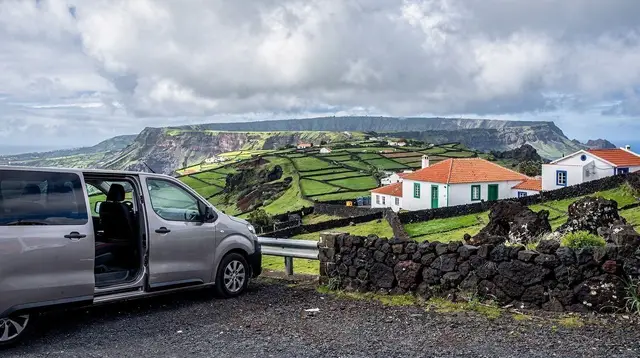
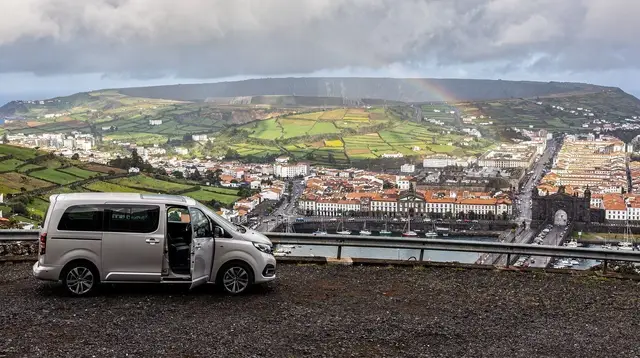
GetYourGuide does not provide a product photo for this activity — the image shows the meeting point, photographed by us.