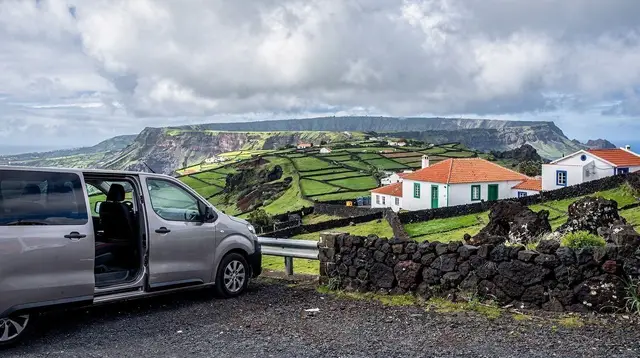
Azores Honeymoon Guide: Choosing Islands and Moments for Two
Which Azores island is best for a honeymoon?
Santa Maria and Graciosa suit couples who want quiet and few crowds, Pico pairs well with wine tasting and a slower pace, and São Miguel offers the most convenient base but is also the busiest island in the archipelago. Most honeymooning couples combine two islands rather than choosing just one.
What Kind of Romantic Are You Actually Looking For?
Couples researching an Azores honeymoon usually arrive with a picture in mind: green cliffs, empty roads, a glass of wine somewhere quiet. The Azores can deliver all of that, but not uniformly across all nine islands, and not on every island in the same way. Before comparing flights or hotels, it helps to be honest about which kind of romantic trip you actually want, because the archipelago rewards that kind of planning far more than a one-size-fits-all itinerary.
Broadly, three moods are on offer here. There is quiet and solitude, best found on the smaller, less-visited islands. There is a slower, sensory pace built around food and wine, which points toward Pico. And there is convenience and range of activities, which points toward São Miguel, the island most people fly into first and, not coincidentally, the busiest one in the archipelago. This guide is about matching your version of romantic to the right island or islands, not about handing you a day-by-day itinerary — for that, see our full Azores honeymoon week itinerary once you have decided roughly where you want to spend your time.
Quiet Islands for Two: Santa Maria and Graciosa
If seclusion is the priority, two islands consistently stand out from the rest of the archipelago: Santa Maria and Graciosa.
Santa Maria is the oldest island geologically and the southernmost in the group, with a noticeably drier climate than the rest of the Azores and a distinctive look — many houses here are painted yellow, a local tradition unlike anything on the other islands. Its sandy beach at Praia Formosa and the reddish, almost lunar terrain around Barreiro da Faneca give it a completely different visual identity from the greener central islands. Santa Maria also carries a quiet historical footnote for couples who enjoy that kind of detail: this is where Christopher Columbus’s ships put in at the Bay of Angels in February 1493, on the way home from his first Atlantic crossing.
Graciosa, the smallest island in the central group, is an even quieter proposition. It is a UNESCO biosphere reserve, and its landscape is dominated by the Caldeira da Graciosa and the extraordinary Furna do Enxofre — the largest volcanic cave in Europe, with an underground lake and sulphur fumaroles. White windmills near Santa Cruz da Graciosa complete a scene that feels genuinely apart from the rest of the Azores. One practical note worth flagging honestly: as of early September 2026, Graciosa has no bookable tours listed on GetYourGuide, so activities there are arranged locally rather than pre-booked online, which some couples treat as part of the island’s appeal rather than an inconvenience.
Both islands share the same trade-off: fewer restaurants, fewer scheduled activities, and inter-island transport that is less frequent than around São Miguel or the Pico-Faial-São Jorge Triangle. For a couple who wants to disappear together for a few days rather than fill a schedule, that trade-off is the point.
São Miguel: Convenient, Dramatic, and Busier Than You’d Think
It would be dishonest to write an Azores honeymoon guide without a clear caveat about São Miguel, because it is the island most first-time visitors default to, and it is not automatically the most romantic choice.
São Miguel is the largest and most populated island, home to the archipelago’s main airport and its capital, Ponta Delgada. It has genuinely spectacular scenery — the twin crater lakes at Sete Cidades, the thermal valley of Furnas, the Gorreana tea plantation, and the crater lake at Lagoa do Fogo — but it is also, by a wide margin, the most visited island in the Azores. Cruise-ship days, larger tour groups, and the busiest viewpoints all concentrate here. A couple picturing themselves alone on a cliff edge should know that on São Miguel, that scene is shared with far more other visitors than on Santa Maria, Graciosa, or Corvo.
None of this rules São Miguel out. It simply means the island suits a different part of a honeymoon: the convenient first or last stop, the place with the widest choice of restaurants and spa experiences, and the easiest base for couples who want variety over solitude.
A soak at the Terra Nostra thermal pool or the Poça da Dona Beija hot springs is a genuinely romantic half-day for two — just go in expecting other couples around you, and pack a swimsuit and towel you don’t mind staining, since the iron-rich water there leaves a lasting orange tint on light fabric. Many couples treat São Miguel as the “arrival and departure” island and build their quieter days into a second island entirely.
A Toast Among the Currais: Wine Tasting on Pico
For couples who want their romance built around taste and slowness rather than isolation, Pico is the island that delivers it best.
Pico’s vineyard landscape is inscribed as a UNESCO World Heritage Site, protecting roughly 987 hectares of currais — small rectangular plots enclosed by low walls of black volcanic stone, built to shield vines from Atlantic wind and salt spray. The best-preserved stretches are around Criação Velha and Santa Luzia, where this style of viticulture has continued since the fifteenth century. Walking the currais at golden hour, glass of local white in hand, is about as close as the Azores get to a postcard honeymoon moment, and it comes without the crowds of a typical wine region.
a guided day exploring Pico’s volcanic landscape and vineyard country is a straightforward way to see the currais and the island’s black-stone villages without renting a car, if you would rather sit back together than navigate.
Pico rewards a slower pace generally. Beyond the vineyards, Lajes do Pico was historically the archipelago’s main whaling port and remains the best place to learn how that history connects to today’s whale watching, and the island’s mountain, the Montanha do Pico, is the highest point in Portugal at 2,351 metres — worth admiring from a vineyard terrace even for couples who have no plans to climb it. If a hike does appeal, the moderate guided hike to Janela do Inferno and Caldeira Velha is a gentler alternative to the mountain’s regulated, permit-only summit route.
Pico pairs naturally with neighbouring Faial via the short Atlânticoline ferry between Madalena and Horta, which runs year-round, several times a day — one of the most dependable inter-island links in the whole archipelago. Horta’s marina, its tradition of murals painted by passing sailors, and the century-old Peter Cafe Sport make for an easy, walkable second stop; a relaxed local-guided walk through Horta and along Faial’s coast is a low-key way to spend a shared afternoon there. For a closer look at how the two islands compare as a pairing, see Pico versus Faial.
Private Time on the Water: Boat Trips for Couples
A private or small-group boat outing is one of the most consistently romantic bookings available anywhere in the Azores, and it works from several different islands, not just one.
a sunset boat tour along the coast is the simplest version: a couple of hours on the water as the light turns gold, with none of the logistics of a full-day whale-watching trip. It is worth being clear with yourselves about what you are booking — most sunset and small-boat tours are shared departures with other passengers rather than an exclusive charter just for two, so if true privacy on the water matters to you, ask the operator directly whether an exclusive booking is available and what it costs, rather than assuming a “boat tour” automatically means private.
Whale and dolphin watching itself can also be a shared romantic highlight rather than a purely wildlife-focused excursion. Resident dolphins and cachalots are seen across much of the year, while the great migratory whales pass through mainly in spring. No operator can promise a sighting on any single outing, however high their success rate — treat any trip on the water as a beautiful experience in its own right, with wildlife as a possible bonus rather than a guarantee. For more on timing sightings around your trip, see our dedicated whale watching in the Azores guide and best island for whale watching comparison.
Matching the Island to the Mood
| Island | Best for | What to know |
|---|---|---|
| Santa Maria | Quiet, beach, few crowds | Driest climate in the archipelago; limited evening options |
| Graciosa | Total seclusion, volcanic scenery | No bookable online tours as of Sept 2026; plan locally |
| Pico | Wine tasting, slower pace | Pairs well with Faial via year-round ferry |
| Faial | Marina walks, easy pairing with Pico | Reached from Pico in about 30 minutes by ferry |
| São Miguel | Convenience, variety, thermal pools | Busiest island in the Azores; not the pick for isolation |
| Corvo / Flores | Remote, dramatic, adventurous couples | Least reliable inter-island transport in the archipelago |
This is a starting point, not a ranking — plenty of honeymooning couples combine a quiet island with São Miguel bookended around it, using São Miguel’s flight connections without spending their whole trip there. For a deeper look at how specific islands stack up against each other, which Azores island to visit and Flores versus São Jorge go further into the trade-offs than this page can.
Timing It Around Weather, Whales, and Hydrangeas
The Azores do not have a dry season the way the Canary Islands or Madeira do — expect humidity and cloud cover in any month, and remember the local saying about “four seasons in one day,” when a front can bring sun, rain, and sun again within hours. That unpredictability is worth planning around rather than fighting.
For a honeymoon specifically, most couples land on late May through August as the sweet spot: hydrangeas start flowering from around May-June and reach full bloom in July-August, the great migratory whales are more likely earlier in that window (spring, roughly April to June), and daytime temperatures are at their most comfortable for boat trips and walks. September carries some of that same appeal with slightly thinner crowds. Whatever month you choose, build in flexibility rather than a schedule that depends on one particular afternoon being clear.
Getting Between Islands Without Losing Honeymoon Time
Because this guide deliberately avoids laying out a day-by-day plan, it is still worth flagging the one practical issue that derails more Azores honeymoons than any other: assuming inter-island transport works the same everywhere. It doesn’t.
The ferry connection between Pico, Faial, and São Jorge — known locally as the Triangle — runs year-round and is genuinely reliable. Extend beyond that to Terceira or Graciosa and ferries only run from June to September. The connections out to Flores and Corvo are the most fragile in the archipelago, easily disrupted by swell or fog for days at a time, which is part of why those two islands suit adventurous couples more than time-pressed ones. SATA Air Açores covers all nine islands by air, but direct flights from Pico or Faial to Lisbon are seasonal rather than year-round.
The practical takeaway for a honeymoon: pick fewer islands and give each one more days, rather than trying to string together a tight multi-leg route on transport links that can slip.
Practical Notes Before You Book
A few details worth settling before you finalise flights or accommodation. Car rental is arranged separately per island — there is no single archipelago-wide rental network — and is close to essential if you want to explore beyond your base on any island. Roads can be narrow and cliff-hugging, fog rolls in fast at altitude, and free-roaming cattle on upland roads are a real hazard rather than a postcard detail, so factor slower drive times into any plan, especially around sunset. The Azores are on UTC-1, one hour behind mainland Lisbon, which occasionally trips up couples connecting through the mainland — check your arrival time locally, not against your departure city.
On accommodation specifically, this guide intentionally stops short of recommending particular properties or areas — that decision deserves its own comparison, covered in where to stay in the Azores. Likewise, if a fully private guide or driver for your whole trip appeals more than booking single activities, our separate guide to private tours in the Azores covers that option in more depth than we can here.
Honeymoon in the Azores: Frequently Asked Questions
Which Azores island is best for a honeymoon?
There is no single best island: it depends on what a couple wants. Santa Maria and Graciosa are the quietest, with the fewest visitors and the fewest large tour groups. Pico suits couples who want wine tasting and a slower island rhythm. São Miguel is the easiest to reach and has the widest choice of activities, but it is also the most visited island, so it is not the pick for couples chasing isolation.
Is São Miguel too busy for a romantic trip?
São Miguel is not overrun, but it is by far the most visited island in the Azores, with Ponta Delgada and sites like Sete Cidades and Furnas seeing the bulk of the archipelago’s tour groups and cruise-day crowds. A couple can still find quiet corners there, but if the goal is seclusion, Santa Maria or Graciosa deliver it more reliably than São Miguel does.
What is the best time of year for an Azores honeymoon?
Late spring through summer (May to August) brings the mildest weather, the best odds of hydrangeas in bloom from June onward, and the highest chance of dolphin and cachalot sightings. Spring (April to June) is also when the great baleen whales pass through on migration. Whatever the month, the Azores’ famous shifting weather means no season is guaranteed to be dry or calm all day.
Can we do a private boat tour just for the two of us?
Several operators across the islands run sunset or small-group boat trips that can be booked as a couple’s outing rather than joining a large group, though a fully private, just-the-two-of-you charter is a separate and pricier product from a shared small-boat tour. Ask directly when booking whether the departure is shared or exclusive.
Is wine tasting on Pico worth the ferry crossing?
For most couples, yes. The UNESCO-listed vineyard landscape on Pico, with its currais of black volcanic stone, is unlike anywhere else on the islands, and the short Atlânticoline ferry between Madalena and Horta runs year-round, several times a day, making a Pico-Faial pairing one of the most dependable inter-island combinations in the archipelago.
Do we need a full week to enjoy the Azores as a couple?
A week is comfortable for two islands at an unhurried pace, but shorter trips work too if a couple accepts covering less ground. Because inter-island transport outside the central Triangle can be seasonal or weather-dependent, it is safer to plan fewer islands with more time on each than to pack in transfers.
Are the Azores more romantic than Madeira or the Canary Islands?
It depends on the kind of romance a couple wants. The Azores offer more solitude, greener scenery, and a stronger sense of remoteness on islands like Santa Maria, Corvo, or Graciosa, while Madeira and the Canaries generally offer more resort infrastructure and more reliably dry, sunny weather. Couples who prioritize quiet landscapes over guaranteed sunshine tend to prefer the Azores.
Trip-planning essentials on GetYourGuide
Verified deep-linked GetYourGuide tours. Book through these links and we earn a small commission at no cost to you.
GetYourGuide does not provide a product photo for this activity — the image shows the meeting point, photographed by us.