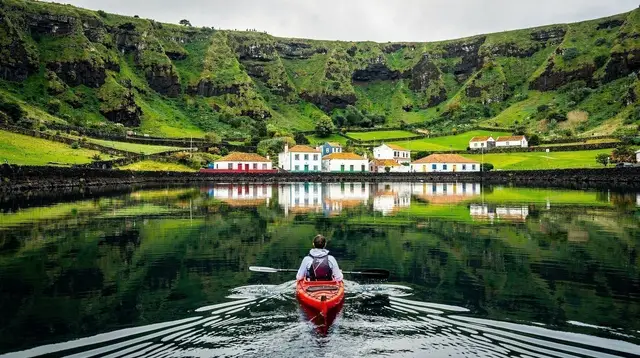
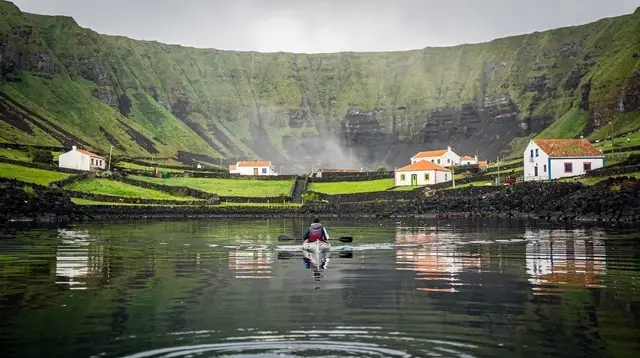
Kayaking and Paddleboarding in the Azores
Where can you go kayaking or paddleboarding in the Azores?
The best conditions are in sheltered bays on the south coast of São Miguel, around Vila Franca do Campo and Caloura, and in the calm channel between Pico and Faial. Both activities are beginner-friendly and run as short guided sessions rather than expeditions, unlike surfing or open-water sailing.
Calm-Water Paddling on a Volcanic Coastline
The Azores are famous for cetaceans, volcanic craters, and hiking trails along cliff-top pastures, but the archipelago also has a quieter, gentler side on the water: kayaking and stand-up paddleboarding in the sheltered bays that sit between the exposed, swell-battered coasts. Unlike canyoning or diving, neither activity demands prior training. A paddle session usually runs an hour or two, starts and ends on a beach or small pier, and is built around calm, shallow, close-to-shore water rather than distance or exposure.
This guide covers where the water is actually flat enough to paddle, what to expect from a beginner session, and which bookable tours put you on a board or in a kayak without booking a full boat charter or a whale-watching seat. It does not cover motorised or sailing boat trips (see boat tours in the Azores and sailing and yachting), surfing on exposed swell breaks (see surfing in the Azores), or the islet of Vila Franca do Campo as a destination in its own right (see the Vila Franca islet guide) — this page treats that islet’s surrounding bay purely as a paddling ground.
Why Location Matters More Than Skill
The single biggest factor in a good Azores paddling session is not fitness or technique — it is which stretch of coast you are on. The archipelago sits fully exposed to the North Atlantic, and most coastlines take direct swell and wind for at least part of the year. Kayaking and paddleboarding operators have responded by concentrating almost entirely on the handful of bays that stay protected in typical conditions, rather than offering routes along open coastline.
⚠️ A recurring mistake among first-time visitors is assuming that because one bay on an island is calm, the whole coastline will be too. In practice, the north-facing shores of São Miguel, Pico, and most other islands face the open Atlantic and are frequently too rough for kayaking or paddleboarding, even on days when the south coast is glassy. Always check with the operator or guide on the day rather than assuming conditions are uniform around an island.
Where to Kayak and Paddleboard in the Azores
São Miguel: the most reliable island for beginners
São Miguel’s south coast holds the most consistent sheltered water in the archipelago, which is why the great majority of bookable sessions run here.
- Vila Franca do Campo: the bay in front of town, with the crescent-shaped islet just offshore, is the archipelago’s best-known kayaking ground. Paddling here is scenic rather than sporty — flat water, short distances, and views back at the volcanic crater rim of the islet itself.
- Caloura: a small fishing village a short drive from Ponta Delgada, with a naturally protected inlet that suits paddleboarding as much as kayaking.
- Ponta Delgada: the marina area offers calmer water than most people expect from a working port, and is the most convenient starting point if you are based in the capital without a rental car.
Pico and Faial: the sheltered channel
The narrow stretch of water between Pico and Faial, the same channel crossed by the year-round Madalena–Horta ferry, is comparatively sheltered for the central group of islands and occasionally used for guided paddling close to shore near Madalena or Horta. Conditions here are more variable than São Miguel’s south coast, so confirm with an operator rather than planning around it in advance.
Where it does not work
Terceira, São Jorge, Graciosa, Flores, Corvo, and Santa Maria do not currently have a meaningful bookable kayaking or paddleboarding scene — their coastlines are either more exposed or simply lack tour operators offering the activity. If flat-water paddling is a priority for your trip, build your itinerary around São Miguel rather than expecting to find it everywhere.
Kayaking vs Stand-Up Paddleboarding: Which to Choose
Both activities are available on the same stretches of water, but they suit slightly different people and conditions.
| Kayaking | Stand-Up Paddleboarding | |
|---|---|---|
| Position | Seated | Standing (or kneeling to start) |
| Best conditions | Calm to slightly choppy | Flat, glassy water |
| Physical demand | Moderate, upper body | Moderate, full-body balance |
| Typical session | 1.5–2 hours, small group | 1–2 hours, solo or small group |
| Good for | Families, older children, longer coastal views | Balance-focused visitors, solo travellers, photos |
| Learning curve | Quick to pick up | A little longer to find balance |
Neither requires swimming ability beyond basic confidence in the water, and both are typically done in a life jacket.
No Experience Needed: What a Beginner Session Looks Like
A first-timer kayaking or paddleboarding session in the Azores typically follows the same pattern regardless of which bay you book:
- A short land briefing covering paddle technique, what to do if you capsize or fall in, and basic safety signals.
- Fitting of a life jacket and, for paddleboarding, a leash connecting the board to your ankle or calf.
- A guided group paddle at an easy pace, usually hugging the shoreline rather than heading into open water.
- Time floating or resting mid-session, often near a rock formation, sea cave entrance, or the base of a cliff.
- Return to the beach or pier, usually with the whole session lasting one to two hours door to door.
For a structured introduction with instruction included, the beginner-level kayaking session is built specifically around visitors with no prior paddling experience. If you would rather explore independently at your own pace once you have basic balance, an inflatable stand-up paddleboard rental lets you set your own route within a sheltered bay.
Bookable Kayaking and Paddleboarding Tours
| Tour | Format | Best for |
|---|---|---|
| Vila Franca do Campo islet kayaking experience | Guided group kayaking around the islet bay | First-timers wanting a scenic, guided route |
| Beginner-level kayaking session | Instruction-led kayaking for newcomers | Anyone with zero prior kayaking experience |
| Inflatable stand-up paddleboard rental | Self-guided paddleboard hire | Confident beginners who want independence |
Two related activities are sometimes booked around the same trip but are not paddling: coasteering combines swimming, scrambling, and cliff jumps along exposed rock rather than sitting or standing on a board, and a sunset boat tour covers the same waters from a motorised boat rather than under your own paddle power. Both make sense as a second, different activity on the same island rather than a substitute for kayaking or paddleboarding itself.
Safety and What to Bring
Life jackets are provided and worn throughout every guided session — this is standard practice among operators, not an optional extra. A few practical points worth knowing before you book:
- Weather changes fast. The Azorean saying about “four seasons in one day” applies on the water as much as on land: a flat, sunny bay in the morning can turn choppy by early afternoon as an Atlantic front passes through. Operators will postpone or cancel a session rather than run it in unsafe conditions, so build a spare day into your plans if paddling matters to your trip. See Azores weather month by month for typical patterns.
- Water temperature in the Azores sits in the high teens to low twenties Celsius depending on season — cool enough that a rash guard or light wetsuit top, sometimes supplied by the operator, is worth asking about outside peak summer.
- Sun exposure on open water is stronger than it feels, thanks to reflection off the surface. Reef-safe sunscreen, a hat with a chin strap, and sunglasses with a retention strap are all worth packing — see the general Azores packing list for the rest of your kit.
- Footwear: water shoes or old trainers help on the rocky or volcanic-sand entry points typical of Azorean bays, since few beaches here have the soft, uniform sand of a typical resort coastline.
- Group size and supervision: guided sessions keep groups small, generally under a dozen paddlers, with a guide in the water or on a support kayak throughout.
How Kayaking and Paddleboarding Fit Around Other Water Activities
The Azores offer a wide spread of water-based activities, and it helps to know where kayaking and paddleboarding sit relative to the others so you do not book the wrong one by accident:
- Boat tours and sailing (boat tours guide, sailing and yachting) cover far more distance using a motor or sail, and suit visitors who want to see coastline or wildlife without physical effort.
- Surfing (surfing in the Azores) deliberately seeks out the exposed swell that kayaking and paddleboarding avoid, on different beaches entirely.
- Coasteering (see above) mixes swimming, climbing, and jumping along cliffs rather than paddling on the surface.
- Diving and snorkelling (diving, snorkelling) take place underwater rather than on it, usually from a boat rather than a kayak.
- Natural swimming pools (natural swimming pools guide) are static volcanic-rock pools for swimming in place, not for paddling a craft.
If your priority is a low-effort, low-commitment introduction to being on Azorean water rather than in it or under it, kayaking or paddleboarding is the right starting point, and both pair naturally with a beach or pool visit later the same day.
Planning Kayaking Into Your Azores Trip
Because the reliable paddling grounds are concentrated on São Miguel’s south coast, it is straightforward to build a kayaking or paddleboarding morning into a broader island itinerary without dedicating a full day to it. A short session at Vila Franca do Campo or Caloura fits naturally alongside a visit to Furnas or a day exploring Sete Cidades — see São Miguel in 5 days for a full sample plan, or the broader best time to visit the Azores guide if you are still choosing a travel month.
A rental car makes reaching Caloura or the south-coast bays far easier than relying on limited local transport; see car rental in the Azores for practical notes on that. For a wider look at everything on offer along São Miguel’s coastline, the things to do on São Miguel hub groups paddling alongside hiking, hot springs, and boat-based activities on the same island.
Kayaking and Paddleboarding in the Azores: Your Questions Answered
Do I need experience to kayak or paddleboard in the Azores?
No. Most sessions are pitched at complete beginners, run in sheltered bays with a guide, and start with a short briefing on land before anyone gets on the water.
Which islands have the best kayaking and paddleboarding conditions?
São Miguel’s south coast, especially around Vila Franca do Campo and Caloura, offers the most consistently calm water. The channel between Pico and Faial is also relatively sheltered for the central group.
What is the difference between kayaking and stand-up paddleboarding here?
Kayaking uses a seated, double-bladed paddle and suits longer coastal routes and choppier conditions. Stand-up paddleboarding is a standing, single-bladed activity better suited to flat, glassy water and shorter sessions close to shore.
Is it safe to paddle on the north coast of São Miguel or other islands?
Generally no for beginners. The north-facing coasts of most islands are exposed to Atlantic swell and wind, and operators concentrate their kayaking and paddleboarding sessions on the rare sheltered bays instead, mostly on the south coast.
What should I bring on a kayaking or paddleboarding trip?
A swimsuit worn under quick-dry clothing, a change of clothes and towel for afterwards, reef-safe sunscreen, and water shoes if you have them. Operators supply the board or kayak, paddle, and a life jacket.
Can I combine kayaking with whale watching or coasteering?
Not usually in the same session. Whale watching uses motorised or sailing boats to cover distance, and coasteering combines swimming, scrambling, and jumping along exposed rock rather than paddling, so they are booked as separate activities.
What is the best time of year to kayak in the Azores?
Late spring through early autumn gives the calmest, warmest conditions, but the Azores’ fast-changing weather means any single day can turn from flat calm to choppy within hours, whatever the month.
tours.kayaking-paddling
Verified deep-linked GetYourGuide tours. Book through these links and we earn a small commission at no cost to you.
GetYourGuide does not provide a product photo for this activity — the image shows the meeting point, photographed by us.